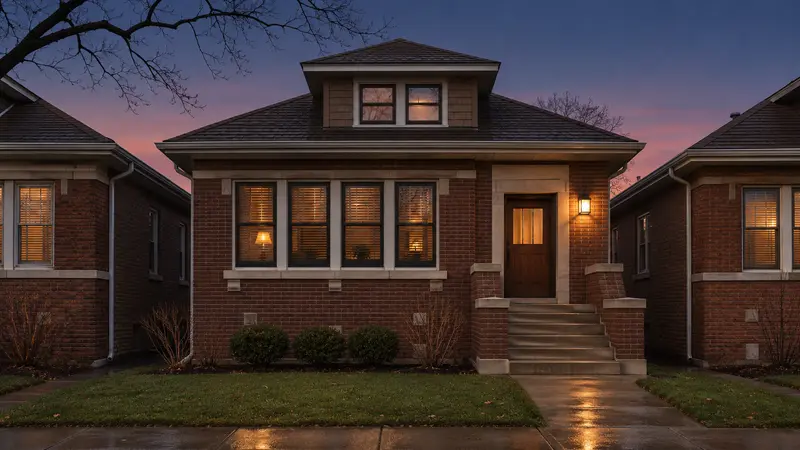
Cash earns the most dollars per flip, and a flip loan earns the most per dollar of your own money. On the example bungalow, all cash nets $68,155 on $325,755 invested; a loan at 90% of price plus rehab nets $44,985 on $63,925. A HELOC sits between, with your home as collateral.
- All-cash profit, example deal
- $68,155 on $325,755 of cash (20.92%)
- Flip loan profit, same deal
- $44,985 on $63,925 of cash (70.37%)
- Cost of the leverage
- $23,170 in points, fees and interest
- Deals the all-cash stake could fund with loans
- 5
- HELOC collateral
- Your home; the CFPB warns you could lose it if you fall behind
Program terms as of November 26, 2026. Rates as of November 25, 2026.
On this page
- How much more profit does an all-cash flip keep?
- What happens to return on cash once you borrow?
- How many flips can the same capital carry?
- Does a financed buyer lose to cash offers in Chicago?
- What does a HELOC on your own home put at risk?
- Is a HELOC used for a flip consumer credit or business credit?
- Which funding source fits which flipper?
- Can you combine cash, a HELOC and a flip loan?
- What should you run before you choose?
If you have $325,755 in the bank, you can buy and renovate the bungalow in this example without asking anyone's permission. If you have equity in your own house, a bank will lend you part of that sum at a consumer rate. Either way a flip loan looks expensive by comparison, and per deal it is.
The fairer comparison is per dollar of your own money, and it has to count what the cheaper money is secured by. A lender publishes this page, so the arithmetic is laid out for you to check.
How much more profit does an all-cash flip keep?
An all-cash flip keeps every dollar the lender would have charged. On the example that is $23,170: $5,700 of points, $1,795 of fees and $15,675 of interest. The purchase, the rehab, the Chicago transfer taxes, the commission and the carry cost are the same in both columns.
Cash also removes moving parts: no draw inspections, no maturity date, and a permit delay costs taxes and insurance, not interest. For a buyer with deep reserves doing one project a year, that is a real reason to skip the loan.
What happens to return on cash once you borrow?
Borrowing cuts the profit and cuts the cash you commit by much more, so the return on each dollar rises.
A $250,000 Belmont Cragin bungalow: all cash against a flip loan
Identical purchase, $60,000 rehab, $420,000 resale and 6-month hold. Only the funding changes.
All cash: money you put in
| Line | Amount | How it is figured |
|---|---|---|
| Purchase price | $250,000 | |
| Closing costs and buyer transfer tax | $4,775 | $2,900 plus $1,875.00 |
| Rehab | $60,000 | |
| Contingency and carry | $10,980 | 10% of rehab plus 6 months of taxes, insurance, utilities |
| Return on cash | 20.92% | $68,155 / $325,755 |
| Cash invested, all cash | $325,755 |
Line items sum to the stated result. Checked in code at build.
Flip loan of $285,000: money you put in
| Line | Amount | How it is figured |
|---|---|---|
| Down payment | $25,000 | price less the $225,000 advance |
| Closing costs and buyer transfer tax | $4,775 | |
| Points and lender fees | $7,495 | 2 points plus $1,795 |
| Contingency and carry | $10,980 | |
| Interest | $15,675 | $285,000 x 11% / 12 x 6 |
| Return on cash | 70.37% | $44,985 / $63,925 |
| Cash invested, flip loan | $63,925 |
Line items sum to the stated result. Checked in code at build.
Where the profit difference goes
| Line | Amount | How it is figured |
|---|---|---|
| All-cash profit | $68,155 | $420,000 resale less all costs |
| Points | -$5,700 | |
| Lender fees | -$1,795 | |
| Interest | -$15,675 | |
| Flip loan profit | $44,985 |
Line items sum to the stated result. Checked in code at build.
Assumptions
- Rate of 11% and 2 points are inputs inside the published ranges of 8.99%-13.5% and 1-3 points, not an offer. Interest is charged on the full commitment.
- Closing costs, fees, carry, contingency and a 5% resale commission are illustrative.
All cash returns 20.92% on the money invested over 6 months. The financed version returns 70.37%, because $63,925 is doing the work of $325,755. Financing most of the price and the rehab budget still leaves real cash in the deal: the down payment, closing costs, interest, contingency and work finished before each draw. The line-by-line version is in cash required at closing.
Leverage cuts both ways. If the resale drags, the leveraged buyer still owes $2,613 a month in interest until the sale closes.
How many flips can the same capital carry?
The all-cash stake in this example would cover the cash requirement of 5 financed deals of the same size. That is the strongest argument for a loan, and the easiest one to abuse.
Capital is rarely the binding limit for a small operator; supervision is. A fair use of the math: finance one deal, keep the remaining cash as reserves and as earnest money for the next contract, and add a second project only when the first is past rough inspections. How monthly costs stack up when a hold stretches is laid out in carry by hold length.
Does a financed buyer lose to cash offers in Chicago?
Not automatically. A seller choosing a cash offer is choosing certainty of closing and speed. A financed buyer answers both with a proof of funds letter tied to the address and a lender whose published timeline is 7-10 business days on complete files, counted after borrower conditions are met. Jaken Finance Group issues those letters through its proof of funds request page; how agents read them is covered in proof of funds for offers.
Cash still wins where the clock is shorter than any lender's. Some auction and estate sales set deadlines tighter than any loan closing. The realistic closing window is set out in Cook County closing speed.
What does a HELOC on your own home put at risk?
A HELOC puts your residence behind a business bet. The CFPB's HELOC booklet (updated August 2022) states it plainly: if you cannot repay on schedule, you could lose your home. A flip loan's lien sits on the investment property, though a personal guarantee is still serious.
Three features in that booklet matter to a flipper:
- Variable rate. Most lines float on an index plus a margin, so the payment can rise mid-project.
- Freeze or reduction. Plans generally let the bank freeze or cut the line if your home's value drops or your finances worsen.
- Balloon and payoff on sale. Some plans require the full balance when the draw period ends, and the line is generally due if you sell your home.
As an illustration only: if the whole $325,755 came from a line at 8.5%, an input to replace with your own plan's rate, 6 months of interest would be about $13,845 and profit about $54,310. That beats the flip loan's $44,985 on paper. The price of the difference is the collateral.
Is a HELOC used for a flip consumer credit or business credit?
A HELOC opened as an ordinary household line is consumer credit under Regulation Z, and that status brings protections a flip loan does not carry. Section 1026.40 requires disclosures and limits when a creditor may terminate the plan and accelerate the balance. Section 1026.15 gives you until midnight of the third business day after opening to rescind, and the creditor may not disburse until that period ends. Open the line before you need it.
Regulation Z turns on purpose, though, not collateral. The official commentary lists a loan to expand a business as business-purpose credit even when the borrower's residence secures it (12 CFR 1026.3(a)). Tell a bank the line is for flipping and it may document the loan as business credit without those protections.
| Item | Figure | Source | Effective |
|---|---|---|---|
| TILA / Regulation Z business-purpose exemption | Exempt: credit primarily for business, commercial or agricultural purposes, and credit to non-natural persons | eCFR / Consumer Financial Protection Bureau | 2026 |
| Regulation Z: non-owner-occupied rental property | Deemed business purpose; owner may occupy no more than 14 days in the coming year | Consumer Financial Protection Bureau | 2026 |
| APLD property subject to the Act | 1-4 unit, owner-occupied residential | Illinois Department of Financial and Professional Regulation | 2010-07-01 |
How purpose and occupancy classify the credit
Two side notes: IRS Publication 936 says interest on home-secured debt is not deductible as home mortgage interest unless the proceeds bought, built or substantially improved that home. And IDFPR's fact sheet lists HELOCs as exempt from the Cook County predatory lending database. General education; confirm with a CPA and counsel.
Which funding source fits which flipper?
| Your situation | Likely best fit | Why |
|---|---|---|
| Cash covers the deal twice over, one project a year | All cash | Highest profit per deal, no lender timeline |
| Cash covers one deal, you want two or three a year | Flip loan | Same stake funds 5 deals; reserves stay intact |
| Home equity but little cash, light cosmetic rehab | HELOC, cautiously | Cheapest money, but your home is the collateral |
| Thin cash and no equity | Partner or wait | See debt versus a money partner |
| Auction or estate deal that must fund in days | Cash | No lender's timeline is that short |
Can you combine cash, a HELOC and a flip loan?
Yes. A common arrangement: the loan carries the purchase and rehab, cash covers the down payment and closing, and the HELOC stays undrawn as the emergency reserve. That is different from gap funding, where a second lender takes a lien on the flip itself and which needs separate approval and first-lender consent. The trade-offs of that route are in flipping with a gap lender.
When the flip loan is the wrong choice
If you hold enough cash to do the project with reserves to spare and are not capital-constrained on the next deal, the loan only subtracts $23,170 from your profit. Pay cash.
The loan is also wrong for a deal so thin that financing cost erases the margin. That problem is the purchase price, so rework the offer first.
What should you run before you choose?
Run your own deal both ways before you commit.
- Enter the deal in the analyzer with adjustable leverage with the loan, then with leverage at zero. Jaken Finance Group's fix and flip calculator gives a second read.
- Compare profit, cash invested and return on cash, not profit alone.
- Fill in the closing cash worksheet so every dollar has a named account.
- If a HELOC is in the plan, read the agreement for its freeze, balloon and sale clauses.
- Price the loan using how points and fees are quoted, then see the other funding options on the compare hub.
Questions: Flip loan vs cash or HELOC
Can I use my HELOC for the down payment on a flip loan?
Often yes, but tell the lender. A flip lender verifies where your cash to close comes from, and a draw on a line secured by your residence is borrowed money, not savings. Two loans then ride on one project: the flip mortgage on the investment property and the HELOC on your home. Budget both payments for the full hold plus a cushion.
Is HELOC interest deductible when the money goes into a flip?
Not as home mortgage interest. IRS Publication 936 says interest on a line secured by your home is not deductible under those rules when the proceeds were not used to buy, build or substantially improve that home. It then points to allocating interest to the business or investment activity the proceeds funded. Ask your CPA how that applies to flip inventory before you draw.
What happens if the bank freezes my HELOC in the middle of the rehab?
You finish the job with whatever cash you have left. The CFPB's HELOC booklet says plans generally let the lender freeze or reduce a line if your home's value falls or your finances change for the worse. If a HELOC is your only rehab money, draw what the budget needs early or keep a second source lined up.
Does a cash offer get a lower price from Chicago sellers?
This site has no data showing a set discount, so it will not quote one. What a seller is buying with a cash offer is certainty and speed. A financed offer narrows that gap when it arrives with a property-specific proof of funds letter and a lender that closes in 7-10 business days on complete files. Against a short-fuse auction, true cash still wins.
Can I buy with cash now and borrow against the property later?
Possibly, but do not assume it. Financing a property you already own is a different request from a purchase loan, sized on current value and the remaining scope rather than on your contract price. Whether and how this lender would do it is underwritten file by file, ask your loan officer. If recovering your cash matters to the plan, ask before you close.
Local rates and rules cited on this page
| Item | Figure | Primary source | Effective |
|---|---|---|---|
| Chicago transfer tax, City portion (buyer) | $3.75 per $500 of price | Real Property Transfer Tax (7551) (City of Chicago Department of Finance) | 2008-04-01 |
| Chicago transfer tax, CTA portion (seller) | $1.50 per $500 of price | Real Property Transfer Tax (7551) (City of Chicago Department of Finance) | 2008-04-01 |
| Cook County real estate transfer tax | $0.25 per $500 of value | Transfer Fees (Cook County Clerk) | 1968-01-01 |
| Illinois state real estate transfer tax | $0.50 per $500 of value | 35 ILCS 200/31-10, Imposition of tax (Illinois General Assembly) | 2005-06-01 |
Rates as of November 25, 2026. Confirm with the agency before relying on any figure.
Sources
- What you should know about home equity lines of credit (HELOC), Consumer Financial Protection Bureau, 2022-08.
- 12 CFR 1026.40 Requirements for home equity plans, Consumer Financial Protection Bureau, 2026.
- 12 CFR 1026.15 Right of rescission (open-end credit), Consumer Financial Protection Bureau, 2026.
- 12 CFR 1026.3 Exempt transactions and official commentary, Consumer Financial Protection Bureau, 2026.
- Publication 936 (2025), Home Mortgage Interest Deduction, Internal Revenue Service, 2025.
- Illinois Anti-Predatory Lending Database fact sheet, Illinois Department of Financial and Professional Regulation, 2010-07-01.