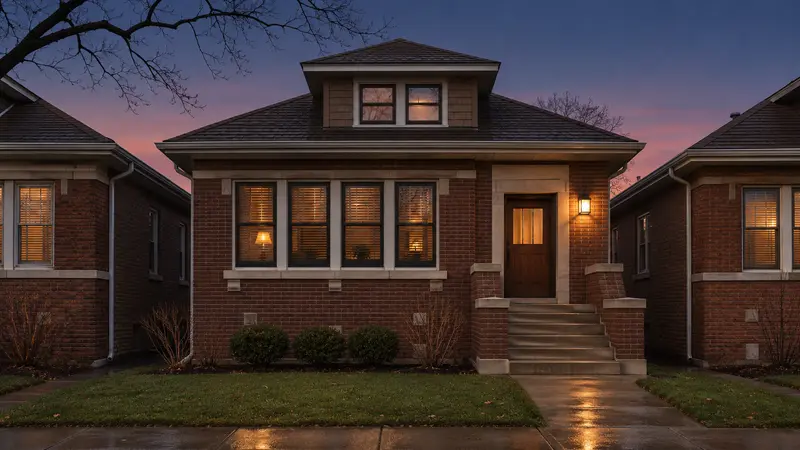
Cash to close is your down payment plus loan and closing charges, minus the earnest money you already deposited and the seller's property tax credit. On the $285,000 bungalow below, the wire is $29,326 after $10,000 of earnest money. JFG advances 90% of the price at closing; the rehab holdback is not paid out that day.
- Advance toward purchase
- 90% of price, subject to the ARV cap
- Origination
- 1-3 points on the full loan
- Chicago transfer tax, buyer
- $3.75 per $500 of price
- Recording, deed plus mortgage
- $214
- Wire rule
- $50,000 or more from one party must arrive as wired or collected funds
- Personal checks
- $5,000 per closing in total
- Example wire
- $29,326
Program terms as of November 26, 2026. Rates as of November 25, 2026.
On this page
- What counts as cash to close, and what does not?
- Which charges land on the buyer's side?
- How is the down payment set?
- Which credits shrink the wire?
- Why does a Cook County seller owe you a tax credit?
- A buyer's statement, line by line
- Why is there no Closing Disclosure on a flip loan?
- How does the money have to arrive?
- What moves the number in the final week?
- What should you do in the ten days before closing?
The number that matters on closing day is one wire. It is built from about a dozen lines, some set by the lender, some by the title company, two by government schedule and one by the seller's unpaid taxes. Miss any of them and the wire is short, and a short wire does not close.
This page covers the closing table only. It is published by Jaken Finance Group, a lender, and uses JFG's published terms for the loan lines.
What counts as cash to close, and what does not?
Cash to close is the amount you must deliver in good funds on the day the deed transfers. It includes your down payment, the lender's charges, third-party closing costs and prepaid items, net of credits.
It does not include the money you need afterward: contractor deposits, work done ahead of draws, monthly interest, the contingency. That is total project liquidity, a larger number. It has its own page: total cash to flip in Chicago.
Which charges land on the buyer's side?
Eight lines, in three groups.
| Line | Basis | Who sets it |
|---|---|---|
| Down payment | Price less the lender's advance | Loan sizing |
| Origination | 1-3 points on the full loan | Lender |
| Lender fees | Flat amounts | Lender |
| Lender's title policy and closing fee | Quoted | Title company |
| Recording | $107 per deed; $107 per mortgage or release | Cook County Clerk |
| City transfer tax, buyer portion | $3.75 per $500 of price | City ordinance |
| Attorney | Flat fee, quoted | Your attorney |
| Insurance | First premium | Your carrier |
Only two lines can be looked up. The Clerk's recording fee schedule is flat per document, and the City's transfer tax page gives the buyer's rate; the calculator that rounds per $500 does the rounding to the next $500. Title charges are a quote: the state regulator's title insurance brochure tells consumers prices vary and to compare. The seller pays the county and state stamps, covered under who owes which transfer tax.
How is the down payment set?
The down payment is the contract price minus what the lender advances toward it. At JFG's default loan-to-cost limit that advance is 90% of the price, so you bring the rest. If the ARV cap binds, the advance shrinks and the down payment grows by the same amount; the test is worked through under when the ARV cap binds. First-time flippers are reviewed; maximum leverage is not assured, which can mean a larger down payment than the default.
Which credits shrink the wire?
Three, typically. Your earnest money, already sitting in escrow. The seller's property tax proration. And any repair or closing credit you negotiated during attorney review. The loan advance works like a fourth: it is the lender's money arriving on your side of the ledger.
Credits appear as negative lines on your statement. They reduce the wire without reducing what the building cost you.
Why does a Cook County seller owe you a tax credit?
Because Cook County bills property tax a year behind. The Treasurer's tax bill primer explains that most taxes are paid in arrears and that the first installment is 55% of the prior year's total tax. On closing day the seller has used the building for months that have not been billed yet. You will receive those bills, so the seller pays you now.
The amount is an estimate by contract. The Multi-Board 8.0 contract prorates at a negotiated percentage of the most recent full-year tax bill, and the percentage is a blank the attorneys fill in. A higher percentage means a larger credit to you. On a distressed purchase, check whether the last bill reflects a vacancy or exemption that will not continue, because your real bill may be higher than the credit assumed. A tax proration that is final at closing cannot be reopened later.
A buyer's statement, line by line
Buyer's statement: a $285,000 brick bungalow with a $68,000 rehab
Charges are positive, credits negative. Inputs are illustrative and the closing is assumed to fall on day 320 of the year, after both installments of the prior tax year were paid.
Settlement statement, buyer side
| Line | Amount | How it is figured |
|---|---|---|
| Contract price | $285,000 | |
| Origination, 2 points | $6,490 | on the full $324,500 loan, holdback included |
| Lender processing, document and inspection fees | $1,650 | |
| Lender's title policy and closing fee | $2,450 | quoted, not scheduled |
| Recording, deed and mortgage | $214 | |
| Chicago transfer tax, buyer portion | $2,138 | 570 units of $500 |
| Buyer's attorney | $950 | |
| Insurance premium, vacant dwelling under renovation | $2,900 | |
| Loan advance toward purchase | -$256,500 | 90% of price |
| Earnest money on deposit | -$10,000 | |
| Seller's tax proration credit | -$5,965 | $6,480 x 105% x 320 / 365 |
| Rehab holdback, not disbursed | $68,000 | |
| Cash due from buyer | $29,326 |
Line items sum to the stated result. Checked in code at build.
Where your cash went, through closing
| Line | Amount | How it is figured |
|---|---|---|
| Down payment | $28,500 | price less the advance |
| Loan and closing charges | $16,792 | |
| Seller's tax credit | -$5,965 | |
| Earnest money plus wire | $39,326 |
Line items sum to the stated result. Checked in code at build.
The $5,965.15 credit lowers the wire, but it is the seller handing you a bill. Set it aside for the tax installments that arrive while you own the building.
Assumptions
- Loan sized at up to 90% of purchase price plus 100% of approved rehab, capped at 75% of supported ARV; the cost limit binds here. Points of 2 are inside the published 1-3 points.
- Title, attorney, insurance and lender fee amounts are placeholders. The proration percentage is whatever your contract says.
Why is there no Closing Disclosure on a flip loan?
Because the consumer mortgage disclosure rules do not apply. Regulation Z exempts credit extended primarily for a business purpose, which is what a loan to flip a non-owner-occupied property is. You will not get a Loan Estimate or a Closing Disclosure. You get a term sheet from the lender and a settlement statement from the title company, and nothing requires either to reach you days ahead.
So ask for the draft statement early and read it yourself. One Cook County detail: an investment-property mortgage is exempt from the state's anti-predatory lending database, but under the exemption statute it still needs a certificate of exemption attached before the Clerk will record it. The title company normally handles that; confirm it is done.
How does the money have to arrive?
By wire once your side reaches the statutory threshold. Under the Illinois Title Insurance Act's settlement funds section, $50,000 or more from one party must arrive as wired or collected funds before the title company can disburse. Below that amount a cashier's check also counts as good funds, but ask the title company what it will accept. The example wire of $29,326 is under the line; a larger purchase or a binding ARV cap puts you over it. Send the wire the business day before if your bank allows, and keep the confirmation.
What moves the number in the final week?
Four things move it late: the title company's final invoice, the insurance premium once the carrier learns the building is vacant, the proration when the closing date slides, and any change in the loan amount after valuation. JFG's guide to points and fees on a flip loan explains the lender lines. Title problems that surface late, such as unpaid water or an open lien, are covered under title, water certificate and liens.
When the wire takes everything you have
If cash to close uses all of your liquid funds, the loan may close and the project will still stall. Draws reimburse finished work, so the first phase of demolition and rough-in is paid from your pocket, and interest starts the next month. A proof of funds letter shows a seller you can close; it does not show you can finish. The better route is a smaller purchase, a partner's equity, or separately approved gap funding, which needs separate approval and first-lender consent. JFG takes those requests through its gap lending form.
What should you do in the ten days before closing?
- Get the lender's final loan amount, points and fee figures in writing.
- Ask the title company for a draft settlement statement and wire instructions.
- Bind insurance for a vacant building under renovation and send the lender the evidence.
- Have your attorney confirm the proration percentage and any seller credits.
- Fill in the cash-to-close worksheet and compare it to the draft statement line by line.
- Verify the wire instructions by phone, then send from the buying entity's account.
- Confirm a first-draw plan so you know when the first reimbursement arrives.
If you need a letter for the offer before any of this, JFG issues proof of funds requests online. The other deal math lives in the numbers section. Closing practice and tax proration are legal matters; this is general education, and your closing attorney has the final word on your statement.
Questions: Cash needed at the closing table
Does the lender wire the rehab money at closing?
No. The approved rehab budget stays with the lender as a holdback and is released in draws after work is inspected; JFG's draws are staged against a rehab holdback, with inspections. In the example, $68,000 of the $324,500 loan is not on the statement as cash to anyone. Two consequences follow. Points are still charged on the whole loan at closing. And you pay for the first phase of work yourself before the first draw reimburses it, which is cash you need the week after closing, not at the table.
Can I bring a cashier's check to closing?
Below the statutory line, yes; at or above it, plan on a wire. The Illinois Title Insurance Act stops a title company from disbursing unless amounts of $50,000 or more from one party must arrive as wired or collected funds. The buyer counts as one party no matter how many members the LLC has. Personal checks are good funds only up to $5,000 per closing in total. Ask the title company for wire instructions early, confirm them by calling a number you already trust, and send from the account that matches the buying entity.
Is earnest money subtracted from the down payment?
It is subtracted from the total you owe, which amounts to the same thing. Earnest money is held in escrow from contract signing and shows up as a credit on your side of the statement. It is not an extra cost and it is not a discount. In the example the $10,000 deposit and the $29,326 wire together make $39,326, and that combined figure is what the purchase closing actually took from your accounts.
Why is my cash to close higher than the lender's estimate?
Usually because the estimate covered the lender's lines only. A term sheet shows the down payment, points and lender fees. It does not show the title company's invoice, your attorney, the City transfer tax, recording or your insurance premium, because the lender does not set those. In the example those third-party lines total $8,652. The dollar breakdown of points and fees separates lender charges from everyone else's.
Does buying in an LLC change what I bring?
It changes the paperwork and one small fee, not the arithmetic. Forming an Illinois LLC costs $150 with the Secretary of State, paid before closing and off the statement. The lender and title company will want the entity documents, and the wire should come from an account in the entity's name. The steps are on the page about buying through an Illinois LLC. Ask your attorney whether the entity or you should sign the purchase contract.
Local rates and rules cited on this page
| Item | Figure | Primary source | Effective |
|---|---|---|---|
| Cook County deed recording fee | $107 per deed | Recording Fees (Cook County Clerk) | 2024-04-01 |
| Cook County mortgage / release recording fee | $107 per mortgage or release | Recording Fees (Cook County Clerk) | 2024-04-01 |
| Chicago transfer tax, City portion (buyer) | $3.75 per $500 of price | Real Property Transfer Tax (7551) (City of Chicago Department of Finance) | 2008-04-01 |
| First installment amount | 55% of the prior year's total tax | How the Illinois Property Tax System Works (October 2025 update) (Cook County Treasurer's Office) | 2025-10 |
| Tax proration under the Multi-Board 8.0 contract | a negotiated percentage of the most recent full-year tax bill | Multi-Board Residential Real Estate Contract 8.0, full redline (paragraph 12, Prorations) (Chicago Association of REALTORS) | 2025-02 |
| Illinois good funds rule at closing | $50,000 or more from one party must arrive as wired or collected funds | 215 ILCS 155/26, Settlement funds (Illinois General Assembly) | 2020-01-01 |
| Personal checks accepted at an Illinois closing | $5,000 per closing in total | 215 ILCS 155/26, Settlement funds (Illinois General Assembly) | 2020-01-01 |
| Illinois LLC Articles of Organization fee | $150 | 805 ILCS 180/50-10(b)(1) - Fees (Illinois General Assembly (ilga.gov)) | 2022-01-01 |
| Chicago transfer tax, CTA portion (seller) | $1.50 per $500 of price | Real Property Transfer Tax (7551) (City of Chicago Department of Finance) | 2008-04-01 |
| Cook County real estate transfer tax | $0.25 per $500 of value | Transfer Fees (Cook County Clerk) | 1968-01-01 |
| Illinois state real estate transfer tax | $0.50 per $500 of value | 35 ILCS 200/31-10, Imposition of tax (Illinois General Assembly) | 2005-06-01 |
Rates as of November 25, 2026. Confirm with the agency before relying on any figure.
Sources
- Recording Fees, Cook County Clerk, 2024-04-01.
- Real Property Transfer Tax (7551), City of Chicago Department of Finance, 2026.
- 215 ILCS 155/26, Settlement funds, Illinois General Assembly, 2020-01-01.
- 765 ILCS 77/78, Illinois General Assembly, 2015-01-01.
- 12 CFR 1026.3, Exempt transactions, Consumer Financial Protection Bureau (eCFR), current.
- Multi-Board Residential Real Estate Contract 8.0, full redline, Chicago Association of REALTORS, 2025.
- Understanding Your Property Tax Bill (primer), Cook County Treasurer, 2025-10.
- Title Insurance Section consumer brochure, Illinois Department of Financial and Professional Regulation, 2026.