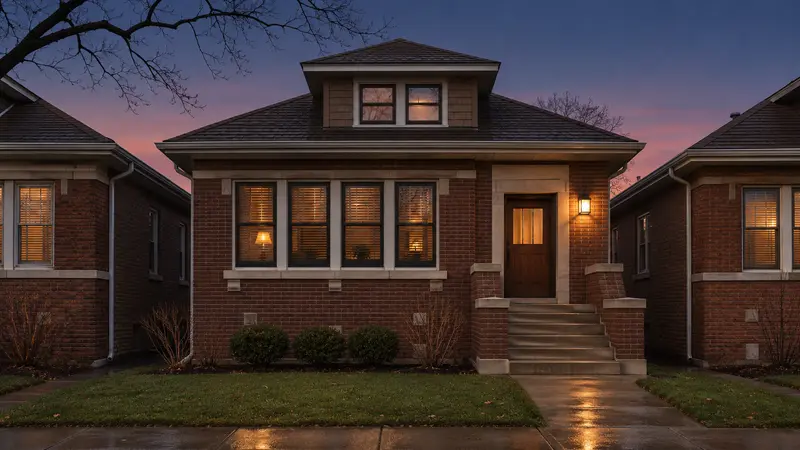
A Chicago fix and flip loan file needs a borrowing entity in good standing, a non-owner-occupied property, a line-item scope of work, comps that support the ARV, and cash for closing plus reserves. Credit: no minimum FICO on select programs; credit is reviewed, never waived. First-time flippers are reviewed; maximum leverage is not assured. Loans run to $10M.
- Occupancy
- non-owner-occupied investment property only
- Credit
- no minimum FICO on select programs; credit is reviewed, never waived
- First-time flippers
- reviewed; maximum leverage is not assured
- ARV
- supported by comparable sales; a third-party valuation may be required
- Maximum loan
- $10M
- Experience tiers
- underwritten file by file, ask your loan officer
- Minimum loan
- underwritten file by file, ask your loan officer
Program terms as of November 26, 2026. Rates as of November 25, 2026.
On this page
- Who is the borrower, and does it have to be an LLC?
- Which Illinois entity documents does the lender read?
- What property is eligible?
- How do experience and credit affect approval?
- How much liquidity does the file need to show?
- What makes a scope of work and budget acceptable?
- How is the ARV supported?
- What goes in the document checklist?
- What is published, and what is underwritten file by file?
- What is the fastest way to get a file ready?
Lender requirement lists tend to blur two different things: rules the lender has put in writing, and judgments an underwriter makes on your particular deal. Mixing them is how investors end up surprised at the term sheet.
This page keeps them apart. Jaken Finance Group publishes this site, so where JFG has a published rule you get the rule. Where it does not, you get the words "underwritten file by file" and what to prepare.
Who is the borrower, and does it have to be an LLC?
The borrower is normally a business entity, and its owners should plan to sign a personal guarantee. A flip loan is business-purpose credit, which is what keeps it outside consumer mortgage rules. An Illinois LLC is the usual vehicle. Whether a file can close in an individual's name, and which owners must guarantee, is underwritten file by file. Vesting and signing mechanics are covered in closing in an Illinois LLC.
Which Illinois entity documents does the lender read?
Four documents prove the entity exists, who owns it and who can sign: file-stamped articles of organization, the signed operating agreement, the IRS EIN letter and a current Certificate of Good Standing. The IRS issues an EIN online at no charge.
Good standing is the one that goes stale. Illinois law declares an LLC delinquent and not in good standing when its annual report is not filed before the first day of its anniversary month. An LLC must also keep a registered agent: Required at all times; Illinois resident or entity authorized to do business in Illinois.
What property is eligible?
Eligible property is non-owner-occupied investment property only: one-to-four-unit houses, two-flats, three-flats and similar residential buildings you will renovate and sell or refinance. A building of five or more units is commercial property to most lenders, and how this program treats one is underwritten file by file; see why five units is commercial.
Condition is expected to be rough. What matters is that the scope cures it. If the building is vacant, Chicago's vacant building rules require liability coverage of $300,000 per occurrence on residential structures, so the insurance binder has to reflect vacancy.
How do experience and credit affect approval?
Both are reviewed on every file and neither is a published cutoff. First-time flippers are reviewed; maximum leverage is not assured. Experience tiers are underwritten file by file, ask your loan officer. On credit, the published statement is no minimum FICO on select programs; credit is reviewed, never waived.
In practice, bring proof. List completed projects with addresses, purchase and sale dates, and settlement statements. If the credit report has a late payment, judgment or foreclosure, write a short explanation before the underwriter finds it. More on a first deal is in funding for first-time flippers.
How much liquidity does the file need to show?
Enough to close and to carry the project until draws and the exit pay you back. The loan can fund up to 90% of purchase price plus 100% of approved rehab, capped at 75% of supported ARV, but "100% of rehab" never means no cash: the down payment, points, closing costs, interest, overruns and work done before each draw are yours. The reserve an underwriter wants on a given file is underwritten file by file. Here is a way to size it yourself.
Liquidity to show on a $340,000 Jefferson Park bungalow
Illustrative inputs. The reserve lines are a planning method, not a published JFG requirement.
Cash to close
| Line | Amount | How it is figured |
|---|---|---|
| Down payment | $34,000 | price less the $306,000 purchase advance |
| Points | $8,320 | 2 points on a $416,000 loan |
| Chicago transfer tax, buyer portion | $2,550 | 680 units of $500 |
| Title, recording, attorney | $4,800 | illustrative |
| Cash to close | $49,670 |
Line items sum to the stated result. Checked in code at build.
Reserves after closing
| Line | Amount | How it is figured |
|---|---|---|
| Interest, 3 months | $11,440 | $416,000 x 11% / 12 x 3 |
| Taxes, insurance, utilities, 3 months | $2,850 | $950 a month, illustrative |
| Contingency | $11,000 | 10% of the $110,000 budget |
| First construction phase, floated until draw one | $30,000 | reimbursed after inspection |
| Reserves | $55,290 |
Line items sum to the stated result. Checked in code at build.
What the bank statements should show
| Line | Amount | How it is figured |
|---|---|---|
| Cash to close | $49,670 | |
| Reserves | $55,290 | |
| Share of purchase plus rehab | 23.32% | |
| Liquidity to document | $104,960 |
Line items sum to the stated result. Checked in code at build.
With the rehab fully financed, this file still needs about $104,960 in verifiable funds.
Assumptions
- The 11% rate and 2 points sit inside the published 8.99%-13.5% and 1-3 points; they are inputs, not a quote.
- Reserve months and contingency percent are the investor's planning choices. The reserve a given file must show is decided in underwriting.
Statements should cover two months, all pages, with large deposits explained. The line items behind the first table are built out in cash needed to close.
What makes a scope of work and budget acceptable?
A scope of work is acceptable when an inspector could walk the building with it and check off lines. That means trades, quantities, labor and material per line, and a total that matches the contractor's signed bid. The rehab holdback is sized from this document.
Two Chicago items belong in the package. The City requires a general contractor license for permitted work done as an investment or for resale, so name the licensed contractor. In pre-1978 housing, EPA's renovation rule applies to paid work that disturbs paint. A lender-ready format is in the scope of work budget template.
How is the ARV supported?
After-repair value is supported by comparable sales; a third-party valuation may be required. Because the loan is capped at 75% of that number, weak comps cut the loan directly. Send recent closed sales of renovated buildings of the same type, on nearby blocks, with photos.
You are entitled to see the result: Regulation B requires a creditor to give you copies of appraisals and written valuations on a first-lien dwelling loan. How underwriters weigh comps is in how lenders support ARV.
What goes in the document checklist?
| Document | Issued by | What the underwriter checks |
|---|---|---|
| Articles of organization | Illinois Secretary of State | Entity exists; exact legal name |
| Operating agreement | Your LLC | Owners, percentages, signing authority |
| EIN letter | IRS | Tax ID matches the entity |
| Certificate of Good Standing | Illinois Secretary of State | Annual reports current |
| Photo ID and credit authorization | Each guarantor | Identity; credit is reviewed |
| Two months of bank statements | Your bank | Cash to close plus reserves |
| Executed purchase contract with riders | Buyer and seller | Price, closing date, assignments |
| Scope of work and contractor bid | You and your contractor | Line items match the holdback |
| Comparable sales | You | Support for ARV |
| Insurance binder | Your agent | Property and liability; lender named |
| Title commitment | Title company | Liens, taxes, legal description |
The printable version, in underwriting order, is the printable submission checklist. JFG's own requirements overview covers its national program.
What is published, and what is underwritten file by file?
| Program term | Published by Jaken Finance Group |
|---|---|
| Occupancy | non-owner-occupied investment property only |
| Credit | no minimum FICO on select programs; credit is reviewed, never waived |
| First-time flippers | reviewed; maximum leverage is not assured |
| ARV support | supported by comparable sales; a third-party valuation may be required |
| Leverage | up to 90% of purchase price plus 100% of approved rehab, capped at 75% of supported ARV |
| Maximum loan | $10M |
| Experience tiers | underwritten file by file, ask your loan officer |
| Minimum loan | underwritten file by file, ask your loan officer |
Source: Jaken Finance Group program facts, as of November 26, 2026. Terms are offered only to qualified borrowers and can change without notice.
| If your file shows | Expect |
|---|---|
| No completed flips | Review of the deal and your team; maximum leverage is not assured |
| Derogatory credit | A request for explanation; credit is reviewed, never waived |
| Thin or distant comps | A third-party valuation and possibly a smaller loan |
| You plan to occupy | Not eligible for this program |
| LLC not in good standing | Cure with the Secretary of State before closing |
Files that stall
A file stalls when the cash is borrowed, the scope is one lump sum, or the value rests on a single listing price. No lender can size a holdback from "full gut, $90,000," and unexplained deposits read as undisclosed debt.
The fix is preparation, not a different lender: itemize the scope, document the funds, and test the deal in the flip deal analyzer before you submit. If the cash truly is not there, a partner or a smaller project is the better route.
What is the fastest way to get a file ready?
Fill in the deal summary first: address, price, rehab budget, ARV, exit and entity. A lender can quote from that block, and every document proves one line of it. The mechanics of the loan those documents support are in how a Chicago flip loan works.
Then pick a route. Get terms lists what to have ready, the downloads library holds the templates, and you can send JFG a scenario before the file is complete. JFG's Illinois fix and flip page covers lending outside Chicago.
Questions: Flip loan requirements
Does my LLC need to be formed before I make an offer?
No, but it has to exist and be in good standing before the loan documents are drawn. Illinois charges $150 to file articles of organization and $100 more for expedited handling. If the contract is in your own name, your attorney can assign it to the entity during attorney review. Tell the lender the borrower name on day one so title, insurance and the loan documents all match.
My LLC missed an annual report. Can I still close?
Not until it is cured. Under 805 ILCS 180/50-15 the Secretary of State declares an LLC delinquent and not in good standing when the annual report and fee are not in before the first day of its anniversary month. The report costs $75 and the late penalty is $100, plus $100 per additional year of delinquency. File, pay, then order a fresh Certificate of Good Standing, because the lender and the title company will each ask for one.
Can I live in one unit of the two-flat while I renovate it?
No. The program is for non-owner-occupied investment property only. Federal rules draw the same line. The Regulation Z commentary on a rental property that is not owner-occupied reads: Deemed business purpose; owner may occupy no more than 14 days in the coming year. A house hack is a consumer loan with different rules, and the renovation-loan options for owner-occupants are compared on this site's 203(k) and HomeStyle page.
Do I get a copy of the valuation I paid for?
Yes, when the loan is secured by a first lien on a dwelling. Regulation B, 12 CFR 1002.14, requires the creditor to provide copies of appraisals and other written valuations, on this schedule: Promptly on completion or 3 business days before closing, whichever is earlier. The official commentary says the rule covers business-purpose credit. Read the report when it arrives. If the value came in under your number, the comps it used tell you what to rebut.
Will the title company ask who owns my LLC?
Expect it. Title underwriters verify who can sign for an entity, and the lender needs the same answer for the guarantee. One federal filing is on hold, though: FinCEN's Residential Real Estate Rule was vacated by a federal court on March 19, 2026, and FinCEN says reporting persons are not required to file while that order stands. FinCEN has appealed, so ask your closing agent what applies on your date.
Local rates and rules cited on this page
| Item | Figure | Primary source | Effective |
|---|---|---|---|
| Registered agent requirement | Required at all times; Illinois resident or entity authorized to do business in Illinois | 805 ILCS 180/1-35 - Registered office and registered agent (Illinois General Assembly (ilga.gov)) | 2010-07-02 |
| Vacant building liability insurance, residential | $300,000 per occurrence | Requirements for Vacant Building Owners (Revised 1/2026) (City of Chicago Department of Buildings) | 2026-01 |
| Illinois LLC Articles of Organization fee | $150 | 805 ILCS 180/50-10(b)(1) - Fees (Illinois General Assembly (ilga.gov)) | 2022-01-01 |
| Expedited fee for LLC articles of organization | $100 | 805 ILCS 180/50-50(e) - Department of Business Services Special Operations Fund (Illinois General Assembly (ilga.gov)) | 2019-08-26 |
| Illinois LLC annual report fee | $75 | 805 ILCS 180/50-10(b)(11) - Fees (Illinois General Assembly (ilga.gov)) | 2022-01-01 |
| LLC annual report late penalty | $100, plus $100 per additional year of delinquency | 805 ILCS 180/50-15(b)(1) - Penalty (Illinois General Assembly (ilga.gov)) | 2019-01-01 |
| Regulation Z: non-owner-occupied rental property | Deemed business purpose; owner may occupy no more than 14 days in the coming year | 12 CFR 1026.3 Exempt Transactions, Official Interpretation comment 3(a)-4 (Consumer Financial Protection Bureau) | 2026 |
| Copy of appraisal or written valuation (Regulation B) | Promptly on completion or 3 business days before closing, whichever is earlier | 12 CFR 1002.14, Rules on providing appraisals and other valuations (Consumer Financial Protection Bureau) | 2014-01-18 |
| Chicago transfer tax, City portion (buyer) | $3.75 per $500 of price | Real Property Transfer Tax (7551) (City of Chicago Department of Finance) | 2008-04-01 |
| Chicago transfer tax, CTA portion (seller) | $1.50 per $500 of price | Real Property Transfer Tax (7551) (City of Chicago Department of Finance) | 2008-04-01 |
| Cook County real estate transfer tax | $0.25 per $500 of value | Transfer Fees (Cook County Clerk) | 1968-01-01 |
| Illinois state real estate transfer tax | $0.50 per $500 of value | 35 ILCS 200/31-10, Imposition of tax (Illinois General Assembly) | 2005-06-01 |
Rates as of November 25, 2026. Confirm with the agency before relying on any figure.
Sources
- Limited Liability Company Act, 805 ILCS 180/50-15, Penalty, Illinois General Assembly, 2026.
- Limited Liability Company Act, 805 ILCS 180/50-10, Fees, Illinois General Assembly, 2022-01-01.
- Get an employer identification number, Internal Revenue Service, 2026.
- 12 CFR 1002.14, Rules on providing appraisals and other valuations (Regulation B), Consumer Financial Protection Bureau, 2026.
- 12 CFR 1026.3, Exempt transactions (Regulation Z) and official commentary, Consumer Financial Protection Bureau, 2026.
- General Contractor License, City of Chicago Department of Buildings, 2026.
- Vacant building owner requirements, City of Chicago Department of Buildings, 2026-01.
- Residential Real Estate Rule, Financial Crimes Enforcement Network, 2026-03-19.
- Lead Renovation, Repair and Painting Program, U.S. Environmental Protection Agency, 2026.