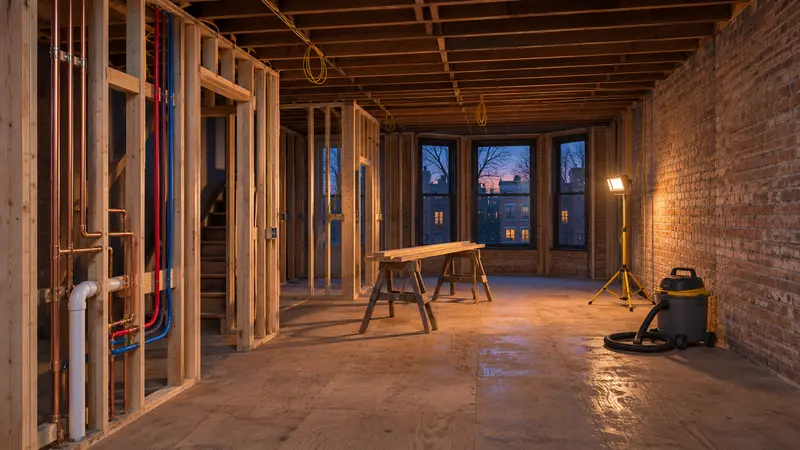
Plan eighteen phases, from attorney review to resale closing, with a planned start and planned days for each, then record actual dates as they happen. The spreadsheet calculates planned end dates, variance in days and a delay cost, using a carry cost per day built from your own interest, taxes, insurance and utilities.
Chicago Flip Project Timeline Template
Eighteen phases from accepted offer to resale closing, planned against actual, with the cost of every day of slip.
On this page
- Which dates anchor the whole schedule?
- How do you plan the eighteen phases?
- How is the carry cost per day worked out?
- Why is variance cumulative, and how do you read delay cost?
- What is in the project timeline template?
- Where do Chicago schedules slip?
- What should you do when the projected payoff passes maturity?
A flip loan has an end date, and the schedule either fits inside it or it does not. Many investors find out which in the last two months. This template is for finding out in the first two weeks.
It carries no durations. Permit and construction times vary too much by building and by scope for a template to guess, so you enter your contractor's numbers and the sheet holds everyone to them.
Which dates anchor the whole schedule?
Two dates anchor it: the purchase closing date and the loan's maturity date. Everything before closing is driven by the contract. Everything after is a race against maturity.
Write both at the top, with your attorney review and inspection deadline between them. The loan term is underwritten file by file, ask your loan officer, and extension terms are underwritten file by file, ask your loan officer, so take both from your own loan documents, not from a rule of thumb. On the front end, Jaken Finance Group quotes closings in 7-10 business days on complete files, counted after borrower conditions are met.
How do you plan the eighteen phases?
Enter a planned start and planned days for each row, and the sheet returns the planned end. The rows run in deal order:
- Contract to closing (rows 1 to 5): attorney review, inspection, loan submission, title and municipal certificates, closing.
- Permit (rows 6 and 7): application filed, permit issued.
- Construction (rows 8 to 14): demolition, rough trades, rough inspections, insulation and drywall, finishes, final inspections, punch list.
- Sale (rows 15 to 18): listing, accepted contract, the buyer's appraisal and loan approval, closing and payoff.
Each row has an owner. A phase with no name beside it is the one that slips. For typical sequencing and where the weeks go, see the walkthrough of the offer-to-payoff timeline.
How is the carry cost per day worked out?
The Carry Cost sheet takes four monthly figures, loan interest, property taxes, insurance and utilities, and converts each to a daily cost: monthly times twelve, divided by 365. The total of the daily column is your carry cost per day.
Use your real numbers. Interest is your loan balance times your note rate, divided by twelve. Taxes come from the latest bill. If you want to see how the daily figure changes with rate and balance before you have a loan, run the daily interest and carry calculator, and read month-by-month carry tables for the month-by-month view.
Why is variance cumulative, and how do you read delay cost?
Variance is actual end minus planned end, so a late phase pushes its lateness onto every phase after it. If demolition ends eight days late and nobody makes up the time, drywall also shows eight.
That is why you should not add up the delay cost column. Each row already includes the slip inherited from the rows above it. The totals row shows the largest variance and its cost, which is the project's delay to date.
| Row shows | Meaning |
|---|---|
| Variance of zero | Phase ended on plan |
| Positive variance | Days late against the original plan |
| Negative variance | Days early; delay cost shows zero |
| Blank | No actual end date entered yet |
What is in the project timeline template?
Project dates that do not move
Write these down first. Every phase below is planned backward from the maturity date and forward from the closing date.
Carry cost per day
Convert each monthly cost to a daily one (monthly times 12, divided by 365). The spreadsheet does this and feeds the total into the delay cost column.
| Carry item | Per month | Per day | Source |
|---|---|---|---|
| Loan interest | Loan balance times rate, divided by 12 | ||
| Property taxes | Latest Cook County Treasurer bill, divided by 12 | ||
| Insurance | Policy premium, divided by the policy months | ||
| Gas, electric and water | Recent bills or utility estimates | ||
| Other (security, snow, lawn, association dues) | |||
| Total carry cost |
Phase schedule
Planned end is planned start plus planned days. Variance is actual end minus planned end. Delay cost is variance times carry cost per day.
| Phase | Planned start | Planned days | Planned end | Actual start | Actual end | Variance (days) | Delay cost | Owner | Notes |
|---|---|---|---|---|---|---|---|---|---|
| Accepted offer and attorney review | Attorney | ||||||||
| Inspection and contractor walk | You and contractor | ||||||||
| Loan submission and term sheet | You and lender | ||||||||
| Title commitment, survey and municipal certificates | Title and attorneys | ||||||||
| Purchase closing | Title | ||||||||
| Permit application filed | Architect or expediter | ||||||||
| Permit issued | Department of Buildings | ||||||||
| Demolition | Contractor | ||||||||
| Rough trades: framing, plumbing, electrical, HVAC | Contractor | ||||||||
| Rough inspections | Department of Buildings | ||||||||
| Insulation and drywall | Contractor | ||||||||
| Finishes: kitchens, baths, flooring, paint | Contractor | ||||||||
| Final inspections | Department of Buildings | ||||||||
| Punch list and cleaning | Contractor | ||||||||
| Listing live | Listing agent | ||||||||
| Buyer contract accepted | Listing agent and attorney | ||||||||
| Buyer's appraisal and loan approval | Buyer's lender | ||||||||
| Resale closing and loan payoff | Title | ||||||||
Chicago checkpoints to place on the schedule
- Permit path chosen before closing
The Department of Buildings runs separate processes: the Express Permit Program for most repair work, Standard Plan Review for projects needing architectural plans, and the Self-Certified Permit Application Program for eligible projects. - Landmark or demolition-delay review identified, if the building is a landmark, in a landmark district or rated red or orange in the Chicago Historic Resources Survey
- Certificate of Zoning Compliance and Full Payment Certificate ordered for both the purchase and the resale
- Utility service restored or upgraded: schedule the gas and electric utilities as soon as you own the building
- Rough inspections booked before insulation and drywall are scheduled
- Exterior masonry, concrete and roofing sequenced around freezing weather
- Draw requests timed to the end of each phase, with the days your lender takes to fund built in
- Listing photos and staging booked against the final inspection date, not the hoped-for one
Weekly review
Ten minutes, same day every week.
- Enter actual start and end dates for anything that moved
- Read the largest variance and its delay cost
- Re-plan every later phase from the new dates
- Compare the projected resale closing with the loan maturity date
- If the cushion is gone, call your lender before the maturity date, not after
- Name one person responsible for the phase that is slipping
How to read variance and delay cost
- Variance is measured against the planned end date, so it is cumulative. If demolition ends ten days late and nothing is recovered, every later phase also shows about ten days.
- Because variance is cumulative, do not add the delay cost column. The project delay cost is the largest figure in the column, which the spreadsheet shows in the totals row.
- A negative variance means the phase finished early. Delay cost shows zero for those rows.
- Planned days are calendar days, the way interest accrues.
- Carry cost per day ignores the profit you lose to a softer market or a price cut. It is the floor of what a delay costs, not the ceiling.
Where do Chicago schedules slip?
They slip at the handoffs to someone outside your crew. Four are worth a row note:
- Permit path. The Department of Buildings runs separate permit processes, including the Express Permit Program for most repair work and Standard Plan Review for projects that need architectural plans. Picking the wrong one costs a resubmission. The guide to choosing a DOB permit path compares them.
- Historic review. The City's Demolition-Delay Ordinance places a hold on demolition permits for buildings rated red or orange in the Chicago Historic Resources Survey.
- Closing certificates. A Certificate of Zoning Compliance and a Full Payment Certificate are needed on the way in and again on the way out, when you are the seller.
- Weather. Masonry, concrete and roofing do not go well in a freeze. The page on cold-weather construction limits explains what to sequence around it.
What should you do when the projected payoff passes maturity?
Call your lender while the gap is still a projection. Re-plan every unfinished phase from today's actual dates and read the last row's planned end against the maturity date in your note. If it lands past maturity, or inside the time a buyer's loan needs to close, you have a decision to make now: add crew, cut scope, or ask about an extension.
The options and their costs are covered in the guide to loans that run long. Jaken's page on Chicago fix and flip loans describes the program this site is built around, and the downloads hub has the draw log and budget sheets that feed this schedule.
Questions: Project timeline template
Should planned days be business days or calendar days?
Calendar days. Interest, taxes and insurance accrue every day of the week, so a schedule in calendar days lines up with what the delay costs you. Contractors and the City often quote in business days or weeks; convert before you enter anything. A phase quoted at ten business days is two calendar weeks, and a permit quoted in weeks should be entered as weeks times seven.
How do I schedule phases that overlap, like permit review and demolition prep?
Give each phase its own planned start and let the dates overlap. The sheet does not force one phase to begin when the previous one ends, because real jobs do not work that way: the permit application is filed during the purchase closing period, and listing prep starts before the punch list is done. What matters is that every phase has a planned end date you can be measured against.
Where do loan draws go on the timeline?
Draws are not their own phase. They fall at the end of demolition, rough trades, drywall and finishes, or wherever your draw schedule puts them. Note the draw number in the notes column of the phase it follows, and add the days your lender takes to fund when you plan the start of the next phase. The draw request log records the actual dates, and this sheet shows what they did to the schedule.
What is a reasonable cushion between planned payoff and loan maturity?
Enough to absorb the two delays you cannot control: permit review at the front and the buyer's financing at the back. There is no universal number, and this template does not supply one. Work backward: take the maturity date in your note, subtract the time a financed buyer needs from contract to closing, and that is your latest safe date to accept an offer. If the plan does not fit, raise it before you close on the loan.
Does the delay cost include lost profit from a slower market?
No. Delay cost here is variance days times your daily carry: interest, property taxes, insurance and utilities. It leaves out price reductions, a second season of lawn or snow service, extension charges and the return you would have earned on the next deal. Treat the figure as the minimum a delay costs. It is still the number that gets a contractor's attention.
Sources
- Permits, City of Chicago Department of Buildings, 2026.
- Demolition Delay, City of Chicago Department of Planning and Development, 2026.
- Certificate of Zoning Compliance, City of Chicago Department of Planning and Development, 2026.
- Full Payment Certificates, City of Chicago Department of Finance, 2026.