Transactional funding is same-day money for a double close: it buys the property from the seller and is repaid hours later from your end buyer's funds. It cannot carry a rehab or a listing; a flip or bridge loan does. A Chicago double close costs $11,075 in taxes, title charges and fees in this page's example.
- Assignment
- You sell the contract; one deed, one closing
- Double close
- You buy and resell; two deeds, two closings
- Transactional funding term
- Same day to a few days; pricing not published here
- Illinois license trigger
- 2 or more occasions in any 12-month period
- Chicago transfer tax, both sides
- $5.25 per $500 of price
- Example net, assignment
- $24,400
- Example net, double close
- $13,926
Program terms as of November 26, 2026. Rates as of November 25, 2026.
On this page
- Assignment or double close: what changes at the closing table?
- What is transactional funding, and what does the funder look at?
- Why can't same-day money carry a rehab or a listing?
- Which financing fits a wholetail?
- Do you need an Illinois broker license to wholesale?
- Which costs are paid twice in a Chicago double close?
- What does the same spread net each way?
- What has to be disclosed, and can the contract be assigned?
- Set up the exit before you sign with the seller
A wholesaler has a signed contract with a seller and a buyer who will pay more. Each way of turning that into money needs a different kind of funding, or none.
This page is published by Jaken Finance Group, which makes flip and bridge loans and does not offer same-day transactional funding. Where that product or a plain assignment is the better tool, this page says so.
Assignment or double close: what changes at the closing table?
In an assignment you sell your rights under the contract, and the end buyer closes directly with the seller. In a double close you buy the property and resell it, usually the same day.
| Route | Do you take title? | Money you need | Time you own it | Fits when |
|---|---|---|---|---|
| Assignment | No | Earnest money only | None | Contract is assignable; buyer pays cash or uses a lender that allows it |
| Double close | Yes | The full first purchase price, for hours | Minutes to days | Contract bars assignment, or the buyer's lender needs you on title |
| Wholetail | Yes | Purchase, light clean-up, carry | Weeks | The house sells for more on the open market as-is |
The page for wholesalers and agents covers how JFG works with each of these.
What is transactional funding, and what does the funder look at?
Transactional funding is a loan that exists for one day: it pays the seller at the first closing and is repaid from the end buyer's money at the second. The funder is underwriting the second closing, not the house, so it wants both contracts, the end buyer's funds or loan approval, and a title company that will run both files.
The product exists because of a funding rule. Under the Illinois Title Insurance Act, 215 ILCS 155/26, a title agent may not disburse unless amounts of $50,000 or more from a single party are wired or collected funds. Your purchase has to be funded with money that has arrived.
Funders quote their own points or flat fee, so the example below treats pricing as an input.
If your purchase funds and the end buyer then fails to close, you own the house and owe a loan written to last a day. Ask the funder in writing what happens on day two.
Why can't same-day money carry a rehab or a listing?
Same-day money has no term, no draws and no valuation of the finished house. Without a specific buyer's wire there is no loan.
A rehab needs the opposite: a interest-only loan that stays open while work is done, with funds staged against a rehab holdback, with inspections. That is a flip loan, sized at up to 90% of purchase price plus 100% of approved rehab, capped at 75% of supported ARV. The labels overlap in the market; the flip, bridge and hard money comparison sorts them out.
Which financing fits a wholetail?
A wholetail, where you buy, clean out, maybe paint and relist, needs a loan that lasts weeks. That is a short bridge loan or your own cash, not transactional funding.
Two things decide whether it pays: carry for the listing period, and your buyer pool. FHA rules make a resale Ineligible for FHA financing at 90 days or less after your acquisition (24 CFR 203.37a), so a quick wholetail sells mainly to cash and conventional buyers. JFG's Chicago bridge loans page describes the short-term option, and paying cash or using a HELOC is the alternative when the hold is short.
Do you need an Illinois broker license to wholesale?
You may. The Real Estate License Act of 2000, at 225 ILCS 454/1-10 as amended effective January 1, 2025, defines a broker to include a person who, for another or for themselves, engages in a pattern of business of dealing in contracts, including assignable contracts and options. A pattern is 2 or more occasions in any 12-month period.
The Act exempts an Owner acting only on property the owner owns or leases. That is one reason some wholesalers take title through a double close. Whether a given structure falls inside it is a legal question. Section 20-10 sets the civil penalty for unlicensed practice at Up to $25,000 per offense. Confirm your position with an Illinois real estate attorney or IDFPR before your second deal in a year.
Which costs are paid twice in a Chicago double close?
Transfer taxes, title charges, recording and the City certificates are each paid on both transfers. The City of Chicago taxes each transfer of title, and the Cook County Clerk lists the county and state taxes with the seller as the liable party.
| Item | Figure | Source | Effective |
|---|---|---|---|
| Chicago transfer tax, City portion (buyer) | $3.75 per $500 of price | City of Chicago Department of Finance | 2008-04-01 |
| Chicago transfer tax, CTA portion (seller) | $1.50 per $500 of price | City of Chicago Department of Finance | 2008-04-01 |
| Cook County real estate transfer tax | $0.25 per $500 of value | Cook County Clerk | 1968-01-01 |
| Illinois state real estate transfer tax | $0.50 per $500 of value | Illinois General Assembly | 2005-06-01 |
| Cook County deed recording fee | $107 per deed | Cook County Clerk | 2024-04-01 |
| Chicago Full Payment Certificate fee | $50 | City of Chicago Department of Finance | 2026 |
Charges that apply to each of the two transfers
Each transfer also needs transfer stamps and a Full Payment Certificate for water. Ask the title company whether a second zoning certificate is needed. The two-deed transfer tax calculator prices both deeds, the Chicago transfer tax rules explain exemptions, and JFG has a transfer tax guide for investors. In an assignment there is one deed, so these are paid once, by the seller and the end buyer.
What does the same spread net each way?
On a $25,000 spread the assignment nets $24,400 and the double close nets $13,926.
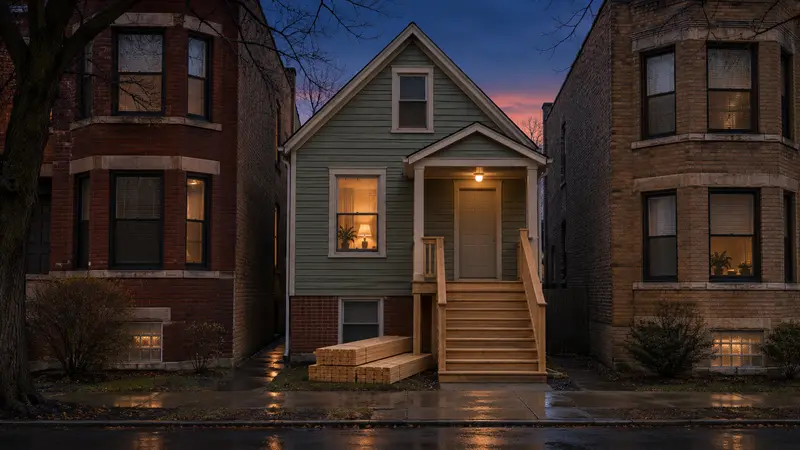
A $25,000 spread on a Chicago Lawn cottage, taken two ways
Contract with the seller at $180,000; end buyer at $205,000. Same spread, two closings structures. Inputs are illustrative.
Assignment of the contract
| Line | Amount | How it is figured |
|---|---|---|
| Assignment fee | $25,000 | $205,000 less $180,000 |
| Attorney, assignment documents | -$600 | |
| Net from the assignment | $24,400 |
Line items sum to the stated result. Checked in code at build.
Double close with transactional funding
| Line | Amount | How it is figured |
|---|---|---|
| Spread between the two prices | $25,000 | |
| Chicago buyer transfer tax, first closing | -$1,350 | City portion on $180,000 |
| Seller transfer taxes, second closing | -$923 | City, county and state on $205,000 |
| Transactional funding fee | -$3,195 | 1.5% of $180,000 plus $495 |
| Title and settlement, as buyer | -$1,650 | |
| Title and settlement, as seller | -$2,300 | |
| Recording your deed | -$107 | Cook County Clerk |
| Second water certificate | -$50 | City of Chicago |
| Attorney, two closings | -$1,500 | |
| Given up against the assignment | $10,475 | |
| Net from the double close | $13,926 |
Line items sum to the stated result. Checked in code at build.
The double close keeps $13,926 of a $25,000 spread; costs take 44.3%. The assignment keeps $24,400, if the contract can be assigned and the end buyer's financing allows it.
Assumptions
- The funding fee, title charges and attorney fees are illustrative inputs, not quotes. Transactional funding is not a JFG product and its pricing is not published here.
- Transfer taxes use the City, Cook County and Illinois rates cited on this page, charged per $500 of price or fraction.
- No holding period, repairs, commission or income tax are included.
The $10,475 difference is the price of taking title. The broader list of closing costs on a flip loan applies if you hold longer.
What has to be disclosed, and can the contract be assigned?
Check four documents before you market the deal.
- The purchase contract. If it is silent or prohibits assignment, you need the seller's written consent or a double close. Raise it during the attorney review period.
- The end buyer's financing. An FHA loan requires that the Seller must be owner of record; no contract assignment.
- The disclosure report. On one to four units the seller must deliver the Residential Real Property Disclosure Report Before the contract is signed (765 ILCS 77/20). In a double close you are the second seller.
- Your entity. Decide which LLC signs before the first contract; see taking title in an LLC.
When a flip loan is the wrong tool for a wholesaler
A flip loan will not work for a same-day resale. It carries points, valuation and legal costs built for a project that lasts months, and it cannot be approved and repaid in an afternoon.
The better route is an assignment when the contract and the buyer's financing allow it, or transactional funding from a funder your title company already works with. Bring a flip or bridge loan in only when you will own the house long enough to change it or relist it.
Set up the exit before you sign with the seller
- Ask the title company which structures it will close, and how it wants each closing funded.
- Write assignability into the contract, or plan for two closings.
- Price both routes with the transfer tax figures above.
- Line up funding that matches the hold: none, same-day, or a bridge loan with a JFG proof of funds letter.
- Order title early; the title, water certificate and lien page and the records-to-pull checklist cover what to pull.
For deals where you will hold and renovate, the other financing comparisons are the next read.
Questions: Flip loan vs transactional funding
Is wholesaling legal in Illinois?
Selling your contract rights is not banned, but Illinois treats a pattern of it as brokerage. The Real Estate License Act defines a broker to include a person who deals in contracts or options on real estate on 2 or more occasions in any 12-month period, and unlicensed practice carries a civil penalty of Up to $25,000 per offense. This is general education. Read the statute and ask an Illinois real estate attorney how it applies to you.
Can I use my end buyer's money to fund my purchase?
Only if the title company agrees to it, and some will not. Illinois' Title Insurance Act bars a title agent from disbursing unless amounts of $50,000 or more from a single party are wired or collected funds, so each closing has to be funded with money that has arrived. That is the reason same-day funders exist. Ask the title company in writing how it handles two linked closings.
Will a flip lender finance a deal I plan to resell without repairs?
Sometimes, as a short bridge loan, but it is priced and documented as a real loan: valuation, title, entity documents and a term measured in months. That only makes sense if you intend to hold for weeks, as in a wholetail. For a same-day resale the points and fees on a full loan would usually exceed a transactional funder's charge. JFG's flip program covers non-owner-occupied investment property only.
Does an assignment show my fee to the seller and the buyer?
Often, yes. An assignment fee paid through the closing is typically itemized on the settlement statement, so ask the title company how it will be shown. A double close keeps the two prices on separate statements. If the size of the spread would upset either side, the honest fix is to disclose your role early, and to weigh the extra closing costs against the fee you are protecting.
How much proof of funds does a wholesaler need to show a seller?
Enough to show you, or your funding source, can close at the contract price. A letter that names a lender and an amount is stronger than a bank screenshot, and it should be real: do not present a funding letter for money you could not draw. JFG takes letter requests through its proof of funds page; see how proof of funds works for what a seller's agent checks.
Local rates and rules cited on this page
| Item | Figure | Primary source | Effective |
|---|---|---|---|
| FHA anti-flipping: resale within 90 days | Ineligible for FHA financing at 90 days or less | 24 CFR 203.37a - Sale of property (eCFR / HUD) | 2006-06-07 |
| Illinois broker license trigger for dealing in contracts | 2 or more occasions in any 12-month period | Real Estate License Act of 2000, 225 ILCS 454/1-10, Definitions (Illinois General Assembly (ilga.gov)) | 2025-01-01 |
| License exemption for owners | Owner acting only on property the owner owns or leases | Real Estate License Act of 2000, 225 ILCS 454/5-20, Exemptions (Illinois General Assembly (ilga.gov)) | 2025-01-01 |
| Civil penalty for unlicensed brokerage practice | Up to $25,000 per offense | Real Estate License Act of 2000, 225 ILCS 454/20-10, Unlicensed practice; civil penalty (Illinois General Assembly (ilga.gov)) | 2019-08-09 |
| FHA owner-of-record requirement | Seller must be owner of record; no contract assignment | 24 CFR 203.37a - Sale of property (eCFR / HUD) | 2006-06-07 |
| When the disclosure report is due | Before the contract is signed | 765 ILCS 77/20 - Disclosure report requirements (Illinois General Assembly (ilga.gov)) | 2022-05-13 |
| Chicago transfer tax, combined rate | $5.25 per $500 of price | Real Property Transfer Tax (7551) (City of Chicago Department of Finance) | 2008-04-01 |
| Cook County deed recording fee | $107 per deed | Recording Fees (Cook County Clerk) | 2024-04-01 |
| Chicago Full Payment Certificate fee | $50 | Full Payment Certificates (City of Chicago Department of Finance) | 2026 |
| Chicago transfer tax, City portion (buyer) | $3.75 per $500 of price | Real Property Transfer Tax (7551) (City of Chicago Department of Finance) | 2008-04-01 |
| Chicago transfer tax, CTA portion (seller) | $1.50 per $500 of price | Real Property Transfer Tax (7551) (City of Chicago Department of Finance) | 2008-04-01 |
| Cook County real estate transfer tax | $0.25 per $500 of value | Transfer Fees (Cook County Clerk) | 1968-01-01 |
| Illinois state real estate transfer tax | $0.50 per $500 of value | 35 ILCS 200/31-10, Imposition of tax (Illinois General Assembly) | 2005-06-01 |
Rates as of November 25, 2026. Confirm with the agency before relying on any figure.
Sources
- 225 ILCS 454/1-10, Real Estate License Act of 2000, definitions, Illinois General Assembly, P.A. 103-1039, eff. 2025-01-01.
- 225 ILCS 454/5-20, Exemptions from license requirement, Illinois General Assembly, current text, accessed 2026-11-25.
- 225 ILCS 454/20-10, Unlicensed practice; civil penalty, Illinois General Assembly, P.A. 101-357, eff. 2019-08-09.
- Real Property Transfer Tax, City of Chicago Department of Finance, 2026.
- Transfer Fees, Cook County Clerk, 2026.
- 24 CFR 203.37a, Sale of property, eCFR / HUD, 2006-06-07.
- 215 ILCS 155/26, Title Insurance Act, settlement funds, Illinois General Assembly, current text, accessed 2026-11-25.
- 765 ILCS 77/20, Residential Real Property Disclosure Act, Illinois General Assembly, P.A. 102-765, eff. 2022-05-13.