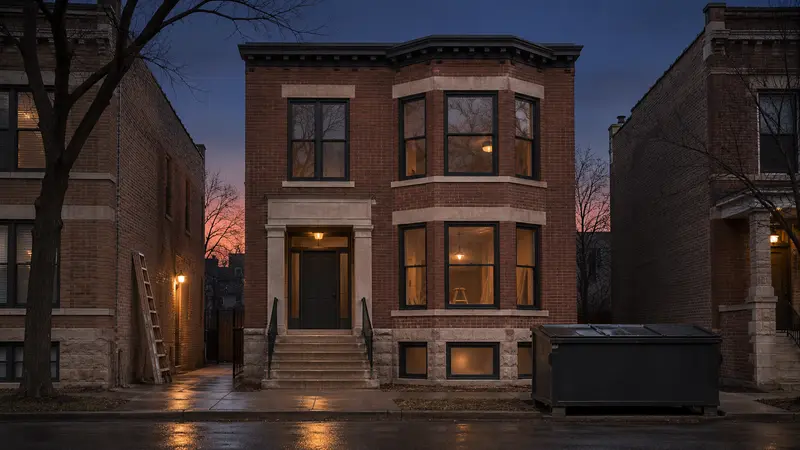
Every flip in Chicago comes down to five figures: what the finished building will sell for, how much of the cost a lender will fund, how much cash you wire, what the project has cost by the day it pays off, and what is left after tax. The ten pages in this section each take one of those figures apart with an example computed in code. None of them needs the others to make sense, but they build on each other, and reading them in deal order saves rework.
Jaken Finance Group, the lender that publishes this site, sizes its flip loans at up to 90% of purchase price plus 100% of approved rehab, capped at 75% of supported ARV. That sentence is why the section starts with value and not with cost. Leverage is never the same thing as no cash: closing costs, interest, overruns and work done ahead of a draw stay with you.
Start with the two numbers that size the loan
Resale value comes first because it caps everything after it. Read the ARV support rules to see which closed sales a reviewer accepts, then the page on the cost limit and the ARV cap to learn which of three limits sets your loan and what a binding cap adds to your down payment. If you have time for two pages before an offer, read those two.
Then price the work and the money
The rehab budget is the input a lender questions most. The scope page explains why no public source gives a dependable Chicago cost per square foot and how to budget by line item instead. Points and fees have a page of their own, which turns the published 1-3 points into dollars on one loan and shows what they cost per year on a short hold and a longer one. How a quote lands inside the published rate and point ranges is a program question, answered outside this section.
Two different cash questions
"How much do I wire?" and "How much do I need in the bank?" have different answers. The closing-table page builds a buyer's settlement statement down to the wire amount, and a fill-in wire worksheet lets you repeat it for your own deal. Total liquidity, including contingency, interest and draw float, is the subject of the six-bucket liquidity count in the answers section.
What the whole deal costs, and what a slow one costs
Use the five-group cost stack as the master list: acquisition, financing, construction, carry and sale, in the order you pay them. The carry page then reprices one deal at four, six, nine and twelve months, so you can see a delay in dollars before it happens. Transfer taxes appear in both, but the law behind them, including who owes each stamp, sits with the Chicago rules.
Screens, bands and tax
Three pages test a deal from the outside. The 70% rule page measures how much of the rule's 30% Chicago costs consume on a low-priced and a high-priced deal. The price band page runs one deal shape at three citywide sale prices to show why fixed-dollar costs weigh most on cheap houses. The tax page is general education on how a regular flipper's profit is treated; take it to a CPA before you rely on it.
What this section leaves out
No calculators live here. To run your own figures, open the deal analyzer or back into an offer price. Schedules, draws and closings belong to the process section, where a dated flip calendar shows how many months your carry has to cover. Vocabulary such as loan-to-cost, holdback and carry is defined in the glossary of loan terms, and the wider question of whether the margins still exist has its own answer page.
The ten pages, in deal order
- How lenders support ARVThe comp selection rules a valuation reviewer applies to a Chicago rehab, the public records to check your own number against, and the cash effect when the supported figure is lower.
- Cost limit vs ARV capHow the cost-based limit, the ARV cap and the maximum loan interact, the break-even ARV where the cap takes over, and three deals sized side by side.
- Rehab cost by scopeUses City of Chicago permit records and federal price indexes, not unsourced square-foot ranges, to frame cosmetic, systems and gut budgets, then builds one from line items.
- Points and fees in dollarsConverts the published points range and the usual lender, title and recording lines into dollars on one Chicago loan, then annualizes them over two hold lengths.
- Cash needed at the closing tableA buyer-side closing statement for a Chicago flip purchase, with every charge and credit explained and the wire amount computed from one bungalow deal.
- Full cost stack of a Chicago flipAll five cost groups of a Chicago flip, line by line in the order you pay them, with one two-flat computed to the dollar and links to the page behind each line.
- Carry cost by hold lengthEach carrying cost on a vacant Chicago rehab, how it is billed, and one deal's total carry computed at four hold lengths so you can price a delay before it happens.
- The 70% rule, testedSplits the rule's 30% into the Chicago costs it has to cover on two deals, then compares the rule-of-thumb offer with an offer solved for a profit target.
- Margin by price bandRuns identical purchase and rehab proportions at three citywide price anchors from Assessor sales to show which costs are fixed, which scale and what that does to margin.
- Taxes on flip profitGeneral education on dealer versus investor treatment, self-employment tax, Illinois income and replacement tax, estimated payments and records, with a simplified estimate on one flip.