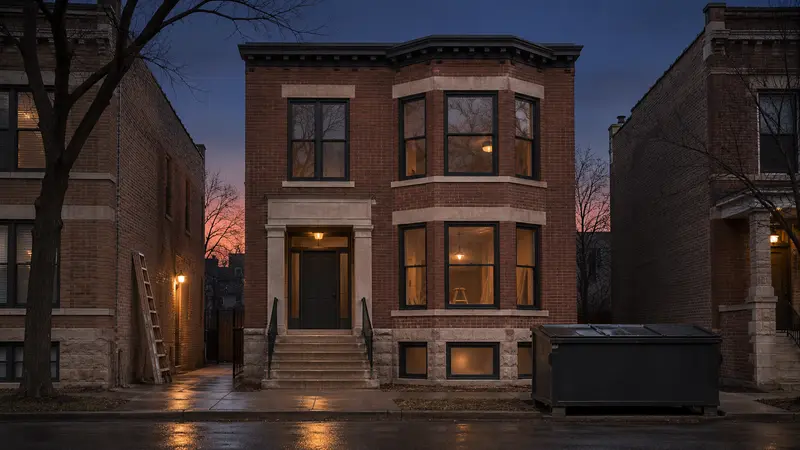
A Chicago fix and flip loan is one commitment paid in two parts: a purchase advance wired at closing and a rehab holdback released by inspected draws. It funds up to 90% of purchase price plus 100% of approved rehab, capped at 75% of supported ARV, with interest-only payments at 8.99%-13.5% plus 1-3 points.
- Structure
- Purchase advance at closing plus a rehab holdback, one first mortgage
- Leverage
- up to 90% of purchase price plus 100% of approved rehab, capped at 75% of supported ARV
- Maximum loan
- $10M
- Payments
- interest-only, at 8.99%-13.5% plus 1-3 points
- Rehab money
- staged against a rehab holdback, with inspections
- Speed
- 7-10 business days on complete files, counted after borrower conditions are met
- Chicago closing items
- Full Payment Certificate, zoning certificate on five or fewer units, City transfer stamps, MyDec
Program terms as of November 26, 2026. Rates as of November 25, 2026.
On this page
- What are the two parts of a Chicago flip loan?
- Which of the three limits sets your loan amount?
- What funds at the closing table, and what waits for a draw?
- What does your own cash have to cover?
- Where do attorney review, the water certificate and transfer stamps sit in the sequence?
- Why does permit timing decide when your first draw arrives?
- How does a draw turn the holdback into cash?
- How do interest-only payments work while the rehab runs?
- Does a flip loan come with a Loan Estimate?
- How is the loan paid off?
- What should you line up before attorney review ends?
A flip loan is a single commitment that pays out on two schedules. Part of it reaches the title company the morning you close. The rest stays with the lender until the work it pays for is in the building. Most cash surprises on a first Chicago flip come from not knowing which dollar is on which schedule.
This page follows one loan from contract to payoff. Its publisher is the lender, Jaken Finance Group.
What are the two parts of a Chicago flip loan?
A Chicago flip loan has a purchase advance and a rehab holdback. The purchase advance is the share of the price the lender wires at closing. The holdback is the approved rehab budget: committed in the note, then released in draws as work is completed and inspected. One first mortgage secures both, and both are repaid together.
The published structure is up to 90% of purchase price plus 100% of approved rehab, capped at 75% of supported ARV, as listed on JFG's Chicago fix and flip program page.
Which of the three limits sets your loan amount?
The lowest of three numbers sets the loan: the cost limit (90% of price plus 100% of approved rehab), the ARV cap at 75% of supported after-repair value, and the $10M program maximum.
When the cost limit is lowest, the holdback covers the whole approved budget and your down payment is the unfinanced slice of the price. When the ARV cap is lowest, the loan shrinks, the shortfall lands on the purchase side, and you bring more cash to closing. ARV is supported by comparable sales; a third-party valuation may be required. The break point is worked out in cost limit versus ARV cap.
What funds at the closing table, and what waits for a draw?
Only the purchase advance funds at closing. On the deal below the commitment is $326,500, but the lender's closing wire is $238,500.
A $265,000 Belmont Cragin two-flat, from closing wire to first draw
Deal inputs are illustrative, not an offer.
The commitment, split by when it funds
| Line | Amount | How it is figured |
|---|---|---|
| Purchase advance, wired at closing | $238,500 | 90% of the $265,000 price |
| Rehab holdback, released later by draw | $88,000 | 100% of the $88,000 approved budget |
| ARV cap | $352,500 | 75% of $470,000; the cost limit is lower |
| Total loan commitment | $326,500 |
Line items sum to the stated result. Checked in code at build.
Your cash at the closing table
| Line | Amount | How it is figured |
|---|---|---|
| Down payment | $26,500 | $265,000 less the $238,500 advance |
| Points | $6,530 | 2 points on $326,500 |
| Chicago transfer tax, buyer portion | $1,987.50 | 530 units of $500 at the City rate |
| Mortgage recording | $107 | Cook County Clerk flat fee |
| Title, deed recording, attorney | $4,200 | illustrative input |
| Cash you wire to close | $39,325 |
Line items sum to the stated result. Checked in code at build.
The holdback after the first draw
| Line | Amount | How it is figured |
|---|---|---|
| Holdback at closing | $88,000 | |
| First draw: demolition and rough plumbing, inspected | -$24,000 | you paid this phase first |
| Funded balance after the draw | $262,500 | $238,500 plus $24,000 |
| Monthly interest on the purchase advance alone | $2,086.88 | $238,500 x 10.5% / 12 |
| Monthly interest on the full commitment | $2,856.88 | $326,500 x 10.5% / 12 |
| Holdback still available | $64,000 |
Line items sum to the stated result. Checked in code at build.
The lender wires $238,500, you wire $39,325, and $88,000 has not left the lender.
Assumptions
- The 10.5% rate and 2 points are inputs inside the published ranges of 8.99%-13.5% and 1-3 points, not a quote.
- Whether interest accrues on the funded balance or the full commitment is set by your loan documents.
| Dollar | Who pays it | When |
|---|---|---|
| Purchase advance | Lender, by wire to title | Closing day |
| Down payment, points, title charges, buyer's City transfer tax | You | Closing day |
| Each phase of approved rehab | You first, then the holdback | After inspection |
| Monthly interest | You | Monthly from closing |
| Overruns and work outside the approved scope | You | As they happen |
What does your own cash have to cover?
Your cash covers everything the two loan buckets do not: down payment, points, title charges, the buyer's Chicago transfer tax, the first construction phase, monthly interest and any overrun. That is why financing 100% of rehab never means a no-cash project. The holdback reimburses work in place. It does not prepay it.
The City's Real Property Transfer Tax page sets the buyer's portion at $3.75 per $500 of price. Recording the mortgage costs $107 per mortgage or release on the Cook County Clerk's fee schedule. The full build is in cash needed to close, and the fill-in closing cash sheet takes your own figures.
Where do attorney review, the water certificate and transfer stamps sit in the sequence?
They all sit between the accepted contract and the closing wire, and the loan runs in parallel with them. The published speed is 7-10 business days on complete files, counted after borrower conditions are met, so contract and title days should also be underwriting days.
- Attorney review. The Multi-Board 8.0 contract gives the attorneys 5 business days after the date of acceptance. Send the signed contract to the lender that day.
- Term sheet, valuation, title order. The title company issues a title commitment naming the lender as a proposed insured.
- City certificates. A Full Payment Certificate is needed on All transfers of real property, taxable or exempt. The Department of Finance says to allow at least 10 business days.
- Closing. The lender wires the purchase advance, you wire your cash, and the title company buys the transfer stamps, files MyDec and records the deed and mortgage.
- Permit and first phase, paid with your own cash.
- First draw. Inspection, then the first holdback wire.
The early title checks are in title, water certificate and liens.
Why does permit timing decide when your first draw arrives?
A draw pays for work in place, and permitted work cannot start until the permit issues. The path to a first draw is permit, work, inspection, wire, while interest runs from closing day. Sequencing is the lever. The Department of Buildings lists Paint, tile, carpet, cabinets and countertops as needing no building permit when no plumbing or electrical connections are involved. Plan-based work is slower: the City says self-certified applications are typically issued 10 business days after zoning approval. The routes are compared in Chicago permit paths and timelines.
How does a draw turn the holdback into cash?
You finish a phase, request a draw, an inspector checks the work against the approved scope of work, and the lender releases that phase's dollars. Draws are staged against a rehab holdback, with inspections. Draw fees are underwritten file by file, ask your loan officer.
You float every phase until its wire lands, so the largest phase sets your working cash; the working-cash draw planner shows that peak. Pair each draw with a sworn contractor's statement and lien waivers: the Mechanics Lien Act makes it the owner's duty to require that statement before paying. See draws and inspections and JFG's longer guide to the draw process.
How do interest-only payments work while the rehab runs?
Payments are interest-only: each month you pay interest and no principal, at a rate inside 8.99%-13.5%, with 1-3 points charged at origination. On the example, a month of interest on the purchase advance is $2,086.88.
Ask one question before comparing quotes: is interest charged on the funded balance or the full commitment? What moves the rate itself is covered in rates, points and fees. Loan term is underwritten file by file, ask your loan officer.
Does a flip loan come with a Loan Estimate?
No. Regulation Z exempts business-purpose credit and credit to non-natural persons. You will not receive an APR, a Loan Estimate or a Closing Disclosure.
Your numbers live in the lender's term sheet and the title company's settlement statement. The exemption is also why the program is for non-owner-occupied investment property only.
How is the loan paid off?
At resale, the title company orders a payoff letter, pays the funded principal and accrued interest from the buyer's money, and records a release. As seller you also owe the CTA portion of the City tax ($1.50 per $500 of price) plus county and state tax.
Prepayment terms are underwritten file by file, ask your loan officer. Choosing between the two is covered in sale versus refinance exit.
Where this structure does not fit
A holdback loan fails the investor who needs rehab money before the work is done. If your contractor wants a large deposit and your cash is gone after closing, the first draw cannot rescue you: nothing has been built to inspect.
Better routes: cut the first phase to what your cash can float, negotiate a smaller mobilization payment, or look at gap funding, which needs separate approval and first-lender consent. The trade-offs are in flips with and without gap funding.
What should you line up before attorney review ends?
Send the signed contract, scope of work and comps to the lender on the day of acceptance. Settle with your attorney who orders the Full Payment Certificate. Have your contractor's license and insurance ready.
The file itself is listed in what a Chicago flip file needs, and the rest of the sequence is in the process section. When the address is real, send the deal to JFG for terms.
Questions: How a Chicago flip loan works
Is the rehab holdback sitting in an escrow account, and do I pay interest on it?
It depends on how the loan is documented. Some loans advance holdback only when a draw is approved, and interest follows the funded balance. Others fund everything on day one into a controlled account and charge interest on all of it. On the example deal that difference is $770.00 a month before the first draw. Confirm the basis in writing.
What happens to holdback money I never draw?
Money that was never advanced is never owed. If the job finishes under the $88,000 approved budget, the payoff covers the purchase advance plus the draws you took, with accrued interest. The reverse does not work: the holdback is tied to the approved scope, so unspent dollars cannot be redirected to carry costs or to your pocket.
Why does the title company need a certificate of exemption to record my mortgage?
Illinois runs an Anti-Predatory Lending Database in Cook, Kane, Peoria, and Will counties. Under 765 ILCS 77/78 a mortgage on non-owner-occupied property has this status: Exempt, but a certificate of exemption is required to record the mortgage. The closing agent generates the certificate through the database. It is routine, but the title company needs your entity documents and legal unit count early.
Does interest start on closing day or when construction starts?
Interest starts when money is advanced, and the purchase advance is advanced on closing day. A property that sits five weeks waiting on a permit accrues interest the whole time, plus taxes, insurance and utilities. On the example deal the purchase advance alone costs $2,086.88 a month at the illustrative rate. Start drawings and contractor paperwork during attorney review.
Who receives the draw wire: my LLC or my contractor?
The published program says only that rehab draws are staged against a rehab holdback, with inspections. The payee and the paperwork for each draw are set in your loan documents, so ask before closing. Whoever receives the wire, collect a sworn contractor's statement and matching lien waivers every time. An unpaid subcontractor can lien the property, and that lien comes out of your resale proceeds.
Local rates and rules cited on this page
| Item | Figure | Primary source | Effective |
|---|---|---|---|
| Chicago transfer tax, City portion (buyer) | $3.75 per $500 of price | Real Property Transfer Tax (7551) (City of Chicago Department of Finance) | 2008-04-01 |
| Cook County mortgage / release recording fee | $107 per mortgage or release | Recording Fees (Cook County Clerk) | 2024-04-01 |
| Attorney review period (Multi-Board contract 8.0) | 5 business days after the date of acceptance | Multi-Board Residential Real Estate Contract 8.0, highlighted major changes (Chicago Association of REALTORS) | 2025-01 |
| When a Full Payment Certificate is required | All transfers of real property, taxable or exempt | Full Payment Certificates (City of Chicago Department of Finance) | 2026 |
| No-permit finish work | Paint, tile, carpet, cabinets and countertops | What Types of Work Do Not Require a Building Permit? (Full List) (City of Chicago Department of Buildings) | 2026 |
| Self-Certification typical issuance time | 10 business days after zoning approval | Self-Certified Permit Application Program (City of Chicago Department of Buildings) | 2026 |
| Chicago transfer tax, CTA portion (seller) | $1.50 per $500 of price | Real Property Transfer Tax (7551) (City of Chicago Department of Finance) | 2008-04-01 |
| Anti-Predatory Lending Database counties | Cook, Kane, Peoria, and Will | 765 ILCS 77/70(a-5) - Predatory lending database program (Illinois General Assembly (ilga.gov)) | 2025-01-01 |
| APLD treatment of investment property loans | Exempt, but a certificate of exemption is required to record the mortgage | 765 ILCS 77/78 - Exemption (Illinois General Assembly (ilga.gov)) | 2015-01-01 |
| Cook County real estate transfer tax | $0.25 per $500 of value | Transfer Fees (Cook County Clerk) | 1968-01-01 |
| Illinois state real estate transfer tax | $0.50 per $500 of value | 35 ILCS 200/31-10, Imposition of tax (Illinois General Assembly) | 2005-06-01 |
Rates as of November 25, 2026. Confirm with the agency before relying on any figure.
Sources
- Multi-Board Residential Real Estate Contract 8.0, highlighted major changes, Chicago Association of REALTORS, 2025.
- Full Payment Certificates, City of Chicago Department of Finance, 2026.
- Real Property Transfer Tax (7551), City of Chicago Department of Finance, 2026.
- Residential Real Property Disclosure Act, 765 ILCS 77/78, Exemption, Illinois General Assembly, 2015-01-01.
- Mechanics Lien Act, 770 ILCS 60/5, Illinois General Assembly, 2025-01-01.
- 12 CFR 1026.3, Exempt transactions (Regulation Z), Consumer Financial Protection Bureau, 2026.
- 12 CFR 1024.5, Coverage of RESPA (Regulation X), Consumer Financial Protection Bureau, 2026.
- Self-Certification Permit Program, City of Chicago Department of Buildings, 2026.
- Recording Fees, Cook County Clerk, 2024-04-01.