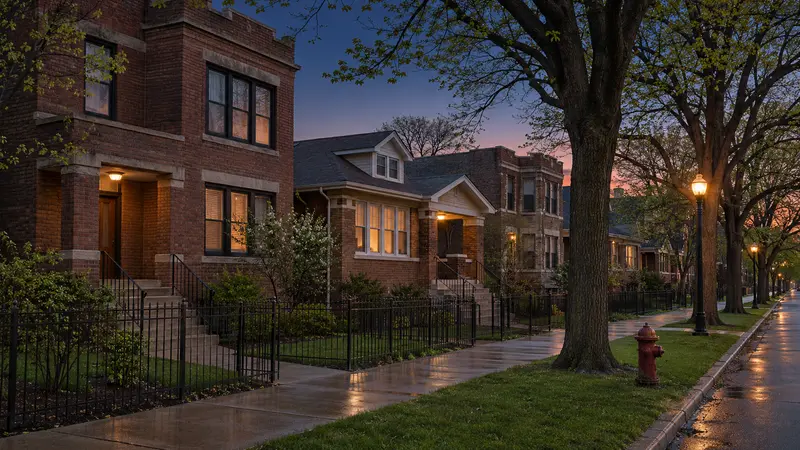
The rules on these twelve pages come from four places: City of Chicago ordinances, Cook County tax practice, Illinois statutes and federal lead paint regulations. A lender wrote them, and they are general education, not legal advice. Each page cites the ordinance, statute or agency it relies on, dates it, and says what to confirm with an Illinois attorney, an architect or a CPA. They are grouped below by the part of a deal each rule moves.
Rules that change what you should pay
Four pages belong in your reading before an offer goes firm, because what they turn up comes off the price.
- Start with violation records and court cases. Open Department of Buildings violations stay with the building, so the buyer inherits the repair duty and any case attached to it.
- The landmark page covers two separate checks: landmark status, and the survey rating that can put a demolition permit on hold for Up to 90 days.
- The zoning page reduces added units, dormers and basement apartments to four numbers set by the district, and explains why the Certificate of Zoning Compliance states the legal unit count.
- The ADU page says where a coach house or conversion unit is allowed and what conditions come attached.
The site's records to pull before offering turn these four pages into a list of lookups by office.
Rules that set the crew and the calendar
Two pages decide who may do the work and how. On a pre-1978 building, the lead paint page explains why the firm must be certified and what the job site and the paperwork have to look like. The masonry and porch page sorts porch, parapet, lintel and tuckpointing work by permit type and license.
Two more decide when it can happen. The permit page is the one most flippers need first: it sorts a scope into the right Buildings review path and shows how long each path has taken in City records. The winter page covers frost depth, the Heat Ordinance and keeping a vacant building from freezing. To turn either delay into dollars, price a schedule slip with your own loan balance.
Rules that send a bill
Three pages cover charges with a public schedule. Transfer tax is owed at both closings of a flip. Vacant building registration starts a clock at closing: a buyer must file within 30 days after vacancy or 30 days after taking ownership, whichever is later, and the fee when filed on time is $30 per six-month period. Reassessment explains how permitted work reaches the Cook County Assessor and changes the bill your buyer inherits. Two calculators go with them: stamp math for both closings and a way to estimate the buyer's tax bill.
Rules that apply once someone lives there
One page covers the Residential Landlord and Tenant Ordinance. Read it before closing on any occupied building and before deciding to keep a finished flip as a rental, because the duties begin the day you take title.
Where these pages stop
This section explains each rule and its cost. It does not walk through a closing: the City certificates at closing are covered with the process pages. Monthly dollar figures are in the holding cost tables. Four area pages print local counts beside these rules: Englewood's vacancy complaints beside registration, South Shore's violation record beside open cases, and South Lawndale's skipped-permit cases and West Englewood's unpermitted-work citations beside the permit paths. Short answers to single questions about any of them are grouped with the permit and rule questions. Outside the city limits a different set applies, starting with the what follows into suburban Cook.
The twelve rule pages
- DOB permit paths and timelinesSorts a flip scope into the right Department of Buildings review path, shows real issuance times for each from city permit records, and prices the wait.
- Open building violationsExplains where Chicago violation records live, how hearing-room and courtroom cases differ, what a buyer inherits, and how to budget the cure against per-day fines.
- Zoning for added units and dormersWalks a Chicago flipper through the four zoning tests for added units and added space, with a district table, a lot-area calculation and the loan effect of a third unit.
- ADU ordinance for investorsCovers where an investor can add a coach house or conversion unit in Chicago, the caps and conditions attached, the approval sequence, and the break-even value of a basement unit.
- Landmark districts and demolition delayShows a flipper how to check landmark and survey status before offering, what the Commission reviews at permit, and what a 90-day demolition hold costs in carry.
- Lead paint and the RRP ruleExplains who must be RRP certified on a pre-1978 Chicago flip, what the job site has to look like, which papers to keep, and what you owe the buyer at resale.
- Masonry, porches and parapetsSorts porch, parapet, lintel, chimney and tuckpointing work on Chicago brick buildings by permit type and license, then budgets it as a block and measures it against the rehab holdback.
- Winter work on a Chicago rehabPlans a Chicago rehab around the cold months: what the code and Heat Ordinance require, how to keep a vacant building from freezing, and what a six-week exterior pause costs.
- Vacant building registrationWalks a flipper through Chicago's vacant building chapter: the registration clock after closing, the 2026 fee, insurance, securing rules and the fine exposure for skipping it.
- Transfer taxes on both closingsLays out city, county and state transfer taxes on each side of a Chicago flip, which deeds are exempt for investors, and the two-closing total as line items.
- Reassessment after rehabTraces how permitted rehab value reaches the Cook County Assessor, converts it into a tax bill with current factors, and shows what the jump means for resale and proration.
- RLTO if you hold or inherit tenantsCovers the landlord duties a flipper inherits with an occupied Chicago building: deposits, notice periods by tenure, foreclosure relocation money and the carry cost of waiting.
Local rates and rules cited on this page
| Item | Figure | Primary source | Effective |
|---|---|---|---|
| Demolition-Delay hold | Up to 90 days | Demolition Delay (City of Chicago Department of Planning and Development) | 2003 |
| When a buyer's vacant building registration duty starts | 30 days after vacancy or 30 days after taking ownership, whichever is later | Municipal Code of Chicago 14X-12-1204.2 Time for compliance (City of Chicago (American Legal Publishing)) | 2024-06-12 |
| Vacant building registration or renewal fee, filed on time | $30 per six-month period | Municipal Code of Chicago 14X-12-1204.4 Fees (City of Chicago (American Legal Publishing)) | 2026-01-01 |
Rates as of November 25, 2026. Confirm with the agency before relying on any figure.