Carry on a Chicago flip is loan interest plus property tax, insurance, utilities, upkeep and vacant building registration. On the example deal it totals $18,569 at four months, $28,777 at six, $44,120 at nine and $59,432 at twelve. Every month after the work is finished adds $5,104. JFG's rate is 8.99%-13.5%, interest-only.
- Interest
- 8.99%-13.5%, interest-only
- First tax installment
- 55% of the prior year's total tax
- Late tax interest
- 0.75% per month (9% per year)
- Vacant registration
- $30 to $100 at initial registration; renewal $30 per renewal
- Water
- $4.98 per 1,000 gallons, sewer billed at 100% of the water charge
- Unoccupied building, insurer may cancel
- after 60 consecutive unoccupied days, on 10 days' notice
- Example cost of one late month
- $5,104
Program terms as of November 26, 2026. Rates as of November 25, 2026.
On this page
- What makes up monthly carry?
- Is interest charged on the full loan or only what you have drawn?
- How do Cook County tax bills land during a hold?
- What insurance does a vacant rehab need?
- What do utilities cost in an empty building?
- When does vacant building registration start to cost you?
- Who handles the lawn and the sidewalk?
- One deal at 4, 6, 9 and 12 months
- Which months cost the most?
- How do you keep the hold short?
A flip budget usually shows carry as one line for one hold length. The building does not know your schedule. Permits run long, a buyer's financing falls through, a January listing sits, and each delay is paid for in the same six bills.
So price carry as a curve. This page totals one deal at four hold lengths. Jaken Finance Group, a lender, publishes the site; interest uses its published range.
What makes up monthly carry?
Six items, and they do not scale the same way.
| Item | How it grows | Chicago detail |
|---|---|---|
| Loan interest | With time and with each draw | 8.99%-13.5%, interest-only |
| Property tax | Accrues daily; billed twice a year, a year behind | First bill is 55% of the prior year's total tax |
| Insurance | Annual premium, often paid up front | Vacant liability minimum $300,000 per occurrence |
| Utilities | Monthly; heat is seasonal | Water at $4.98 per 1,000 gallons plus equal sewer |
| Lawn and snow | Seasonal | Snow cleared by 10 p.m. for snow that falls 7 a.m. to 7 p.m.; by 10 a.m. for overnight snow |
| Vacant registration | Steps up every renewal | $30 to $100 at initial registration, then $30 per renewal |
Where carry sits among the other four cost groups is shown in the full Chicago cost stack.
Is interest charged on the full loan or only what you have drawn?
It depends on the loan documents. On a drawn-balance basis you pay interest on the purchase advance from day one and on each piece of the rehab holdback only after it is released. On a full-commitment basis you pay on the whole loan from closing.
In the example the gap over a four-month rehab is $1,948. After the last draw the two methods cost the same every month. JFG's draw process guide explains how draws are requested; one-time fees are priced under loan closing costs in dollars.
How do Cook County tax bills land during a hold?
Tax accrues every day you own the building, but the bills follow their own calendar. The Treasurer's primer explains that the first installment is 55% of the prior year's total tax. The Treasurer's due date page shows how much the second installment moves: Monday, December 15, 2025 for tax year 2024, Thursday, October 1, 2026 for tax year 2025.
Budget the accrual: last year's bill divided by twelve. For cash, check whether an installment falls inside your hold. JFG's Cook County property tax guide covers the assessment side.
What insurance does a vacant rehab need?
A policy written for a vacant building under renovation, not a homeowner's or landlord policy carried over. Under Illinois Insurance Code section 143.20a, a property insurer may cancel after 60 consecutive unoccupied days, on 10 days' notice. The statute excepts buildings under construction or repair that are properly secured, which is the footing a builder's risk or vacant-dwelling policy is written on.
The City adds its own floor: a registered vacant residential building must carry liability coverage of at least $300,000 per occurrence. Get the quote before you close; a long hold may run past the policy term.
What do utilities cost in an empty building?
Less than in an occupied one, never zero. Heat stays on through winter or the plumbing is winterized; see Chicago winter rehab rules. Water is billed by the City at $4.98 per 1,000 gallons on metered accounts under the published rate table, and the sewer charge is 100% of the water charge, so the effective rate is double. Shut the water at the meter between plumbing phases.
When does vacant building registration start to cost you?
Almost at once. The Department of Buildings' owner requirements sheet sets one deadline, Within 30 days, for a vacant building to be secured, insured, registered, posted and maintained. Registration costs $30 to $100 at initial registration and lasts 6 months; each renewal is $30 per renewal. The duties behind the fee are the real carry: site visits, lighting, and replacing plywood with secure doors and windows after six months. Details are under vacant property upkeep rules.
Who handles the lawn and the sidewalk?
You do, from the day you take title. The same City sheet requires the owner of a vacant building to cut the grass and shovel the walk. The Department of Transportation's snow removal rules set a path at least five feet wide, seven days a week, cleared by 10 p.m. for snow that falls 7 a.m. to 7 p.m.; by 10 a.m. for overnight snow, with fines of $50 to $500 per citation. Hire a service for the listing period, when no crew is on site.
One deal at 4, 6, 9 and 12 months
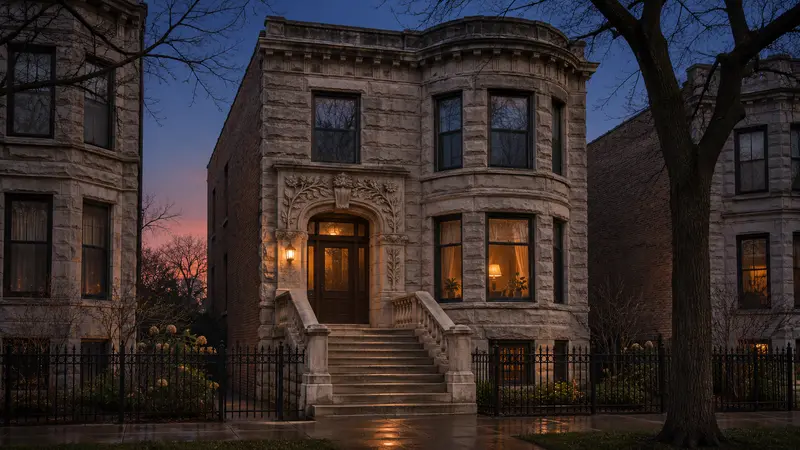
One greystone two-flat, four hold lengths
Purchase $360,000, approved rehab $85,000, ARV $600,000, rehab drawn evenly over 4 months. Interest is shown on the drawn balance; the full-commitment figure is beside it. Inputs are illustrative.
4 months: sold as the last draw is paid
| Line | Amount | How it is figured |
|---|---|---|
| Interest on drawn balance | $13,049 | starts at $2,970.00 a month on $324,000, rises with each draw |
| Property tax accrual | $2,440 | $610 a month |
| Insurance | $1,140 | $285 a month |
| Utilities | $1,360 | $340 a month |
| Lawn and snow | $480 | $120 a month |
| Vacant building registration | $100 | initial fee |
| Interest if charged on the full commitment | $14,997 | |
| Carry, 4 months | $18,569 |
Line items sum to the stated result. Checked in code at build.
6 months: two months on the market
| Line | Amount | How it is figured |
|---|---|---|
| Interest on drawn balance | $20,547 | $3,749.17 a month once fully drawn |
| Property tax accrual | $3,660 | |
| Insurance | $1,710 | |
| Utilities | $2,040 | |
| Lawn and snow | $720 | |
| Vacant building registration | $100 | |
| Carry, 6 months | $28,777 |
Line items sum to the stated result. Checked in code at build.
9 months: a permit delay or a failed contract
| Line | Amount | How it is figured |
|---|---|---|
| Interest on drawn balance | $31,795 | |
| Property tax accrual | $5,490 | |
| Insurance | $2,565 | |
| Utilities | $3,060 | |
| Lawn and snow | $1,080 | |
| Vacant building registration | $130 | initial fee plus one renewal |
| Carry, 9 months | $44,120 |
Line items sum to the stated result. Checked in code at build.
12 months: a full year
| Line | Amount | How it is figured |
|---|---|---|
| Interest on drawn balance | $43,042 | |
| Property tax accrual | $7,320 | |
| Insurance | $3,420 | |
| Utilities | $4,080 | |
| Lawn and snow | $1,440 | |
| Vacant building registration | $130 | |
| Carry, 12 months | $59,432 |
Line items sum to the stated result. Checked in code at build.
Tripling the hold from 4 to 12 months multiplies carry by 3.2, not 3, because the later months carry the full balance.
Assumptions
- The 11% rate is inside the published 8.99%-13.5% and is not an offer. Whether interest accrues on the drawn balance or the full commitment is a term sheet item.
- Loan of $409,000 sized at up to 90% of purchase price plus 100% of approved rehab, capped at 75% of supported ARV. Extension fees are excluded because extension terms are underwritten file by file, ask your loan officer.
| Hold | Interest | Everything else | Total carry | Average per month |
|---|---|---|---|---|
| 4 months | $13,049 | $5,520 | $18,569 | $4,642 |
| 6 months | $20,547 | $8,230 | $28,777 | $4,796 |
| 9 months | $31,795 | $12,325 | $44,120 | $4,902 |
| 12 months | $43,042 | $16,390 | $59,432 | $4,953 |
The average rises with the hold because the cheap months come first.
Which months cost the most?
The ones after construction ends. Once the last draw is paid you are at the full balance, $5,104 a month in the example or about $168 a day, and no value is being added.
The front end has a quieter cost. In the City's permit data, renovation permits that went through standard plan review took a median of 94 days from application to issuance over the past 24 months; self-certified ones took 27.
Source: City of Chicago, Department of Buildings, Building Permits (dataset ydr8-5enu), 2024-11-01 to 2026-10-31; retrieved 2026-11-26.
On this deal the difference between those two medians is worth $9,527 of carry before any work starts. See permit path eligibility and timing for which projects qualify. If the hold threatens to run past maturity, extension terms are underwritten file by file, ask your loan officer; see what to do near maturity.
When a long hold eats the deal
Carry cannot be financed away. If the nine-month column erases most of your projected profit, the plan depends on everything going right. The better routes are a scope the permit process handles quickly, a price that leaves room for three extra months, or an exit that does not depend on a spring buyer. A finished building that will not sell can sometimes be rented and refinanced; see the sale versus refinance exit page.
How do you keep the hold short?
- Start drawings and the permit application during attorney review, not after closing.
- Order long-lead items such as windows and cabinets the week you close.
- Schedule trades back to back on the phase-by-phase timeline template and request draws as each phase finishes.
- Order the water certificate, zoning certificate and survey before listing.
- Price each slipped week in the delay cost calculator.
To have a specific deal priced at more than one hold length, send JFG a deal scenario. The rest of the deal math is in the numbers section. Tax and insurance rules change; confirm specifics with your attorney and insurance agent.
Questions: Carry cost by hold length
Do I pay interest every month or all at payoff?
JFG's flip loans are interest-only, so interest is the only scheduled charge and principal is repaid at sale or refinance. Whether you pay it monthly from your own account or from an interest reserve set up at closing depends on the loan documents. Ask which applies before you build a cash plan: monthly interest in the example starts at $2,970.00 and reaches $3,749.17.
Can I shut off the utilities in a vacant flip to save money?
Winterizing is allowed; abandoning the systems is not. The City's vacant building standards require owners to maintain or winterize plumbing and heating. Separately, the Illinois Insurance Code lists disconnected utilities among the grounds for cancelling a property policy: after 30 consecutive days without heat, water or sewer service connected, on 10 days' notice. If you winterize, tell your insurance agent and plan the restart before finish work begins.
Will the rehab raise my property taxes while I still own the building?
It can raise the assessment, though usually not the bills you pay during a short hold. The Assessor can revalue a property in any year when permits are filed, and Chicago's next scheduled reassessment is for tax year 2027. Because Cook County bills a year behind, a higher value mostly reaches your buyer. The page on Cook County reassessment timing shows the estimate.
What happens if a tax installment comes due during my hold?
You pay it, using the credit the seller gave you at purchase. Unpaid Cook County taxes accrue interest at 0.75% per month (9% per year), and a title company will not close your resale with a delinquent installment open. The tax year 2025 bills were due Wednesday, April 1, 2026 and Thursday, October 1, 2026. Paying a bill reduces the credit you owe your own buyer, so over the hold it nets out to the monthly accrual.
How many months of carry should a first budget assume?
More than the construction schedule. Add the permit wait in front and the weeks to list, go under contract and close behind it. The stage-by-stage flip timeline lays out each stage. Then price one bad outcome: in the example, moving from six months to nine adds $15,343. If the deal cannot absorb that, the margin is too thin for the scope.
Local rates and rules cited on this page
| Item | Figure | Primary source | Effective |
|---|---|---|---|
| First installment amount | 55% of the prior year's total tax | How the Illinois Property Tax System Works (October 2025 update) (Cook County Treasurer's Office) | 2025-10 |
| Vacant building liability insurance, residential | $300,000 per occurrence | Requirements for Vacant Building Owners (Revised 1/2026) (City of Chicago Department of Buildings) | 2026-01 |
| Chicago metered water rate | $4.98 per 1,000 gallons | Water and Sewer Rates (City of Chicago Department of Finance) | 2026-06-01 |
| Chicago sidewalk snow clearing deadline | by 10 p.m. for snow that falls 7 a.m. to 7 p.m.; by 10 a.m. for overnight snow | Sidewalk Snow Removal (City of Chicago Department of Transportation) | 2026 |
| Vacant building registration fee | $30 to $100 at initial registration | Requirements for Vacant Building Owners (Revised 1/2026) (City of Chicago Department of Buildings) | 2026-01 |
| Vacant building renewal fee | $30 per renewal | Requirements for Vacant Building Owners (Revised 1/2026) (City of Chicago Department of Buildings) | 2026-01 |
| Tax year 2024 second installment due date | Monday, December 15, 2025 | Due Dates (Cook County Treasurer's Office) | 2025-12-15 |
| Tax year 2025 second installment due date | Thursday, October 1, 2026 | Due Dates (Cook County Treasurer's Office) | 2026-10-01 |
| Insurer's right to cancel on an unoccupied building | after 60 consecutive unoccupied days, on 10 days' notice | 215 ILCS 5/143.20a, Cancellation of Fire and Marine Policies (Illinois General Assembly) | 2023-08-04 |
| Chicago sewer charge | 100% of the water charge | Water and Sewer Rates (City of Chicago Department of Finance) | 2015-01-01 |
| Vacant building registration deadline | Within 30 days | Requirements for Vacant Building Owners (Revised 1/2026) (City of Chicago Department of Buildings) | 2026-01 |
| Vacant building registration term | 6 months | Requirements for Vacant Building Owners (Revised 1/2026) (City of Chicago Department of Buildings) | 2026-01 |
| Fine for an uncleared sidewalk | $50 to $500 per citation | Sidewalk Snow Removal (City of Chicago Department of Transportation) | 2026 |
| Interest on late Cook County property taxes | 0.75% per month (9% per year) | Free Payment Plan Calculator now live online (press release) (Cook County Treasurer's Office) | 2026-09-30 |
| Insurer's right to cancel when utilities are disconnected | after 30 consecutive days without heat, water or sewer service connected, on 10 days' notice | 215 ILCS 5/143.20a, Cancellation of Fire and Marine Policies (Illinois General Assembly) | 2023-08-04 |
| Tax year 2025 first installment due date | Wednesday, April 1, 2026 | Due Dates (Cook County Treasurer's Office) | 2026-04-01 |
Rates as of November 25, 2026. Confirm with the agency before relying on any figure.
Sources
- Property Tax Due Dates, Cook County Treasurer, 2026.
- Understanding Your Property Tax Bill (primer), Cook County Treasurer, 2025-10.
- 215 ILCS 5/143.20a, Cancellation of Fire and Marine Policies, Illinois General Assembly, 2023-08-04.
- Requirements for Vacant Building Owners, City of Chicago Department of Buildings, 2026-01.
- Water and Sewer Rates, City of Chicago Department of Finance, 2026-06-01.
- Sidewalk Snow Removal, City of Chicago Department of Transportation, 2026.
- Building Permits dataset, City of Chicago Department of Buildings, 2026-11-25.
- Assessment Calendar and Deadlines, Cook County Assessor's Office, 2026.