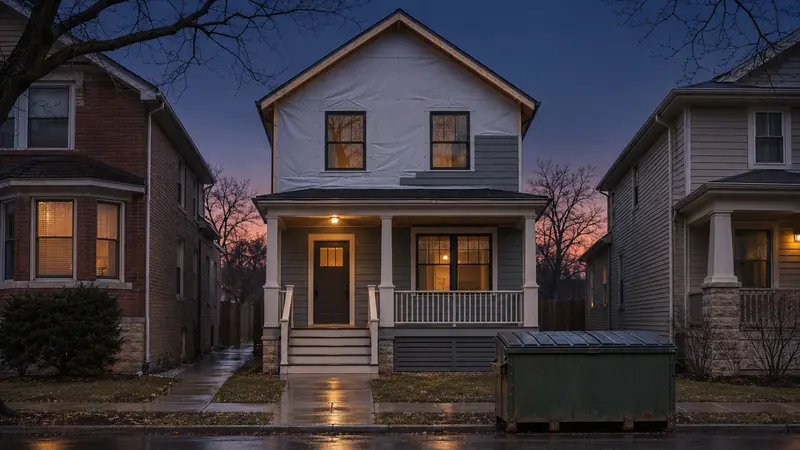
DuPage County is a single-family market taxed under different rules than Cook: nine township assessors, a one-third assessment level and bills due June 1 and September 1. The Census median owner-occupied value is $391,400, against $324,500 in Cook, and 58.4% of units are detached houses.
- Median owner-occupied value
- $391,400 (ACS 2020-2024)
- Median year built
- 1978
- Assessment level
- 33 1/3% of fair cash value
- Who sets the first value
- 9 township assessors
- 2026 tax due dates
- June 1 and September 1, 2026
- County transfer stamp
- $0.25 per $500 of value
- Naperville stamp
- $1.50 per $500 of price (buyer pays)
Program terms as of November 26, 2026. Rates as of November 25, 2026.
On this page
- How does DuPage housing compare with Cook County's?
- Who values the property, and at what level?
- When are DuPage tax bills due?
- What does the tax line do to your carry and to your buyer?
- Which DuPage municipalities sell transfer stamps?
- Where do you pull a permit in DuPage?
- How much new construction competes with a DuPage flip?
- What is the first call to make on a DuPage deal?
A Chicago flipper who crosses into DuPage County keeps the same loan and the same state law, and trades in almost everything local. The assessor is elected by township. The tax bill arrives once, with two coupons. The transfer stamp depends on which of 13 municipalities the lot sits in.
DuPage is also a different product. The two-flats and greystones that fill Chicago comp sets barely exist here, so the numbers below start with what the housing stock is.
How does DuPage housing compare with Cook County's?
DuPage is newer, more owner-occupied and far more detached. The Census Bureau's 2020-2024 estimates show it side by side with Cook County and the City of Chicago.
| Measure | DuPage County | Cook County | City of Chicago |
|---|---|---|---|
| Housing units | 367,152 | 2,276,493 | 1,277,054 |
| Owner-occupied share | 73.1% | 57.7% | 46% |
| Median owner-occupied value | $391,400 | $324,500 | $334,100 |
| Median gross rent | $1,688 | $1,435 | $1,440 |
| Median year built | 1978 | 1961 | 1953 |
| Built before 1940 | 5.3% | 27.8% | 38.8% |
| Detached single-family share | 58.4% | 39.6% | 25.6% |
| Two-to-four-unit share | 4.7% | 19.4% | 27.4% |
Source: U.S. Census Bureau, American Community Survey 2020-2024 5-Year Estimates, Detailed Tables (table-based summary file) (dataset ACSDT5Y2024), 2020-01-01 to 2024-12-31; retrieved 2026-11-26.
The DuPage median hides a wide range. The same Census tables put the median owner-occupied value at $1,053,700 in Hinsdale, $540,200 in Naperville, $341,300 in Addison and $261,700 in Glendale Heights. Elmhurst is the old-house exception, with a median year built of 1966 and 14.7% of units from before 1940. Jaken Finance Group has its own pages on DuPage County lending and Naperville deals.
Who values the property, and at what level?
A township assessor does, at one third of market value. The DuPage County Supervisor of Assessments says the county's 9 township assessors make the initial valuation of its 336,277 parcels, while the Supervisor equalizes and clerks the Board of Review. The nine are Addison, Bloomingdale, Downers Grove, Lisle, Milton, Naperville, Wayne, Winfield and York.
The assessment level comes from state law: 35 ILCS 200/9-145 sets it at 33 1/3% of fair cash value. The general reassessment cycle is Every 4 years (1995 and every fourth year after), and the Illinois Department of Revenue's property tax guide notes that assessors may revalue a property between general assessments. That guide gives DuPage township assessors until November 15 to finish each year's work. A renovated house in Milton or York Township can be picked up in the next annual pass.
When are DuPage tax bills due?
Twice a year, on one DuPage bill. The DuPage County Treasurer mailed 2025 bills on April 29, 2026, with coupons due June 1 and September 1, 2026. Late payments carry interest of 1.5% per month per installment.
Those are taxes for the year before, so a seller in DuPage credits the buyer at closing for tax accrued but not yet billed. That tax proration shows up on both of your DuPage settlement statements. A hold that crosses June 1 or September 1 also means writing the check yourself, a carry cost covered in the hold-length carry tables.
What does the tax line do to your carry and to your buyer?
In DuPage it costs you a few hundred dollars a month and can cost your buyer thousands per year. The example applies the statutory one-third level to the purchase price and to the resale price, using a tax rate you supply and a county equalizer of 1.
A $240,000 Naperville purchase resold at the DuPage median of $391,400
The resale price is set equal to the county's Census median owner-occupied value. The tax rate is a user-supplied input, not a published DuPage rate.
The annual tax bill your resale buyer inherits
| Line | Amount | How it is figured |
|---|---|---|
| Bill on the as-bought value | $5,999 | $240,000 x 33.33% = $79,992 assessed, x 7.5% |
| Added when the township assessor picks up the new value | $3,785 | assessed value rises to $130,454 |
| Bill on the resale value | $9,784 |
Line items sum to the stated result. Checked in code at build.
The flip with that tax line in the carry
| Line | Amount | How it is figured |
|---|---|---|
| Resale price | $391,400 | DuPage County median owner-occupied value, ACS 2020-2024 |
| Purchase and buy-side closing | -$242,900 | no county or state stamp on the buyer |
| Naperville stamp, buyer | -$720 | 480 units of $500 at $1.50 per $500 of price (buyer pays) |
| Points, lender fees and interest | -$21,850 | $278,000 loan at 10.5%, 2 points, 6 months |
| Rehab and 10% contingency | -$68,200 | $62,000 plus $6,200 |
| Taxes, insurance, utilities | -$5,280 | tax line is $3,000 of this |
| Commission, stamps and sell-side closing | -$22,557 | state and DuPage stamps are $587 |
| Projected profit before income tax | $29,893 |
Line items sum to the stated result. Checked in code at build.
On these inputs the buyer's annual bill is $3,785 higher than the bill you carried, and six months of tax carry costs you $3,000.
Assumptions
- The 7.5% tax rate and the multiplier of 1 are illustrative inputs. Read the real rate for the tax code off the DuPage bill.
- The 10.5% interest rate sits inside the published range of 8.99%-13.5% and is not an offer. Costs and fees are illustrative.
- Assessed value is modeled at the statutory level; a township assessor's actual value can differ.
The post-rehab tax estimator is built for Cook County's method, but the logic carries: the buyer's lender qualifies them on the expected bill, not on yours. In DuPage, ask the township assessor how a permit is picked up.
Which DuPage municipalities sell transfer stamps?
Thirteen sell their own transfer stamps, according to the DuPage County Recorder's stamp table. The rates below are the Recorder's figures, and the Recorder warns that municipal fees can change without notice to its office.
| Item | Figure | Source | Effective |
|---|---|---|---|
| Bolingbrook real estate transfer stamp | $7.50 per $1,000 | DuPage County Recorder | 2026 |
| Carol Stream real estate transfer stamp | $3.00 per $1,000 | DuPage County Recorder | 2026 |
| Glen Ellyn real estate transfer stamp | $3.00 per $1,000 | DuPage County Recorder | 2026 |
| Addison real estate transfer stamp | $2.50 per $1,000 | DuPage County Recorder | 2026 |
| Wheaton real estate transfer stamp | $2.50 per $1,000 | DuPage County Recorder | 2026 |
| Woodridge real estate transfer stamp | $2.50 per $1,000 | DuPage County Recorder | 2026 |
| Elmhurst real estate transfer stamp | $1.50 per $1,000 | DuPage County Recorder | 2026 |
Selected municipal stamps on the DuPage County Recorder's table
Naperville's own stamp page puts its stamp on the buyer, which is unusual and lands on a flipper at purchase. On top of any municipal stamp, the DuPage County Code imposes $0.25 per $500 of value and the state adds $0.50 per $500 of value. Downers Grove, Lombard and other towns absent from the Recorder's table still need a call to the village hall before closing.
Where do you pull a permit in DuPage?
At the municipality, unless the lot is unincorporated. DuPage County's Building and Zoning Department describes its building permitting as covering unincorporated areas. Inside Wheaton, Elmhurst, Naperville or any other city or village, the municipal building department sets the submittal list, review time and contractor registration rules.
No single DuPage timeline exists, so none is quoted here. Chicago's process, for contrast, is laid out under DOB permit paths.
How much new construction competes with a DuPage flip?
Not much, by the standards of Will or Kane County. The Census Building Permits Survey counted 844 single-family units authorized in DuPage County in 2025 and 1,265 units of all types, in a county of 367,152 housing units. Will County's permit volume for single-family houses is more than twice that, and the Kane and McHenry figures sit between. North of Cook, Lake County's municipal sale rules add a pre-sale certificate in Waukegan and a buyer-paid stamp in Lake Forest to the comparison.
When a DuPage flip does not pencil
The weak case is a high-priced DuPage teardown-grade house bought at a price where the loan hits the ARV cap. The program lends up to 90% of purchase price plus 100% of approved rehab, capped at 75% of supported ARV, so in Hinsdale or Naperville the 75% cap, or the $10M maximum, can bind before the cost limit does. The page on which loan limit binds works the test you would run on a DuPage price.
The other weak case is a Chicago-style two-flat plan. With 4.7% of DuPage units in two-to-four-unit buildings, the comparable sales are not there. A detached house in Addison, Lombard or Glendale Heights is the product the data supports.
What is the first call to make on a DuPage deal?
- Identify the municipality and township from the PIN; the Recorder's page maps each city and village to its townships.
- Call the municipal finance office for the stamp rate, who pays it and any water or inspection sign-off.
- Pull the current DuPage tax bill and note the tax code rate for the address.
- Ask the township assessor when permit work is picked up.
- Enter the municipal stamp, both DuPage tax installments and the prorations in the buyer's closing cash sheet.
The city against collar counties comparison puts DuPage next to its neighbors, and the suburban and collar hub lists every county page. JFG's Illinois fix and flip page has the statewide program. Nothing here is legal or tax advice: a DuPage township assessor, the Treasurer or a CPA should confirm any figure you plan around, since these were read in November 2026.
Questions: DuPage County flips
Why do DuPage assessed values look three times higher than Cook's?
Because the assessment level is different, not the tax. Outside Cook the statute sets assessed value at 33 1/3% of fair cash value, while Cook assesses residential property at 10% of market value and then applies a large equalizer. A DuPage house and a Chicago house with the same market value will show very different assessed values on paper. Compare the dollar bills and the effective rate on market value, never the assessed values themselves.
Does a Naperville address in Will County still need the Naperville stamp?
Yes. Naperville spans both counties, and the city appears on the DuPage County Recorder's municipal stamp table and on the Will County Recorder's list of 9 municipalities whose stamps must be bought before recording. The city's rate is $1.50 per $500 of price (buyer pays) either way. What changes with the county is where the deed records, which treasurer bills the taxes and which township assessor values the house.
Can my resale buyer use the DuPage home improvement exemption for work I did?
Do not market it. The DuPage Treasurer describes a homestead improvement exemption of Up to $25,000 of assessed value for 4 years, administered by the township assessor. It is a homestead exemption, and a flip is non-owner-occupied while you hold it. Whether any of it reaches a later owner-occupant is the township assessor's call, so the buyer should ask that office directly and their lender should underwrite the full post-rehab bill.
Are two-flats a realistic flip product in DuPage County?
Rarely. Census estimates put two-unit buildings at 0.7% of DuPage housing units and three-or-four-unit buildings at 4%, against 8.9% and 10.4% in Cook County. With so few buildings, comparable sales are thin and value support gets harder. Detached houses and townhomes, which together make up about seven in ten DuPage units, are where the comps are.
What does it cost to record the deed in DuPage County?
The DuPage County Recorder's schedule lists a deed at $86 per deed, which already includes the document storage, GIS and Rental Housing Support Program charges. Cook County's flat deed fee is $107 per deed. The Recorder's page also says fees can change without notice, and municipal stamps, where a city or village sells them, must be on the deed before it records. Your title company collects both at closing.
Local rates and rules cited on this page
| Item | Figure | Primary source | Effective |
|---|---|---|---|
| Hinsdale median value, owner-occupied homes | $1,053,700 | American Community Survey 2020-2024 5-Year Estimates, table B25077 (U.S. Census Bureau) | 2020-2024 |
| Naperville median value, owner-occupied homes | $540,200 | American Community Survey 2020-2024 5-Year Estimates, table B25077 (U.S. Census Bureau) | 2020-2024 |
| Addison median value, owner-occupied homes | $341,300 | American Community Survey 2020-2024 5-Year Estimates, table B25077 (U.S. Census Bureau) | 2020-2024 |
| Glendale Heights median value, owner-occupied homes | $261,700 | American Community Survey 2020-2024 5-Year Estimates, table B25077 (U.S. Census Bureau) | 2020-2024 |
| Elmhurst median year housing built | 1966 | American Community Survey 2020-2024 5-Year Estimates, table B25035 (U.S. Census Bureau) | 2020-2024 |
| Elmhurst housing units built before 1940 | 14.7% | American Community Survey 2020-2024 5-Year Estimates, table B25034 (U.S. Census Bureau) | 2020-2024 |
| DuPage County township assessors | 9 township assessors | Supervisor of Assessments (DuPage County Supervisor of Assessments) | 2026 |
| DuPage County parcels, 2025 assessment year | 336,277 parcels | Supervisor of Assessments (DuPage County Supervisor of Assessments) | 2025 |
| Statutory assessment level outside Cook County | 33 1/3% of fair cash value | 35 ILCS 200/9-145, Statutory level of assessment (Illinois General Assembly) | 2000-01-01 |
| General reassessment cycle in counties under 3,000,000 | Every 4 years (1995 and every fourth year after) | 35 ILCS 200/9-215, General assessment years; counties of less than 3,000,000 (Illinois General Assembly) | 1995 |
| DuPage township assessors return assessment books | November 15 | The Illinois Property Tax System (PTAX-1004) (Illinois Department of Revenue) | 2026-01 |
| DuPage County tax installments, 2025 taxes payable 2026 | June 1 and September 1, 2026 | Tax Information (DuPage County Treasurer) | 2026 |
| Interest on late property tax installments outside Cook | 1.5% per month | Tax Information (DuPage County Treasurer) | 2026 |
| DuPage County real estate transfer tax | $0.25 per $500 of value | DuPage County Code, Chapter 33, Article IV, Section 33-30 (DuPage County) | 2026-08-10 |
| Illinois state real estate transfer tax | $0.50 per $500 of value | 35 ILCS 200/31-10, Imposition of tax (Illinois General Assembly) | 2005-06-01 |
| Naperville real estate transfer tax | $1.50 per $500 of price (buyer pays) | Real Estate Transfer Tax Stamps (City of Naperville) | 2026 |
| Cook County Class 2 residential assessment level | 10% of market value | How Residential Properties Are Valued (Cook County Assessor's Office) | 2026 |
| Will County municipalities requiring stamps before recording | 9 municipalities | FAQs (Will County Recorder) | 2026 |
| DuPage home improvement exemption | Up to $25,000 of assessed value for 4 years | Tax Information (DuPage County Treasurer) | 2026 |
| DuPage County deed recording fee | $86 per deed | Forms and Fee Schedules (DuPage County Recorder) | 2026 |
| Cook County deed recording fee | $107 per deed | Recording Fees (Cook County Clerk) | 2024-04-01 |
| Chicago transfer tax, City portion (buyer) | $3.75 per $500 of price | Real Property Transfer Tax (7551) (City of Chicago Department of Finance) | 2008-04-01 |
| Chicago transfer tax, CTA portion (seller) | $1.50 per $500 of price | Real Property Transfer Tax (7551) (City of Chicago Department of Finance) | 2008-04-01 |
| Cook County real estate transfer tax | $0.25 per $500 of value | Transfer Fees (Cook County Clerk) | 1968-01-01 |
Rates as of November 25, 2026. Confirm with the agency before relying on any figure.
Sources
- American Community Survey 2020-2024 5-Year Estimates, U.S. Census Bureau, 2026-01-29.
- DuPage County Townships and Municipal Transfer Stamps, DuPage County Recorder, 2026.
- Supervisor of Assessments, DuPage County, 2026.
- Tax Information, DuPage County Treasurer, 2026.
- DuPage County Code, Chapter 33, Article IV, Section 33-30, DuPage County, 2026-08-10.
- The Illinois Property Tax System (PTAX-1004), Illinois Department of Revenue, 2026-01.
- 35 ILCS 200/9-145, Statutory level of assessment, Illinois General Assembly, 2026.
- Real Estate Transfer Tax Stamps, City of Naperville, 2026.
- Building and Zoning, DuPage County, 2026.