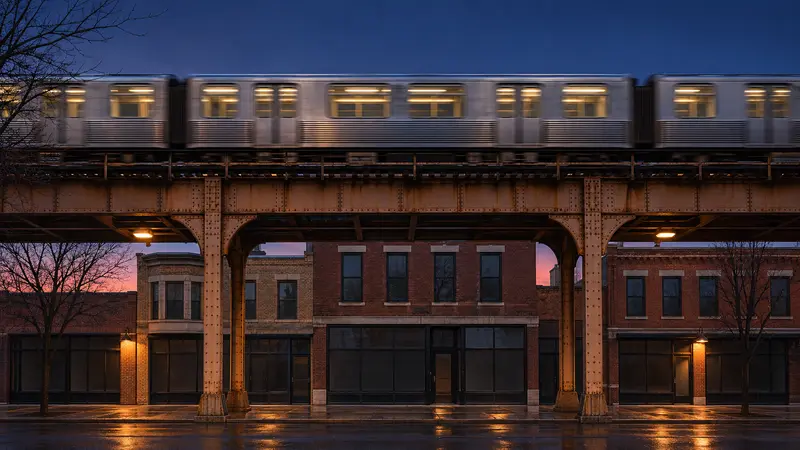
Lincoln Park flips are slow-permit, high-basis deals: renovation permits take a median 62 days, and 105 in Standard Plan Review. Single-family houses sold at a $2,005,850 median on 308 sales and two-to-six unit buildings at $1,453,000, while the City's historic survey rates 1,586 Lincoln Park buildings orange.
- Median permit wait, all paths
- 62 days (city: 56)
- Standard Plan Review median
- 105 days on 176 permits (city: 94)
- Self-Certification median
- 41 days on 199 permits
- Wrecking permits, 24 months
- 84, beside 140 new construction permits
- Single-family sales
- 308 at a $2,005,850 median
- Two-to-six unit sales
- 158 at a $1,453,000 median
- Violations per square mile
- 280 (city: 416)
Program terms as of November 26, 2026. Rates as of November 25, 2026.
On this page
- Why does a Lincoln Park plan review take 105 days at the median?
- How much of Lincoln Park carries a landmark or survey rating?
- What kind of buildings and zoning make up Lincoln Park?
- What do houses, flats and condos sell for in Lincoln Park?
- Does a single-family flip work at Lincoln Park's medians?
- What do the violation records show on Lincoln Park blocks?
- Can you add a unit in Lincoln Park's RT-4 and RM-5 districts?
- What order should a Lincoln Park deal be checked in?
- What should you send to get Lincoln Park terms?
Lincoln Park, community area 7, runs from North Avenue to Diversey Parkway and from the North Branch of the Chicago River to the lake. Two things set it apart among the community areas we track: permit time and the number of buildings the City has flagged as historic.
Sources: City of Chicago Data Portal (Building Permits ydr8-5enu, Building Violations 22u3-xenr, 311 Service Requests v6vf-nfxy), 2024-11-01 to 2026-10-31; Cook County Assessor Parcel Sales (wvhk-k5uv), 2024-05-01 to 2026-04-30.
Why does a Lincoln Park plan review take 105 days at the median?
Lincoln Park's Standard Plan Review permits took a median 105 days from application to issuance, against 94 citywide, and 44.6% of the area's 395 renovation permits went that way. The slower quarter of all Lincoln Park permits took 118 days or more.
| Review path | Permits | Median days | Middle half | Citywide median |
|---|---|---|---|---|
| Self Cert | 199 | 41 | 19 to 68 | 27 |
| Standard Plan Review | 176 | 105 | 54 to 151 | 94 |
| Direct Developer Services | 20 | 137 | 69 to 623 | 87.5 |
| All renovation/alteration permits | 395 | 62 | 33 to 118 | 56 |
Source: City of Chicago, Department of Buildings, Building Permits (dataset ydr8-5enu), 2024-11-01 to 2026-10-31; retrieved 2026-11-26.
Self-Certification is slower here too: 41 days in Lincoln Park against 27 across the city. The City's Building Permits dataset does not record a reason. These counts are the Renovation/Alteration permit type only and leave out Express Permit Program work. Which path a scope qualifies for is covered in our guide to which permit path fits a scope.
How much of Lincoln Park carries a landmark or survey rating?
A large share. The City's Chicago Historic Resources Survey dataset maps 1,586 orange-rated and 4 red-rated buildings inside Lincoln Park, more than twice the count in the Near North Side, and most date from the 1870s through the 1890s. A wrecking permit on an orange or red building triggers the Demolition-Delay Ordinance, a hold of Up to 90 days.
The Commission on Chicago Landmarks lists nine districts in Lincoln Park: Old Town Triangle, Mid-North, McCormick Row House, Arlington and Roslyn Place, Burling Row House, Armitage-Halsted, Fremont Row House, Bissell Street and Arlington-Deming. The Sheffield Historic District is a National Register listing, separate from City designation. Read how landmark and demolition-delay review works before you price a facade.
Demolition still happens: Lincoln Park drew 84 wrecking permits and 140 new construction permits in 24 months.
What kind of buildings and zoning make up Lincoln Park?
Lincoln Park is mostly multi-unit: 10.7% of its 37,490 housing units are single-family detached and 18.6% sit in two-to-four unit buildings.
| Housing stock | Lincoln Park |
|---|---|
| Housing units | 37,490 |
| Single-family detached share | 10.7% |
| Units in 2 to 4 unit buildings | 18.6% |
| Built before 1940 | 34% |
| Owner-occupied share of occupied units | 44.8% |
Source: U.S. Census Bureau, American Community Survey 2020-2024 5-Year Estimates, Detailed Tables (table-based summary file) (dataset ACSDT5Y2024), 2020-01-01 to 2024-12-31; retrieved 2026-11-26. Source: City of Chicago, Boundaries - Census Tracts - 2020 (dataset 7qjk-677h); retrieved 2026-11-26.
The City's zoning district data shows RT-4 as Lincoln Park's most common residential district by land area, followed by RM-5, with RS-3 on a small share of land. About a fifth of the community area is zoned parks and open space, chiefly the lakefront park. RT-4 caps floor area ratio at 1.20, the limit to check before a single-family gut rehab adds square footage.
What do houses, flats and condos sell for in Lincoln Park?
Lincoln Park's 308 single-family sales had a median of $2,005,850, with a quarter of them above $3,000,000.
| Property class | Sales | 25th pct. | Median | 75th pct. | Citywide median |
|---|---|---|---|---|---|
| Single-family (class 2-02 to 2-10, 2-34, 2-78) | 308 | $1,500,000 | $2,005,850 | $3,000,000 | $307,100 |
| Two to six units (class 2-11, 2-12) | 158 | $1,100,000 | $1,453,000 | $1,833,750 | $443,000 |
| Condominium (class 2-99) | 1,721 | $330,000 | $565,000 | $850,000 | $325,000 |
Source: Cook County Assessor's Office, Assessor - Parcel Sales (dataset wvhk-k5uv), 2024-05-01 to 2026-04-30; retrieved 2026-11-26. Source: Cook County Assessor's Office, Assessor - Parcel Universe (Current) (dataset pabr-t5kh); retrieved 2026-11-26.
Two-to-six unit buildings sold at a $1,453,000 median on 158 sales, more than three times the citywide $443,000. Condos are the volume: 1,721 sales at $565,000. Sales are Assessor-recorded transfers from May 2024 through April 2026, filtered to drop non-market deed types.
Does a single-family flip work at Lincoln Park's medians?
Barely, on paper. The example uses the single-family class because it has the deepest non-condo sample in Lincoln Park, 308 sales against 158. Purchase is that class's 25th percentile, a proxy for a discounted buy; resale is its median, standing in for ARV; rehab is the median reported permit cost, which counts permitted work only and understates a real gut.
A Lincoln Park house from the 25th percentile to the median, with the permit clock priced in
Sale prices and the permit wait are Lincoln Park data. Rate, points, fees and monthly carry are illustrative inputs.
Cost stack at the 62-day median wait
| Line | Amount | How it is figured |
|---|---|---|
| Purchase at the single-family 25th percentile | $1,500,000 | 308 sales in the sample |
| Buyer closing and transfer tax | $15,250 | |
| Rehab at the median reported permit cost | $130,000 | |
| Contingency | $13,000 | 10% of rehab |
| Points and lender fees | $24,195 | 1.5 points on $1,480,000 |
| Interest | $94,196 | 9.5% for 8.04 months |
| Taxes, insurance, utilities | $34,570 | |
| Commission, seller transfer tax, closing | $113,820 | |
| Resale at the single-family median | $2,005,850 | |
| Result | $80,820 | 4.03% of resale |
| Total cost | $1,925,030 |
Line items sum to the stated result. Checked in code at build.
The same hold under each review path
| Line | Amount | How it is figured |
|---|---|---|
| Interest and carry if self-certified | $117,701 | 7.35 months at $16,017 a month |
| Added by the Standard Plan Review median | $33,719 | 105 days against 41 |
| Interest and carry under Standard Plan Review | $151,421 | 9.45 months |
Line items sum to the stated result. Checked in code at build.
Assumptions
- Rate of 9.5% sits inside the published 8.99%-13.5% range and 1.5 points inside 1-3 points; neither is a quote.
- Hold is 6 months of construction and marketing plus the permit wait converted at 30.4 days a month.
- Interest is figured on the full commitment; taxes, insurance and utilities are illustrative.
A $505,850 spread between the Lincoln Park quartile and median shrinks to $80,820, or 4.03% of resale, after the rehab and $295,030 of other costs. That is a statement about median-to-median math, not a prediction. The second table shows the permit path alone moving $33,719 of carry cost. Leverage of up to 90% of purchase price plus 100% of approved rehab, capped at 75% of supported ARV still leaves $331,211 of your cash in this deal. Model your dates in the calculator that prices slipped dates and see how hold length changes carry.
What do the violation records show on Lincoln Park blocks?
Lincoln Park is one of the least cited areas on this site: 280 violations per square mile against 416 citywide, spread over 303 addresses.
| Most cited violation (elevator bureau excluded) | Citations, 24 months |
|---|---|
| Arrange Premise Inspection (CN190019) | 73 |
| Repair Exterior Wall (CN061014) | 46 |
| Plans & Permits Req - Contrctr (NC2011) | 32 |
| Open (PL151137) | 25 |
| Arrange For Inspection (RF301041) | 25 |
| All violations, 303 addresses | 886 |
Source: City of Chicago, Department of Buildings, Building Violations (dataset 22u3-xenr), 2024-11-01 to 2026-10-31; retrieved 2026-11-26. Source: City of Chicago, Boundaries - Community Areas (dataset igwz-8jzy); retrieved 2026-11-26.
Only 141 of Lincoln Park's 886 line items came from the elevator bureau, so the table shows what a small-building buyer meets: premise-inspection notices, exterior wall repair and plans-and-permits citations. 649 show as open in the City's Building Violations dataset, which rarely records a closing.
Can you add a unit in Lincoln Park's RT-4 and RM-5 districts?
Yes, in most of it. Chicago allows an ADU by right in multi-unit residential districts, which covers Lincoln Park's RT-4 and RM-5 blocks. The City's pre-approval applications dataset, which begins March 31, 2026, shows 21 applications in Lincoln Park, 14 of them on RT-4 lots. The rules for conversion units and a coach house are in our guide to Chicago's ADU ordinance.
What order should a Lincoln Park deal be checked in?
- Look up the address on the City zoning map for a landmark district or an orange or red rating; that decides whether exterior work and demolition are discretionary.
- Ask the architect which review path the scope takes, then put the Lincoln Park median for that path, 41 or 105 days, into the permit-to-payoff schedule template.
- Pull Department of Buildings records for open cases, especially plans-and-permits citations left by a prior owner.
- Pick comps from the same property class and block; do not mix a $1,453,000 two-flat market with a $2,005,850 house market.
The Lincoln Park deal that fails
Buying an orange-rated frame house in Lincoln Park at land value and planning to wreck it is a new construction project with a possible Up to 90 days hold in front of it, and it does not fit a rehab loan sized on 100% of an approved renovation budget.
Buying at the $1,500,000 quartile and doing only the $130,000 median permit scope also fails if plan review runs to the slow quarter. For shorter permit clocks on similar stock, compare Lake View's permit data or the Near North Side.
What should you send to get Lincoln Park terms?
Send the address, contract, scope, your architect's expected review path and three same-class comps. JFG's Chicago fix and flip loans cover non-owner-occupied property only, credit is reviewed on every file, and first-time flippers should not assume maximum leverage. If the building is a flat you may keep, the firm's two-flat and three-flat guide and its Chicago bridge loan page cover the alternatives. Nothing here is legal advice on a Lincoln Park landmark or zoning question; the City and your attorney have the final word.
Questions: Lincoln Park flip data
Which aldermen's wards split Lincoln Park?
City ward boundary data for the 2023 map puts about two thirds of Lincoln Park's land in the 43rd Ward, including the Fullerton and Armitage stations and the lakefront park. The 32nd and 2nd wards share the rest, with the 2nd taking in Clybourn Avenue and parts of the North Avenue edge. Zoning relief requests start with the ward office that covers the parcel.
Where is the Mid-North District, and does it matter for windows and facades?
The Commission on Chicago Landmarks describes the Mid-North District as bounded by Fullerton, Armitage, Lincoln and Clark, designated in 1977, with brick rowhouses from the last three decades of the 1800s. Inside it, and inside the Old Town Triangle District to the south, every permit application goes to Historic Preservation staff, so exterior changes on a Mid-North rowhouse are reviewed before the permit issues.
How often are Lincoln Park buildings cited for work without permits?
Often enough to rank. The third most cited non-elevator violation in Lincoln Park is the new-construction bureau's plans and permits required item, behind premise-inspection notices and exterior wall repair. A stop work order on unpermitted work carries a penalty of 200% of the regular permit fee, and an open case can hold up a later permit, so check the address before you buy a half-finished Sheffield or Old Town project.
Why did Lincoln Park vacant-building complaints fall?
Lincoln Park logged 91 vacant or abandoned building complaints to 311 across 24 months, but only 19 of them, 20.9%, came in the most recent 12. The data does not say why. A complaint is a call, not a finding, and in an area with 84 wrecking permits it cannot separate a neglected building from one emptied ahead of a teardown.
What tax increment district covers the river edge of Lincoln Park?
City boundary data shows the Cortland and Chicago River TIF along the North Branch at Lincoln Park's southwest corner, with an expiration date of December 31, 2043. It sits inside the North Branch Framework area that the Plan Commission adopted in May 2017. A TIF redirects tax growth to the district fund; it does not change the rate on a rehabbed house on Wayne or Southport.
Local rates and rules cited on this page
| Item | Figure | Primary source | Effective |
|---|---|---|---|
| Demolition-Delay hold | Up to 90 days | Demolition Delay (City of Chicago Department of Planning and Development) | 2003 |
| RT4 maximum floor area ratio | 1.20 | Chicago Zoning Ordinance 17-2-0300 Bulk and density standards (American Legal Publishing (Chicago Zoning Ordinance)) | 2026-09-29 |
| Stop work order penalty for unpermitted work (code) | 200% of the regular permit fee | Municipal Code of Chicago 14A-12-1204.4 Stop work order (American Legal Publishing (Municipal Code of Chicago)) | 2022-12-14 |
| Chicago transfer tax, City portion (buyer) | $3.75 per $500 of price | Real Property Transfer Tax (7551) (City of Chicago Department of Finance) | 2008-04-01 |
| Chicago transfer tax, CTA portion (seller) | $1.50 per $500 of price | Real Property Transfer Tax (7551) (City of Chicago Department of Finance) | 2008-04-01 |
| Cook County real estate transfer tax | $0.25 per $500 of value | Transfer Fees (Cook County Clerk) | 1968-01-01 |
| Illinois state real estate transfer tax | $0.50 per $500 of value | 35 ILCS 200/31-10, Imposition of tax (Illinois General Assembly) | 2005-06-01 |
Rates as of November 25, 2026. Confirm with the agency before relying on any figure.
Sources
- Building Permits (ydr8-5enu), City of Chicago Department of Buildings, 2026-11-25.
- Chicago Historic Resources Survey - Red and Orange Buildings, City of Chicago, 2026-08-21.
- Mid-North District, Commission on Chicago Landmarks, designated 1977.
- Old Town Triangle District, Commission on Chicago Landmarks, designated 1977.
- Demolition-Delay Ordinance, City of Chicago Department of Planning and Development, 2003.
- Boundaries - Zoning Districts (current), City of Chicago, 2026-11-04.
- Additional Dwelling Unit Preapproval Applications, City of Chicago Department of Housing, 2026-11-26.
- Assessor - Parcel Sales (wvhk-k5uv), Cook County Assessor's Office, 2026-11-15.
- Building Violations (22u3-xenr), City of Chicago Department of Buildings, 2026-11-25.