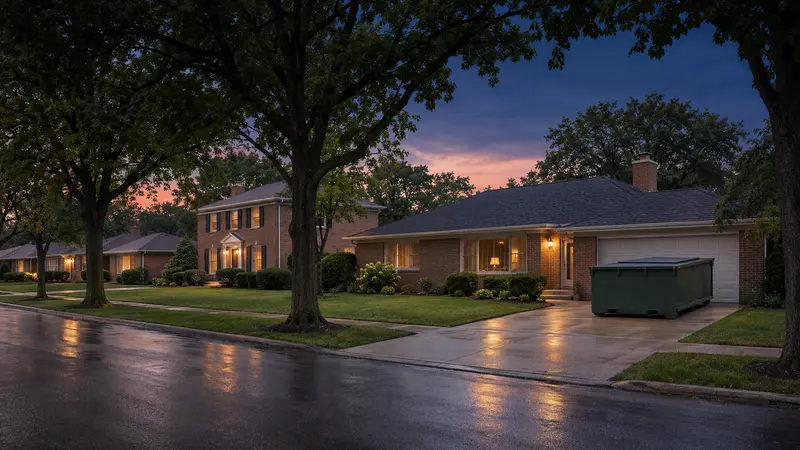
Neither is better across the board: Chicago has the old multi-unit buildings and a city transfer tax, the collar counties have newer detached houses and a different tax system. On a $285,000 purchase resold at $480,000, Chicago's own transfer tax adds $3,578 to the cost stack. Two-to-four-unit buildings are 27.4% of Chicago's housing and 4.7% of Will County's.
- Chicago transfer tax
- $5.25 per $500 of price, city limits only
- State and county stamps
- $0.50 per $500 of value state; $0.25 per $500 of value county
- Assessment level, Cook residential
- 10% of market value
- Assessment level, collar counties
- 33 1/3% of fair cash value
- Reassessment cycle
- Cook every 3 years; collar counties Every 4 years (1995 and every fourth year after)
- Median year built
- Chicago 1953; Will County 1992
- Permit authority
- Chicago Department of Buildings in the city; the municipality elsewhere
Program terms as of November 26, 2026. Rates as of November 25, 2026.
On this page
- How do Chicago, Cook and the five collar counties compare?
- Where does each building type actually exist?
- What transfer taxes stack in the city and outside it?
- How much do transfer taxes alone change the same deal?
- How do the property tax systems differ?
- Who issues the building permit?
- Which side of the line fits which plan?
- What should you do before choosing a side?
The Cook County line changes more than the drive. Cross from Chicago into DuPage or Will and the building stock, the transfer taxes, the assessor, the tax calendar and the permit counter all change at once. The loan does not.
This page lines the seven geographies up on public data, then isolates the one cost that is purely a function of the city limits.
How do Chicago, Cook and the five collar counties compare?
Chicago is the oldest and densest of the seven, and Will County the newest. The Census Bureau's 2020-2024 estimates and its 2025 Building Permits Survey put them side by side.
| Geography | Housing units | Median value | Median year built | Built before 1940 | Detached houses | 2-4 unit buildings | Single-family permits, 2025 |
|---|---|---|---|---|---|---|---|
| City of Chicago | 1,277,054 | $334,100 | 1953 | 38.8% | 25.6% | 27.4% | not in county file |
| Cook County, all | 2,276,493 | $324,500 | 1961 | 27.8% | 39.6% | 19.4% | 1,191 |
| DuPage County | 367,152 | $391,400 | 1978 | 5.3% | 58.4% | 4.7% | 844 |
| Lake County | 270,618 | $345,700 | 1983 | 8.4% | 66.6% | 5.8% | 570 |
| Will County | 254,278 | $319,600 | 1992 | 6.9% | 74.5% | 4.7% | 1,797 |
| Kane County | 190,921 | $327,000 | 1985 | 12.7% | 69.1% | 6.5% | 1,389 |
| McHenry County | 121,329 | $308,100 | 1989 | 8% | 77.3% | 3.7% | 919 |
Source: U.S. Census Bureau, American Community Survey 2020-2024 5-Year Estimates, Detailed Tables (table-based summary file) (dataset ACSDT5Y2024), 2020-01-01 to 2024-12-31; retrieved 2026-11-26. Source: U.S. Census Bureau, Building Permits Survey, annual county file (housing units authorized by building permits, estimates with imputation) (dataset co{YYYY}a), 2021-01-01 to 2025-12-31; retrieved 2026-11-26.
Median values sit close together: Chicago's $334,100 is within about $60,000 of every collar county. Age and building type are where Chicago and the collar counties split.
Where does each building type actually exist?
Small multi-unit buildings are a Chicago and inner-ring product. Two-to-four-unit buildings hold 27.4% of Chicago's housing units, against 4.7% in DuPage County and 3.7% in McHenry County. Detached houses run the other way: 25.6% in Chicago and 77.3% in McHenry.
A two-flat renovation has deep sets of comparable sales in a community area such as Logan Square and almost none in Naperville or Crystal Lake. A cosmetic update on a 1990s house fits Will County, not a city where 38.8% of units predate 1940. Jaken Finance Group's Chicago fix and flip page and its Illinois page cover the same program on both sides of the line.
What transfer taxes stack in the city and outside it?
Three layers in Chicago, two or three outside. Illinois charges $0.50 per $500 of value everywhere, and the Cook County Clerk's fee table puts the county at $0.25 per $500 of value, with the seller liable for both. DuPage, Lake, Kane and McHenry counties each set the same county rate in their own codes.
Inside city limits the Chicago Real Property Transfer Tax adds $3.75 per $500 of price on the buyer and $1.50 per $500 of price on the seller. Outside them, the third layer is the municipality's own transfer stamps, if it sells any.
| Item | Figure | Source | Effective |
|---|---|---|---|
| Chicago transfer tax, combined rate | $5.25 per $500 of price | City of Chicago Department of Finance | 2008-04-01 |
| Oak Park real estate transfer tax | $8 per $1,000 of contract price | Village of Oak Park | 2026 |
| Naperville real estate transfer tax | $1.50 per $500 of price (buyer pays) | City of Naperville | 2026 |
| Joliet real estate transfer tax | $3.00 per $1,000 of price (seller pays) | City of Joliet | 2026 |
The municipal layer: Chicago and three verified suburban stamps
McHenry County is the exception: its Recorder says None charged by any municipality. The City's tax is explained under Chicago's transfer tax rules, and JFG's transfer tax guide goes deeper on exemptions.
How much do transfer taxes alone change the same deal?
By the two City of Chicago lines and nothing else.
One flip, priced inside Chicago and outside it: $285,000 in, $480,000 out
Every input is identical in both runs except the location flag, so the difference is the City of Chicago transfer tax and nothing else.
Transfer stamps, Chicago run
| Line | Amount | How it is figured |
|---|---|---|
| Purchase: City portion, paid as buyer | $2,138 | 570 units of $500 x $3.75 per $500 of price |
| Resale: CTA portion, paid as seller | $1,440 | 960 units x $1.50 per $500 of price |
| Resale: Cook County stamp | $240 | $0.25 per $500 of value |
| Resale: Illinois stamp | $480 | $0.50 per $500 of value |
| Stamps over the flip, in Chicago | $4,298 |
Line items sum to the stated result. Checked in code at build.
Transfer stamps, outside Chicago
| Line | Amount | How it is figured |
|---|---|---|
| Resale: county stamp | $240 | same rate in Cook, DuPage, Lake, Kane and McHenry |
| Resale: Illinois stamp | $480 | statewide |
| If the house were in Naperville: buyer stamp | $855 | $1.50 per $500 of price (buyer pays); not in the total |
| If the house were in Oak Park: seller stamp | $3,840 | $8 per $1,000 of contract price; not in the total |
| Stamps over the flip, no municipal stamp | $720 |
Line items sum to the stated result. Checked in code at build.
Projected profit before income tax
| Line | Amount | How it is figured |
|---|---|---|
| Profit outside Chicago | $46,002 | margin 9.58% of resale price |
| Less City portion at purchase | -$2,138 | also raises cash needed at the first closing |
| Less CTA portion at resale | -$1,440 | comes out of sale proceeds |
| Profit in Chicago | $42,425 | margin 8.84% |
Line items sum to the stated result. Checked in code at build.
The city's tax costs this deal $3,578, of which $2,138 is extra cash at the purchase closing. An Oak Park address would cost $3,840 in village stamps instead.
Assumptions
- All prices, fees and carry lines are illustrative inputs, held equal in both runs. The outside-Chicago run assumes no municipal stamp.
- The 10.9% rate sits inside the published range of 8.99%-13.5% and is not an offer.
Use the city and county stamp calculator on your own prices and add the suburb's stamp from its municipal page.
How do the property tax systems differ?
Cook and the collar counties differ in the level, the cycle and the calendar. Cook is a classifying county: the Cook County Assessor assesses residential property at 10% of market value and the state then applies an equalizer of 3.0300. Cook County's cycle is the triennial reassessment. In the collar counties 35 ILCS 200/9-145 sets the assessment level at 33 1/3% of fair cash value, and township assessors do the valuing.
| Cook County, city and suburbs | DuPage, Lake, Will, Kane, McHenry | |
|---|---|---|
| Who values the house | County Assessor | Township assessors, reviewed by the county |
| Residential assessment level | 10% of market value | 33 1/3% of fair cash value |
| General reassessment | Every 3 years by triad; Chicago next for tax year 2027 | Every 4 years (1995 and every fourth year after) |
| 2026 due dates | Second installment Thursday, October 1, 2026 | DuPage and Will June 1 and September 1, 2026; Lake June 4 and September 4, 2026 |
| Late interest | 0.75% per month (9% per year) | 1.5% per month |
The cycle length comes from 35 ILCS 200/9-215. Assessed values in Cook and DuPage are not comparable, so compare dollar bills. The pages for DuPage County, Lake County, Will County and Kane and McHenry carry each treasurer's dates.
Who issues the building permit?
In Chicago, the Department of Buildings; everywhere else, the municipality. The city runs one system with defined paths: its Express Permit Program for repair work and a Self-Certification program with a typical issuance time of 10 business days after zoning approval. Chicago's paths are mapped under Chicago's permit review tracks.
Outside Chicago there are as many permit counters as municipalities. DuPage County's own building department covers unincorporated areas only, and Waukegan requires contractors to register each year. No collar county publishes one review time, so ask the municipal building department.
Which side of the line fits which plan?
| If the plan is | Look first at | Why, from the data |
|---|---|---|
| Two-flat or three-flat rehab | Chicago; Cicero and Berwyn in suburban Cook | 27.4% of Chicago units are in 2-4 unit buildings; 4.7% in Will County |
| Heavy rehab of a prewar house | Chicago, the inner-ring suburbs, Joliet, Elgin, Waukegan | 38.8% of Chicago units predate 1940; 5.3% in DuPage County |
| Cosmetic update of a newer house | Will and McHenry counties | median year built 1992 and 1989 |
| Avoiding new-build competition | Chicago and DuPage County | 844 single-family permits in DuPage in 2025 against 1,797 in Will |
When crossing the line is a mistake
Taking a Chicago playbook to a collar county fails when the playbook depends on old multi-unit stock. With 5.8% of Lake County units and 6.5% of Kane County units in two-to-four-unit buildings, the buildings and the comps are scarce.
The reverse fails too. A suburban investor who buys a Chicago house without budgeting the city's buyer-side tax of $2,138 on a $285,000 purchase starts short at the closing table. Price the Chicago or collar-county differences before the offer, not after.
What should you do before choosing a side?
Decide the product first, then choose between Chicago and a collar county. If the plan needs two-flats or prewar houses, work Chicago and suburban Cook County and read the suburban Cook rules. If it needs newer detached houses, pick the collar county closest to your contractors.
Whichever side you pick, run the address through the diligence checklist for any address and use the suburbs hub to reach the county pages. This Chicago and collar-county comparison is general education built from public data and each office's rules as published in November 2026; a local attorney or CPA should confirm anything that moves your number.
Questions: Chicago vs the collar counties
Are Cook County suburbs part of the collar counties?
No. The collar counties are the five that ring Cook: DuPage, Lake, Will, Kane and McHenry. A suburb such as Evanston, Cicero or Oak Lawn is still in Cook County, so it keeps Cook's 10% residential assessment level, its triennial reassessment and the Cook County Clerk's recording rules. It drops only the City of Chicago layer: the city transfer tax, the Full Payment Certificate and the Department of Buildings permit.
Is Chicago's transfer tax higher than any suburban stamp?
Combined, yes, among the stamps verified for this site, but not by much. Chicago's $5.25 per $500 of price works out to $10.50 per $1,000 split between buyer and seller. Cicero charges $10 per $1,000, Oak Park $8 per $1,000 of contract price and Bolingbrook $7.50 per $1,000. A seller-paid suburban stamp on the higher resale price can cost a flipper more than Chicago's split.
Which side of the county line reassesses a renovated house sooner?
It depends on the assessor more than the calendar. Cook County reassesses each triad every three years, and the collar counties follow a general cycle of Every 4 years (1995 and every fourth year after). In both systems permit work can bring a new value in an off year: the Cook County Assessor revalues for permits in any year, and the Illinois Department of Revenue's guide says township assessors may revalue between general assessments.
Does Jaken Finance Group price a collar county flip differently?
The published program does not list separate terms by county: 8.99%-13.5%, interest-only, with 1-3 points, sized at up to 90% of purchase price plus 100% of approved rehab, capped at 75% of supported ARV, up to $10M. What changes with location is the evidence, since value is supported by comparable sales; a third-party valuation may be required. Full rehab funding still leaves the down payment, points, closing costs and carry as your cash.
Are property tax bills due at the same time in Cook and the collar counties?
No. Cook County bills in two installments with the second due later in the year; for tax year 2025 it was due Thursday, October 1, 2026. DuPage's 2026 dates were June 1 and September 1, 2026, Lake's June 4 and September 4, 2026 and McHenry's June 9 and September 9, 2026. A spring-to-fall hold in a collar county crosses both due dates.
Local rates and rules cited on this page
| Item | Figure | Primary source | Effective |
|---|---|---|---|
| Illinois state real estate transfer tax | $0.50 per $500 of value | 35 ILCS 200/31-10, Imposition of tax (Illinois General Assembly) | 2005-06-01 |
| Cook County real estate transfer tax | $0.25 per $500 of value | Transfer Fees (Cook County Clerk) | 1968-01-01 |
| Chicago transfer tax, City portion (buyer) | $3.75 per $500 of price | Real Property Transfer Tax (7551) (City of Chicago Department of Finance) | 2008-04-01 |
| Chicago transfer tax, CTA portion (seller) | $1.50 per $500 of price | Real Property Transfer Tax (7551) (City of Chicago Department of Finance) | 2008-04-01 |
| Municipal transfer taxes in McHenry County | None charged by any municipality | General Information (McHenry County Recorder) | 2026 |
| Cook County Class 2 residential assessment level | 10% of market value | How Residential Properties Are Valued (Cook County Assessor's Office) | 2026 |
| Cook County final equalization factor, tax year 2025 | 3.0300 | 2025 Cook County Final Multiplier Announced (Illinois Department of Revenue) | 2026-06-18 |
| Statutory assessment level outside Cook County | 33 1/3% of fair cash value | 35 ILCS 200/9-145, Statutory level of assessment (Illinois General Assembly) | 2000-01-01 |
| General reassessment cycle in counties under 3,000,000 | Every 4 years (1995 and every fourth year after) | 35 ILCS 200/9-215, General assessment years; counties of less than 3,000,000 (Illinois General Assembly) | 1995 |
| Tax year 2025 second installment due date | Thursday, October 1, 2026 | Due Dates (Cook County Treasurer's Office) | 2026-10-01 |
| Will County tax installments, 2025 levy payable 2026 | June 1 and September 1, 2026 | Tax Levy Calendar (Will County Treasurer) | 2026 |
| Lake County tax installments, 2025 taxes payable 2026 | June 4 and September 4, 2026 | 2025 Real Estate Tax Calendar (payable in 2026) (Lake County Treasurer) | 2026 |
| Interest on late Cook County property taxes | 0.75% per month (9% per year) | Free Payment Plan Calculator now live online (press release) (Cook County Treasurer's Office) | 2026-09-30 |
| Interest on late property tax installments outside Cook | 1.5% per month | Tax Information (DuPage County Treasurer) | 2026 |
| Self-Certification typical issuance time | 10 business days after zoning approval | Self-Certified Permit Application Program (City of Chicago Department of Buildings) | 2026 |
| Chicago transfer tax, combined rate | $5.25 per $500 of price | Real Property Transfer Tax (7551) (City of Chicago Department of Finance) | 2008-04-01 |
| Naperville real estate transfer tax | $1.50 per $500 of price (buyer pays) | Real Estate Transfer Tax Stamps (City of Naperville) | 2026 |
| Oak Park real estate transfer tax | $8 per $1,000 of contract price | Finance and Budget (Real Estate Transfer Tax) (Village of Oak Park) | 2026 |
| Cicero real estate transfer tax | $10 per $1,000 | Transfer Tax Stamps Process (Town of Cicero) | 2026 |
| Bolingbrook real estate transfer stamp | $7.50 per $1,000 | DuPage County Townships and Municipal Transfer Stamps (DuPage County Recorder) | 2026 |
| DuPage County tax installments, 2025 taxes payable 2026 | June 1 and September 1, 2026 | Tax Information (DuPage County Treasurer) | 2026 |
| McHenry County tax installments, 2026 | June 9 and September 9, 2026 | Your Property Taxes (McHenry County Treasurer) | 2026 |
Rates as of November 25, 2026. Confirm with the agency before relying on any figure.
Sources
- American Community Survey 2020-2024 5-Year Estimates, U.S. Census Bureau, 2026-01-29.
- Building Permits Survey, U.S. Census Bureau, 2026.
- Real Property Transfer Tax (7551), City of Chicago Department of Finance, 2026.
- Transfer Fees, Cook County Clerk, 2026.
- 35 ILCS 200/9-145, Statutory level of assessment, Illinois General Assembly, 2026.
- 35 ILCS 200/9-215, General assessment years, Illinois General Assembly, 2026.
- How Residential Property is Valued, Cook County Assessor's Office, 2026.
- Self-Certification Permit Program, City of Chicago Department of Buildings, 2026.
- The Illinois Property Tax System (PTAX-1004), Illinois Department of Revenue, 2026-01.