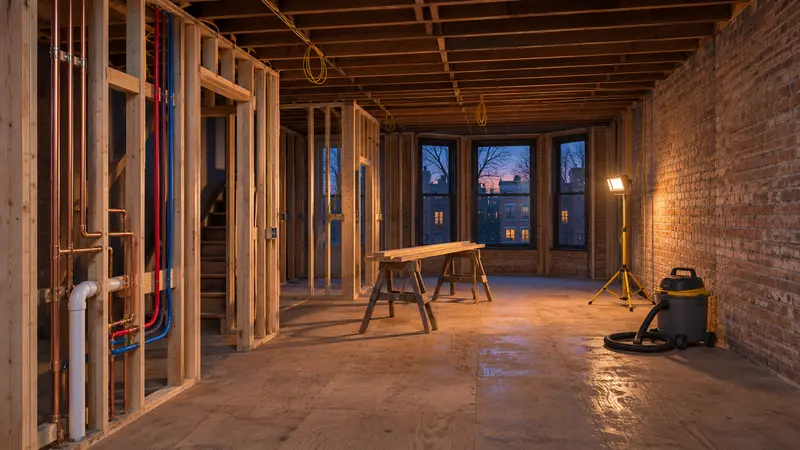
You need enough cash to pay for your largest rehab phase before the lender reimburses it, plus any rehab the holdback does not cover. The planner splits the budget into five phases, scales each draw to the holdback, and reports both figures. Draw fees are underwritten file by file, ask your loan officer.
Result
The math
| Draw schedule | |
|---|---|
| Draw 1: Demo, rough framing, roof Work in place $17,000, month 1; $68,000 left in holdback | $17,000 |
| Draw 2: Rough plumbing, electrical, HVAC Work in place $21,250, month 2; $46,750 left in holdback | $21,250 |
| Draw 3: Insulation, drywall, windows Work in place $17,000, month 3; $29,750 left in holdback | $17,000 |
| Draw 4: Kitchens, baths, flooring Work in place $21,250, month 4; $8,500 left in holdback | $21,250 |
| Draw 5: Finish, punch list, final inspection Work in place $8,500, month 5; $0 left in holdback | $8,500 |
| Total released Of $85,000 holdback | $85,000 |
| Cash you need on hand | |
| Peak work in place awaiting reimbursement Reached when phase 2 finishes; each draw funds about 5 days after its phase | $21,250 |
| Rehab above the holdback Paid from your cash, pro rata each draw | $0 |
| Working cash for the rehab Before contingency | $21,250 |
Phase shares add to 100%.
Draws reimburse work in place. Deposits and material orders before a draw come from your cash unless your lender approves otherwise.
Draw fees and inspection charges are underwritten file by file; ask your loan officer.
Estimates for planning, not a loan offer or a closing figure. Program limits from Jaken Finance Group as of November 26, 2026.
The formula
- Phase amount = rehab budget x phase share.
- Each draw releases the phase amount, scaled down if the holdback is smaller than the budget.
- Working cash = the most work in place you are carrying before reimbursement (phases stack when one finishes before the previous draw has funded) + any rehab the holdback does not cover.
The result shown before you type anything is a worked example using the starting inputs. It is computed with the same code your inputs run through.
On this page
- Why does a fully financed rehab still need working cash?
- What goes in the Budget group?
- How should you split the five phases?
- How does the planner scale draws when the holdback is short?
- What do the two cash numbers in the result mean?
- What does Illinois lien law add to a draw request?
- Which timing effects does the planner leave out?
- Where does the schedule go from here?
Financing 100% of a rehab budget does not mean the lender pays your contractor. It means the lender pays you back. Between the day a phase is finished and the day the wire lands, the money in the building is yours.
The planner sizes that gap. It carries no interest rate and makes no offer; its numbers are planning estimates from a site published by a lender, Jaken Finance Group.
Why does a fully financed rehab still need working cash?
A fully financed rehab needs working cash because a draw reimburses completed work. The sequence is fixed: the contractor finishes a phase, you request the draw, the lender orders a draw inspection, and funds follow. The draw and inspection walkthrough covers each step. Your exposure at any moment is one phase, and the planner finds the biggest one.
What goes in the Budget group?
Three figures go in first.
| Field | Source | Watch for |
|---|---|---|
| Rehab budget | The signed scope of work total | Use the contract figure, not the walkthrough estimate |
| Rehab holdback in the loan | Your term sheet | Can be lower than the budget on a capped loan |
| Days from draw request to funds | Your lender's stated turnaround | Inspection scheduling plus the wire |
If you have no budget yet, build one in the rehab budget builder tool and bring the total here.
How should you split the five phases?
Split the budget by what each stage costs, not by time. The planner starts with five stages in construction order: demolition, framing and roof; rough plumbing, electrical and HVAC; insulation, drywall and windows; kitchens, baths and flooring; then finish and punch list. Replace the default shares with percentages from your contractor's schedule of values. They must add to 100, and the tool tells you when they do not. Give each phase the month you expect it to finish.
How does the planner scale draws when the holdback is short?
When the rehab holdback is smaller than the budget, the planner scales every draw by the same ratio, holdback divided by budget. The unfunded slice of each phase stays with you, spread across all five draws.
A $120,000 rehab with a $102,000 holdback
The holdback sits below the budget here, the case the default scenario does not show. Illustrative inputs, run through the planner's function.
Draws released from the holdback
| Line | Amount | How it is figured |
|---|---|---|
| Draw 1: demo, rough framing, roof | $15,300 | $18,000 of work in place x 85% |
| Draw 2: rough plumbing, electrical, HVAC | $30,600 | $36,000 of work in place |
| Draw 3: insulation, drywall, windows | $20,400 | $24,000 of work in place |
| Draw 4: kitchens, baths, flooring | $25,500 | $30,000 of work in place |
| Draw 5: finish, punch list, final inspection | $10,200 | $12,000 of work in place |
| Total released | $102,000 |
Line items sum to the stated result. Checked in code at build.
Working cash for the rehab
| Line | Amount | How it is figured |
|---|---|---|
| Largest phase to float | $36,000 | phase 2, paid before about 7 days of inspection and wire |
| Rehab above the holdback | $18,000 | $120,000 budget minus $102,000 holdback |
| Working cash, before contingency | $54,000 |
Line items sum to the stated result. Checked in code at build.
Assumptions
- Each phase is paid in full by you, then reimbursed once, with no overlap between phases.
- No draw fee or inspection charge is included, because none is published.
What do the two cash numbers in the result mean?
The largest single float is the most expensive phase, the one you must be able to pay for before any reimbursement. Rehab from your cash is the part of the budget the holdback never reaches. Their sum is working cash for the rehab. It sits on top of contingency and on top of the closing-table cash in the purchase-day cash breakdown. If the sum is more than you have, the comparison of deals with and without gap funding shows one option; gap or second-lien funding needs separate approval and first-lender consent.
What does Illinois lien law add to a draw request?
Illinois lien law adds paperwork to every payment, and a lender may ask for it with the draw. Under 770 ILCS 60/5, an owner has a duty to require a sworn contractor's statement listing everyone furnishing labor or material, and the amounts due them, before paying the contractor. A contractor has 4 months after completion to record a claim that holds against a buyer or lender (770 ILCS 60/7), and a subcontractor's notice is due Within 90 days after completing work. Collect a lien waiver with each payment and log it in the draw-by-draw request log. This is general information; ask your attorney how it applies to your contract.
Which timing effects does the planner leave out?
The planner leaves out more timing than its fields suggest. The days-to-funds figure and the finish months label the schedule; neither one changes a dollar amount in the result. Overlapping phases, a failed inspection, deposits, retainage and draw fees are not modeled either. If two phases will be open at once, add their amounts yourself.
Where does the schedule go from here?
Share the phase split with your contractor and your loan officer before closing, so the construction contract, the scope of work and the draw schedule all describe the same five payments. JFG's draw process guide explains the lender's side in detail. Its national capital stack calculator assumes every loan is fully advanced at closing; this planner covers the staged part it leaves out. More calculators are on the tools hub.
Questions: Draw schedule planner
Why would my holdback be smaller than my rehab budget?
Because the loan hit a ceiling and the shortfall was allocated to rehab. The other calculators on this site fill the holdback first, so an ARV-capped loan shrinks the closing advance instead. A term sheet can split it differently, and the document controls. Enter the holdback exactly as it is written there. The planner then scales every draw by the same share and shows the remainder as rehab from your cash.
Can I request a draw for materials I have paid for but not installed?
Plan on no unless your lender has agreed otherwise in writing. Draws reimburse work in place that an inspector can see, so cabinets in a warehouse or a deposit on windows normally come out of your pocket until they are installed. Long-lead orders are the usual reason working cash runs higher than the largest phase, so add them to your reserve by hand.
How many draws should a rehab have?
As few as your cash allows. Every draw means a request, an inspection and a wait, so fewer and larger draws mean less paperwork but more money floated at once. The planner is fixed at five phases. To model fewer, set a phase share to zero and move its percentage into a neighbor; the draw count in the result drops accordingly.
Who pays the contractor while a draw is pending?
You do, or the contractor waits. Some contractors will carry the gap between finishing a phase and being paid, and others will not start the next phase until the last one clears. Settle the payment terms in the construction contract before closing, and line them up with the turnaround you entered in the days-to-funds field.
Does the final draw get held until the project is finished?
Expect the last draw to follow a final inspection of the completed scope, which is why the fifth phase in the planner includes the punch list. If your loan documents hold back a percentage of each draw as retainage, the planner does not model it. Add that percentage of the budget to your working cash for the period before the final release.
Local rates and rules cited on this page
| Item | Figure | Primary source | Effective |
|---|---|---|---|
| Lien recording deadline against buyers and lenders | 4 months after completion | 770 ILCS 60/7(a) - Claim for lien (Illinois General Assembly (ilga.gov)) | 2010-01-01 |
| Subcontractor notice of lien claim | Within 90 days after completing work | 770 ILCS 60/24 - Written notice by subcontractor (Illinois General Assembly (ilga.gov)) | 2025-01-01 |
Rates as of November 25, 2026. Confirm with the agency before relying on any figure.
Sources
- 770 ILCS 60/5, Statement of contractor, Illinois General Assembly, 2025-01-01.
- 770 ILCS 60/7, Claim for lien, Illinois General Assembly, 2010-01-01.
- 770 ILCS 60/24, Written notice by subcontractor, Illinois General Assembly, 2025-01-01.