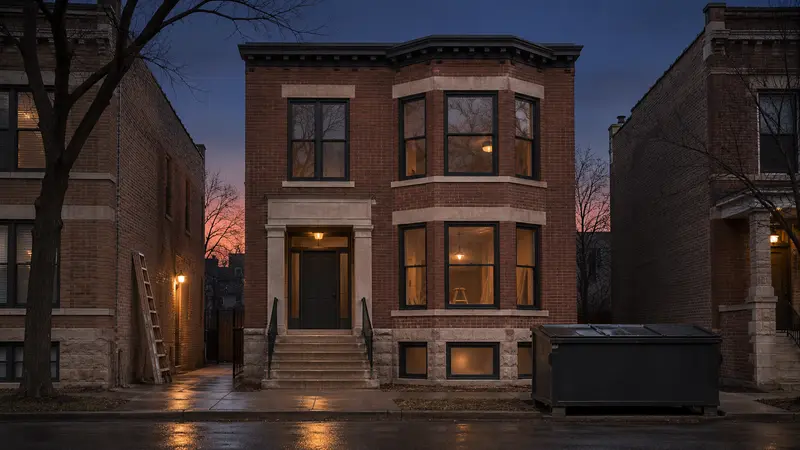
Both exits retire the flip loan the same way: a payoff letter with a good-through date, per-diem interest, a wire from the title company and a recorded release. A sale pays you the price less selling costs; a refinance pays the new loan less its costs.
- Refinance exit
- DSCR loan at 5.75%-10.5%, 30-year, up to 75% LTV cash-out in Chicago
- Lender's release deadline (Illinois Mortgage Act)
- 30 days after payoff
- Recording a release in Cook County
- $107 per mortgage or release
- FHA buyer, fast resale
- Ineligible for FHA financing at 90 days or less
- Seasoning before a cash-out refinance
- underwritten file by file
- Prepayment terms
- underwritten file by file, ask your loan officer
Program terms as of November 26, 2026. Rates as of November 25, 2026.
On this page
- What does the flip lender need before it lets go of the building?
- How do you order a payoff letter, and what is per-diem interest?
- Who releases the lien, and how fast?
- How do a sale closing and a refinance closing differ?
- What do the two exits pay on the same building?
- Will the refinance appraisal match your resale number?
- How long must you own before a cash-out refinance?
- What must be true of the rents and leases?
- Can the FHA 90-day rule stall a fast resale?
- When should you switch from one exit to the other?
- What should you do this week?
The last inspection passes, the dumpster leaves, and the loan is still there. Getting it paid off is a closing of its own, with documents to order and dates that have to line up. This page covers that closing and how it differs when the money comes from a buyer or from a new lender.
Whether to flip or hold is a decision for before you buy, turning on rent, taxes and how much cash stays in the building. It is worked through under flip or BRRRR.
What does the flip lender need before it lets go of the building?
The flip lender needs the full payoff amount by wire before it releases its mortgage. Nothing else satisfies it: not a signed contract, not a refinance approval. The amount is stated in a payoff letter, and the title company handling your closing sends the wire and collects the release. On either exit, the first call goes to your lender's payoff contact.
How do you order a payoff letter, and what is per-diem interest?
Order the payoff letter in writing at least a week before closing, and give a good-through date a few days past the scheduled closing. The letter lists principal, interest accrued since your last payment, any fees, wiring instructions and a per-diem figure: the interest that accrues each additional day.
Do not assume a statutory deadline protects you. Illinois sets a 10-business-day turnaround for payoff statements in section 15-1505.5 of the foreclosure law, but that section applies inside a foreclosure action. On a performing loan the timing is a matter of your lender's practice, which is the reason to ask early.
Who releases the lien, and how fast?
The lender releases its own mortgage, and Illinois gives it a deadline. Under the Mortgage Act a paid lender must deliver a release or send it for recording, and section 4 makes a lender that fails to do so within 30 days after payoff liable for $200 plus reasonable attorney's fees. The Cook County Clerk's fee schedule puts recording at $107 per mortgage or release.
In practice the title company insures over the gap: it pays the lender from the closing, issues the new policy without the old mortgage, and follows up on the recorded release. Ask for a copy when it records. Other title items at closing are covered under title, water and liens.
How do a sale closing and a refinance closing differ?
They differ in who brings the money, what gets recorded and what you owe afterward.
| Sale | DSCR cash-out refinance | |
|---|---|---|
| Money comes from | Buyer and the buyer's lender | New lender: 5.75%-10.5%, 30-year, up to 75% LTV |
| Value set by | Contract price | Appraisal |
| Recorded | Deed, buyer's mortgage, your release | New mortgage, your release |
| Transfer taxes | Seller portions due; see seller-side transfer stamps | None, no deed |
| City certificates | Water and zoning certificates | Not triggered by a refinance alone |
| Underwritten on | The buyer | Rent against the new payment (DSCR) |
| After closing | No debt, no building | A 30-year loan and a rental to run |
JFG's rental product is described on its Chicago DSCR loan page.
What do the two exits pay on the same building?
The two exits pay very different cash on day one, because a sale converts all the equity and a refinance converts only the share the loan-to-value limit allows.
One Avondale three-flat, two exits: sell at $560,000 or refinance at a $545,000 appraisal
Inputs are illustrative, not an offer. Net proceeds are cash from the closing, not profit: your down payment, interest already paid and out-of-pocket rehab are not subtracted here.
The payoff statement, good through closing day
| Line | Amount | How it is figured |
|---|---|---|
| Principal advanced | $374,000 | purchase advance plus the full rehab holdback, all drawn |
| Interest since the last payment | $1,278 | $106.49 a day for 12 days at 10.25% |
| Release recording | $107 | Cook County Clerk flat fee |
| Payoff amount | $375,385 |
Line items sum to the stated result. Checked in code at build.
Exit one: sale closing
| Line | Amount | How it is figured |
|---|---|---|
| Contract price | $560,000 | |
| Brokerage commission | -$28,000 | 5% of price |
| Seller transfer taxes | -$2,520 | CTA, county and state portions |
| Attorney, title and survey | -$4,200 | illustrative |
| Flip loan payoff | -$375,385 | |
| Net proceeds at sale | $149,895 |
Line items sum to the stated result. Checked in code at build.
Exit two: DSCR cash-out refinance
| Line | Amount | How it is figured |
|---|---|---|
| New loan | $408,750 | 75% of the $545,000 appraisal |
| Refinance closing costs | -$12,263 | 3% of the new loan, illustrative |
| Flip loan payoff | -$375,385 | |
| New monthly payment with taxes and insurance | $3,828 | rent of $5,400 covers it 1.41 times |
| Net proceeds at refinance | $21,103 |
Line items sum to the stated result. Checked in code at build.
The sale hands you $149,895 and ends the project. The refinance hands you $21,103, a building, and a 30-year payment. They are different outcomes, not two prices for the same thing.
Assumptions
- Flip rate of 10.25% and DSCR rate of 7.25% are inputs inside the published ranges of 8.99%-13.5% and 5.75%-10.5%, not quotes.
- The refinance appraisal is set $15,000 under the resale price on purpose; appraisers and buyers do not always agree.
Change the rent, the appraisal and the rate in the exit comparer tool, or use JFG's BRRRR calculator for a second opinion. Tax treatment differs too; see taxes on flip profit.
Will the refinance appraisal match your resale number?
Not reliably, so plan for a lower figure. A buyer pays for finishes and timing; an appraiser reconciles closed comparable sales and, on two-to-four-unit buildings, the rent. Give the appraiser the completed scope, permit numbers, photos and your comps. The comp packet template is built for that. JFG's published position on value is the same at both ends of the loan: supported by comparable sales; a third-party valuation may be required.
How long must you own before a cash-out refinance?
It depends on the lender, and JFG has not published a figure. Seasoning for its DSCR refinance is underwritten file by file. The conventional benchmark shows why flippers rarely use conventional loans here: Fannie Mae's cash-out rules require a borrower on title for at least 6 months and an existing first mortgage at least 12 months old, measured note date to note date. A flip loan is almost never that old.
Ask the seasoning question the week you buy. If the answer is longer than your flip loan's remaining term, you have an extension problem before you have a refinance.
What must be true of the rents and leases?
The building has to be rentable on paper, which in Chicago means legal units and compliant leases. A DSCR lender divides rent by the new payment including taxes and insurance, so three things move the result: signed leases or the appraiser's market rent, the tax bill, and the unit count the City recognizes. Taxes can rise after a rehab; see how a rehab changes the assessment.
An investor-owned building is covered by the RLTO, and the City's ordinance page says the summary must be attached to every written lease. Deposits, late fees and notices are covered under RLTO if you hold, and JFG's BRRRR strategy guide goes deeper on the hold.
Can the FHA 90-day rule stall a fast resale?
Yes. The rule limits your buyer's financing, not your right to sell. Under 24 CFR 203.37a the clock runs from your acquisition date to the date the buyer signs the contract.
| Days since you acquired | FHA buyer's position |
|---|---|
| 90 or fewer | Ineligible for FHA financing at 90 days or less |
| 91 to 180 | Second appraisal if resale price is 100% or more over acquisition price |
| Any | Seller must be owner of record; no contract assignment |
The 2026 FHA limit for a Cook County two-unit is $693,050, so most two-flats are within reach of FHA buyers. After a six-week rehab, tell your agent the first day an FHA contract can be signed, and keep your invoices to support a second appraisal.
When should you switch from one exit to the other?
Switch when the evidence changes, and decide by a date. Use this sequence.
- At 90 days before maturity, order rent comparables and ask a DSCR lender for a soft quote, even if you plan to sell.
- At listing, set a review date three weeks out and a price-cut trigger.
- If showings are strong and offers are low, the price is wrong. Cut before you refinance.
- If there are no showings and rents cover the payment, start the refinance application and take the listing down.
- Order the payoff letter the day either closing is scheduled.
When the refinance exit fails
A refinance will not work as a rescue when rents do not cover the new payment, when a unit is not legal, or when the appraisal comes in near your cost. The new loan then falls short of the payoff, and you bring cash to closing to keep a building you meant to sell.
The better route is the price. A cut that produces a sale ends the interest clock.
What should you do this week?
Write three numbers on one page: today's payoff with per diem, your net at the current list price, and your net at a refinance using a conservative appraisal. If you do not have the first one, email your lender for a payoff letter today. Where the exit sits in the whole project is shown on the whole-project timeline, and the other step-by-step process pages cover the stages before it.
Questions: Sale or refinance at exit
Is there a prepayment charge if I pay the flip loan off early?
It depends on the note. JFG's prepayment terms are underwritten file by file, ask your loan officer, so this page will not state one. Read the prepayment section of the term sheet and the note before you sign. A fast cosmetic flip that pays off in the first few months is where any such clause matters most, so ask before closing.
Do I repay rehab funds I never drew?
No. A payoff covers money actually advanced, plus accrued interest and any fees the note allows. If the project came in under budget and part of the holdback was never drawn, that part was never lent. Check the principal figure on the payoff letter against your own draw log before the title company wires.
Is transfer tax due when I refinance instead of selling?
No deed changes hands in a refinance, so the City, county and state transfer taxes that a seller pays on a sale do not apply. You still pay to record the new mortgage and the old lender's release, each at the Cook County flat fee. Moving title into an LLC during the refinance is a separate deed with its own filings; ask your attorney.
Does the 90-day resale rule apply to buyers using conventional loans or cash?
No. The rule in 24 CFR 203.37a governs FHA-insured mortgages only, so a cash buyer or a conventional borrower is not bound by it, although an individual lender can set its own policy. The regulation also exempts some sellers, including sales of inherited property and sales by government agencies. An investor reselling a rehab is not on that list, so plan around the date.
What does the title company need from me before an exit closing?
The lender's payoff contact, your entity documents and operating agreement, final lien waivers from the general contractor and major subcontractors, and for a Chicago sale the water and zoning certificates. A contractor's deadline to record a lien that binds a buyer or lender is 4 months after completion, so title asks for waivers on either exit. Collect them with each draw.
Local rates and rules cited on this page
| Item | Figure | Primary source | Effective |
|---|---|---|---|
| Lender's deadline to release a paid-off mortgage | 30 days after payoff | Mortgage Act, 765 ILCS 905/4 (Illinois General Assembly (ilga.gov)) | 2020-01-01 |
| Penalty for a late mortgage release (Illinois Mortgage Act) | $200 plus reasonable attorney's fees | 765 ILCS 905/4, Mortgage Act (Illinois General Assembly) | 2020-01-01 |
| Cook County mortgage / release recording fee | $107 per mortgage or release | Recording Fees (Cook County Clerk) | 2024-04-01 |
| Fannie Mae cash-out refinance: time on title | on title for at least 6 months | Selling Guide B2-1.3-03, Cash-Out Refinance Transactions (Fannie Mae) | 2025-12-10 |
| Fannie Mae cash-out refinance: age of the existing first mortgage | at least 12 months old | Selling Guide B2-1.3-03, Cash-Out Refinance Transactions (Fannie Mae) | 2025-12-10 |
| FHA anti-flipping: resale within 90 days | Ineligible for FHA financing at 90 days or less | 24 CFR 203.37a - Sale of property (eCFR / HUD) | 2006-06-07 |
| FHA anti-flipping: resale in days 91-180 | Second appraisal if resale price is 100% or more over acquisition price | 24 CFR 203.37a - Sale of property (eCFR / HUD) | 2006-06-07 |
| FHA owner-of-record requirement | Seller must be owner of record; no contract assignment | 24 CFR 203.37a - Sale of property (eCFR / HUD) | 2006-06-07 |
| FHA forward mortgage limit, Cook County, 2-unit, 2026 | $693,050 | FHA Mortgage Limits lookup (Cook County, IL, CY2026) (U.S. Department of Housing and Urban Development) | 2026-01-01 |
| Lien recording deadline against buyers and lenders | 4 months after completion | 770 ILCS 60/7(a) - Claim for lien (Illinois General Assembly (ilga.gov)) | 2010-01-01 |
| Chicago transfer tax, City portion (buyer) | $3.75 per $500 of price | Real Property Transfer Tax (7551) (City of Chicago Department of Finance) | 2008-04-01 |
| Chicago transfer tax, CTA portion (seller) | $1.50 per $500 of price | Real Property Transfer Tax (7551) (City of Chicago Department of Finance) | 2008-04-01 |
| Cook County real estate transfer tax | $0.25 per $500 of value | Transfer Fees (Cook County Clerk) | 1968-01-01 |
| Illinois state real estate transfer tax | $0.50 per $500 of value | 35 ILCS 200/31-10, Imposition of tax (Illinois General Assembly) | 2005-06-01 |
Rates as of November 25, 2026. Confirm with the agency before relying on any figure.
Sources
- 765 ILCS 905/2, Mortgage Act: release of mortgage, Illinois General Assembly, P.A. 101-97, eff. 2020-01-01.
- 765 ILCS 905/4, Mortgage Act: penalty for failure to release, Illinois General Assembly, P.A. 101-97, eff. 2020-01-01.
- 735 ILCS 5/15-1505.5, Payoff demands, Illinois General Assembly, P.A. 95-961, eff. 2009-01-01.
- 24 CFR 203.37a, Sale of property, eCFR, U.S. Department of Housing and Urban Development, 2006-06-07.
- Selling Guide B2-1.3-03, Cash-Out Refinance Transactions, Fannie Mae, 2025-12-10.
- Recording Fees, Cook County Clerk, 2024-04-01.
- Residential Landlord and Tenant Ordinance, City of Chicago Department of Housing, 2024-05-01.