Plan liquidity for six buckets, not only a down payment. With leverage of up to 90% of purchase price plus 100% of approved rehab, capped at 75% of supported ARV, the example deal on this page needs about $107,444 available for closing cash, contingency, interest, carrying costs and draw float, and $115,204 when the ARV cap binds.
- Published leverage
- up to 90% of purchase price plus 100% of approved rehab, capped at 75% of supported ARV
- Rehab funding
- staged against a rehab holdback, with inspections
- Example liquidity, cost limit binding
- $107,444 on a $265,000 purchase
- Example liquidity, ARV cap binding
- $115,204
- Due at the closing table in the example
- $41,753
- Lender liquidity test
- underwritten file by file, ask your loan officer
Program terms as of November 26, 2026. Rates as of November 25, 2026.
On this page
- Why does a loan that funds 100% of rehab still need your cash?
- Which six buckets make up the liquidity for one flip?
- How much of the total is due at the closing table?
- How large should the contingency be?
- What does carrying the building cost while you hold it?
- What is draw float, and how much should you plan for?
- What happens to your cash when the ARV cap binds?
- What reserves does a lender want to see on top of the buckets?
- What should you do before you make an offer?
Ask how much cash a flip takes and the usual reply is a down payment figure. That figure is one slice of what the project pulls from your bank account between contract acceptance and the day the resale funds. This page counts all of it for a Chicago deal.
The site is published by Jaken Finance Group, a lender. Leverage figures are its published program facts, local charges are cited to the agency that sets them, and other inputs are labeled illustrative.
Why does a loan that funds 100% of rehab still need your cash?
Because the rehab money is not handed to you at closing. Rehab draws are staged against a rehab holdback, with inspections: the lender keeps the budget in a rehab holdback and releases it after work is in place. Your contractor expects a deposit and progress payments before that. The loan is also sized against cost and value, not against your closing statement, so points, title charges, transfer tax, interest and overruns stay with you. "100% financing" never means no cash, a point taken apart in what full financing covers.
Which six buckets make up the liquidity for one flip?
Closing-table cash, contingency, interest, other carrying costs, draw float and any cost the loan cannot cover. They differ in when the money leaves and whether it returns.
| Bucket | When you need it | Does it come back? | What sets the size |
|---|---|---|---|
| Closing-table cash | Purchase closing | Inside resale proceeds | Down payment, points, title, transfer tax |
| Contingency | Any day of the rehab | Only the unspent part | Age and scope of the building |
| Interest | Monthly | No | Balance, rate, months held |
| Taxes, insurance, utilities | By bill date | No | Tax bill timing, vacant coverage |
| Draw float | Before each draw | Yes, when the draw funds | Largest phase the contractor bills |
| Cost above the loan | Purchase closing | Inside resale proceeds | Whether the ARV cap binds |
How much of the total is due at the closing table?
The closing-table bucket is the down payment plus points, lender fees, title and settlement charges and the buyer's share of transfer tax. On a Chicago purchase the buyer's City tax is $3.75 per $500 of price under the Real Property Transfer Tax, and Cook County charges a flat amount to record each document, per the Clerk's recording fee schedule. Prorations, escrows and every other line are on the cash to close breakdown.
| Item | Figure | Source | Effective |
|---|---|---|---|
| Chicago transfer tax, City portion (buyer) | $3.75 per $500 of price | City of Chicago Department of Finance | 2008-04-01 |
| Cook County deed recording fee | $107 per deed | Cook County Clerk | 2024-04-01 |
| Cook County mortgage / release recording fee | $107 per mortgage or release | Cook County Clerk | 2024-04-01 |
Fixed charges on a Chicago purchase closing
How origination is quoted is covered in JFG's points and fees explainer.
How large should the contingency be?
No public source sets a contingency percentage. The example uses 10% of the rehab budget as an illustrative input. For liquidity, the point is that contingency is cash. An overrun sits outside the approved budget the holdback funds, and added scope needs lender approval before any of it can be drawn. Until then you are paying for it.
One Chicago item belongs in this bucket before closing: a plan-based permit application carries a deposit of $600 non-refundable, set in the Department of Buildings' 2026 fee changes.
What does carrying the building cost while you hold it?
Interest plus taxes, insurance and utilities, every month, with no rent against them. Payments are interest-only at a rate inside 8.99%-13.5%. Property tax is the lumpy part of carry cost. Cook County's first installment equals 55% of the prior year's total tax, according to the Treasurer's property tax primer. A bill that falls due inside your hold is yours to pay in full, even though the seller credited their share at closing through tax proration. Keep that credit aside.
Insurance changes when the building is empty. The City's vacant building requirements call for liability coverage of at least $300,000 per occurrence on a residential structure. Monthly figures for longer and shorter projects are in the carry cost tables.
What is draw float, and how much should you plan for?
Draw float is what you pay your contractor for finished work before the lender inspects it and reimburses you. It is not a cost, because it returns, but it has to exist. Size it to the largest phase you will pay for between draws, plus the mobilization deposit. The example carries $28,000. Smaller, more frequent draws shrink it. The peak-float draw planner finds the peak for your own phases, how draws and inspections run covers timing, and JFG's draw process guide lists the paperwork.
What happens to your cash when the ARV cap binds?
The loan is the lower of the cost-based amount and 75% of supported ARV. When comps support less value than you projected, the loan shrinks and the difference moves to you. In the sizing this site uses, the holdback stays whole and the purchase advance drops, so the shortfall appears as a larger down payment. A lender could trim the holdback instead. Both are cash. The mechanics are on cost limit versus ARV cap.
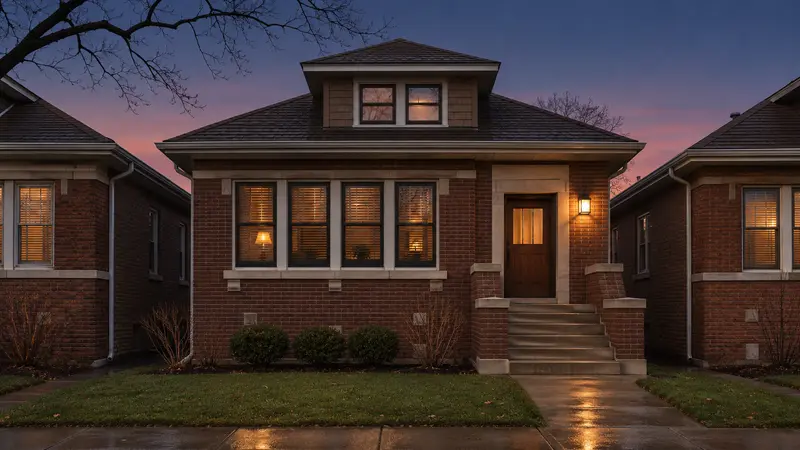
A $265,000 brick bungalow with an $85,000 rehab, held 7 months
Every input is illustrative, not an offer. The second table reruns the identical deal with a lower supported value.
Liquidity by bucket with comps supporting $470,000
| Line | Amount | How it is figured |
|---|---|---|
| Down payment | $26,500 | $265,000 less the $238,500 advanced at closing |
| Origination points | $6,470 | 2 points on $323,500 |
| Lender fees and buyer closing costs | $6,795 | title, settlement, attorney, processing |
| Chicago transfer tax, buyer side | $1,988 | $3.75 per $500 of price |
| Contingency | $8,500 | 10% of the rehab budget, kept in cash |
| Interest through the hold | $21,701 | $323,500 x 11.5% / 12 x 7 |
| Taxes, insurance, utilities | $7,490 | $1,070 a month x 7 |
| Draw float | $28,000 | largest phase paid before reimbursement |
| Loan amount | $323,500 | cost limit binds; not summed |
| Liquidity to have available | $107,444 |
Line items sum to the stated result. Checked in code at build.
The identical deal when comps support only $420,000
| Line | Amount | How it is figured |
|---|---|---|
| Down payment | $35,000 | advance falls to $230,000 |
| Origination points | $6,300 | 2 points on $315,000 |
| Lender fees and buyer closing costs | $6,795 | unchanged |
| Chicago transfer tax, buyer side | $1,988 | unchanged |
| Contingency | $8,500 | unchanged |
| Interest through the hold | $21,131 | smaller balance, 7 months |
| Taxes, insurance, utilities | $7,490 | unchanged |
| Draw float | $28,000 | unchanged |
| Loan amount | $315,000 | 75% of $420,000; not summed |
| Added liquidity versus the first table | $7,760 | net of lower points and interest |
| Liquidity to have available | $115,204 |
Line items sum to the stated result. Checked in code at build.
Assumptions
- Rate of 11.5% sits inside the published range of 8.99%-13.5% and is an input, not a quote. Interest is charged on the full commitment from day one.
- Contingency percentage, closing costs, monthly carrying costs and the $28,000 float are illustrative.
- Selling costs are left out because sale proceeds pay them.
With the cost limit binding, the six buckets total $107,444, of which $41,753 is due at the purchase closing. When supported value falls to $420,000, the loan drops by $8,500 and liquidity rises by $7,760, slightly less than the loan cut because points and interest shrink with the balance.
What reserves does a lender want to see on top of the buckets?
Liquidity requirements are underwritten file by file, so there is no published reserve formula to quote. Expect to show, with recent statements, that the buckets exist and that funding them does not empty the account. Other projects count against you: unfinished budgets and open holdbacks elsewhere are claims on the same cash. A borrower with no completed projects should expect closer questions, as funding a first flip explains.
Borrowed liquidity is a separate matter. Gap funding or second-lien money needs separate approval and first-lender consent, and the trade-offs are laid out in flips with and without gap money.
The cash plan that fails
Holding exactly the closing-table amount and nothing else. The first contractor invoice arrives before the first draw, and one failed sewer line uses a contingency you never set aside.
The better route is a smaller project. Lower the price or lighten the scope until all six buckets fit, or bring in a capital partner who supplies float and reserves for a share of the profit.
What should you do before you make an offer?
- Fill in the six buckets with your own figures on the cash to close worksheet.
- Size the loan twice: once at your projected ARV and once at a lower value your weakest comp would support.
- Ask your contractor for a payment schedule and mark the largest stretch between a payment and the draw that repays it.
- Check the Cook County installment due dates against your planned hold.
- Pull statements that show the total, then request terms on the deal.
Other first questions are answered in the flip loan questions hub.
Questions: Total cash to flip a house
Can a HELOC or business credit line count as my liquidity for a flip?
Borrowed cash can pay for part of a project, but disclose it. A line secured by another property is your own debt and your own payment, and a lender reviewing the file will ask where each dollar comes from. Money secured by the flip property itself is different: gap or second-lien funding needs separate approval and first-lender consent. A line fully drawn for the down payment leaves nothing for contingency and float, which is where projects run short.
Do I get the contingency back if the rehab finishes on budget?
Yes, because it was never spent. The contingency in this page's example is your own cash held outside the loan, so whatever is left at the end is still yours. That is why it belongs in a liquidity count and not a cost count: it has to exist on the day a hidden condition appears, and on a clean project it returns to your account. Budget profit as if you will spend it.
Is flip loan interest charged on the whole loan or only on what has been drawn?
It depends on the loan documents, so ask before you budget. The example on this page charges interest on the full commitment from the first day, which produces the larger figure and is the safer assumption for a liquidity plan. If interest accrues only on funds advanced, the early months cost less because the rehab holdback has not been released yet. Payments are interest-only in both cases, and the rate sits inside 8.99%-13.5%.
How much more cash does a second flip need if I run two at once?
Each project needs its own six buckets. The mistake is counting one pool of float or one contingency twice. Two rehabs can hit their largest unpaid phase in the same week, and two tax bills can land in the same month. A lender reviewing the second file will also subtract what the first still requires. Stagger the start dates if the cash only covers one peak.
Does my earnest money count toward the cash I bring to closing?
It does. Earnest money is credited against what you owe on the closing statement, so it is part of the down payment, not an extra cost. The catch is timing: it leaves your account when the contract is accepted, days or weeks before the loan funds, and it is at risk if you default under the contract. Count it in the closing-table bucket, but have it ready first.
Local rates and rules cited on this page
| Item | Figure | Primary source | Effective |
|---|---|---|---|
| Chicago transfer tax, City portion (buyer) | $3.75 per $500 of price | Real Property Transfer Tax (7551) (City of Chicago Department of Finance) | 2008-04-01 |
| Plan-based permit application deposit | $600 non-refundable | Department of Buildings Changes for 2026 (City of Chicago Department of Buildings) | 2026-01-06 |
| First installment amount | 55% of the prior year's total tax | How the Illinois Property Tax System Works (October 2025 update) (Cook County Treasurer's Office) | 2025-10 |
| Vacant building liability insurance, residential | $300,000 per occurrence | Requirements for Vacant Building Owners (Revised 1/2026) (City of Chicago Department of Buildings) | 2026-01 |
| Chicago transfer tax, CTA portion (seller) | $1.50 per $500 of price | Real Property Transfer Tax (7551) (City of Chicago Department of Finance) | 2008-04-01 |
| Cook County real estate transfer tax | $0.25 per $500 of value | Transfer Fees (Cook County Clerk) | 1968-01-01 |
| Illinois state real estate transfer tax | $0.50 per $500 of value | 35 ILCS 200/31-10, Imposition of tax (Illinois General Assembly) | 2005-06-01 |
Rates as of November 25, 2026. Confirm with the agency before relying on any figure.
Sources
- Real Property Transfer Tax (7551), City of Chicago Department of Finance, 2026.
- Recording Fees, Cook County Clerk, 2024-04-01.
- Department of Buildings Changes for 2026, City of Chicago Department of Buildings, 2026-01-06.
- How the Illinois Property Tax System Works (October 2025 update), Cook County Treasurer's Office, 2025-10.
- Requirements for Vacant Building Owners (Revised 1/2026), City of Chicago Department of Buildings, 2026-01.
- Jaken Finance Group published program terms, Jaken Finance Group, 2026-11-25.