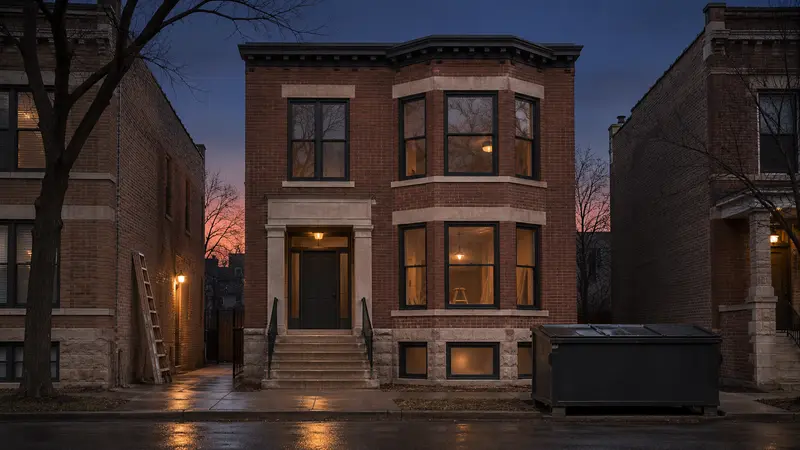
All-in cost is the purchase price plus four more groups: financing, construction, carry and sale. On the two-flat computed below, a $265,000 purchase becomes $448,264 by payoff. The City taxes both closings at $5.25 per $500 of price combined, and the loan runs 8.99%-13.5% plus 1-3 points.
- Cost groups
- Acquisition, financing, construction, carry, sale
- Buyer transfer tax at purchase
- $3.75 per $500 of price
- Seller transfer taxes at resale
- City $1.50 per $500 of price, county $0.25 per $500 of value, state $0.50 per $500 of value
- Loan pricing
- 8.99%-13.5%, 1-3 points, interest-only
- Recording a deed or a mortgage
- $107 per deed
- Water certificate before resale
- $50 application fee
- Example all-in cost
- $448,264 on a $489,000 resale
Program terms as of November 26, 2026. Rates as of November 25, 2026.
On this page
- What do you pay to get the deed?
- What does the money cost?
- What belongs in construction besides the bid?
- What does the building cost while you hold it?
- What comes off the top when you sell?
- The whole stack on one two-flat
- Which lines are fixed by a public schedule?
- Why is the tax proration credit not a cost line?
- Which lines get left out most often?
- What should you do with the stack before you offer?
Most flip budgets have three lines: price, rehab, "closing costs." A Chicago flip has closer to thirty, and the ones that get skipped are almost all local: two different transfer taxes on two different closings, a water certificate, a zoning certificate, a vacant building registration, a survey the seller buys.
This page lists every line in the order you pay it and totals one deal. Each group has its own page; the job here is to make sure nothing is missing. The publisher is a lender, Jaken Finance Group, so the financing lines use its published terms.
What do you pay to get the deed?
Acquisition is the contract price plus four closing lines: title and settlement charges, recording, your attorney and the City's buyer-side transfer tax. The City portion of the Real Property Transfer Tax is $3.75 per $500 of price, and the Department of Finance puts it on the buyer. The Cook County Clerk's fee schedule sets recording at $107 per deed and $107 per mortgage or release.
Title charges are the soft spot. The state regulator's consumer brochure says prices vary and tells buyers to compare, so treat any title figure as a quote. Get the lender's policy and closing fee quoted when the title commitment is ordered.
What does the money cost?
Financing has three lines: points, flat lender fees and interest. JFG's published pricing is 8.99%-13.5%, interest-only, with 1-3 points. Points are charged on the whole loan, undrawn holdback included. The dollar breakdown of points and lender fees has its own page, and JFG keeps a longer explainer on how points and fees are charged.
Interest is the only financing line that grows. In the example it is $20,427 over 7 months, more than the points and fees combined.
What belongs in construction besides the bid?
Three things the contractor's number leaves out: design and permit costs, the expediter if you use one, and a contingency. A plan-based permit starts with a $600 non-refundable deposit before the fee itself, and the permit path you choose decides whether you need stamped drawings. Ranges by scope level are under rehab cost by scope.
The loan can cover 100% of the approved rehab budget. It does not cover the contingency, which is why the example holds $9,500 in cash.
What does the building cost while you hold it?
Carry is property tax, insurance, utilities, site upkeep and, for an empty building, the City's vacant building registration. The Department of Buildings' owner requirements sheet lists a fee of $30 to $100 at initial registration, renewal at $30 per renewal and liability coverage of at least $300,000 per occurrence on a residential building. The page on registering a vacant building covers when the rule applies.
These lines are small per month and scale with time, as shown under carry by hold length.
What comes off the top when you sell?
Brokerage is the largest sale line, and three transfer taxes follow it. As seller you owe the CTA portion of the City tax at $1.50 per $500 of price, Cook County's at $0.25 per $500 of value and the state's at $0.50 per $500 of value; the Clerk's transfer fee table names the seller as the party liable for the last two. The mechanics and exemptions are on the transfer tax rules page, and JFG's investor guide to the Chicago transfer tax goes deeper.
The City will not issue transfer stamps without a Full Payment Certificate, a $50 application, and a building of five or fewer units needs a Certificate of Zoning Compliance at $120. The standard Multi-Board 8.0 contract puts the survey on the seller. Add your attorney, the owner's title policy and any inspection credits. Sequence matters; see water certificate and title work.
The whole stack on one two-flat
A $265,000 brick two-flat, bought vacant and resold in 7 months
Every input is illustrative, not a quote. The groups are listed in the order the money leaves your account.
1. Acquisition
| Line | Amount | How it is figured |
|---|---|---|
| Contract price | $265,000 | |
| Title and settlement charges, buyer side | $2,350 | |
| Recording the deed and the mortgage | $214 | two documents |
| Buyer's attorney | $850 | |
| Chicago transfer tax, buyer portion | $1,988 | 530 units of $500 |
| Acquisition | $270,402 |
Line items sum to the stated result. Checked in code at build.
2. Financing
| Line | Amount | How it is figured |
|---|---|---|
| Origination, 2 points | $6,670 | on a $333,500 loan |
| Flat lender fees | $1,895 | |
| Interest, 7 months | $20,427 | $333,500 x 10.5% / 12 x 7 |
| Financing | $28,992 |
Line items sum to the stated result. Checked in code at build.
3. Construction
| Line | Amount | How it is figured |
|---|---|---|
| Contractor bid, hard costs | $86,000 | |
| Drawings, permit fees, expediter | $9,000 | |
| Contingency, held in cash | $9,500 | 10% of $95,000 |
| Construction | $104,500 |
Line items sum to the stated result. Checked in code at build.
4. Carry
| Line | Amount | How it is figured |
|---|---|---|
| Property tax accrual | $3,780 | $540 a month |
| Insurance | $1,715 | $245 a month |
| Gas, electric, water | $2,240 | $320 a month |
| Lawn, snow, board-up upkeep | $595 | $85 a month |
| Vacant building registration | $130 | initial fee plus one renewal |
| Carry, excluding interest | $8,460 |
Line items sum to the stated result. Checked in code at build.
5. Sale
| Line | Amount | How it is figured |
|---|---|---|
| Brokerage, both sides | $24,450 | 5% of $489,000 |
| Chicago transfer tax, CTA portion | $1,467 | 978 units of $500 |
| Cook County transfer tax | $245 | |
| Illinois transfer tax | $489 | |
| Seller's attorney | $950 | |
| Owner's title policy and seller closing fees | $2,600 | |
| Plat of survey | $650 | |
| Water and zoning certificates | $170 | |
| Credits to the buyer | $4,890 | 1% of price |
| Sale | $35,911 |
Line items sum to the stated result. Checked in code at build.
The stack
| Line | Amount | How it is figured |
|---|---|---|
| Acquisition | $270,402 | |
| Financing | $28,992 | |
| Construction | $104,500 | |
| Carry | $8,460 | |
| Sale | $35,911 | |
| Resale price | $489,000 | |
| Profit before income tax | $40,736 | 8.33% of the resale price |
| All-in cost | $448,264 |
Line items sum to the stated result. Checked in code at build.
Costs beyond the contract price come to $183,264, or 69.2% of what you paid for the building.
Assumptions
- The 10.5% rate and 2 points sit inside the published ranges of 8.99%-13.5% and 1-3 points; neither is an offer.
- Loan sized at up to 90% of purchase price plus 100% of approved rehab, capped at 75% of supported ARV; here the cost limit of $333,500 is below the ARV cap of $366,750.
- Title, attorney, survey, insurance, utility and tax figures are placeholders for your own quotes.
The price is $265,000. The all-in cost is $448,264. The $183,264 between them is what a three-line budget hides.
Which lines are fixed by a public schedule?
Eight lines are set by statute or ordinance. Nobody discounts them, so they go into the budget first.
| Line | Who pays | Published amount |
|---|---|---|
| City transfer tax, City portion | Buyer | $3.75 per $500 of price |
| City transfer tax, CTA portion | Seller | $1.50 per $500 of price |
| Cook County transfer tax | Seller | $0.25 per $500 of value |
| Illinois transfer tax | Seller | $0.50 per $500 of value |
| Recording, per deed or mortgage | Party recording | $107 per deed |
| Full Payment Certificate | Applicant | $50 |
| Certificate of Zoning Compliance | Applicant | $120 |
| Vacant building registration | Owner | $30 to $100 at initial registration |
Everything else is quoted.
Why is the tax proration credit not a cost line?
Because it is a transfer of a bill, not a new cost. Cook County taxes are billed a year behind, so at purchase the seller credits you for taxes accrued but not yet billed, and at resale you credit your buyer the same way. The Multi-Board contract prorates at a negotiated percentage of the most recent full-year tax bill.
Your true tax cost is the accrual for the months you own the building, which is the $540 a month in the carry table. If you count the monthly accrual and also count the resale credit as a cost, you have charged yourself twice. The tax proration percentage is negotiable in both contracts.
Which lines get left out most often?
Four, mostly. The seller-side transfer taxes, because the buyer-side tax was small. Interest for the months between the last draw and the resale closing. The second title bill: a lender's policy going in, the buyer's owner's policy going out. And insurance priced for a vacant building under renovation, not an occupied home.
When the stack says no
If the full stack leaves a thin margin at your own ARV, a cheaper loan will not rescue the deal. In the example, financing is $28,992 of a $448,264 total; cutting a point saves $3,335, while construction alone is $104,500. A deal that only works when every quoted line comes in low is a deal with no contingency. The better route is a lower offer, a smaller scope, or a pass. The page on the 70% rule with Chicago costs shows how far that shortcut drifts from the real total.
What should you do with the stack before you offer?
- Put the property's actual tax bill, from the Treasurer's site by PIN, into the carry group.
- Get one title quote and one attorney quote for each closing, four numbers in all.
- Have the contractor price the scope of work line by line using the scope and budget template, then add design, permit and contingency yourself.
- Enter all five groups in the complete flip cost analyzer, or cross-check against JFG's own fix and flip calculator.
The rest of the flip math section takes each group apart. Transfer tax, title and permit rules change, and nothing here is legal or tax advice; confirm the current figures with your closing attorney before you rely on them.
Questions: Full cost stack of a Chicago flip
Do I pay Chicago transfer tax twice on one flip?
Yes, on different sides. When you buy, you owe the City portion at $3.75 per $500 of price. When you sell, you owe the CTA portion at $1.50 per $500 of price, the county tax at $0.25 per $500 of value and the state tax at $0.50 per $500 of value. In the example that is $1,988 going in and $2,201 coming out.
Who pays for the survey when I resell a rehabbed house in Chicago?
Under the Multi-Board Residential Real Estate Contract 8.0, the form most Chicago-area residential deals are written on, the seller supplies the plat of survey: seller's expense; dated no more than 6 months before closing. If your rehab added a deck, a garage or a fence, the old survey you received at purchase will not match the lot anymore, so budget a new one. Have your attorney confirm what your contract requires.
Should the contingency be in the loan or in my bank account?
Keep it in cash. The loan funds the approved rehab budget through a holdback released by draw, and an overrun is by definition not in the approved budget. Rehab draws are staged against a rehab holdback, with inspections, so even the financed work is fronted before it is reimbursed. In the example the $9,500 contingency sits outside the $333,500 loan.
Is income tax part of the cost stack?
No. The stack ends at profit before income tax, which is $40,736 in the example. What you keep after federal and Illinois tax depends on your entity, your other income and whether the IRS treats you as a dealer, so it is figured separately. The page on tax owed on flip profit walks through that estimate. Have a CPA run the real one.
Does a flip outside the city limits have the same cost lines?
The groups are identical but the municipal lines change. Outside Chicago there is no City transfer tax, water certificate or City zoning certificate, yet many suburbs levy their own stamp tax and require a pre-sale inspection. Oak Park charges $8 per $1,000 of contract price and Cicero $10 per $1,000, for example. County and state transfer taxes and the Clerk's recording fees apply across Cook County, so check the village code before reusing a Chicago budget.
Local rates and rules cited on this page
| Item | Figure | Primary source | Effective |
|---|---|---|---|
| Chicago transfer tax, City portion (buyer) | $3.75 per $500 of price | Real Property Transfer Tax (7551) (City of Chicago Department of Finance) | 2008-04-01 |
| Cook County deed recording fee | $107 per deed | Recording Fees (Cook County Clerk) | 2024-04-01 |
| Cook County mortgage / release recording fee | $107 per mortgage or release | Recording Fees (Cook County Clerk) | 2024-04-01 |
| Plan-based permit application deposit | $600 non-refundable | Department of Buildings Changes for 2026 (City of Chicago Department of Buildings) | 2026-01-06 |
| Vacant building registration fee | $30 to $100 at initial registration | Requirements for Vacant Building Owners (Revised 1/2026) (City of Chicago Department of Buildings) | 2026-01 |
| Vacant building renewal fee | $30 per renewal | Requirements for Vacant Building Owners (Revised 1/2026) (City of Chicago Department of Buildings) | 2026-01 |
| Vacant building liability insurance, residential | $300,000 per occurrence | Requirements for Vacant Building Owners (Revised 1/2026) (City of Chicago Department of Buildings) | 2026-01 |
| Chicago transfer tax, CTA portion (seller) | $1.50 per $500 of price | Real Property Transfer Tax (7551) (City of Chicago Department of Finance) | 2008-04-01 |
| Cook County real estate transfer tax | $0.25 per $500 of value | Transfer Fees (Cook County Clerk) | 1968-01-01 |
| Illinois state real estate transfer tax | $0.50 per $500 of value | 35 ILCS 200/31-10, Imposition of tax (Illinois General Assembly) | 2005-06-01 |
| Chicago Full Payment Certificate fee | $50 | Full Payment Certificates (City of Chicago Department of Finance) | 2026 |
| Certificate of Zoning Compliance fee | $120 | Certificate of Zoning Compliance (City of Chicago Department of Planning and Development) | 2021-01-11 |
| Tax proration under the Multi-Board 8.0 contract | a negotiated percentage of the most recent full-year tax bill | Multi-Board Residential Real Estate Contract 8.0, full redline (paragraph 12, Prorations) (Chicago Association of REALTORS) | 2025-02 |
| Chicago transfer tax, combined rate | $5.25 per $500 of price | Real Property Transfer Tax (7551) (City of Chicago Department of Finance) | 2008-04-01 |
| Plat of survey under the Multi-Board 8.0 contract | seller's expense; dated no more than 6 months before closing | Multi-Board Residential Real Estate Contract 8.0, full redline (paragraph 21, Plat of Survey) (Chicago Association of REALTORS) | 2025-02 |
| Oak Park real estate transfer tax | $8 per $1,000 of contract price | Finance and Budget (Real Estate Transfer Tax) (Village of Oak Park) | 2026 |
| Cicero real estate transfer tax | $10 per $1,000 | Transfer Tax Stamps Process (Town of Cicero) | 2026 |
Rates as of November 25, 2026. Confirm with the agency before relying on any figure.
Sources
- Real Property Transfer Tax (7551), City of Chicago Department of Finance, 2026.
- Transfer Fees, Cook County Clerk, 2026.
- Recording Fees, Cook County Clerk, 2024-04-01.
- Full Payment Certificates, City of Chicago Department of Finance, 2026.
- Certificate of Zoning Compliance, City of Chicago Department of Planning and Development, 2026.
- Requirements for Vacant Building Owners, City of Chicago Department of Buildings, 2026-01.
- Multi-Board Residential Real Estate Contract 8.0, full redline, Chicago Association of REALTORS, 2025.
- Title Insurance Section consumer brochure, Illinois Department of Financial and Professional Regulation, 2026.