One point is 1% of the loan amount, so on a $308,500 flip loan each point costs $3,085. Jaken Finance Group publishes 1-3 points, which is $3,085 to $9,255 on that loan. Flat lender fees, the lender's title policy and Cook County recording are added on top and do not shrink when the hold is short.
- Published origination
- 1-3 points
- One point on the sample loan
- $3,085 on $308,500
- Cook County recording, deed
- $107 per deed
- Cook County recording, mortgage
- $107 per mortgage or release
- Draw fees
- underwritten file by file, ask your loan officer
- Prepayment terms
- underwritten file by file, ask your loan officer
- Minimum loan
- underwritten file by file, ask your loan officer
Program terms as of November 26, 2026. Rates as of November 25, 2026.
On this page
- What does one point cost on a Chicago flip loan?
- Which settlement statement lines are lender charges?
- Which lines go to third parties, and which does Cook County set?
- What do the charges total at each end of the points range?
- How much do points add per year on a 4-month versus an 8-month hold?
- Why is there no APR on a flip loan term sheet?
- Which fees are unpublished, and how do you budget for them?
- How do you compare two term sheets in dollars?
- What should you do before you sign the term sheet?
A term sheet states its price in percentages. The closing table takes dollars. This page converts one into the other for a single Chicago loan, sorts each line by who sets it and who keeps it, and then shows what those charges add to your yearly cost of money when the house sells in four months instead of eight.
The interest rate is a separate subject. How the 8.99%-13.5% range is set, and what moves a file inside it, is covered on the rate and points page.
What does one point cost on a Chicago flip loan?
One point is 1% of the loan amount, paid once at closing. The published origination fee is 1-3 points. On the sample loan of $308,500, each point is $3,085, so the range runs from $3,085 to $9,255.
The base matters more than the percentage. The sample loan is $238,500 toward the purchase plus a $70,000 rehab holdback, and points are normally charged on both from day one. A bigger rehab budget therefore raises the points bill before a single draw is funded.
Which settlement statement lines are lender charges?
Lender charges are the lines the lender sets and keeps: origination points, a processing or underwriting fee, and loan document preparation. Some lenders fold all three into the points; others itemize. Ask for the fee sheet with the term sheet. For more on each category, see the JFG guide to points and fees.
The title company prints these lines on an ALTA settlement statement, which ALTA publishes in four versions: borrower-buyer, cash, combined and seller. Your loan charges sit in the buyer column.
Which lines go to third parties, and which does Cook County set?
Third-party lines pay someone other than the lender, and only the government ones have a fixed price.
| Line | Who sets the price | Who is paid | Changes with loan size? |
|---|---|---|---|
| Origination points | Lender | Lender | Yes, in proportion |
| Processing, underwriting, documents | Lender | Lender or its counsel | Usually flat |
| Valuation | Appraiser or valuation firm | Third party | Flat per property |
| Lender's title policy and endorsements | Title company | Title company | Per the title company rate card |
| Recording of deed | Cook County Clerk | County | No: $107 per deed |
| Recording of mortgage | Cook County Clerk | County | No: $107 per mortgage or release |
| Chicago transfer tax, buyer portion | City ordinance | City | Yes: $3.75 per $500 of price |
Illinois does not set title prices. The Title Insurance Act, at 215 ILCS 155/19, says the state regulator has no authority to set or adjust what title companies charge for policies, searches or closings. Ask for a written quote when the title commitment is ordered; what it must show before funding is under water certificates and lien searches.
The Cook County Clerk's fee schedule is flat per document, and $18 of each $107 recording goes to the state Rental Housing Support Program. An investment loan is exempt from the Anti-Predatory Lending Database program, but 765 ILCS 77/78 still requires a certificate of exemption before a Cook County mortgage can record.
The buyer's City transfer tax, set by the Department of Finance, is a purchase cost that prints on the same page; see transfer taxes on a flip.
What do the charges total at each end of the points range?
On the sample loan, loan-related closing charges run from $8,564 at 1 point to $14,734 at 3 points. The flat lines do not move.
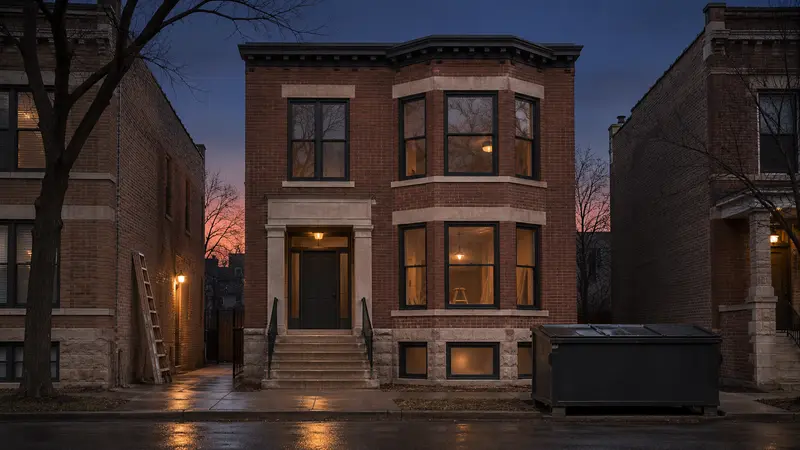
Points and fees on a $308,500 loan for a Portage Park two-flat
Purchase $265,000, approved rehab $70,000, supported ARV $465,000.
Closing charges across the published points range
| Line | Amount | How it is figured |
|---|---|---|
| Origination, 1 point | $3,085 | $308,500 x 1% |
| Processing and underwriting | $1,295 | lender charge, flat |
| Loan document preparation | $895 | lender charge, flat |
| Valuation | $675 | third party |
| Lender's title policy and endorsements | $1,450 | third party |
| Settlement fee | $950 | third party |
| Recording, deed and mortgage | $214 | Cook County Clerk |
| Origination at 3 points instead | $9,255 | $308,500 x 3% |
| Total at the high end | $14,734 | flat lines unchanged |
| Loan-related charges at closing, low end | $8,564 |
Line items sum to the stated result. Checked in code at build.
Cost of the money at the high end, sold in month 4
| Line | Amount | How it is figured |
|---|---|---|
| Points and flat charges | $14,734 | paid once, at closing |
| Interest, 4 months | $11,569 | $308,500 x 11.25% / 12 x 4 |
| Annualized, high end, 4 months | 25.58% | total / loan x 12 / 4 |
| Annualized, high end, 8 months | 18.41% | total / loan x 12 / 8 |
| Financing cost, high end, 4 months | $26,303 |
Line items sum to the stated result. Checked in code at build.
The gap between the two ends of the points range is $6,170 on this loan, more than every flat line combined ($5,479).
Assumptions
- The 11.25% rate is an input inside the published range of 8.99%-13.5%, not an offer, and interest is figured on the full commitment.
- Flat fees and title charges are illustrative inputs, not quotes. Draw fees are left out because they are underwritten file by file, ask your loan officer.
The flat charges come to $5,479, or 1.8% of this loan. On a loan half the size they would be nearly the same dollars and twice the percentage, which is why small loans are expensive to close. That squeeze is measured under margin at three price bands.
How much do points add per year on a 4-month versus an 8-month hold?
Points are paid once, so their yearly cost rises as the hold gets shorter. At 3 points and an assumed note rate of 11.25%, the sample loan costs 25.58% a year if it pays off in month four and 18.41% in month eight. At 1 point the figures are 19.58% and 15.41%.
A fast sale raises the annualized percentage and lowers the dollars: the four-month hold costs $26,303 in total against $37,872 for eight. Dollars are what leave your profit; the annualized figure is only for comparing a flip loan with other money, such as a partner's preferred return. Monthly interest and the other holding lines are under interest, taxes and insurance by month.
Why is there no APR on a flip loan term sheet?
A flip loan is business-purpose credit, and the federal Truth in Lending rules that produce an APR do not apply to it. Regulation Z at 12 CFR 1026.3(a) exempts credit extended primarily for a business or commercial purpose, and credit to a borrower that is not a natural person, such as your LLC.
So nobody hands you a Loan Estimate with a standardized APR box, and you build the comparison yourself. The exemption also explains the occupancy rule: the program is for non-owner-occupied investment property only.
Which fees are unpublished, and how do you budget for them?
Four items that affect total cost are not published for this program:
- Draw fees: underwritten file by file, ask your loan officer. A draw inspection happens each time you request funds, so multiply the per-draw charge by your planned draw count; see how rehab draws are released.
- Prepayment terms: underwritten file by file, ask your loan officer.
- Extension terms: underwritten file by file, ask your loan officer. See running past maturity.
- Minimum loan: underwritten file by file, ask your loan officer.
Put each one on your budget as a named line, filled from your written term sheet.
How do you compare two term sheets in dollars?
Convert both quotes to total dollars over the same hold.
- Size both quotes on the same purchase, rehab and ARV; lower leverage means a smaller points bill and a bigger down payment.
- Multiply points by the full commitment, holdback included.
- Add every flat lender fee and the title quote.
- Add interest for your planned hold, then again for the hold plus three months.
- Add per-draw charges times your draw count.
- Compare the totals at both hold lengths. If the ranking flips, your schedule risk decides.
The full flip deal model runs the same arithmetic with the rest of the deal attached, and the JFG draw process guide helps you estimate a draw count.
When paying points is the wrong move
If a resale contract or refinance is lined up within about 60 days, even the low end of the points range is a heavy charge for the time you use the money. On the sample loan 1 point is $3,085 whether you hold for two months or twelve. A deal that short with no construction is often a job for transactional money, compared under same-day funding versus a flip loan.
What should you do before you sign the term sheet?
Ask for three documents on the same day: the term sheet, the lender's full fee sheet, and a title quote for the lender's policy and settlement fee. Enter them into the closing-table cash worksheet next to the down payment and the buyer's transfer tax. The complete cash picture is under cash needed at closing, and the numbers hub links every other cost line on a Chicago flip.
Questions: Points and fees in dollars
Are points charged on the full loan or only on the purchase advance?
On a purchase-plus-rehab loan, points are normally figured on the whole commitment, including the rehab holdback you have not drawn yet. On the sample loan that means $308,500, not the $238,500 funded at the closing table. Confirm the base on your term sheet, because one point on the holdback alone is $700 here.
Can points and lender fees be rolled into the loan?
Do not plan on it. The program sizes the loan at up to 90% of purchase price plus 100% of approved rehab, capped at 75% of supported ARV, and those limits are measured against purchase price, approved rehab and value, not against closing charges. Points, flat fees, title and recording are cash items on the settlement statement. That is why full rehab funding never means a closing with no cash: on the sample loan the loan-related charges alone run $8,564 to $14,734 before the down payment.
Do I pay the recording fee on the mortgage, or does the lender?
The borrower pays it. The Cook County Clerk charges $107 per mortgage or release and $107 per deed, so a purchase with one deed and one mortgage records for $214 before any surcharge. The title company collects the money at closing and records the documents. When the flip sells and the loan is paid off, the release of the mortgage is a third recording at the same per-document price, usually collected on the payoff or the resale statement.
Is a lower rate with more points better on a short flip?
Usually not. Points are a one-time charge, so the shorter the hold, the more each point weighs. On the sample loan one point is $3,085, while one percentage point of rate costs $257 per month. A point therefore equals twelve months of a one-point rate difference. If you expect to sell in six months, a quote that trades one extra point for a rate one percentage point lower costs you about half a point more.
Are points on a flip loan refundable if I pay off early?
Treat points as earned at closing unless your loan documents say otherwise. Origination is the lender's charge for making the loan, and it is collected on the settlement statement on day one. Whether anything else is owed for an early payoff is a separate question: prepayment terms are underwritten file by file, ask your loan officer. Ask for the payoff mechanics in writing before closing.
Local rates and rules cited on this page
| Item | Figure | Primary source | Effective |
|---|---|---|---|
| Cook County deed recording fee | $107 per deed | Recording Fees (Cook County Clerk) | 2024-04-01 |
| Cook County mortgage / release recording fee | $107 per mortgage or release | Recording Fees (Cook County Clerk) | 2024-04-01 |
| Chicago transfer tax, City portion (buyer) | $3.75 per $500 of price | Real Property Transfer Tax (7551) (City of Chicago Department of Finance) | 2008-04-01 |
| Rental Housing Support Program fee inside recording fee | $18 of each $107 recording | Recording Fees (Cook County Clerk) | 2024-04-01 |
Rates as of November 25, 2026. Confirm with the agency before relying on any figure.
Sources
- 12 CFR 1026.3 Exempt transactions (Regulation Z), Consumer Financial Protection Bureau, 2026.
- Recording Fees, Cook County Clerk, 2024-04-01.
- Title Insurance Act, 215 ILCS 155, Illinois General Assembly, 2026.
- ALTA Settlement Statements, American Land Title Association, 2026.
- Real Property Transfer Tax (7551), City of Chicago Department of Finance, 2026.
- Residential Real Property Disclosure Act, 765 ILCS 77/78 (Anti-Predatory Lending Database exemptions), Illinois General Assembly, 2015-01-01.