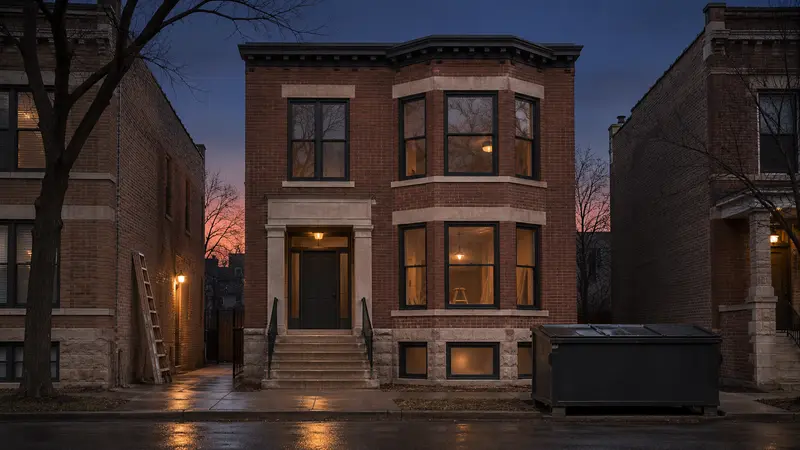
A lender supports ARV with closed sales of renovated buildings of the same type in the same market area, not with your budget or nearby list prices. JFG caps the loan at 75% of supported ARV. In the example below, a supported value $70,000 under the investor's own figure adds $11,000 to the down payment.
- JFG's published standard
- supported by comparable sales; a third-party valuation may be required
- Loan cap tied to ARV
- 75% of supported ARV
- Closed comps in a Fannie Mae appraisal
- at least 3 closed sales
- Preferred comp age
- closed within the last 12 months
- Sale history shown
- 3 years for the subject; 12 months for each comparable
- Citywide 2-6 unit median sale
- $443,000
- Citywide single-family median sale
- $307,100
Program terms as of November 26, 2026. Rates as of November 25, 2026.
On this page
- What does "supported" mean?
- Which sales count as comps?
- Why is a two-flat compared only to other two-flats?
- How do boundary streets change the comp set?
- How is as-is value different from as-completed value?
- What can a third-party valuation involve?
- Why does the lender's ARV come in lower than yours?
- What a lower supported ARV does to the loan
- Where can you pull Cook County sales yourself?
- How do you build a comp packet a reviewer will accept?
You ran comps and got one number. The lender ran comps and got a lower one. Nobody is lying; the two of you chose different sales. Know which sales a reviewer accepts and you can find the lower number yourself, before the offer.
Jaken Finance Group, the lender that publishes this site, sizes its flip loans against after-repair value. This page describes the test your number has to pass, using public appraisal standards.
What does "supported" mean?
Supported means a third party could reach the same value from closed sales without taking your word for anything. JFG's published wording is that ARV is supported by comparable sales; a third-party valuation may be required. Your contractor's budget is not support. A $110,000 rehab adds $110,000 of value only if renovated buildings nearby sold for that much more.
Which sales count as comps?
The sales that count are closed, recent, nearby, the same building type and already renovated. Fannie Mae's comparable sales topic is the reference most residential appraisers are trained on, and a private lender's reviewer applies the same logic.
| Test | What a reviewer looks for | Why it matters on a flip |
|---|---|---|
| Closed | at least 3 closed sales; listings and pendings are support only | Asking prices are not evidence |
| Recent | closed within the last 12 months; older needs a reason and a time adjustment | A stale peak sale gets adjusted or dropped |
| Location | Same neighborhood where possible; outside sales need a stated reason | A sale across a major street can be a different market |
| Type | Same unit count and building style | Two-flats are not houses |
| Condition | Renovated, similar finish level | ARV is the value after the work |
| Arm's length | Ordinary sale between unrelated parties | Related-party and estate transfers mislead |
Fannie Mae sets no cap on the size of adjustments and no rule that comps must straddle the subject. Bracketing is still worth doing in your own packet: show one renovated sale slightly smaller or plainer than your finished building and one slightly larger or better.
Why is a two-flat compared only to other two-flats?
Because a different buyer pays for it, with different financing and a different reason to buy. Appraisers report two- to four-unit buildings on Fannie Mae's Form 1025, the small residential income form, and houses on Form 1004, per the report forms topic. The Cook County Assessor separates them too: its class definitions put apartment buildings of two to six units in class 2-11 and houses in other class 2 codes by size and age.
The price gap is visible in recorded sales across the city:
| Chicago sales, May 2024 to April 2026 | Sales | 25th percentile | Median | 75th percentile |
|---|---|---|---|---|
| Single-family | 19,138 | $193,813 | $307,100 | $475,000 |
| Two to six units | 9,243 | $270,000 | $443,000 | $695,000 |
Source: Cook County Assessor's Office, Assessor - Parcel Sales (dataset wvhk-k5uv), 2024-05-01 to 2026-04-30; retrieved 2026-11-26.
Citywide medians mix every neighborhood and condition and prove nothing about your block. They do show how far a comp from the wrong row can move a value. JFG's two-flat and three-flat financing guide covers underwriting; five units and up is valued differently again, as covered under the four-unit residential cutoff.
How do boundary streets change the comp set?
An appraiser has to name the neighborhood's limits to the north, south, east and west, using streets, rail lines, water or recognized boundaries, under Fannie Mae's neighborhood section topic. Comps should come from inside those limits when they exist. A sale from a competing neighborhood is allowed if the appraiser says so and addresses the difference; the boundary cannot be stretched to take it in.
Prices in Chicago can step at an arterial, a viaduct or an expressway. Pull comps by community area first, then check each against the street that divides the market. The neighborhood data pages list median prices by building class.
How is as-is value different from as-completed value?
As-is value is the building today, in its present condition, use and zoning. As-completed value is a prospective figure: what it should be worth once the work is done, as of the expected completion date. Those definitions come from the federal bank regulators' appraisal and evaluation guidelines, which say a lender financing a renovation would generally want the as-is figure and may also ask for the prospective one.
The as-is number is a check on what you are paying. The as-completed number is the ARV the ARV cap is measured against. On Fannie Mae's condition scale a fully renovated home with no deferred maintenance rates C2, and your comps should be in that condition as of their sale dates.
What can a third-party valuation involve?
It can range from a desk check of your comps to a full interior appraisal reporting both values. A broker price opinion is a third form: the regulators' glossary calls it an agent's estimate of a probable sale or list price, not an appraisal by itself. Which one a given file needs is the lender's call; JFG's loan requirements page lists what it asks for, and this site's requirements summary covers the Chicago file.
Why does the lender's ARV come in lower than yours?
Usually for one of six reasons:
- You used list prices or pending deals; the reviewer used closings.
- Your best comp is a single-family house and the subject is a two-flat, or the reverse.
- Your best comp sits across a boundary street in a stronger market.
- The comp is larger, has a garage or carries a higher finish level than your scope delivers.
- The comp closed more than a year ago.
- The comp price included seller credits, which appraisers adjust out.
You can contest the figure with closings, not opinions. Fannie Mae's reconsideration of value procedure is the model: one borrower request per appraisal, up to five alternative sales, each with its source. It does not bind a private flip lender, so ask how rebuttals are handled before the valuation is ordered.
What a lower supported ARV does to the loan
Same two-flat, two ARVs: $610,000 and $540,000
One purchase at $340,000 with a $110,000 approved rehab, sized twice. Inputs are illustrative.
Sized at your ARV
| Line | Amount | How it is figured |
|---|---|---|
| Advance toward the purchase | $306,000 | 90% of $340,000 |
| Rehab holdback | $110,000 | 100% of the approved budget |
| ARV cap | $457,500 | 75% of $610,000; not binding |
| Down payment | $34,000 | |
| Loan | $416,000 |
Line items sum to the stated result. Checked in code at build.
Sized at the supported ARV
| Line | Amount | How it is figured |
|---|---|---|
| Advance toward the purchase | $295,000 | what is left under the cap after the holdback |
| Rehab holdback | $110,000 | |
| ARV cap | $405,000 | 75% of $540,000; now the limit |
| Down payment | $45,000 | |
| Loan | $405,000 |
Line items sum to the stated result. Checked in code at build.
What the lower number costs at the closing table
| Line | Amount | How it is figured |
|---|---|---|
| Down payment at your ARV | $34,000 | |
| Added because the cap binds | $11,000 | $416,000 less $405,000 |
| Down payment at the supported ARV | $45,000 |
Line items sum to the stated result. Checked in code at build.
The first $55,333 of the haircut cost nothing: the cap does not bind until ARV falls below $554,667. Only the last stretch, from $554,667 down to $540,000, came out of the loan.
Assumptions
- Sized at up to 90% of purchase price plus 100% of approved rehab, capped at 75% of supported ARV. First-time flippers: reviewed; maximum leverage is not assured.
- Down payment excludes points, fees, title and transfer tax.
A haircut hurts only once it pushes ARV below the point where the cap starts to bind. The break-even is derived under LTC versus the ARV cap. Every dollar the loan loses is a dollar added to your cash at the closing table.
Where can you pull Cook County sales yourself?
Two free public sources cover most of it. The Assessor's parcel sales dataset lists sales since 1999 by PIN, class, date, price and deed type. It leaves out sales under $10,000 and quitclaim, executor and beneficial-interest deeds, and records can appear months after recording. For the newest closings, search the Clerk's recordings system by PIN to see the deed and any mortgage recorded with it.
Public records give price and date, not condition, so confirm each sale was renovated from listing photos.
When there are no renovated comps
If yours would be the first full rehab on the block and nothing renovated has closed nearby in a year, no packet will support a premium number. Offering less, cutting the scope to what the block has paid for, or bringing more cash will. The ARV-to-offer calculator runs the offer backward from a conservative ARV, and JFG's 2026 neighborhood guide shows where renovated sales are already closing.
How do you build a comp packet a reviewer will accept?
- Fix the building type and legal unit count first. Every comp must match.
- Pull closed sales from the last twelve months inside your boundary streets.
- Keep only renovated ones. Save a photo and the recorded price for each.
- Choose three to six, with at least one a little inferior and one a little superior to your finished plan.
- Note every difference: size, garage, basement, finish level, credits.
- State your ARV as a range and say which comp it leans on.
The ARV comp packet template lays this out in the order a reviewer reads it. The rest of the deal math is in the numbers index. This page is general education, not an appraisal or a commitment to lend at any value.
Questions: How lenders support ARV
Can I use active listings or pending contracts as comps?
As color, yes. As support, no. Fannie Mae's comparable sales guidance, the reference most residential appraisers work from, allows contracts and current listings as supporting data but does not count them toward the required closed sales, which are at least 3 closed sales. Put listings on a separate page of your packet, labeled as market context, and lead with recorded closings.
Will the price I paid for the building hold my ARV down?
It will be on the page. Appraisal forms report the subject's sale history for three years, so a distressed purchase a few months earlier sits beside the after-repair opinion. That does not cap the value, but the gap has to be explained by the work. Hand over the scope of work, the budget and, after completion, permits and photos, so the difference is documented.
Is price per square foot a fair way to argue value on a two-flat?
Only among buildings of the same type and size class. A per-foot figure from renovated single-family houses overstates a two-flat, because the buyers and the financing differ. Fannie Mae also requires adjustments to reflect how the market reacts, not rules of thumb, so a flat per-foot multiplier is weak support by itself. Use it as a cross-check after picking comps on type, unit count, location and condition. The Chicago two-flat page covers what those buyers pay for.
Can I order my own appraisal and give it to the lender?
Ask before you spend the money. Federal bank regulators treat a borrower-ordered appraisal as a violation of their appraisal rules, because the lender is supposed to engage the appraiser. Those rules bind regulated banks, not every private lender, but most lenders order any valuation themselves. JFG's published position is that ARV is supported by comparable sales; a third-party valuation may be required.
Does a basement or attic unit without permits add to ARV?
Do not count on it. In Chicago, a transfer of residential property with five or fewer units needs a Certificate of Zoning Compliance, which states the number of legal dwelling units; the fee is $120. A valuation follows legal use, so a two-flat with an unrecognized garden unit is compared to two-flats. If the plan needs a third legal unit, the zoning rules for added units come first.
Local rates and rules cited on this page
| Item | Figure | Primary source | Effective |
|---|---|---|---|
| Minimum comparable sales in a Fannie Mae appraisal | at least 3 closed sales | B4-1.3-08, Comparable Sales (Fannie Mae) | 2025-06-04 |
| Preferred age of comparable sales | closed within the last 12 months | B4-1.3-08, Comparable Sales (Fannie Mae) | 2025-06-04 |
| Sales left out of the Assessor's parcel sales data | sales under $10,000 and quitclaim, executor and beneficial-interest deeds | Assessor - Parcel Sales (Cook County Assessor's Office) | 2026 |
| Sales history reported in an appraisal | 3 years for the subject; 12 months for each comparable | B4-1.3-07, Sales Comparison Approach Section of the Appraisal Report (Fannie Mae) | 2025-06-04 |
| Certificate of Zoning Compliance fee | $120 | Certificate of Zoning Compliance (City of Chicago Department of Planning and Development) | 2021-01-11 |
Rates as of November 25, 2026. Confirm with the agency before relying on any figure.
Sources
- Selling Guide B4-1.3-08, Comparable Sales, Fannie Mae, 2025-06-04.
- Selling Guide B4-1.3-03, Neighborhood Section of the Appraisal Report, Fannie Mae, 2025-06-04.
- Selling Guide B4-1.2-01, Appraisal Report Forms and Exhibits, Fannie Mae, 2025-09-03.
- Selling Guide B4-1.3-06, Property Condition and Quality of Construction, Fannie Mae, 2025-06-04.
- Selling Guide B4-1.3-09, Adjustments to Comparable Sales, Fannie Mae, 2025-06-04.
- Selling Guide B4-1.3-12, Appraisal Quality Matters, Fannie Mae, 2025-09-03.
- Interagency Appraisal and Evaluation Guidelines, 75 FR 77450, OCC, Federal Reserve, FDIC, OTS, NCUA (Federal Register), 2010-12-10.
- Assessor - Parcel Sales, Cook County Assessor's Office, 2026.
- Property Records Search, Clerk's Recordings System, Cook County Clerk, 2026.
- Definitions for the Classifications of Real Property, Cook County Assessor's Office, 2026.