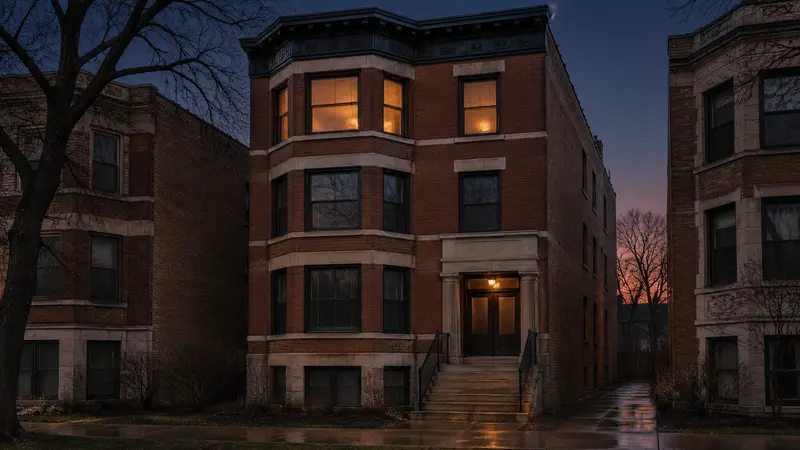
Four units is the top of residential mortgage lending; five is commercial multifamily. Fannie Mae's single-family guide covers 1 to 4 units, and Regulation C defines multifamily as 5 or more dwelling units. Cook County's property tax class holds through six units, and the Chicago RLTO's small-building exemption also stops at six.
- Conforming single-family loans
- 1 to 4 units
- Multifamily under Regulation C
- 5 or more dwelling units
- Cook County class 2 apartment buildings
- 2 to 6 units (class 2-11)
- Class 3 level at seven or more units
- 10% of market value
- FHA limit, four units, Cook County
- $1,041,125 (2026)
- Published rental exit
- DSCR loan at 5.75%-10.5%, 30-year, up to 75% LTV cash-out in Chicago
- Class 2-11 median sale, Chicago
- $440,000
Program terms as of November 26, 2026. Rates as of November 25, 2026.
On this page
- Why is four the cutoff for a residential mortgage?
- Where does each Chicago and Cook County rule draw its line?
- Does a fifth unit change the property tax class?
- How is a four-flat valued compared with a five-unit?
- What does the four-unit exit look like in numbers?
- Who can buy a four-flat that cannot buy a five-unit?
- Does your flip loan change at five units?
- Where are three- and four-unit buildings concentrated?
- Should you add or remove a unit to cross the line?
- What do you confirm before closing on either?
Investors talk about the four-unit line as if one rule sat there. In Chicago the lines fall at four, five, six and seven units, and a different agency or lender owns each. The lending line moves the most money: it decides which loans you can refinance into and which buyers can bid on your finished building.
This page maps every line, then prices the four-unit side. Building-specific rehab issues are on the three-flat page and the two-flat page; the property types hub has the rest.
Why is four the cutoff for a residential mortgage?
Four is the cutoff because the agencies that buy and insure home loans define their single-family programs that way. Fannie Mae's Selling Guide covers residential property of one to four units, and FHA publishes loan limits for one through four units and nothing above. On the other side, the federal mortgage reporting rule, Regulation C, defines a multifamily dwelling as one with 5 or more dwelling units.
At five units the loan is commercial, and each lender sets its own terms.
Where does each Chicago and Cook County rule draw its line?
Each rule has its own count, and only some sit between four and five. Use this as a checklist for any building near the edge:
| Rule | Applies to | Changes between 4 and 5 units? |
|---|---|---|
| Conforming single-family mortgage | 1 to 4 units | Yes |
| Illinois seller disclosure report | 1 to 4 residential units | Yes |
| City Certificate of Occupancy after rehab | Construction or substantial alteration of 4 or more dwelling units | No, starts at 4 |
| City Certificate of Zoning Compliance at sale | Residential property with 5 or fewer dwelling units | No, ends after 5 |
| Cook County class 2 | 2 to 6 units (class 2-11) | No, ends after 6 |
| RLTO small-building exemption | Owner-occupied buildings with 6 units or fewer | No, ends after 6 |
| Foreclosure law "residential real estate" | 6 or fewer dwelling units, one occupied by the mortgagor as a principal residence | No, ends after 6 |
| Tax sale redemption shortened to 1 year from the date of sale | Buildings of 7 or more units | No |
The City's Certificate of Occupancy page, the RLTO summary and the foreclosure definition are the sources for three of those rows. This is general education; confirm how each applies to your building with counsel.
Does a fifth unit change the property tax class?
No. Cook County's class 2 runs through six units, and even past that the level does not rise. The Assessor's class definitions put apartment buildings of two to six units in class 2-11 and buildings of seven or more in Major Class 3, and both carry a 10% assessment level. The 25% level belongs to commercial and industrial classes.
What changes at seven units is method and policy. The Assessor says it uses the income approach for most commercial property and counts apartment buildings over six units as commercial for its vacancy policy, where renovation vacancy relief is capped at 24 months per event.
How is a four-flat valued compared with a five-unit?
A four-flat is valued mainly from comparable sales, and a five-unit mainly from its income. Fannie Mae's appraisal standard for residential property calls for at least 3 closed sales, and Chicago supplies them: 8,701 class 2-11 sales in 24 months at a median of $440,000.
At five units, expect a commercial appraisal that capitalizes net operating income, the same logic the Assessor describes for apartment buildings. Your renovation then adds value only to the extent it adds rent or cuts expenses, and one vacant unit lowers the value of the whole building.
What does the four-unit exit look like in numbers?
On the four-unit side, the published rental exit is a DSCR loan at 5.75%-10.5%, 30-year, up to 75% LTV cash-out in Chicago. A DSCR loan is sized on value and tested on rent.
A finished four-flat refinanced at $760,000
Illustrative inputs, not an offer. This is the four-unit baseline; the fifth unit changes the loan product, not the arithmetic below.
Refinance proceeds
| Line | Amount | How it is figured |
|---|---|---|
| New DSCR loan | $570,000 | 75% of $760,000 |
| Refinance closing costs | -$14,250 | 2.5% of the new loan, an input |
| Flip loan payoff | -$505,000 | |
| Cash still in the deal | $45,250 | $96,000 invested less net proceeds |
| Net proceeds | $50,750 |
Line items sum to the stated result. Checked in code at build.
Monthly coverage
| Line | Amount | How it is figured |
|---|---|---|
| Rent, four units | $7,400 | |
| Principal and interest | -$3,986 | 7.5%, 30-year amortization |
| Property tax | -$1,315 | from the table below |
| Insurance | -$310 | |
| DSCR | 1.32 | rent divided by the full payment |
| Cash flow before vacancy and repairs | $1,789 |
Line items sum to the stated result. Checked in code at build.
Annual property tax on $760,000 either side of the class line
| Line | Amount | How it is figured |
|---|---|---|
| Class 2-11, two to six units | $15,781 | $76,000 assessed x 3.03 x 6.85% |
| Class 3, seven or more units | $15,781 | same 10% level |
| Class 5 commercial level, for contrast | $39,454 | |
| Tax at four, five or six units | $15,781 |
Line items sum to the stated result. Checked in code at build.
For a five-unit version, replace the first table's leverage and the second table's rate and amortization with a commercial lender's quoted terms. Those are your inputs; this site does not publish them.
Assumptions
- The 7.5% rate is an input inside the published DSCR range of 5.75%-10.5%; leverage is the published 75% cash-out maximum.
- Tax uses 3.0300 and 6.853152% for tax year 2025 on the refinance value, which is not the Assessor's value.
- Rent, insurance, payoff and closing costs are placeholders.
Compare this refinance with a sale in the exit comparer tool, and read selling versus keeping the building for the strategy. Whether a DSCR loan is available on five or more units is underwritten file by file, ask your loan officer; JFG's Chicago DSCR loans page describes the program and its BRRRR calculator runs the same math.
Who can buy a four-flat that cannot buy a five-unit?
Owner-occupants. A buyer who will live in one unit can use conforming or FHA financing on a four-flat, with 2027 conforming limits for a four-unit property in Cook County at $1,645,350.
A five-unit sells to investors using commercial debt, a smaller pool that prices to yield. The sale versus refinance page covers how the exit choice changes the hold.
Does your flip loan change at five units?
The legal category does not, but the program might. Under Regulation Z's commentary, credit to buy or improve non-owner-occupied rental property is business-purpose credit regardless of the number of units, so a four-flat flip and a five-unit rehab are both business loans.
The published flip program is up to 90% of purchase price plus 100% of approved rehab, capped at 75% of supported ARV. Whether it is offered on five or more units, or the deal moves to a bridge or commercial product, is underwritten file by file, ask your loan officer. State the legal unit count on the first page of your deal package checklist so the file goes to the right desk. JFG's two-flat and three-flat financing guide covers the small-building end. Either way, rehab financing leaves closing costs, interest and overruns to you in cash.
Where are three- and four-unit buildings concentrated?
Three- and four-unit buildings are a large share of the housing stock in a band of older community areas, measured by the Census Bureau's units-in-structure count.
| Community area | Units in 3- or 4-unit structures | Units in 5-or-more structures | Class 2-11 median sale |
|---|---|---|---|
| Lower West Side | 33.6% | 29% | $510,000 |
| North Lawndale | 33.2% | 24.3% | $363,000 |
| West Town | 33.1% | 42.1% | $926,000 |
Source: U.S. Census Bureau, American Community Survey 2020-2024 5-Year Estimates, Detailed Tables (table-based summary file) (dataset ACSDT5Y2024), 2020-01-01 to 2024-12-31; retrieved 2026-11-26. Source: Cook County Assessor's Office, Assessor - Parcel Sales (dataset wvhk-k5uv), 2024-05-01 to 2026-04-30; retrieved 2026-11-26.
In the North Lawndale community area and West Town roughly a third of all units sit in three- and four-unit buildings, which is where four-unit comps are easiest to find.
Should you add or remove a unit to cross the line?
Sometimes, but price both sides first. Chicago's additional dwelling unit rules allow conversion units at 33% of existing legal units; 1 unit for buildings with 1-4 units, so on a qualifying lot a four-flat can gain a fifth unit. That adds rent and moves the building out of residential lending in one step. Ask the lender you plan to exit with how it counts the added unit before you build it; the ADU ordinance page has the rules.
Going the other way, a permit that reduces the unit count carries a minimum fee of $1,800, and you give up a rent. A mixed-use building counts its commercial space too; see the storefront with apartments page.
When the four-unit plan fails
It fails when the fourth unit is not legal: a three-flat with an unpermitted garden apartment is a three-flat on the zoning certificate. It also fails when you size a five-unit exit with four-unit assumptions: there is no published DSCR term here to rely on above four units.
The better route is to pull the zoning certificate early, underwrite to the legal count, and get a commercial quote in writing before you buy anything with five or more.
What do you confirm before closing on either?
- Get the Certificate of Zoning Compliance and read the legal unit count.
- Match that count to the Assessor's class on the PIN record.
- Decide the exit, sale or refinance, and name the loan type your buyer or you will use.
- For five or more units, get a written commercial term quote and rerun the example with it.
- Check whether your rehab scope triggers a Certificate of Occupancy.
Questions: Four units versus five
Is a four-flat with a basement apartment a four-unit or a five-unit building?
It is whatever the legal unit count says, and each party checks that differently. The City's Certificate of Zoning Compliance states the number of legal dwelling units, and its scope is this: Residential property with 5 or fewer dwelling units. If the garden unit is not on that certificate, expect a lender to underwrite four units, and expect a buyer to ask you to legalize or remove the fifth before closing.
Does the RLTO treat a five-unit building differently from a four-flat?
Not for an investor. The ordinance's small-building exemption depends on the owner living there: Owner-occupied buildings with 6 units or fewer. A non-owner-occupied four-flat and a non-owner-occupied five-unit are both fully covered. The count matters only to an owner-occupant buyer, who is exempt up to six units. See RLTO rules for holders.
Do I owe a seller disclosure report on a five-unit building?
The Illinois Residential Real Property Disclosure Act covers 1 to 4 residential units, so the statutory report is tied to buildings of four units or fewer. A five-unit sale falls outside that form. Commercial buyers replace the form with their own inspection and document requests. Federal lead disclosure still applies to sales of housing built before 1978. Ask your closing attorney which disclosures your contract requires.
Does a four-unit rehab need a Certificate of Occupancy?
It can. The Department of Buildings states the trigger this way: Construction or substantial alteration of 4 or more dwelling units. The threshold sits at four, one unit below where commercial lending starts. A three-flat rehab does not need a certificate, while a four-flat with reconfigured units does, and so does every five-unit. Plan the final inspections and the certificate into the schedule.
Can an FHA buyer purchase a four-flat I renovated?
Yes, if the buyer will live in one unit and the numbers pass. The 2026 FHA limit for a four-unit property in Cook County is $1,041,125. Three- and four-unit purchases also face HUD's self-sufficiency test: PITI may not exceed 100% of net self-sufficiency rental income. A four-flat priced above what its rents support can fail that test even under the loan limit. None of this exists at five units, where FHA single-family programs stop.
Local rates and rules cited on this page
| Item | Figure | Primary source | Effective |
|---|---|---|---|
| Regulation C definition of a multifamily dwelling | 5 or more dwelling units | 12 CFR 1003.2(n) (Consumer Financial Protection Bureau) | 2026 |
| Fannie Mae single-family eligibility by unit count | 1 to 4 units | Selling Guide B2-3-01, General Property Eligibility (Fannie Mae) | 2025-09-03 |
| Residential Real Property Disclosure Act coverage | 1 to 4 residential units | 765 ILCS 77/5 - Definitions (Illinois General Assembly (ilga.gov)) | 2023-08-04 |
| Certificate of Occupancy required | Construction or substantial alteration of 4 or more dwelling units | Certificates of Occupancy (City of Chicago Department of Buildings) | 2026 |
| Transfers that need a Certificate of Zoning Compliance | Residential property with 5 or fewer dwelling units | Certificate of Zoning Compliance (City of Chicago Department of Planning and Development) | 2026 |
| Class 2 unit limit for apartment buildings | 2 to 6 units (class 2-11) | Definitions for the Classifications of Real Property (revised 12/16/24) (Cook County Assessor's Office) | 2024-12-16 |
| RLTO exemption for small owner-occupied buildings | Owner-occupied buildings with 6 units or fewer | Residential Landlord and Tenant Ordinance (City of Chicago Department of Housing) | 2026 |
| Residential real estate under the Illinois Mortgage Foreclosure Law | 6 or fewer dwelling units, one occupied by the mortgagor as a principal residence | 735 ILCS 5/15-1219 (Illinois General Assembly (ilga.gov)) | 2013-06-01 |
| Redemption period: vacant, commercial, industrial or 7+ unit property | 1 year from the date of sale | 35 ILCS 200/21-350, Period of redemption (Illinois General Assembly) | 2026-07-10 |
| Minimum comparable sales in a Fannie Mae appraisal | at least 3 closed sales | B4-1.3-08, Comparable Sales (Fannie Mae) | 2025-06-04 |
| Conforming loan limit, 4-unit, Cook County, 2027 | $1,645,350 | Conforming Loan Limits for Calendar Year 2027 - All Counties (CSV) (Federal Housing Finance Agency) | 2027-01-01 |
| Conversion units allowed | 33% of existing legal units; 1 unit for buildings with 1-4 units | ADU Requirements (City of Chicago Department of Housing) | 2025-09 |
| Minimum permit fee for reducing dwelling units | $1,800 | Department of Buildings Changes for 2026 (City of Chicago Department of Buildings) | 2026-01-06 |
| Cook County Class 3 multi-family assessment level | 10% of market value | Definitions for the Classifications of Real Property (revised 12/16/24) (Cook County Assessor's Office) | 2024-12-16 |
| FHA forward mortgage limit, Cook County, 4-unit, 2026 | $1,041,125 | FHA Mortgage Limits lookup (Cook County, IL, CY2026) (U.S. Department of Housing and Urban Development) | 2026-01-01 |
| Cook County final equalization factor, tax year 2025 | 3.0300 | 2025 Cook County Final Multiplier Announced (Illinois Department of Revenue) | 2026-06-18 |
| City of Chicago general composite tax rate, tax year 2025 | 6.853152% | 2025 Cook County Tax Rates Released (tax rate report) (Cook County Clerk) | 2025 |
| FHA self-sufficiency test, 3-4 unit properties | PITI may not exceed 100% of net self-sufficiency rental income | FHA Single Family Housing Policy Handbook 4000.1 (U.S. Department of Housing and Urban Development) | 2022-05-09 |
| Cook County Class 2 residential assessment level | 10% of market value | How Residential Properties Are Valued (Cook County Assessor's Office) | 2026 |
| Cook County Class 5 commercial/industrial assessment level | 25% of market value | Definitions for the Classifications of Real Property (revised 12/16/24) (Cook County Assessor's Office) | 2024-12-16 |
Rates as of November 25, 2026. Confirm with the agency before relying on any figure.
Sources
- Selling Guide B2-3-01, General Property Eligibility, Fannie Mae, 2025-09-03.
- 12 CFR 1003.2, Definitions (Regulation C), Consumer Financial Protection Bureau, 2026.
- Definitions for the Classifications of Real Property (revised 12/16/24), Cook County Assessor's Office, 2024-12-16.
- How Commercial Properties Are Valued, Cook County Assessor's Office, 2026.
- 735 ILCS 5/15-1219, Residential real estate, Illinois General Assembly, 2013-06-01.
- Residential Landlord and Tenant Ordinance, City of Chicago Department of Housing, 2026.
- Certificate of Occupancy, City of Chicago Department of Buildings, 2026.
- Regulation Z 1026.3, Exempt transactions, Consumer Financial Protection Bureau, 2026.