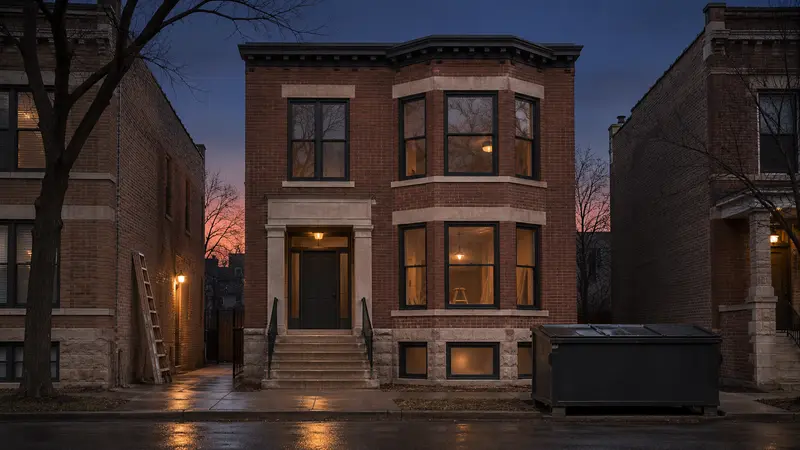
A two-flat flip is priced off other two-flats, because the likeliest buyer is an owner-occupant who wants the second unit's rent. Citywide, class 2-11 buildings sold at a median of $440,000 across 8,701 sales. The loan is capped at 75% of supported ARV, so comps set your ceiling.
- Assessor class
- 2-11, apartment building with 2 to 6 units
- Assessment level
- 10% of market value
- Citywide class 2-11 median sale
- $440,000 (8,701 sales)
- Middle half of class 2-11 sales
- $267,000 to $684,950
- FHA limit, 2-unit, Cook County
- $693,050
- Deconversion permit minimum fee
- $1,800
- Certificate of Zoning Compliance
- $120, required at resale
Program terms as of November 26, 2026. Rates as of November 25, 2026.
On this page
- How does Cook County class a two-flat?
- Who buys a finished two-flat, and why does that set the comps?
- What do two-flats sell for where they are common?
- What does a two-flat flip look like at the median?
- Can you deconvert a two-flat or duplex it down?
- Is the garden unit legal?
- What do two sets of mechanicals change?
- What should you check on the rear porch?
- What order should due diligence run in?
- What is the next step on a two-flat under contract?
Two stacked apartments, one lot, one deed. The Chicago Architecture Center counts more than 76,000 two-unit buildings in the city and notes they were built as wealth-building property: rent from one floor helped pay for the other. That logic still decides who buys your finished flip and what they can pay.
What follows is what differs from a house on a two-flat. Other building types are in the property type guides.
How does Cook County class a two-flat?
The Assessor puts a two-flat in class 2-11, which its class code definitions describe as an apartment building with 2 to 6 units of any age. It is still class 2 residential property, assessed at 10% of market value.
Class 2-11 lumps two-flats with three-flats and six-flats, so a raw class median is not a two-flat price. Citywide there were 8,701 class 2-11 sales in the window, the middle half between $267,000 and $684,950. Use that band as a sanity check, then narrow to two-unit sales on comparable blocks.
Who buys a finished two-flat, and why does that set the comps?
Two buyers show up. The owner-occupant lives in one unit and rents the other; the investor buys both for income. On a renovated building the owner-occupant is usually the stronger bidder. The Institute for Housing Studies at DePaul found roughly 54 percent of Chicago's 2 to 4 unit buildings carried a homeowner exemption in tax year 2019.
Many of those buyers use FHA loans, so two federal rules reach back into your deal:
- The FHA limit for a 2-unit property in Cook County is $693,050. A price above it removes FHA buyers.
- FHA's anti-flipping rule on a quick resale: Ineligible for FHA financing at 90 days or less, counted from your acquisition to the buyer's contract.
The appraiser values what that buyer is buying. ARV is supported by comparable sales; a third-party valuation may be required, which for a two-flat means closed sales of renovated two-unit buildings nearby, not house sales and not a rent multiple. Match unit count first, then construction type, then condition. Comp selection is covered under how lenders support ARV, and owner-occupant rehab loans under the 203(k) and HomeStyle comparison.
What do two-flats sell for where they are common?
Prices vary more by community area than by building. The table pairs the Census share of housing units in two-unit structures with class 2-11 sale prices.
| Community area | Units in 2-unit buildings | Class 2-11 median | Middle half of sales | Sales |
|---|---|---|---|---|
| South Lawndale | 32.9% | $298,000 | $225,000 to $400,000 | 209 |
| Humboldt Park | 31.1% | $400,000 | $276,150 to $535,000 | 319 |
| Austin | 26.6% | $350,500 | $227,000 to $444,975 | 502 |
| Logan Square | 16.6% | $805,000 | $600,000 to $1,050,000 | 380 |
Source: Cook County Assessor's Office, Assessor - Parcel Sales (dataset wvhk-k5uv), 2024-05-01 to 2026-04-30; retrieved 2026-11-26. Source: Cook County Assessor's Office, Assessor - Parcel Universe (Current) (dataset pabr-t5kh); retrieved 2026-11-26. Source: U.S. Census Bureau, American Community Survey 2020-2024 5-Year Estimates, Detailed Tables (table-based summary file) (dataset ACSDT5Y2024), 2020-01-01 to 2024-12-31; retrieved 2026-11-26. Source: City of Chicago, Boundaries - Census Tracts - 2020 (dataset 7qjk-677h); retrieved 2026-11-26.
The Humboldt Park data page sets permits and violations next to these prices.
What does a two-flat flip look like at the median?
The example fixes the resale at the citywide class 2-11 median and works backward to the price you can pay.
A two-flat bought at $199,000 and resold at the citywide class 2-11 median
The resale price is the citywide class 2-11 median, not a forecast for any block.
Where the $440,000 resale price goes
| Line | Amount | How it is figured |
|---|---|---|
| Purchase price | $199,000 | |
| Buyer closing costs and City transfer tax | $4,893 | $3,400 of closing costs plus $1,493 of tax |
| Rehab and contingency | $118,800 | $108,000 plus 10% |
| Points, lender fees and interest | $25,077 | 2 points on $287,100, 7 months at 10.5% |
| Taxes, insurance and utilities | $8,120 | $1,160 a month |
| Commission, seller transfer taxes and closing | $28,180 | |
| Profit before income tax | $55,931 | 12.71% of the resale price |
| Resale price | $440,000 |
Line items sum to the stated result. Checked in code at build.
Cash you front before the sale closes
| Line | Amount | How it is figured |
|---|---|---|
| Down payment | $19,900 | |
| Closing costs, transfer tax, points and fees | $12,385 | |
| Contingency reserve | $10,800 | |
| Interest payments | $17,585 | |
| Taxes, insurance and utilities | $8,120 | |
| Loan amount | $287,100 | 65.3% of resale |
| Cash invested | $68,789 |
Line items sum to the stated result. Checked in code at build.
At a median resale the building has to be bought near $199,000 to leave $55,931. Pay $229,000 for the same building and more than half of it is gone.
Assumptions
- The 10.5% rate and 2 points are inputs inside the published ranges of 8.99%-13.5% and 1-3 points, not an offer.
- Interest runs on the full loan from day one. Price, budget, hold and carrying costs are illustrative.
Financing 100% of the rehab does not mean no cash. Closing costs, points, interest, the contingency and work done ahead of each draw come from you. Test your own inputs in the two-flat rehab budget builder.
Can you deconvert a two-flat or duplex it down?
Sometimes; it depends on the block. Deconversion turns the two units into one house. A duplex-down joins the first floor to the basement and keeps a second unit above. Three zoning rules can stop a deconversion:
- The 606 district. Inside the mapped Predominance of the Block District the rule for a detached house reads: Not allowed in RS3 where more than 50% of the block face is multi-unit (40% in RT3.5).
- Pilsen. The Multi-Unit Preservation District also catches two-flats: Detached house or two-flat allowed only where more than 50% of the block face already holds one.
- Near transit. Citywide, Section 17-2-0303-B makes a newly established detached house a prohibited use in RT and RM districts in community preservation areas within 2,640 feet of a CTA or Metra rail station.
The Department of Housing posts the ordinances behind the Pilsen and 606 rules. Where a deconversion is allowed, the permit that reduces the unit count carries a minimum fee of $1,800.
Check the economics too. DePaul counted more than 4,800 two to four unit buildings lost between 2013 and 2019; 47.5 percent became single-family homes, mostly in high-cost areas such as North Center and Lake View. Elsewhere a deconversion deletes the rent your buyer wanted. Confirm any specific lot with a zoning attorney.
Is the garden unit legal?
Assume it is not until the City says so. A basement garden unit counts only if it is a legal dwelling unit, and the document that settles it is the Certificate of Zoning Compliance. The City requires one when residential property with five or fewer units is sold, the fee is $120, and it states the number of legal units.
You will hand that certificate to your buyer, so a "two-flat plus garden" listing on a building certified for two units invites a renegotiation. Ask the seller for the last certificate during due diligence. Ways to legalize a basement unit are on the page about zoning for a basement unit.
What do two sets of mechanicals change?
They change the budget and the resale pitch. One boiler and one gas meter leave the owner paying to heat both floors to the ordinance minimum (68 degrees F from 8:30 a.m. to 10:30 p.m.). Buyers who plan to rent a unit care which utilities the tenant carries. Separating systems means two heating plants, two water heaters, two electric panels and often new gas piping, each a permit trade. On the walkthrough, count meters and heating plants, note which unit each serves, and ask whether the water service is lead.
What should you check on the rear porch?
Check it first, because it is the upper unit's second way out. The Department of Buildings requires every part of a porch to carry 100 pounds per square foot. Under the Express Permit Program the no-drawings path for a multi-story porch has this limit: In-kind replacement of up to 25% of the structure. Past that you need stamped drawings. Each threshold is explained under porch and masonry repairs.
What order should due diligence run in?
Run the checks that can kill the deal before the ones that only adjust the budget.
- Pull the Assessor record and confirm class 2-11 and the unit count.
- Compare the last Certificate of Zoning Compliance with the listing.
- Look up the zoning district and the 606 and Pilsen boundaries before pricing a deconversion.
- Search open building violations, especially porch and exterior wall items.
- Count meters, heating plants and water heaters, and have the rear stairs inspected.
- Build the comp set from two-unit sales, then write the scope of work against it.
The checklist with City lookup links has the lookup links.
When a two-flat flip does not work
It fails when the plan depends on a unit count or use the lot does not support: a garden unit missing from the zoning certificate, or a deconversion on a block where the ordinance bars it. It also fails when nearby sales are all investor-grade rentals and the budget assumes owner-occupant pricing.
Price the building at its certified unit count. If the block is a rental block, a lighter scope sold to an investor, underwritten on rent the way three-flat buyers do, may fit better than a full gut.
What is the next step on a two-flat under contract?
Send the address, the certified unit count, your comp set and a line-item budget. Jaken Finance Group lends on fix and flip projects in Chicago and publishes a separate two-flat and three-flat financing guide that goes deeper on loan structure. Leverage for first-time flippers is reviewed; maximum leverage is not assured. If the building has a limestone front, read the greystone page before budgeting the facade.
Questions: Flipping a two-flat
Does a two-flat count as one property or two for a fix and flip loan?
One. A two-flat sits on a single PIN with a single deed, and lenders treat it as one 1-4 unit residential property. The loan is sized on the whole building: up to 90% of purchase price plus 100% of approved rehab, capped at 75% of supported ARV. What changes is the budget, since most line items are bought twice, and the valuation, since the appraiser looks for two-unit sales. The program is for non-owner-occupied investment property only, so you cannot live in a unit during the work.
Should both units be vacant before I close on a two-flat flip?
Vacant is simpler, but it is not always what you are offered. A tenant with a lease keeps it after the sale, and Chicago's RLTO sets notice periods from 30 days to 120 days to end a tenancy, depending on how long the tenant has lived there. Put that time into the hold before you price the deal, and confirm possession terms with your attorney.
Can I add a third unit to a two-flat instead of flipping it as is?
Sometimes, through the Additional Dwelling Unit ordinance. A building with 1 to 4 legal units may add one conversion unit if it is at least 20 years old, and in RS districts only inside an ADU-allowed area. A third unit moves the comp set to three-unit sales and adds permit time. The ADU rules for investors cover eligibility and pre-certification.
Will my buyer's property tax bill match the one I paid during the flip?
Not necessarily. Class 2 property, which includes class 2-11, is assessed at 10% of market value, and that level does not change with the owner. Exemptions do. An investor-owned two-flat carries no homeowner exemption, while an owner-occupant buyer can apply for the $10,000 reduction in EAV. Tell buyers the current bill reflects your ownership, not theirs.
How long should I plan to hold a two-flat flip?
Plan from the permit path, not a rule of thumb. Citywide, renovation permits in the data window took a median of 56 days from application to issuance, and a two-flat getting new plumbing, electric and two kitchens is rarely a no-permit job. Add construction, listing time and the buyer's financed closing. The seven months in the example is illustrative.
Local rates and rules cited on this page
| Item | Figure | Primary source | Effective |
|---|---|---|---|
| Cook County Class 2 residential assessment level | 10% of market value | How Residential Properties Are Valued (Cook County Assessor's Office) | 2026 |
| FHA forward mortgage limit, Cook County, 2-unit, 2026 | $693,050 | FHA Mortgage Limits lookup (Cook County, IL, CY2026) (U.S. Department of Housing and Urban Development) | 2026-01-01 |
| FHA anti-flipping: resale within 90 days | Ineligible for FHA financing at 90 days or less | 24 CFR 203.37a - Sale of property (eCFR / HUD) | 2006-06-07 |
| New detached houses in the 606 Predominance of the Block District | Not allowed in RS3 where more than 50% of the block face is multi-unit (40% in RT3.5) | Chicago Zoning Ordinance 17-7-0590 Predominance of the Block (606) District (American Legal Publishing (Chicago Zoning Ordinance)) | 2025-07-16 |
| Pilsen Multi-Unit Preservation District rule | Detached house or two-flat allowed only where more than 50% of the block face already holds one | Municipal Code of Chicago 17-7-0580 Multi-Unit Preservation District (City of Chicago (American Legal Publishing)) | 2021-04-21 |
| Minimum permit fee for reducing dwelling units | $1,800 | Department of Buildings Changes for 2026 (City of Chicago Department of Buildings) | 2026-01-06 |
| Certificate of Zoning Compliance fee | $120 | Certificate of Zoning Compliance (City of Chicago Department of Planning and Development) | 2021-01-11 |
| Minimum indoor temperature, daytime | 68 degrees F from 8:30 a.m. to 10:30 p.m. | Chicago Heat Ordinance (City of Chicago Department of Buildings) | 2026 |
| Porch and deck live load | 100 pounds per square foot | Porch and Deck Safety (City of Chicago Department of Buildings) | 2026 |
| Multi-story porch repair without stamped drawings | In-kind replacement of up to 25% of the structure | Porch, Deck, Balcony, or Fire Escape Repair (City of Chicago Department of Buildings) | 2024-09-16 |
| Notice to end tenancy or raise rent, tenancy under 6 months | 30 days | Municipal Code of Chicago 5-12-130 Landlord remedies (American Legal Publishing (Municipal Code of Chicago)) | 2020-07 |
| Notice to end tenancy or raise rent, over 3 years | 120 days | Know Your Rights: Fair Notice Ordinance (City of Chicago Department of Housing) | 2020-07 |
| Minimum building age for a conversion unit | 20 years | ADU Requirements (City of Chicago Department of Housing) | 2025-09 |
| Cook County Homeowner Exemption | $10,000 reduction in EAV | Homeowner Exemption (Cook County Assessor's Office) | 2017 |
| Chicago transfer tax, City portion (buyer) | $3.75 per $500 of price | Real Property Transfer Tax (7551) (City of Chicago Department of Finance) | 2008-04-01 |
| Chicago transfer tax, CTA portion (seller) | $1.50 per $500 of price | Real Property Transfer Tax (7551) (City of Chicago Department of Finance) | 2008-04-01 |
| Cook County real estate transfer tax | $0.25 per $500 of value | Transfer Fees (Cook County Clerk) | 1968-01-01 |
| Illinois state real estate transfer tax | $0.50 per $500 of value | 35 ILCS 200/31-10, Imposition of tax (Illinois General Assembly) | 2005-06-01 |
Rates as of November 25, 2026. Confirm with the agency before relying on any figure.
Sources
- Definitions for the Codes for Classification of Real Property, Cook County Assessor's Office, 2024-12-16.
- Patterns of Lost 2 to 4 Unit Buildings in Chicago, Institute for Housing Studies at DePaul University, 2021-05-13.
- Two- and Three-flats, Chicago Architecture Center, 2026.
- Municipal Code of Chicago 17-7-0590 Predominance of the Block District, City of Chicago, 2026.
- Municipal Code of Chicago 17-2-0300 Bulk and density standards, City of Chicago, 2026.
- Certificate of Zoning Compliance, City of Chicago Department of Planning and Development, 2026.
- Northwest Side Preservation Ordinance, City of Chicago Department of Housing, 2024-09.