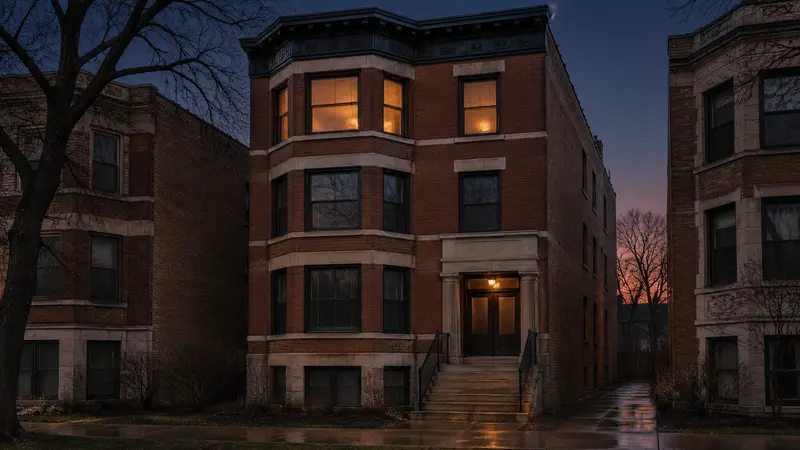
West Town is an expensive, permit-heavy flip market where the median math leaves almost no margin. The City issued 509 renovation permits there in 24 months at a median wait of 72 days. Two-to-six unit buildings sold for a median $926,000, and buying at the 25th percentile nets about $5,115.
- Renovation permits, 24 months
- 509
- Median application to issuance
- 72 days (city: 56)
- Standard Plan Review median
- 104.5 days on 284 permits
- Median two-to-six unit sale
- $926,000 (491 sales)
- Median single-family sale
- $1,225,000 (316 sales)
- Addresses with a violation, 24 months
- 582
- Housing units built before 1940
- 40.9%
Program terms as of November 26, 2026. Rates as of November 25, 2026.
On this page
- Why do Standard Plan Review permits take over 100 days in West Town?
- Which West Town blocks sit inside a landmark district?
- Does the 606 preservation district reach into West Town?
- What do two-to-six unit buildings sell for between the river and Kedzie?
- Does a median-to-median West Town flip clear a profit?
- How old is West Town's housing and how is it built?
- What do inspectors cite most on West Town buildings?
- How should you check a West Town address before you offer?
- What should you run next on a West Town deal?
West Town is community area 24: the blocks between Bloomingdale Avenue on the north and Kinzie Street on the south, from the North Branch of the Chicago River west to Kedzie Avenue. Wicker Park, Ukrainian Village and East Village all sit inside it. So do four Blue Line stations: Damen, Division, Chicago and Grand.
For a flipper, West Town combines three things that pull against each other: prices more than 2.09 times the citywide two-to-six unit median, plan-review waits longer than the city's, and overlay rules on its landmark and 606 district blocks.
Sources: City of Chicago Data Portal (Building Permits ydr8-5enu, Building Violations 22u3-xenr, 311 Service Requests v6vf-nfxy), 2024-11-01 to 2026-10-31; Cook County Assessor Parcel Sales (wvhk-k5uv), 2024-05-01 to 2026-04-30.
Why do Standard Plan Review permits take over 100 days in West Town?
West Town's 284 Standard Plan Review renovation permits took a median 104.5 days from application to issuance, 10.5 days longer than the citywide median for the same path. The 206 Self-Certification permits took 39 days. That two-month gap is the biggest scheduling choice a West Town rehab makes.
| Review path | Permits | Median days | Middle half | Citywide median |
|---|---|---|---|---|
| Standard Plan Review | 284 | 104.5 | 57 to 182 | 94 |
| Self Cert | 206 | 39 | 21 to 71 | 27 |
| Direct Developer Services | 19 | 110 | 74 to 157 | 87.5 |
| All renovation/alteration permits | 509 | 72 | 36 to 147 | 56 |
Source: City of Chicago, Department of Buildings, Building Permits (dataset ydr8-5enu), 2024-11-01 to 2026-10-31; retrieved 2026-11-26.
The West Town count covers the Renovation/Alteration permit type only. Small jobs filed through the Express Permit Program are a separate permit type and are left out. The Department of Buildings says Standard Plan Review is the main path for work that needs architectural plans. The other routes are compared in the guide to Chicago permit review paths.
Which West Town blocks sit inside a landmark district?
West Town holds at least three Chicago Landmark districts. The City's landmark district list dates Wicker Park to 1991, Ukrainian Village to 2002 with extensions in 2005 and 2007, and East Village to 2006. Historic Preservation staff review every permit application inside a district, which adds a review to a West Town schedule that is already slow. Scope limits are on the page about landmark district renovation rules.
Does the 606 preservation district reach into West Town?
Yes, on the northwest side of West Town. The boundary in Municipal Code 17-7-0591 runs down Western Avenue to Division Street, west to California Avenue and north to North Avenue. Inside it, on a lot zoned RS3, a detached house cannot be established where more than half the lots on that side of the block hold multi-unit buildings. In RT3.5 the threshold is 40%. A two-flat deconversion by teardown is the plan this rule stops.
Demolishing a residential building in the district also triggers the City's demolition surcharge of $20,000 per unit and $60,000 per building, in force until December 31, 2029. Logan Square, directly north across Bloomingdale Avenue, carries far more of this district; the Logan Square data page covers the tenant purchase rules that come with it.
What do two-to-six unit buildings sell for between the river and Kedzie?
West Town's 491 two-to-six unit sales had a median of $926,000, with the middle half between $678,750 and $1,250,000. Single-family houses sold higher, at a median $1,225,000 across 316 sales.
| Property class | Sales | 25th pct. | Median | 75th pct. | Citywide median |
|---|---|---|---|---|---|
| Single-family (class 2-02 to 2-10, 2-34, 2-78) | 316 | $874,975 | $1,225,000 | $1,561,138 | $307,100 |
| Two to six units (class 2-11, 2-12) | 491 | $678,750 | $926,000 | $1,250,000 | $443,000 |
| Condominium (class 2-99) | 1,597 | $460,000 | $580,000 | $712,000 | $325,000 |
Source: Cook County Assessor's Office, Assessor - Parcel Sales (dataset wvhk-k5uv), 2024-05-01 to 2026-04-30; retrieved 2026-11-26. Source: Cook County Assessor's Office, Assessor - Parcel Universe (Current) (dataset pabr-t5kh); retrieved 2026-11-26.
These are Cook County Assessor recorded sales with non-market deed types, token-price transfers and multi-parcel sales filtered out. The Institute for Housing Studies reports that business buyers took 44.8% of West Town's 2025 sales of two-to-four unit buildings, so expect to bid against other investors. For a three-flat, the page on three-flat flip financing covers the unit-count issues.
Does a median-to-median West Town flip clear a profit?
Barely: $5,115 on a $926,000 resale. The example uses the two-to-six unit class because its West Town sample (491 sales) is deeper than the single-family sample (316) and matches the area's flat-building stock.
A West Town two-to-six: bought at $678,750, resold at $926,000
Every price below is a West Town median or percentile from the data tables. Rate, points and carry lines are illustrative inputs, not an offer.
Which limit sets the loan
| Line | Amount | How it is figured |
|---|---|---|
| 90% of the purchase price | $610,875 | 25th percentile two-to-six unit sale, $678,750 |
| 100% of the rehab budget | $85,000 | West Town median reported permit cost |
| 75% of the resale value | $694,500 | $926,000 median sale; this lower figure is the loan |
| Loan by cost | $695,875 | $1,375 more than the ARV cap allows |
Line items sum to the stated result. Checked in code at build.
Median resale less every cost
| Line | Amount | How it is figured |
|---|---|---|
| Resale at the West Town median | $926,000 | |
| Purchase | -$678,750 | |
| Buy-side closing and City transfer tax | -$9,593 | $4,500 closing plus $5,093 tax |
| Rehab and 10% contingency | -$93,500 | $85,000 plus $8,500 |
| Points and lender fees | -$15,885 | 2 points on $694,500 |
| Interest, 8.4 months | -$52,990 | 10.9% on the full loan |
| Taxes, insurance, utilities | -$14,700 | $1,100, $350 and $300 a month |
| Commission at 5% | -$46,300 | |
| Seller transfer taxes and closing | -$9,167 | |
| Result before income tax | $5,115 | 0.55% of the resale price |
Line items sum to the stated result. Checked in code at build.
Cash in the deal is $170,918: $94,728 at closing and $76,190 during the hold.
Assumptions
- Rate of 10.9% sits inside the published range of 8.99%-13.5%; it is an input, not a quote.
- Hold is 6 months of rehab and sale plus the West Town median permit wait of 72 days.
- The 25th percentile sale stands in for a discounted purchase. Reported permit cost covers permitted work only.
The first table is the West Town finding. The ARV cap, not cost, sets the loan, by $1,375, because the 25th percentile purchase is so close to three quarters of the median resale. See cost limits versus the ARV cap for why West Town prices trip it. The second table says a typical West Town purchase with a typical permitted scope does not pay: a deal needs a resale above the median or a purchase below the 25th percentile. That is a statement about medians, not a forecast for any one building.
How old is West Town's housing and how is it built?
40.9% of West Town's 43,928 housing units were built before 1940, and 44.1% sit in two-to-four unit buildings. Only 10.8% are detached single-family houses.
| Housing stock | West Town |
|---|---|
| Housing units | 43,928 |
| Single-family detached share | 10.8% |
| Units in 2 to 4 unit buildings | 44.1% |
| Built before 1940 | 40.9% |
| Owner-occupied share of occupied units | 41.6% |
Source: U.S. Census Bureau, American Community Survey 2020-2024 5-Year Estimates, Detailed Tables (table-based summary file) (dataset ACSDT5Y2024), 2020-01-01 to 2024-12-31; retrieved 2026-11-26. Source: City of Chicago, Boundaries - Census Tracts - 2020 (dataset 7qjk-677h); retrieved 2026-11-26.
The figures are 2020-2024 American Community Survey estimates summed from 30 census tracts. Price lead-safe work and old wiring into a West Town scope of work from the first walk-through.
What do inspectors cite most on West Town buildings?
Exterior walls. "Repair exterior wall" leads the West Town list once elevator items are set aside. West Town logged 2,373 violation line items at 582 addresses, but 860 of them came from the elevator bureau and concern buildings with elevators. The conservation bureau, which inspects existing housing, wrote 979.
| Most cited violation (elevator bureau excluded) | Citations, 24 months |
|---|---|
| Repair Exterior Wall (CN061014) | 115 |
| Arrange For Reinspection Regar (CN190029) | 92 |
| Arrange Premise Inspection (CN190019) | 68 |
| Open (PL151137) | 56 |
| Arrange For Inspection (RF301041) | 55 |
| All violations, 582 addresses | 2,373 |
Source: City of Chicago, Department of Buildings, Building Violations (dataset 22u3-xenr), 2024-11-01 to 2026-10-31; retrieved 2026-11-26. Source: City of Chicago, Boundaries - Community Areas (dataset igwz-8jzy); retrieved 2026-11-26.
Most records show as open in the portal, so read the inspection narrative for the address, not the status.
How should you check a West Town address before you offer?
- Look up the parcel on the City zoning map and note the district and any landmark shading.
- If the lot is west of Western Avenue and north of Division Street, count the multi-unit buildings on that side of the block against the 606 district thresholds.
- Pull the address in the Department of Buildings records search for open enforcement cases and past permits.
- Ask your architect whether the West Town scope can self-certify. West Town's own data says the answer moves the permit date by about two months.
- Rerun the numbers in the two-closing deal analyzer with your real price and a hold that includes the permit wait.
When West Town does not work
A plan to buy a tired two-flat near the 606, convert it to a single-family house and sell at the $1,225,000 single-family median fails on zoning before it fails on money wherever the block is mostly multi-unit. If your purchase is not well under $678,750, look at lower-basis areas such as Humboldt Park to the west, or keep the units and model a rental hold.
What should you run next on a West Town deal?
Start with the resale. At these prices a 5% miss on ARV is larger than the whole median profit, so build the comp set by class and by block, and put it in a comp packet with adjustment notes the lender can check. JFG's guide to Chicago flipping neighborhoods gives the lender's view of Wicker Park, and its two-flat and three-flat financing guide covers how flat buildings are underwritten. Leverage is up to 90% of purchase price plus 100% of approved rehab, capped at 75% of supported ARV, and financed rehab still leaves closing costs, interest and overruns to pay in cash. Compare West Town with the Near West Side numbers or browse every tracked community area.
Questions: West Town flip data
Is Humboldt Park, the park, inside West Town?
Yes. The City's community area boundary file runs West Town's western edge along Kedzie Avenue between Augusta Boulevard and North Avenue, which puts the 197-acre park at 1440 N. Humboldt Boulevard inside West Town. Sales on the blocks east of Kedzie are counted in the West Town medians on this page, not in the Humboldt Park community area figures.
How many West Town sales are condominiums?
Condominiums were 66.4% of the West Town sales in the data, 1,597 of them at a median of $580,000. That matters for comps: a rehabbed two-flat or three-flat sold whole competes with a smaller pool of 491 two-to-six unit sales, so pull comps by class, and by block, before you set a West Town resale price.
Which aldermen cover West Town?
Five wards hold nearly all of West Town under the ward map in force since 2023. Measured against the City's ward boundary file, the 1st Ward covers about 30% of the land, the 27th about 25%, the 36th about 19%, the 26th about 17% and the 32nd about 9%. Confirm the ward for a West Town block by address.
Does West Town have tax increment financing districts?
The City's TIF boundary file lists three districts touching West Town: the Kinzie Industrial Conservation Area, Division/Homan, and Cortland and Chicago River. The file lists expiration dates of 2034, 2037 and 2043 for them, in that order. Check any West Town address against the City TIF map before closing. A TIF does not change your permit path.
How many new buildings and demolitions does West Town see?
The Department of Buildings issued 173 new construction permits and 97 wrecking permits in West Town over the same 24 months as the 509 renovation permits. That is roughly one teardown or new build for every two renovation permits, so expect a rehabbed building to be priced against new construction on the same block.
Local rates and rules cited on this page
| Item | Figure | Primary source | Effective |
|---|---|---|---|
| Demolition surcharge, Pilsen and 606 areas | $20,000 per unit and $60,000 per building | Demolition Surcharge (City of Chicago Department of Housing) | 2024-09 |
| Demolition surcharge sunset | December 31, 2029 | Demolition Surcharge (City of Chicago Department of Housing) | 2024-09 |
| Chicago transfer tax, City portion (buyer) | $3.75 per $500 of price | Real Property Transfer Tax (7551) (City of Chicago Department of Finance) | 2008-04-01 |
| Chicago transfer tax, CTA portion (seller) | $1.50 per $500 of price | Real Property Transfer Tax (7551) (City of Chicago Department of Finance) | 2008-04-01 |
| Cook County real estate transfer tax | $0.25 per $500 of value | Transfer Fees (Cook County Clerk) | 1968-01-01 |
| Illinois state real estate transfer tax | $0.50 per $500 of value | 35 ILCS 200/31-10, Imposition of tax (Illinois General Assembly) | 2005-06-01 |
Rates as of November 25, 2026. Confirm with the agency before relying on any figure.
Sources
- Building Permits (dataset ydr8-5enu), City of Chicago Department of Buildings, 2026-11.
- Assessor - Parcel Sales (dataset wvhk-k5uv), Cook County Assessor's Office, 2026-11.
- Municipal Code of Chicago 17-7-0590, Predominance of the Block District, City of Chicago, 2025-07-16.
- Landmark Districts (dataset zidz-sdfj), City of Chicago, 2011.
- Landmark Permit Review, City of Chicago Department of Planning and Development, 2026.
- Demolition Surcharge, City of Chicago Department of Housing, 2024-09.
- Standard Plan Review Permit Program, City of Chicago Department of Buildings, 2026.
- Housing Market Indicators Data Portal: West Town, Institute for Housing Studies at DePaul University, 2025.
- Blue Line route guide, Chicago Transit Authority, 2026.
- Boundaries - Community Areas (dataset igwz-8jzy), City of Chicago, 2025-04.