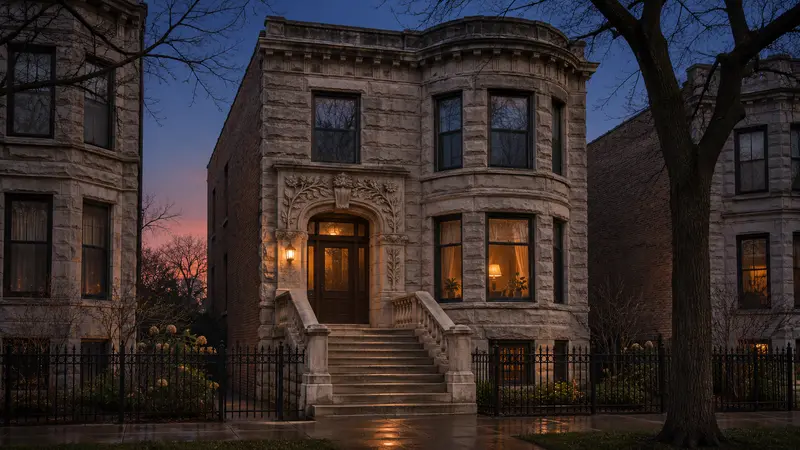
A lender's address matters less than whether the people on your file know how a Chicago deal closes and how its draws get inspected. Scale brings capital and programs; local familiarity brings fewer surprises with two-flats, city certificates and permits. Slow process is the real cost: three delays in this page's example total $5,777.
- What location changes
- Valuation judgment, closing checklist, draw inspection speed
- What scale changes
- Capital, loan size, exit programs
- Water certificate lead time
- Up to 10 business days; in-person may finish same day
- Zoning certificate decision
- 5 business days for the initial decision
- Median renovation permit, self-certified
- 27 days
- Median renovation permit, standard review
- 94 days
- JFG
- Nationwide private lender headquartered in Hoffman Estates, Illinois
Program terms as of November 26, 2026. Rates as of November 25, 2026.
On this page
- Which parts of a Chicago deal trip up an unfamiliar lender?
- How long do Chicago renovation permits take?
- What does a larger lender bring?
- Are you dealing with a direct lender or a broker?
- Which Illinois rules apply to a business-purpose flip loan?
- What is slow process worth in dollars?
- Where does Jaken Finance Group sit in this comparison?
- Seven questions to ask any lender before you apply
Investors ask this as a geography question. It is really a question about who reads your file. A loan officer in another state who has closed many Cook County deals knows more about your two-flat than a lender across town who mostly funds suburban ranches.
This site is published by Jaken Finance Group, so it has a position in this comparison. That position is stated in its own section below, without rankings or deal counts.
Which parts of a Chicago deal trip up an unfamiliar lender?
Four parts: the valuation, the city certificates, the tax credit and the permit clock. Each has a local rule behind it.
Valuation comes first. A greystone two-flat, a frame two-flat and a deconverted single-family on one block are three different products, and the lender has to accept comps from the right one. See how an ARV is supported and the greystone financing page.
Then the closing. Chicago will not issue transfer stamps without a Full Payment Certificate for water, which the Department of Finance says can take Up to 10 business days; in-person may finish same day. A Certificate of Zoning Compliance is required on Residential property with 5 or fewer dwelling units. Cook County taxes are billed in arrears, with a first installment equal to 55% of the prior year's total tax per the Treasurer's primer, so the seller's tax proration credit is an estimate. A lender who has not seen these asks about them in the last week. The title and water certificate page has the sequence.
| Item | Figure | Source | Effective |
|---|---|---|---|
| Full Payment Certificate processing time | Up to 10 business days; in-person may finish same day | City of Chicago Department of Finance | 2026 |
| Certificate of Zoning Compliance decision time | 5 business days for the initial decision | City of Chicago Department of Planning and Development | 2026 |
| Permit inspection request lead time | At least 4 business days | City of Chicago Department of Buildings | 2026 |
| Self-Certification typical issuance time | 10 business days after zoning approval | City of Chicago Department of Buildings | 2026 |
City timelines a lender's closing and draw schedule should already assume
How long do Chicago renovation permits take?
Half of Chicago's renovation and alteration permits issued in the 24 months through October 2026 took longer than 56 days from application to issuance, and the review path changes that number sharply.
| Review path | Permits | Median days | 25th percentile | 75th percentile |
|---|---|---|---|---|
| Self-certification | 4,995 | 27 | 9 | 54 |
| Standard plan review | 5,535 | 94 | 49 | 161 |
Source: City of Chicago, Department of Buildings, Building Permits (dataset ydr8-5enu), 2024-11-01 to 2026-10-31; retrieved 2026-11-26.
A lender who knows this sets the loan term and the first draw around the permit, and asks which path your architect is using. One who does not may approve a six-month plan that spends three months waiting. The Department of Buildings also asks for At least 4 business days of notice on permit inspections. The DOB permit paths page compares the routes.
What does a larger lender bring?
Size brings capital that does not run short and more than one program. Those matter on larger loans and on a plan that ends in a refinance.
| Factor | Where familiarity with Chicago helps | Where scale helps |
|---|---|---|
| Valuation | Picking comps by building type | Consistent written standards |
| Closing | City certificates and attorney closings | Funds wired on the scheduled day |
| Draws | Inspectors who can reach the site quickly | A staffed draw desk |
| Loan size | No difference | Larger loans; JFG's maximum is $10M |
| Exit | Knowing resale and rent levels | A refinance program in the same shop |
| Terminology | No difference | See flip, bridge and hard money labels |
Neither column is tied to a zip code. A national lender can hold all of the left column, and a small local fund can wire on time.
Are you dealing with a direct lender or a broker?
A direct lender funds from its own capital and makes the credit decision; a broker places your loan with someone else. Both can serve you well. What you need is to know which one you have, who approves draws and who collects what fee. Ask too whether the lender keeps the loan or sells it after closing, and who then decides on draws, an extension and the payoff.
Illinois regulates brokering. The Loan Brokers Act of 1995 requires registration to engage in loan brokering, and 815 ILCS 175/15-80 exempts, among others, a creditor on the loan and a person whose fee is wholly contingent on a funded commitment. In plain terms, be careful with anyone who wants a fee before a lender has committed.
Which Illinois rules apply to a business-purpose flip loan?
Fewer consumer rules apply, because the loan is not consumer credit. The Residential Mortgage License Act defines its covered loans by personal, family or household purpose (205 ILCS 635/1-4), and federal Regulation Z exempts credit that is primarily for a business purpose.
One Cook County item still touches every lender: a mortgage on investment property is exempt from the Anti-Predatory Lending Database, but Exempt, but a certificate of exemption is required to record the mortgage. A lender or title agent who has recorded here handles it routinely. Owner-occupant rehab loans sit under a different regime, covered on the 203(k) and HomeStyle comparison. This is general education; confirm licensing questions with Illinois counsel.
What is slow process worth in dollars?
Slow process is worth $175 a day on the example loan. That is the number to hold against any difference in rate or points.
What slow process costs on a $365,000 Bridgeport two-flat
Three ordinary delays on one project: a late purchase closing, a late resale closing and draws that fund slowly. Inputs are illustrative, not an offer.
Purchase closing slips 7 days
| Line | Amount | How it is figured |
|---|---|---|
| Seller's per-diem for the extension | $1,050 | $150 a day; a contract term, not a rule |
| Earnest money exposed if the seller refuses | $10,000 | |
| Cost of the late purchase | $1,050 |
Line items sum to the stated result. Checked in code at build.
Resale closing slips 7 days
| Line | Amount | How it is figured |
|---|---|---|
| Loan interest | $938 | $438,500 x 11% / 360 x 7 |
| Taxes, insurance, utilities | $288 | $1,250 a month |
| Cost of the late resale | $1,226 |
Line items sum to the stated result. Checked in code at build.
4 draws fund in 8 days instead of 3
| Line | Amount | How it is figured |
|---|---|---|
| Loan interest | $2,680 | 20 idle days if the crew waits to be paid |
| Taxes, insurance, utilities | $822 | |
| Largest draw you float meanwhile | $35,000 | |
| Cost of slow draws | $3,502 |
Line items sum to the stated result. Checked in code at build.
All three
| Line | Amount | How it is figured |
|---|---|---|
| Late purchase | $1,050 | |
| Late resale | $1,226 | |
| Slow draws | $3,502 | |
| Cost of slow process | $5,777 |
Line items sum to the stated result. Checked in code at build.
Each day on this loan costs $175. A lender that saves two weeks of process is worth about $2,451 here, before any rate difference.
Assumptions
- Rate of 11% is an input inside the published range of 8.99%-13.5%. Interest is figured on the full $438,500 commitment.
- The per-diem, earnest money, carry and draw timings are illustrative. Draw turnaround is not a published JFG figure.
- No interest runs before the purchase closes, so that slip costs only what the contract and the seller allow.
The late resale is the avoidable one. It usually traces to a certificate ordered late or a payoff letter requested late, not to the lender's location. Model your own schedule in the closing-delay cost calculator, and read draw inspections and timing before you set one.
Where does Jaken Finance Group sit in this comparison?
JFG is a nationwide private lender headquartered in Hoffman Estates, Illinois. It publishes Chicago fix and flip loan terms of up to 90% of purchase price plus 100% of approved rehab, capped at 75% of supported ARV, closing in 7-10 business days on complete files, counted after borrower conditions are met, with draws staged against a rehab holdback, with inspections.
That is a description, not a claim that it is the right lender for your deal. Its draw process guide shows how inspections and releases are sequenced, and the about page says who publishes this site. For timing, see Cook County closing speed.
When the lender's distance does become the problem
A lender far from Chicago is the wrong fit when the deal depends on judgment that is not in the file: a block with few renovated sales, an unusual building, or a legal unit count the records do not settle. A desk that cannot weigh those will cut leverage or decline late.
The better route is a lender, local or not, that will name the comps and the unit count it accepts before you go hard on earnest money. If you already hold a term sheet that changed late, a second look from JFG is one option among several.
Seven questions to ask any lender before you apply
- Do you fund from your own capital, or place the loan?
- Which comps would you accept for this building type on this block?
- Who inspects draws, and how many days from request to wire?
- Is interest charged on the full commitment or on drawn funds?
- Have you closed in Chicago with a water certificate and zoning certificate this year?
- What are the extension terms, in writing?
- What do you need on day one? Our day-one document checklist lists it.
Then compare the answers with the other funding comparisons on this site.
Questions: Local vs national lender
Is a local hard money lender cheaper than a national one?
Not as a rule, and no primary source publishes rates by lender type. Price depends on the lender's own cost of capital, the leverage you ask for and your file. Compare written term sheets on the same deal: rate, points, flat fees, draw fees, extension terms and how interest is charged on undrawn rehab funds. A lower rate with slower draws can cost more over a six-month project.
Will an out-of-state lender send someone to inspect my rehab?
Most lenders, wherever they sit, use a third-party inspector or a photo and video process for draws; few send their own staff. What you need to know is who the inspector is, how many days pass between your request and the visit, and how soon funds are wired after the report. Get those three answers in writing before you close, not at the first draw.
Does a Chicago flip loan have to come from an Illinois-licensed lender?
Illinois' Residential Mortgage License Act defines a residential mortgage loan by consumer purpose: personal, family or household use. A loan to an LLC to buy and renovate a building for resale is a business-purpose loan, outside that definition. That is general education, not a legal opinion; licensing turns on the facts of the loan, so confirm with Illinois counsel if occupancy or purpose is unclear.
Should I keep one lender or shop every deal?
A repeat relationship has real value: the lender already holds your entity documents, track record and contractor information, so the second file moves faster. Shopping has value too, because programs and pricing change. A reasonable practice is one primary lender, plus a second quote on any deal that is unusual in size, property type or leverage. JFG offers a second-look review for that purpose.
Can a national lender close in a land trust or LLC the way Chicago attorneys expect?
Ask before you apply. If your attorney plans to take title in an Illinois LLC or a land trust, the lender has to be comfortable with that vesting and with who signs the guarantee. A lender unfamiliar with the structure may add document requests late in the file. Send the entity documents with the application and ask the lender to confirm its vesting and guarantor requirements in the term sheet.
Local rates and rules cited on this page
| Item | Figure | Primary source | Effective |
|---|---|---|---|
| Full Payment Certificate processing time | Up to 10 business days; in-person may finish same day | Full Payment Certificates (City of Chicago Department of Finance) | 2026 |
| Transfers that need a Certificate of Zoning Compliance | Residential property with 5 or fewer dwelling units | Certificate of Zoning Compliance (City of Chicago Department of Planning and Development) | 2026 |
| First installment amount | 55% of the prior year's total tax | How the Illinois Property Tax System Works (October 2025 update) (Cook County Treasurer's Office) | 2025-10 |
| Permit inspection request lead time | At least 4 business days | Permit Inspections (City of Chicago Department of Buildings) | 2026 |
| APLD treatment of investment property loans | Exempt, but a certificate of exemption is required to record the mortgage | 765 ILCS 77/78 - Exemption (Illinois General Assembly (ilga.gov)) | 2015-01-01 |
| Certificate of Zoning Compliance decision time | 5 business days for the initial decision | Certificate of Zoning Compliance (City of Chicago Department of Planning and Development) | 2026 |
Rates as of November 25, 2026. Confirm with the agency before relying on any figure.
Sources
- Full Payment Certificates, City of Chicago Department of Finance, 2026.
- Certificate of Zoning Compliance, City of Chicago Department of Planning and Development, 2026.
- Permit Inspections, City of Chicago Department of Buildings, 2026.
- Property Tax Primer, Cook County Treasurer's Office, 2025-10.
- 205 ILCS 635/1-4, Residential Mortgage License Act definitions, Illinois General Assembly, 2025-01-01.
- 12 CFR 1026.3, Exempt transactions, eCFR / Consumer Financial Protection Bureau, 2026.
- 815 ILCS 175/15-80, Loan Brokers Act exemptions, Illinois General Assembly, 2017-08-18.
- Building Permits dataset, City of Chicago Department of Buildings, 2024-11 to 2026-10.