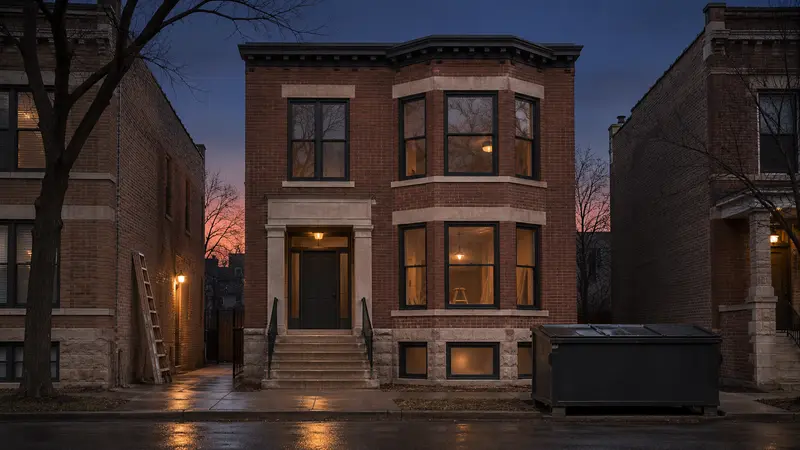
Flip when resale comps carry the deal and you want your cash back; BRRRR when renovated rents cover the new loan and you can leave cash in. The hold exit is a DSCR loan at 5.75%-10.5%, 30-year, up to 75% LTV cash-out in Chicago. Decide before the offer: each plan buys a different building.
- Flip is underwritten on
- Resale comps and days on market
- BRRRR is underwritten on
- Rents, taxes, insurance and DSCR
- Hold exit
- DSCR loan at 5.75%-10.5%, 30-year, up to 75% LTV cash-out in Chicago
- Example flip profit
- $46,303 before income tax
- Example cash left in after refinance
- $61,740
- Example DSCR
- 1.14 at $4,600 monthly rent
- Chicago's next reassessment
- Tax year 2027
Program terms as of November 26, 2026. Rates as of November 25, 2026.
On this page
- Which exit pays more on the same building?
- What do you underwrite differently when you plan to hold?
- Does the rent support a refinance at the leverage you need?
- What does a tenant add under the RLTO?
- How will the Assessor treat the finished building?
- How is the money taxed each way?
- How fast does each plan give your cash back?
- Pick the exit before you write the offer
A two-flat can end as a check at a closing table or as a rental with a 30-year loan on it. The rehab looks similar either way. The purchase does not: a flip buyer pays for what the block sells for, a BRRRR buyer pays for what the units rent for.
Jaken Finance Group, the lender behind this site, funds both exits, so this page has no reason to push one. It prices a single building both ways and then walks the costs that only a holder pays.
Which exit pays more on the same building?
On the example building the flip pays more cash sooner and the BRRRR keeps more wealth in the building. Neither wins on every measure.
A $310,000 Humboldt Park two-flat, sold or kept
One building, one $95,000 rehab, one flip loan. The flip sells at month 7; the BRRRR refinances at month 6. All inputs are illustrative.
Flip: sell at month 7
| Line | Amount | How it is figured |
|---|---|---|
| Resale price | $540,000 | must be supported by closed comps |
| Purchase and buy-side closing | -$315,925 | includes $2,325 of buyer transfer tax |
| Points, fees and interest | -$32,383 | $374,000 loan at 10.5%, 2 points |
| Rehab and contingency | -$104,500 | 10% contingency |
| Taxes, insurance, utilities | -$8,260 | 7 months |
| Commission, seller transfer tax, closing | -$32,630 | 5% commission |
| Cash invested, returned at sale | $87,068 | |
| Flip profit before income tax | $46,303 |
Line items sum to the stated result. Checked in code at build.
BRRRR: refinance at month 6
| Line | Amount | How it is figured |
|---|---|---|
| New DSCR loan | $405,000 | 75% of a $540,000 appraisal |
| Refinance closing costs | -$10,125 | 2.5% of the new loan |
| Flip loan payoff | -$374,000 | |
| Cash invested before the refinance | $82,615 | |
| Cash left in the building | $61,740 | |
| Equity after refinance | $135,000 | |
| Cash back at refinance | $20,875 |
Line items sum to the stated result. Checked in code at build.
BRRRR: each month after
| Line | Amount | How it is figured |
|---|---|---|
| Rent, two units | $4,600 | $2,300 per unit |
| Principal and interest | -$2,832 | 7.5%, 30 years |
| Property tax | -$934 | if assessed at the full $540,000 |
| Insurance | -$260 | |
| Vacancy and repair reserve | -$460 | 10% of rent |
| DSCR | 1.14 | rent / principal, interest, taxes, insurance |
| Cash flow after reserve | $114 |
Line items sum to the stated result. Checked in code at build.
The flip returns your cash plus $46,303. The BRRRR returns $20,875, leaves $61,740 in the building and keeps $135,000 of equity.
Assumptions
- Flip rate of 10.5% sits inside 8.99%-13.5%; the DSCR rate of 7.5% sits inside 5.75%-10.5%. Neither is a quote.
- Rents, resale price, rehab, carry and refinance costs are illustrative inputs. The appraisal at refinance is assumed to equal the resale price.
- Property tax uses the Class 2 level, the tax year 2025 equalizer and Chicago composite rate on full value: a ceiling, not a forecast.
The flip clears $46,303 and frees all $87,068 of your cash at month 7. The hold recovers $20,875 at refinance and leaves $61,740 tied up, in exchange for $135,000 of equity and $114 a month after a reserve. All-in cost is 84.6% of value here. A refinance at 75% returns all of your cash only when all-in cost is at or below that share.
What do you underwrite differently when you plan to hold?
A flip is underwritten on comparable sales; a hold is underwritten on rent and the payment it has to cover. The same address can pass one test and fail the other.
| Question at the offer stage | Flip | BRRRR |
|---|---|---|
| What sets value? | Closed resale comps | Appraisal, then rent coverage |
| Key number | Margin on ARV | DSCR and cash left in |
| Finish level | What buyers on the block pay for | Durable, easy to turn between tenants |
| Unit mix | Owner's duplex-down appeal | Bedrooms that rent |
| Taxes after rehab | The buyer's problem | Yours, every year |
| Exit date risk | Days on market | Lease-up and appraisal |
Sale prices show where each plan is plausible. Recorded two- to six-unit sales, May 2024 through April 2026:
| Community area | Median sale | 25th percentile | 75th percentile | Sales |
|---|---|---|---|---|
| Humboldt Park | $402,500 | $275,000 | $535,000 | 336 |
| Austin | $345,000 | $225,000 | $440,000 | 521 |
| Portage Park | $570,000 | $475,000 | $665,000 | 241 |
Source: Cook County Assessor's Office, Assessor - Parcel Sales (dataset wvhk-k5uv), 2024-05-01 to 2026-04-30; retrieved 2026-11-26.
A wide spread between the quartiles means rehabbed buildings sell well above tired ones, which favors a flip. For how a lender tests the top number, see supporting an ARV; the two-flat financing page covers the building type.
Does the rent support a refinance at the leverage you need?
The rent supports the refinance when it covers principal, interest, taxes and insurance with room to spare. That ratio is the debt service coverage ratio. In the example it is 1.14: $4,600 of rent against $4,026 of payment.
The ratio moves with three inputs you do not control: the rate on the day you lock, the tax bill after rehab, and the insurance quote. Run it at the high end of 5.75%-10.5% before you buy. JFG's Chicago DSCR loan page has the program detail, and its BRRRR calculator runs the refinance math.
What does a tenant add under the RLTO?
A tenant adds a compliance file. Chicago's Residential Landlord and Tenant Ordinance, the RLTO, exempts only Owner-occupied buildings with 6 units or fewer, so an investor-owned two-flat is covered, per the Department of Housing (2026).
Three items change your numbers. The ordinance summary is Required with every written lease and renewal. Late fees are capped at $10 per month on the first $500 of rent, plus 5% of rent above $500. And under the Fair Notice Ordinance, ending or repricing a tenancy takes 30 days, 60 days or 120 days of notice depending on how long the tenant has been there. That matters if you inherit tenants at purchase. Our page on RLTO duties for holders has the full list; confirm lease terms with a landlord-tenant attorney.
How will the Assessor treat the finished building?
Expect the assessed value to rise after a permitted rehab. The Cook County Assessor reassesses outside the triennial year when permits are filed, and Chicago's next full reassessment is for tax year 2027.
A flipper hands that bill to the buyer. A holder pays it, and the lender counts it in the coverage ratio. The example uses the Class 2 level of 10% of market value, the tax year 2025 equalizer of 3.0300 and Chicago's composite rate, which puts tax on a $540,000 value at $11,213 a year. Actual assessments often land lower, and you can appeal. See reassessment after a rehab.
How is the money taxed each way?
Flip profit is generally ordinary income, and rental income gets rental treatment. IRS Publication 544 (2025) says property held mainly for sale to customers is not a capital asset, which is the basis of dealer status; self-employment tax of 15.3% (12.4% Social Security + 2.9% Medicare) can apply on top.
A building you hold as a rental is depreciated over 27.5 years under Publication 527, and refinance proceeds are loan principal, not income. The IRS also says property held primarily for sale does not qualify for a like-kind exchange. How a given building is classified depends on your facts and intent, so have a CPA review it. The flip profit tax page works the dealer math.
How fast does each plan give your cash back?
A flip returns all of your cash at the sale; a BRRRR returns only what the new loan exceeds the old one by, less costs. In the example that is $87,068 against $20,875.
That gap sets your pace. If $61,740 left in one building stops the next purchase, the options are a cheaper building, a partner, or gap funding on the next deal, each with its own cost. Using cash or a HELOC for the rehab changes the payoff but not the coverage test.
The month-five mechanics differ too: a sale needs a listing, a buyer and city certificates, while a refinance needs an appraisal, leases and a payoff. The sale versus refinance exit page covers both timelines.
When BRRRR is the wrong plan
BRRRR will not work when rent cannot cover the payment at the loan amount you need. If the coverage ratio only clears at a much smaller loan, you are leaving most of your cash in a building that returns a few hundred dollars a month, and one vacancy erases the year.
The better route is to sell. Take the flip profit, pay the tax, and hold a later building where all-in cost sits near 75% of value. A flip is the wrong plan in the opposite case: strong rents on a block with few renovated sales to support the price.
Pick the exit before you write the offer
- Pull three closed comps and three rent comps, and file them in the ARV comp packet.
- Run the building through the exit comparer tool; discard it if it fails both exits.
- Read JFG's Chicago BRRRR strategy guide for the hold-side sequence.
- Tell the flip lender which exit is primary, so the term and the refinance are lined up from day one.
- Compare the other ways to fund the deal before you sign.
Questions: Flip vs BRRRR
Can I decide between selling and refinancing after the rehab is done?
You can, and many investors do, but the option only exists if you bought a building that passes both tests. A two-flat bought on resale comps with weak rents cannot refinance at the leverage you need; one bought on rents in a slow resale block may sit unsold. Underwrite both exits at the offer stage and treat the second one as a real plan, with its own numbers and its own deadline.
How much rent does a Chicago two-flat need to refinance?
Enough that rent divided by principal, interest, taxes and insurance clears the lender's DSCR floor at the loan amount you want. In this page's example, $4,600 of rent against a $405,000 loan gives a ratio of 1.14. If the ratio is short, the fix is a smaller loan, which leaves more cash in. Census data put Chicago's median gross rent at $1,440, so check renovated-unit rents block by block.
Is a three-flat or four-flat a better BRRRR than a two-flat?
More units spread the fixed costs of taxes and insurance over more rent, which usually helps the coverage ratio. They also raise the rehab budget, the lease-up time and the number of tenancies you manage under the RLTO. Financing stays residential through four units and changes at five. Price each building on its own rents instead of assuming a unit count rule.
Does a BRRRR lender need tenants in place before closing?
Requirements differ by lender and program. Some size the loan on an appraiser's market rent estimate, others on signed leases, and some reduce leverage on vacant units. Ask the DSCR lender before the rehab ends, because lease-up can add a month or more of flip-loan interest. JFG publishes its hold exit as a DSCR loan at 5.75%-10.5%, 30-year, up to 75% LTV cash-out in Chicago; unit-level lease rules are a question for the loan officer.
What if rents work but I need the cash for the next deal?
Then the flip is usually the right call, even on a building that would rent well. A hold that leaves $61,740 in one two-flat, as in the example here, is a decision to do fewer projects for a while. Some investors sell the first two or three flips to build cash, then keep the building where all-in cost lands near the refinance leverage.
Local rates and rules cited on this page
| Item | Figure | Primary source | Effective |
|---|---|---|---|
| RLTO exemption for small owner-occupied buildings | Owner-occupied buildings with 6 units or fewer | Residential Landlord and Tenant Ordinance (City of Chicago Department of Housing) | 2026 |
| RLTO summary attachment | Required with every written lease and renewal | Residential Landlord and Tenant Ordinance (City of Chicago Department of Housing) | 2024-05-01 |
| RLTO late fee cap | $10 per month on the first $500 of rent, plus 5% of rent above $500 | Municipal Code of Chicago 5-12-140 Rental agreement (American Legal Publishing (Municipal Code of Chicago)) | 1991-11-06 |
| Notice to end tenancy or raise rent, tenancy under 6 months | 30 days | Municipal Code of Chicago 5-12-130 Landlord remedies (American Legal Publishing (Municipal Code of Chicago)) | 2020-07 |
| Notice to end tenancy or raise rent, 6 months to 3 years | 60 days | Know Your Rights: Fair Notice Ordinance (City of Chicago Department of Housing) | 2020-07 |
| Notice to end tenancy or raise rent, over 3 years | 120 days | Know Your Rights: Fair Notice Ordinance (City of Chicago Department of Housing) | 2020-07 |
| Cook County Class 2 residential assessment level | 10% of market value | How Residential Properties Are Valued (Cook County Assessor's Office) | 2026 |
| Cook County final equalization factor, tax year 2025 | 3.0300 | 2025 Cook County Final Multiplier Announced (Illinois Department of Revenue) | 2026-06-18 |
| Self-employment tax rate | 15.3% (12.4% Social Security + 2.9% Medicare) | Self-employment tax (Social Security and Medicare taxes) (Internal Revenue Service) | 2026 |
| Depreciation recovery period, residential rental buildings | 27.5 years | Publication 527 (2025), Residential Rental Property (Internal Revenue Service) | 2025 |
| City of Chicago general composite tax rate, tax year 2025 | 6.853152% | 2025 Cook County Tax Rates Released (tax rate report) (Cook County Clerk) | 2025 |
| Chicago transfer tax, City portion (buyer) | $3.75 per $500 of price | Real Property Transfer Tax (7551) (City of Chicago Department of Finance) | 2008-04-01 |
| Chicago transfer tax, CTA portion (seller) | $1.50 per $500 of price | Real Property Transfer Tax (7551) (City of Chicago Department of Finance) | 2008-04-01 |
| Cook County real estate transfer tax | $0.25 per $500 of value | Transfer Fees (Cook County Clerk) | 1968-01-01 |
| Illinois state real estate transfer tax | $0.50 per $500 of value | 35 ILCS 200/31-10, Imposition of tax (Illinois General Assembly) | 2005-06-01 |
Rates as of November 25, 2026. Confirm with the agency before relying on any figure.
Sources
- Residential Landlord and Tenant Ordinance, City of Chicago Department of Housing, 2026.
- Know Your Rights: Fair Notice Ordinance, City of Chicago Department of Housing, 2020-07.
- Assessment Calendar and Deadlines, Cook County Assessor's Office, 2026.
- 2025 Cook County final multiplier, Illinois Department of Revenue, 2026-06-18.
- Publication 544, Sales and Other Dispositions of Assets, Internal Revenue Service, 2025.
- Publication 527 (2025), Residential Rental Property, Internal Revenue Service, 2025.
- Like-kind exchanges: real estate tax tips, Internal Revenue Service, 2026.