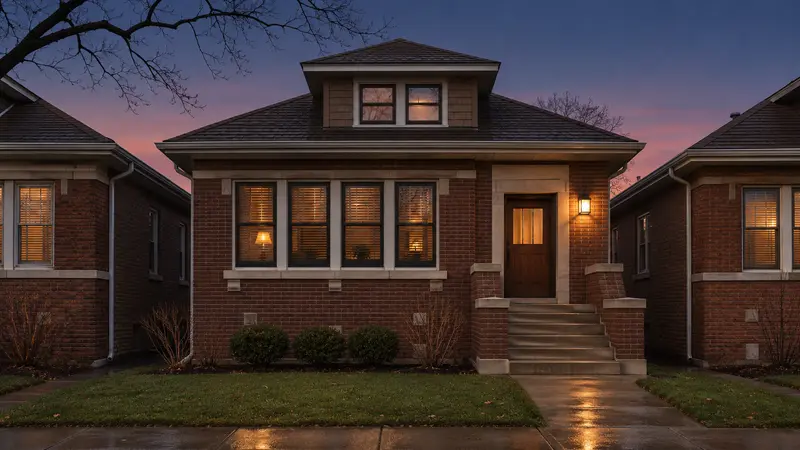
Winter changes the order of work, the cost of holding and your legal duties, not whether you can renovate. Footings must reach 42 inches below final grade, heat is owed to tenants from September 15 to June 1, and a vacant building must be heated or winterized. In the example below a 6-week exterior pause costs $5,048.
- Frost depth for footings
- 42 inches below final grade
- Heat season
- September 15 to June 1
- Daytime minimum
- 68 degrees F from 8:30 a.m. to 10:30 p.m.
- Overnight minimum
- 66 degrees F from 10:30 p.m. to 8:30 a.m.
- Heat Ordinance fine
- $500 to $1,000 per day, per violation
- Vacant building in winter
- Maintain or winterize plumbing and heating; shovel the sidewalk
- Share of yearly renovation permits issued December through February
- 22%
Program terms as of November 26, 2026. Rates as of November 25, 2026.
On this page
- When do Chicago renovation permits get issued?
- What does frost depth mean for footings, porches and additions?
- Which work goes first when you close in the fall?
- What does a winter pause cost?
- What heat do you owe if units are occupied?
- How do you keep a vacant building from freezing?
- What does your insurance say about vacancy?
- When should the finished house hit the market?
A flip that closes in October has its demolition in November and its exterior work due in the coldest part of the year. Nothing in Chicago's code stops construction for the season. What changes is which trades can work, what an empty building needs to survive, and how much each idle week costs.
This page covers the rules that bite in cold months and puts a price on a pause. It is general education from a lender; confirm insurance terms with your agent and tenant duties with counsel.
When do Chicago renovation permits get issued?
Mostly in the warm half of the year. City permit data for 2021 through 2025 shows renovation and alteration permits by month of issue.
| Month | Average permits a year | Share of the year |
|---|---|---|
| January | 545 | 8.2% |
| February | 477 | 7.2% |
| March | 550 | 8.3% |
| April | 580 | 8.7% |
| May | 611 | 9.2% |
| June | 586 | 8.8% |
| July | 591 | 8.9% |
| August | 615 | 9.3% |
| September | 560 | 8.4% |
| October | 581 | 8.8% |
| November | 504 | 7.6% |
| December | 438 | 6.6% |
Source: City of Chicago, Department of Buildings, Building Permits (dataset ydr8-5enu), 2024-11-01 to 2026-10-31; retrieved 2026-11-26.
December through February accounts for 22% of issued permits against 27% for June through August, in the City's building permits dataset. The counts cover plan-based renovation permits only, not Express permits. For how long each route takes, see permit paths and timelines.
What does frost depth mean for footings, porches and additions?
It means digging. Chicago's code requires footings at 42 inches below final grade, under its frost protection amendment, which covers porch piers, addition foundations and garage footings.
Excavating and pouring to that depth is the scope most exposed to frozen ground. If the plan includes a new rear porch, get the footings in before the ground hardens even if the framing waits; the permit side is covered under porch and masonry requirements. Masonry must meet Chapter 21 and concrete Chapter 19 of the Chicago Building Code, per the City's masonry permit terms. This page gives no temperature cutoffs because we could not verify them. Ask each sub for a written cold-weather procedure and its price.
Which work goes first when you close in the fall?
Whatever needs open ground, dry mortar or an open roof.
| If you close in | Do first | Leave for the cold months |
|---|---|---|
| September or October | Footings, flatwork, tuckpointing, roof, windows | Demolition, framing, rough trades, drywall |
| November or December | Roof and window openings, temporary heat, interior demolition | Exterior masonry and concrete, unless bid with cold-weather measures |
| January or February | Interior from rough-in to finishes | Exterior punch list, landscaping, final grading |
Build the schedule in the rehab scheduling template with exterior and interior on separate tracks, and mirror that split in the phase-by-phase draw planner. The overall sequence from offer to payoff is the same in any season; winter only reorders the middle.
What does a winter pause cost?
It costs interest and carry on everything borrowed so far, plus whatever keeps the interior workable.
A 6-week exterior pause on a frame house bought in October
Masonry, concrete and siding stop for a cold snap while the interior crew keeps working under temporary heat. All inputs are illustrative.
Cost of the pause
| Line | Amount | How it is figured |
|---|---|---|
| Interest on the balance outstanding | $2,766 | $215,500 x 11% / 360 = $65.85 a day x 42 days |
| Taxes, insurance and base utilities | $953 | $690 a month = $22.68 a day |
| Temporary heat, your quote | $1,330 | $950 a month, prorated to 42 days |
| Cost per day before heat | $88.53 | |
| Extra cost of a 6-week pause | $5,048 |
Line items sum to the stated result. Checked in code at build.
At $88.53 a day plus heat, the pause has a weekly price. Compare it with the cold-weather premium your mason quotes before you accept the wait.
Assumptions
- We used 11% for interest. The published range is 8.99%-13.5%, and your file sets the real figure.
- Balance is the acquisition advance of $184,500 plus $31,000 of rehab draws funded before the pause.
- Temporary heat of $950 a month is a reader-supplied line: fuel, rental heaters or running the new furnace early. Get a quote for your building.
- The pause is counted as pure delay. If interior work finishes on its original date anyway, the true cost is lower.
Run your own balance through the daily carry calculator. The monthly view is laid out under carry at different hold lengths. If a pause threatens maturity, read about extensions when a project runs long early. Extension terms are underwritten file by file, ask your loan officer.
What heat do you owe if units are occupied?
Full compliance with the Chicago Heat Ordinance, regardless of the rehab. The heat season runs September 15 to June 1. In buildings with central heat the minimums are 68 degrees F from 8:30 a.m. to 10:30 p.m. and 66 degrees F from 10:30 p.m. to 8:30 a.m.. Where tenants control their own heat, the landlord must keep the equipment working.
The fine is $500 to $1,000 per day, per violation, and the City states that the reason for the outage does not matter. A two-flat bought with one unit occupied is a landlord's building from the day of closing. The lease and notice side belongs to the RLTO page for held property, and JFG describes its short-term financing on its Chicago bridge loan page.
How do you keep a vacant building from freezing?
Pick one of two states and document it. The City's vacant building owner requirements say: Maintain or winterize plumbing and heating; shovel the sidewalk.
- At closing, confirm which utilities are live and put gas and electric in your name.
- If no crew will be inside, have a plumber drain supply lines, traps and the water heater, and tag the building as winterized.
- If crews are working, service the furnace or boiler, set a low hold temperature and open any wall cavities with supply lines to warm air.
- Check the building after every hard freeze. A visit costs less than a burst riser, and far less than the carry cost of repairing one.
- Register the building if it meets the vacancy definition. The City's deadline: Within 30 days.
- Keep the public sidewalk shoveled.
Registration, signage and the liability policy the City requires are explained under vacant building registration. This page does not describe water shutoff rules for vacant buildings because we could not verify them.
What does your insurance say about vacancy?
Read the vacancy provision before the first freeze, because it can remove the coverage you are counting on. In one Illinois appellate case, Old Second National Bank v. Indiana Insurance Co., the policy withheld payment for vandalism and theft once the building had been vacant this long: More than 60 consecutive days vacant.
That is one policy's wording, not a statute, and forms differ on which losses are excluded and on how renovation affects vacancy. Ask your agent three questions in writing: when the policy treats the building as vacant, whether freeze and water damage are excluded or conditioned on maintaining heat, and whether a builder's risk or vacant-property form fits a rehab better. Expect a lender to ask for evidence of insurance either way.
The winter plan that fails
Closing in December on a building that needs a roof, a porch and full tuckpointing, with a budget that assumes summer pricing and no heat line, does not work. Exterior trades either wait or charge for cold-weather measures, the vacant interior needs heat or winterization from day one, and each idle week costs what the example shows. The better route is to negotiate a later closing, price the cold-weather premium and temporary heat into the offer, or choose a project whose exterior is sound and whose scope is interior.
When should the finished house hit the market?
When it is finished, in most cases. This page publishes no seasonal sale-price figures, so treat any spring premium as a question for your listing agent's recent comps. What you can compute is the cost of waiting: holding a completed house costs the same daily interest and carry as a stalled one. JFG also publishes a fix and flip calculator for testing a deal.
Start by pricing your pause, then build the two-track schedule. More City rules that affect schedule are on the index of City rules.
Questions: Winter work on a Chicago rehab
Can I shut off the boiler to replace it in January if tenants are in the building?
Not without providing heat another way. The Heat Ordinance requires landlords to supply heat where occupants lack individual control, and the City says the reason for a lack of heat does not matter. Fines run $500 to $1,000 per day, per violation. Schedule a boiler or furnace replacement for a mild stretch, stage the new equipment before the old is disconnected, and arrange temporary heat for the changeover. If the units will be vacated for the rehab, handle that under the tenant ordinance first.
Is it better to keep the heat on or winterize a vacant building?
It depends on whether crews are working inside. The City accepts either: a vacant building's plumbing and heating must be maintained or winterized. Heat on keeps drywall, flooring and paint moving but costs fuel and depends on a furnace that may be at the end of its life. A full winterization costs less to hold but stops any wet trade. You can also do both in sequence: winterize at closing, then restore heat when rough plumbing passes.
Does the City slow down permit review in winter?
The data here measures issuance, not review speed. Over 2021 through 2025, December averaged the fewest renovation permits issued of any month and August the most. Fewer issued permits can reflect fewer applications as much as slower review, so do not read it as a longer queue. What it does show is that a permit applied for in fall often lands in the slowest issuing months, which is when exterior work is hardest to start.
Do I have to shovel the sidewalk at a vacant flip?
Yes. The City's vacant building requirements list snow removal so the adjacent public sidewalk stays usable, alongside securing the building, posting the registration sign and carrying liability insurance of $300,000 per occurrence on a residential building. Put a snow service on the carry budget from the first month. The same sheet limits plywood board-up to the first six months of vacancy, which matters if you close in fall and are still boarded in spring.
Will my lender release a draw for work under temporary protection?
Draws are staged against a rehab holdback, with inspections, so the test is completed, inspectable work. Exterior work finished under tenting or with temporary heat can be drawn like any other once the inspector sees it in place. What cannot be drawn is a deposit for a job waiting on weather. Keep exterior lines separate from interior lines in the draw schedule so a paused exterior does not hold up money for finished interior work.
Local rates and rules cited on this page
| Item | Figure | Primary source | Effective |
|---|---|---|---|
| Footing depth for frost protection | 42 inches below final grade | Municipal Code of Chicago 14B-18-1809 Shallow foundations (American Legal Publishing (Municipal Code of Chicago)) | 2020-08-01 |
| Chicago heat season | September 15 to June 1 | Chicago Heat Ordinance (City of Chicago Department of Buildings) | 2026 |
| Minimum indoor temperature, daytime | 68 degrees F from 8:30 a.m. to 10:30 p.m. | Chicago Heat Ordinance (City of Chicago Department of Buildings) | 2026 |
| Minimum indoor temperature, overnight | 66 degrees F from 10:30 p.m. to 8:30 a.m. | Chicago Heat Ordinance (City of Chicago Department of Buildings) | 2026 |
| Heat Ordinance fine | $500 to $1,000 per day, per violation | Chicago Heat Ordinance (City of Chicago Department of Buildings) | 2026 |
| Winter upkeep of a vacant building | Maintain or winterize plumbing and heating; shovel the sidewalk | Requirements for Vacant Building Owners (Revised 1/2026) (City of Chicago Department of Buildings) | 2026-01 |
| Vacant building registration deadline | Within 30 days | Requirements for Vacant Building Owners (Revised 1/2026) (City of Chicago Department of Buildings) | 2026-01 |
| Vacancy provision in a property policy litigated in Illinois | More than 60 consecutive days vacant | Old Second National Bank v. Indiana Insurance Co., 2015 IL App (1st) 140265 (Illinois Appellate Court, First District (via Justia)) | 2015 |
| Vacant building liability insurance, residential | $300,000 per occurrence | Requirements for Vacant Building Owners (Revised 1/2026) (City of Chicago Department of Buildings) | 2026-01 |
Rates as of November 25, 2026. Confirm with the agency before relying on any figure.
Sources
- Chicago Heat Ordinance, City of Chicago Department of Buildings, 2026.
- Vacant Building Registration: owner requirements, City of Chicago Department of Buildings, 2026-01.
- Vacant Buildings, City of Chicago Department of Buildings, 2026.
- Municipal Code of Chicago: frost protection of footings, American Legal Publishing (Municipal Code of Chicago), 2020-08-01.
- Old Second National Bank v. Indiana Insurance Co., 2015 IL App (1st) 140265, Illinois Appellate Court, First District (via Justia), 2015.
- Building Permits dataset, City of Chicago Department of Buildings, 2021 to 2025 issue dates; fetched 2026-11.
- Masonry Work: Express Permit terms and conditions, City of Chicago Department of Buildings, 2023-11-06.