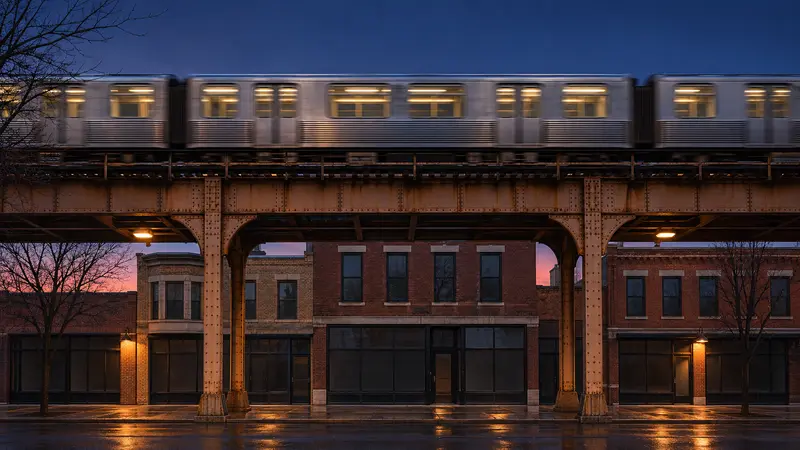
Humboldt Park offers a lower basis than West Town or Logan Square, but the buildings carry more deferred masonry and the median flip still loses. Inspectors cited 354 addresses in 24 months and residents filed 287 vacant-building complaints. Two-to-six unit buildings sold at a median $402,500; break-even needs a purchase near $243,500.
- Violations per square mile, 24 months
- 492 (city: 416)
- Vacant-building complaints per square mile
- 79.6 (city: 46.3)
- Median two-to-six unit sale
- $402,500 (336 sales)
- Median single-family sale
- $320,000 (309 sales)
- Renovation permits and median wait
- 221 permits, 73 days
- Units in two-to-four unit buildings
- 56.8%
- Break-even purchase in the example
- $243,500
Program terms as of November 26, 2026. Rates as of November 25, 2026.
On this page
- Why is masonry the first thing to price on a Humboldt Park building?
- How often are vacant buildings reported in Humboldt Park?
- Why does a Humboldt Park two-flat outsell a Humboldt Park house?
- What does a median Humboldt Park two-flat flip cost, line by line?
- Is plan review slower in Humboldt Park than in the rest of the city?
- Which part of Humboldt Park is inside the 606 district?
- How much of Humboldt Park's housing predates 1940?
- What should you verify before bidding on a Humboldt Park building?
- Where do you take a Humboldt Park deal from here?
The Humboldt Park community area is not where most people picture it. Its eastern edge steps along Humboldt Boulevard, Kedzie Avenue and Sacramento Boulevard, so the 197-acre park itself lies in West Town. Community area 23 is the ground west of that line: out to the rail corridor at Kenton Avenue, between Bloomingdale Avenue and Kinzie Street.
That matters for comps. Sales east of Kedzie Avenue belong to the West Town figures, where the two-to-six unit median is more than double. Everything on this page describes the blocks west of the park.
Sources: City of Chicago Data Portal (Building Permits ydr8-5enu, Building Violations 22u3-xenr, 311 Service Requests v6vf-nfxy), 2024-11-01 to 2026-10-31; Cook County Assessor Parcel Sales (wvhk-k5uv), 2024-05-01 to 2026-04-30.
Why is masonry the first thing to price on a Humboldt Park building?
Because the City's inspectors keep citing it on Humboldt Park buildings. Exterior walls, lintels and chimneys account for three of Humboldt Park's five most-cited violations, 212 line items in 24 months.
| Most cited violation (elevator bureau excluded) | Citations, 24 months |
|---|---|
| Repair Exterior Wall (CN061014) | 110 |
| Arrange For Reinspection Regar (CN190029) | 63 |
| Repair Lintels (CN065014) | 52 |
| Arrange Premise Inspection (CN190019) | 51 |
| Chimney (CN063014) | 50 |
| All violations, 354 addresses | 1,774 |
Source: City of Chicago, Department of Buildings, Building Violations (dataset 22u3-xenr), 2024-11-01 to 2026-10-31; retrieved 2026-11-26. Source: City of Chicago, Boundaries - Community Areas (dataset igwz-8jzy); retrieved 2026-11-26.
Humboldt Park logged 1,774 violation line items at 354 addresses, about 5.01 per cited address, and 74.1% came from the conservation bureau that inspects existing housing. Elevator-bureau items, which dominate the citywide list, barely register here. The portal shows most records as open, so pull the case in the City's building records search and read what the inspector wrote. A lintel or parapet rebuild is a permit item and a budget line; see porch and masonry repair rules. Whether a citation follows the building to you is covered under violations that transfer at sale.
How often are vacant buildings reported in Humboldt Park?
Humboldt Park residents filed 287 vacant or abandoned building complaints with 311 in 24 months, 244 after the City's duplicate flag. That is 79.6 per square mile against 46.3 citywide.
A complaint is a report, not a finding, but it tells you where to expect boarded buildings and registration paperwork. If you buy one, the City's registration deadline applies (Within 30 days); the steps are in registering a vacant building.
Why does a Humboldt Park two-flat outsell a Humboldt Park house?
The Assessor data shows the order plainly, though not the reason. Humboldt Park's 309 single-family sales had a median of $320,000, which is $82,500 below the $402,500 median for its 336 two-to-six unit sales. In Logan Square and West Town the order is reversed.
| Property class | Sales | 25th pct. | Median | 75th pct. | Citywide median |
|---|---|---|---|---|---|
| Single-family (class 2-02 to 2-10, 2-34, 2-78) | 309 | $225,000 | $320,000 | $465,000 | $307,100 |
| Two to six units (class 2-11, 2-12) | 336 | $275,000 | $402,500 | $535,000 | $443,000 |
| Condominium (class 2-99) | 48 | $136,206 | $302,500 | $413,621 | $325,000 |
Source: Cook County Assessor's Office, Assessor - Parcel Sales (dataset wvhk-k5uv), 2024-05-01 to 2026-04-30; retrieved 2026-11-26. Source: Cook County Assessor's Office, Assessor - Parcel Universe (Current) (dataset pabr-t5kh); retrieved 2026-11-26.
Sales are Cook County Assessor records for 2024-05-01 through 2026-04-30, filtered for non-market deeds. The condominium row rests on 48 sales, a small sample. The Institute for Housing Studies puts 55.6% of Humboldt Park's housing units in two-to-four unit buildings and says business buyers took 29.1% of those sales in 2025. JFG's 2026 neighborhood ranking treats the blocks east and west of the park as separate markets.
What does a median Humboldt Park two-flat flip cost, line by line?
$434,177 against a $402,500 resale, a loss of $31,677. The two-to-six unit class is the example because it is the larger Humboldt Park sample and the dominant building type.
Humboldt Park two-flat: $275,000 in, $402,500 out
Prices come from Humboldt Park's two-to-six unit sales. The contingency is set higher than usual because of the masonry record; all carry inputs are illustrative.
Every cost between purchase and resale
| Line | Amount | How it is figured |
|---|---|---|
| Purchase, 25th percentile sale | $275,000 | |
| Closing costs and City transfer tax on the buy | $5,563 | |
| Rehab at the median reported permit cost | $80,000 | permitted work only; a full gut runs higher |
| Contingency, 15% | $12,000 | paid in cash, sized for parapets, lintels and chimneys |
| Points and lender fees | $7,538 | 2 points on a $301,875 loan |
| Interest | $21,504 | 7.43 months at 11.5% |
| Property tax, insurance, utilities | $7,136 | |
| Commission | $20,125 | 5% of $402,500 |
| Seller transfer taxes and closing | $5,311 | |
| Median resale | $402,500 | |
| Result | -$31,677 | resale minus total cost |
| Total cost | $434,177 |
Line items sum to the stated result. Checked in code at build.
What you could pay instead
| Line | Amount | How it is figured |
|---|---|---|
| Purchase that breaks even | $243,500 | $31,500 under the 25th percentile |
| Purchase that leaves 10% of the resale price | $206,500 | a computed target, not a price observed in the Humboldt Park data |
| 70% rule offer | $201,750 | 70% of $402,500 less $80,000 |
At the medians the flip returns -$31,677.
Assumptions
- 11.5% is an illustrative rate within the published 8.99%-13.5%.
- The hold is 5 months for construction and sale plus 73 days, Humboldt Park's median permit wait.
- Loan sizing follows up to 90% of purchase price plus 100% of approved rehab, capped at 75% of supported ARV; here the ARV cap binds, so the down payment is $53,125.
The second table is the useful one for a Humboldt Park bid. A purchase at Humboldt Park's 25th percentile is still $31,500 too high to break even once a contingency and a 73-day permit wait are in the budget. The 70% rule lands lower again, at $201,750; the page on the 70% rule in Chicago shows how that shortcut behaves against a full cost stack. None of this predicts a given deal. It says the median Humboldt Park trade is not a flip, and that the profit is in buildings bought well below the quartile.
Is plan review slower in Humboldt Park than in the rest of the city?
Not on Humboldt Park's main path. Humboldt Park's 136 Standard Plan Review renovation permits took a median 91 days, close to the city's 94. The surprise is Self-Certification: 80 permits at a median 51.5 days, nearly double the citywide 27.
| Review path | Permits | Median days | Middle half | Citywide median |
|---|---|---|---|---|
| Standard Plan Review | 136 | 91 | 48 to 161 | 94 |
| Self Cert | 80 | 51.5 | 26 to 80 | 27 |
| Direct Developer Services | 5 | 94 | 64 to 153 | 87.5 |
| All renovation/alteration permits | 221 | 73 | 37 to 135 | 56 |
Source: City of Chicago, Department of Buildings, Building Permits (dataset ydr8-5enu), 2024-11-01 to 2026-10-31; retrieved 2026-11-26.
The Department of Buildings says a self-certified application typically issues 10 business days after zoning approval, provided there are no building violations or stop work orders on the property. Given Humboldt Park's violation record, that condition is a plausible reason for the slower figure, though the data cannot prove it. Days run from application to issuance, and Express Permit Program jobs are not in the count.
Which part of Humboldt Park is inside the 606 district?
The northern blocks. The boundary in Municipal Code 17-7-0591 runs along Hirsch Street from Kedzie Avenue to the alley west of Harding Avenue, then steps north toward North Avenue and reaches Kostner Avenue at Wabansia Avenue. On RS3 and RT3.5 lots north of that line, a detached house cannot replace multi-unit housing on a majority multi-unit block, and demolition carries a surcharge of $20,000 per unit and $60,000 per building. South of that line, base zoning applies.
How much of Humboldt Park's housing predates 1940?
62.3% of its 21,107 units, by 2020-2024 American Community Survey estimates aggregated from 15 tracts. Detached houses are 20.7% of units.
| Housing stock | Humboldt Park |
|---|---|
| Housing units | 21,107 |
| Single-family detached share | 20.7% |
| Units in 2 to 4 unit buildings | 56.8% |
| Built before 1940 | 62.3% |
| Owner-occupied share of occupied units | 40.7% |
Source: U.S. Census Bureau, American Community Survey 2020-2024 5-Year Estimates, Detailed Tables (table-based summary file) (dataset ACSDT5Y2024), 2020-01-01 to 2024-12-31; retrieved 2026-11-26. Source: City of Chicago, Boundaries - Census Tracts - 2020 (dataset 7qjk-677h); retrieved 2026-11-26.
What should you verify before bidding on a Humboldt Park building?
- Confirm the community area. East of Kedzie Avenue you are in West Town and need West Town comps.
- Search the address in Department of Buildings records and list every open masonry item with a contractor price.
- Check 311 history and the vacant building registry if the building is empty.
- Place the lot against Hirsch Street and the 606 district line before planning any unit change.
- Work backward from resale in the profit-target offer calculator, then log the findings in the diligence checklist for Chicago buys.
Where a Humboldt Park flip breaks
Paying the 25th percentile price, $275,000, for a two-flat with open exterior wall and lintel citations and then budgeting only the permit-median rehab does not work. The example loses money before any masonry surprise. Either get the price near $243,500 or look at areas where the quartile sits lower relative to resale, such as the Austin area or North Lawndale.
Where do you take a Humboldt Park deal from here?
Send the lender a file that already answers the masonry question: photos of parapets and lintels, the violation printout and a line-item bid. JFG's Humboldt Park loan page gives the lender's block-by-block view. Compare other areas from the neighborhood data index.
Questions: Humboldt Park flip data
Is there an L station in Humboldt Park?
No CTA rail station falls inside the Humboldt Park community area when the City's station list is tested against the boundary file. Blue Line stations sit to the east in Logan Square and West Town, and the Green Line's Kedzie and Pulaski stops are south of the area's Kinzie Street edge. Resale comps for Humboldt Park should come from Humboldt Park blocks with the same bus-only access, not from blocks beside a station.
Which TIF districts overlap Humboldt Park?
The City's TIF boundary file lists five for Humboldt Park: Chicago/Central Park, Division/Homan, Pulaski Corridor, Northwest Industrial Corridor and Kinzie Industrial Conservation Area. Chicago/Central Park, approved in 2002, is scheduled to expire on December 31, 2026. The file shows Division/Homan running to 2037, Pulaski Corridor to 2035, and the Northwest Industrial Corridor and Kinzie districts to 2034.
How many foreclosure cases are filed in Humboldt Park?
The Institute for Housing Studies counted 91 new residential foreclosure filings in Humboldt Park in 2025, 44 of them on two-to-four unit buildings, and 22 completed auctions. That is about one filing per 100 residential parcels. For a flipper it means some Humboldt Park inventory reaches the market through the courts, with the title and timing issues that come with a judicial sale.
Are Humboldt Park prices different in the most recent sales?
The Assessor data splits the window by calendar year. Humboldt Park's two-to-six unit median was $380,000 on 109 sales in 2024, $408,000 on 172 in 2025 and $480,000 on 55 early-2026 sales. The 2026 group is small and covers only four months, so treat it as a sample, not a trend, and comp against dated sales.
Which wards cover Humboldt Park?
Five. Measured on the 2023 ward boundary file, the 37th Ward covers about 28% of the Humboldt Park community area, the 27th about 28%, the 26th about 26%, the 36th about 11% and the 28th about 7%. Look up the ward for a Humboldt Park address before asking anyone about a zoning change.
Local rates and rules cited on this page
| Item | Figure | Primary source | Effective |
|---|---|---|---|
| Vacant building registration deadline | Within 30 days | Requirements for Vacant Building Owners (Revised 1/2026) (City of Chicago Department of Buildings) | 2026-01 |
| Self-Certification typical issuance time | 10 business days after zoning approval | Self-Certified Permit Application Program (City of Chicago Department of Buildings) | 2026 |
| Demolition surcharge, Pilsen and 606 areas | $20,000 per unit and $60,000 per building | Demolition Surcharge (City of Chicago Department of Housing) | 2024-09 |
| Chicago transfer tax, City portion (buyer) | $3.75 per $500 of price | Real Property Transfer Tax (7551) (City of Chicago Department of Finance) | 2008-04-01 |
| Chicago transfer tax, CTA portion (seller) | $1.50 per $500 of price | Real Property Transfer Tax (7551) (City of Chicago Department of Finance) | 2008-04-01 |
| Cook County real estate transfer tax | $0.25 per $500 of value | Transfer Fees (Cook County Clerk) | 1968-01-01 |
| Illinois state real estate transfer tax | $0.50 per $500 of value | 35 ILCS 200/31-10, Imposition of tax (Illinois General Assembly) | 2005-06-01 |
Rates as of November 25, 2026. Confirm with the agency before relying on any figure.
Sources
- Building Violations (dataset 22u3-xenr), City of Chicago Department of Buildings, 2026-11.
- 311 Service Requests (dataset v6vf-nfxy), City of Chicago, 2026-11.
- Assessor - Parcel Sales (dataset wvhk-k5uv), Cook County Assessor's Office, 2026-11.
- Municipal Code of Chicago 17-7-0590, Predominance of the Block District, City of Chicago, 2025-07-16.
- Search Building Department Records, City of Chicago Department of Buildings, 2026.
- Self-Certified Permit Application Program, City of Chicago Department of Buildings, 2026.
- Housing Market Indicators Data Portal: Humboldt Park, Institute for Housing Studies at DePaul University, 2025.
- Humboldt (Alexander Von) Park, Chicago Park District, 2026.
- Boundaries - Tax Increment Financing Districts (dataset eejr-xtfb), City of Chicago, 2026-09.