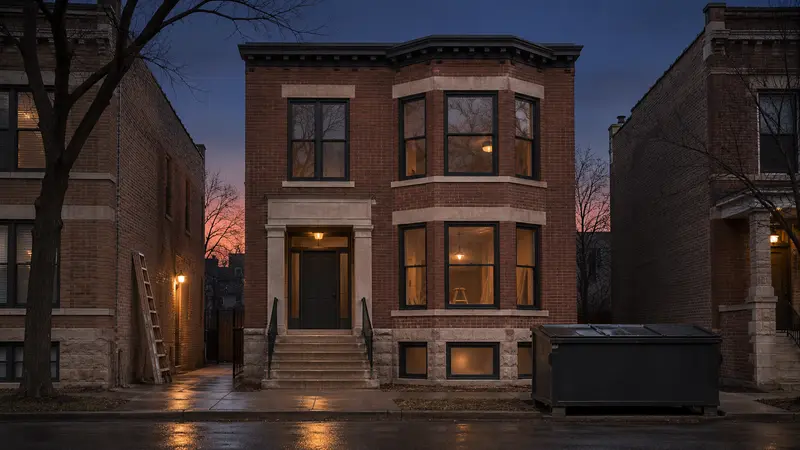
The 70% rule holds up in Chicago as a first screen, but it does not pick your profit for you. On two sample deals financed at the published 8.99%-13.5% and 1-3 points, Chicago costs took 18.29% and 16.4% of ARV, leaving 11.71% and 13.6%. It over-offers when the hold runs long or you need more than that.
- The rule
- 70% of ARV minus repairs = maximum offer
- Chicago transfer tax, buyer
- $3.75 per $500 of price
- Chicago transfer tax, seller (CTA portion)
- $1.50 per $500 of price
- County plus state transfer tax, seller
- $0.25 per $500 of value plus $0.50 per $500 of value
- All transfer taxes, share of ARV
- 0.82% (low deal), 0.81% (high deal)
- Costs inside the 30%, low deal
- 18.29% of ARV
- Costs inside the 30%, high deal
- 16.4% of ARV
Program terms as of November 26, 2026. Rates as of November 25, 2026.
On this page
- What does the 30% have to pay for on a Chicago flip?
- How much of the 30% do Chicago costs use at a low and a high ARV?
- Which costs shrink as the price rises, and which grow?
- When does the rule offer too much?
- When does the rule offer too little?
- How does Cook County property tax fit into the 30%?
- How should you adjust the percentage for a specific deal?
- How do you replace the rule with a solved offer?
- What should you do before your next offer?
The 70% rule says to pay no more than 70% of after-repair value, minus repairs. National explainers repeat the formula and warn that the leftover 30% must cover "other costs" without pricing them. In Chicago those costs can be priced, because the taxes are published and the loan terms are known, so this page runs the test on two deals at opposite ends of the market.
What does the 30% have to pay for on a Chicago flip?
The 30% pays for eight things before it pays you: the buyer-side transfer tax and purchase closing, points and lender fees, interest, property tax and other carry costs, a rehab contingency, brokerage on the resale, seller-side transfer taxes with resale closing, and whatever is left as profit.
Chicago adds lines other markets lack. The City's Real Property Transfer Tax is split between the parties, so a flipper pays the buyer portion going in and the seller portion coming out. The seller also owes the county and state taxes listed in the Cook County Clerk's transfer fee table, and the state tax is set by 35 ILCS 200/31-10. Each tax is walked through under transfer taxes on both closings.
How much of the 30% do Chicago costs use at a low and a high ARV?
On the two sample deals, costs used 18.29% of ARV on the cheaper house and 16.4% on the two-flat. The low deal sits near the $174,000 median single-family sale in Auburn Gresham; the high deal sits a little under the $802,500 median two-to-six unit sale in Logan Square.
Source: Cook County Assessor's Office, Assessor - Parcel Sales (dataset wvhk-k5uv), 2024-05-01 to 2026-04-30; retrieved 2026-11-26. Source: Cook County Assessor's Office, Assessor - Parcel Universe (Current) (dataset pabr-t5kh); retrieved 2026-11-26.
Where the 30% goes: an Auburn Gresham frame house and a Logan Square two-flat
Both deals are bought at the rule's offer. All inputs are illustrative.
Low ARV: $185,000 resale, $38,000 rehab, rule offer $91,500, 5 months
| Line | Amount | How it is figured |
|---|---|---|
| Buyer transfer tax and purchase closing | $3,886 | $686 City stamps |
| Points and lender fees | $4,307 | 2 points on $120,350 |
| Interest | $5,516 | 11%, 5 months |
| Property tax, insurance, utilities | $3,440 | $158 tax accrual per month |
| Contingency | $3,800 | 10% of rehab |
| Brokerage | $9,250 | 5% of resale |
| Seller transfer taxes and resale closing | $3,633 | $833 stamps |
| Profit left | $21,668 | 11.71% of ARV |
| Solved offer for a 10% margin | $94,000 | |
| Solved offer for a 15% margin | $85,500 | |
| 30% of ARV | $55,500 |
Line items sum to the stated result. Checked in code at build.
High ARV: $720,000 resale, $155,000 rehab, rule offer $349,000, 8 months
| Line | Amount | How it is figured |
|---|---|---|
| Buyer transfer tax and purchase closing | $5,818 | |
| Points and lender fees | $11,282 | 2 points on $469,100 |
| Interest | $34,401 | 11%, 8 months |
| Property tax, insurance, utilities | $9,072 | $604 tax accrual per month |
| Contingency | $15,500 | |
| Brokerage | $36,000 | |
| Seller transfer taxes and resale closing | $6,040 | |
| Profit left | $97,888 | 13.6% of ARV |
| Solved offer for a 10% margin | $372,500 | |
| Solved offer for a 15% margin | $339,500 | |
| 30% of ARV | $216,000 |
Line items sum to the stated result. Checked in code at build.
Assumptions
- Both deals use 11% and 2 points, inputs chosen inside the published 8.99%-13.5% and 1-3 points ranges; this is not an offer. Contingency is counted as spent.
- Property tax accrual is estimated from the purchase price with the Cook County formula; the Assessor's value for a given parcel will differ.
Bought at the rule's price, both deals clear a double-digit margin on paper. What the rule hides is which lines eat the 30%, and those differ sharply by price.
Which costs shrink as the price rises, and which grow?
Fixed-dollar lines fall as a share of ARV, percentage lines hold steady, and interest grows with time and loan size.
| Cost, as a share of ARV | Low-ARV deal | High-ARV deal | Behavior |
|---|---|---|---|
| All transfer taxes, both closings | 0.82% | 0.81% | Flat percentage of price |
| Brokerage at the input rate | 5% | 5% | Flat percentage of resale |
| Points, lender fees and interest | 5.31% | 6.34% | Grows with months held |
| Property tax accrual | 0.43% | 0.67% | Grows with months held |
| Closing fees, insurance, utilities | 4.68% | 1.42% | Fixed dollars |
The low deal loses several points of ARV to flat fees that barely register on the two-flat. The two-flat gives that back in interest, because eight months on a $469,100 loan costs far more than five months on $120,350. The same pattern across the whole price range is measured under margin by price band.
When does the rule offer too much?
The rule over-offers in three Chicago situations.
A dollar floor on a cheap house. If you will not take on a project for less than a set profit, percentages mislead. At a floor of $30,000 the solved offer on the low deal is $83,500, against the rule's $91,500.
A long hold on a large loan. Plan-reviewed permits and winter can stretch a gut. At 12 months instead of 8, the high deal's profit at the rule price falls to $76,152. Month-by-month figures are under carry cost by hold length.
A higher margin target. For 15% of ARV, the solved offers are $85,500 and $339,500, both under the rule.
When does the rule offer too little?
The rule under-offers when the job is short and you would accept about 10% of ARV. Solved for that target, the low deal supports $94,000 and the high deal $372,500, against rule offers of $91,500 and $349,000. In a contested neighborhood that gap decides who gets the house. Whether 10% is enough cushion is a separate judgment, discussed under whether Chicago flips still pay.
How does Cook County property tax fit into the 30%?
Property tax belongs in the 30% as a monthly accrual, even though you may never receive a bill. Cook County bills each tax year in the following year, so at resale you credit your buyer for the period you owned the house, a tax proration on the settlement statement. The example estimates the accrual from the purchase price: the Assessor assesses residential property at 10% of market value, the state equalizer of 3.0300 converts that to EAV, and Chicago's composite rate of 6.853152% is applied.
That works out to $158 a month on the low deal and $604 on the high one. Finished work can raise the assessment later, which matters to your buyer more than to you; see reassessment after a rehab.
How should you adjust the percentage for a specific deal?
Match the deal to a row, then solve the real number.
| If the deal looks like this | The rule tends to | Do this |
|---|---|---|
| ARV under about $193,813, the citywide 25th percentile single-family price | Over-offer against a dollar floor | Solve for your minimum dollars, not a percentage |
| Cosmetic scope, sale inside five months | Under-offer | Solve at your lowest acceptable margin |
| Plan-reviewed gut, eight months or more | Over-offer | Add months first, then solve |
| ARV resting on one or two comps | Mislead in either direction | Fix the ARV before any percentage |
The ARV row matters most. A 5% error in value moves the rule's offer by 3.5% of ARV, more than all transfer taxes combined. How a lender tests the number is under how ARV gets supported, and the comp packet template organizes your comparable sales.
How do you replace the rule with a solved offer?
- Set ARV from closed comps and write down the rehab budget with contingency.
- Enter your hold in months, rate, points and flat closing figures.
- Choose a profit target in dollars or as a share of ARV.
- Let the max offer calculator work backward to the highest price that still leaves the target.
- Compare that price with the rule's, and find the line responsible for any gap before you bid.
JFG's fix and flip calculator runs a similar pass with its own inputs, and its transfer tax guide covers exemptions this page skips.
When any percentage rule fails
No percentage rule works when the ARV is a guess or the scope is unknown. Blocks with few closed sales, a property type the block has never sold renovated, or a building you could not get inside all make the 70% arithmetic precise about a number that is not. The better route is to pass, or to price the deal as a gut until an inspection proves otherwise. A solved offer depends on the same two inputs, so it does not rescue you either.
What should you do before your next offer?
Run your live deal both ways, then lay every line out on the full Chicago cost stack so nothing hides inside an unexamined 30%. If you source deals for other buyers, the page for wholesalers and agents explains what a funded buyer needs from you, and the numbers hub links the rest of the math.
Questions: The 70% rule, tested
Does the 70% rule already include Chicago transfer taxes?
Only in the sense that everything other than purchase and repairs has to fit inside the 30%. Nothing in the rule sets aside a transfer tax line. In Chicago you pay the City portion when you buy, $3.75 per $500 of price, and three taxes when you sell: the CTA portion at $1.50 per $500 of price, Cook County at $0.25 per $500 of value and Illinois at $0.50 per $500 of value. On the two sample deals that came to $1,519 and $5,858, under one percent of ARV each time.
Is 70% of ARV the same thing as the lender's ARV cap?
No, and mixing them up causes bad offers. The rule is a buyer's shortcut: purchase plus repairs should not exceed 70% of ARV. The loan limit is a lender's test: the program lends up to 90% of purchase price plus 100% of approved rehab, capped at 75% of supported ARV. A deal bought at the rule's price has total cost at 70% of value, so a loan sized on cost usually sits under the 75% cap, as both sample deals do. Pay more than the rule allows and the cap can start to trim the loan, which raises your cash.
Should wholesalers quote the 70% rule to Chicago buyers?
Use it to open the conversation, then show the stack. A buyer running a long gut on a two-flat will discount your number, and a buyer with a five-month cosmetic job may pay above it. Put your assignment fee inside the price the end buyer can actually pay. On the low sample deal the offer solved for a 10% margin was $94,000, and that figure, not the rule, is the ceiling for price plus fee.
Does the rule work for a suburban Cook County flip?
The rule itself does not change, but the stack under it does. Outside Chicago there is no City or CTA transfer tax, though several suburbs levy their own stamps at different rates and some put them on the seller. Cook County and Illinois transfer taxes still apply at $0.25 per $500 of value and $0.50 per $500 of value. Composite property tax rates also differ by municipality, so rebuild the eight lines for the suburb before trusting any percentage.
What percentage should replace 70 on a long gut rehab?
There is no single replacement, which is the point of solving the offer. On the high sample deal, stretching the hold from 8 to 12 months at the same purchase price cut profit from $97,888 to $76,152. A buyer who wants a 15% margin on that deal at the original eight-month hold could pay $339,500, which is below the rule's $349,000. Enter your own months and target in the calculator instead of picking a new rule of thumb.
Local rates and rules cited on this page
| Item | Figure | Primary source | Effective |
|---|---|---|---|
| Cook County Class 2 residential assessment level | 10% of market value | How Residential Properties Are Valued (Cook County Assessor's Office) | 2026 |
| Cook County final equalization factor, tax year 2025 | 3.0300 | 2025 Cook County Final Multiplier Announced (Illinois Department of Revenue) | 2026-06-18 |
| City of Chicago general composite tax rate, tax year 2025 | 6.853152% | 2025 Cook County Tax Rates Released (tax rate report) (Cook County Clerk) | 2025 |
| Chicago transfer tax, City portion (buyer) | $3.75 per $500 of price | Real Property Transfer Tax (7551) (City of Chicago Department of Finance) | 2008-04-01 |
| Chicago transfer tax, CTA portion (seller) | $1.50 per $500 of price | Real Property Transfer Tax (7551) (City of Chicago Department of Finance) | 2008-04-01 |
| Cook County real estate transfer tax | $0.25 per $500 of value | Transfer Fees (Cook County Clerk) | 1968-01-01 |
| Illinois state real estate transfer tax | $0.50 per $500 of value | 35 ILCS 200/31-10, Imposition of tax (Illinois General Assembly) | 2005-06-01 |
Rates as of November 25, 2026. Confirm with the agency before relying on any figure.
Sources
- Real Property Transfer Tax (7551), City of Chicago Department of Finance, 2026.
- Transfer Fees, Cook County Clerk, 2026.
- 35 ILCS 200/31-10 Imposition of tax, Illinois General Assembly, 2005-06-01.
- 2025 Cook County final multiplier, Illinois Department of Revenue, 2026-06-18.
- How residential property is valued, Cook County Assessor, 2026.
- Assessor - Parcel Sales dataset (wvhk-k5uv), Cook County Assessor's Office, 2026-11-15.