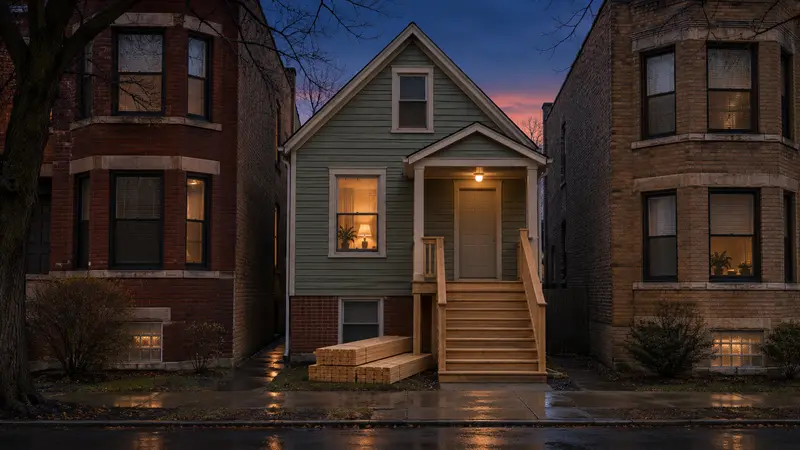
Yes, if nobody lawfully lives there: an empty flip must be registered, insured, secured and posted, and a buyer has 30 days from closing to file. The on-time fee is $30 per six-month period. Fines for skipping it run $500 to $1,000 per violation, per day: $30,200 of exposure in the example, against $3,745 to comply.
- Buyer's registration deadline
- 30 days after vacancy or 30 days after taking ownership, whichever is later
- Fee, filed on time
- $30 per six-month period
- Fee after a City citation
- $100 per six-month period
- Registration term
- 6 months, renewed while vacant
- Liability insurance, residential
- $300,000 per occurrence
- Plywood on openings
- First 6 months of vacancy only
- Deregistration
- Within 20 days of sale, reoccupancy or demolition
Program terms as of November 26, 2026. Rates as of November 25, 2026.
On this page
- Does an empty flip count as a vacant building?
- Which code section applies now that 13-12-125 is gone?
- When does the registration clock start for a buyer?
- What does registration cost in 2026?
- What insurance and local agent does the City require?
- What does the building have to look like while it sits?
- Is there relief while a permitted rehab is underway?
- What does compliance cost next to the fine for skipping it?
- What is your lender's role in a vacant building?
- How do unregistered buildings get found?
- What goes on the calendar from closing to resale?
Almost every flip is a vacant building for part of its life. The tenants are gone, the gut has not started or has stalled, and the City of Chicago has a chapter of code written for exactly that building. Vacant building registration is cheap to follow and expensive to ignore.
This page reads the current chapter and the City's January 2026 owner sheet together. It is general education, not legal advice; confirm the details with a Chicago real estate attorney.
Does an empty flip count as a vacant building?
Usually yes. The City's vacant buildings FAQ gives the test for a house or small residential building as: No lawful occupant and no return expected within 6 months. A flip you bought empty and do not plan to rent meets it on day one.
Two more lines in that FAQ matter to rehabbers. A stalled construction site: Must register within 30 days after permitted work stops. And a building emptied by fire stays registrable until repairs begin under a proper permit, even while you wait on an insurance check.
Which code section applies now that 13-12-125 is gone?
Chapter 14X-12 of the Municipal Code. Older guides, and some attorneys' checklists, still cite sections 13-12-125 and 13-12-126. The code publisher's note at 13-12-125 shows that section was repealed on April 10, 2019, when the City moved its existing-building rules into Title 14X. Owner registration now sits at 14X-12-1204 and lender duties at 14X-12-1205.
When does the registration clock start for a buyer?
At closing, for a building that is already empty. The rule in section 14X-12-1204.2 is 30 days after vacancy or 30 days after taking ownership, whichever is later, and the duty continues as long as the structure stays vacant.
The City does not have to prove the dates the hard way. Under the chapter's presumption, a vacant structure is treated as past the registration threshold if it is unsecured, or if more than one opening is boarded and the yard shows tall weeds, debris or unshoveled walks.
What does registration cost in 2026?
Very little if you file on time. Section 14X-12-1204.4, as amended December 19, 2025, sets these amounts as of January 1, 2026.
| Item | Amount or period | Source |
|---|---|---|
| Registration or renewal, voluntary and timely | $30 per six-month period | MCC 14X-12-1204.4 |
| Registration or renewal after the City identifies a violation | $100 per six-month period | MCC 14X-12-1204.4 |
| Length of each registration | 6 months | MCC 14X-12-1204.5 |
| Governmental owners | Exempt from the fee | MCC 14X-12-1204.4 |
| Fine for a violation not in a specialized table | $500 to $1,000 per violation, per day | MCC 14A-12-1203.1 |
The City's own FAQ page still describes a fee of $250 to $500. Its January 2026 owner requirements sheet and the code agree on the lower figures, so trust the portal at filing.
What insurance and local agent does the City require?
Liability coverage at a stated minimum, and a named person in Cook County. The owner sheet lists $300,000 per occurrence for primarily residential structures and $1,000,000 per occurrence for mixed-use or nonresidential ones, covering bodily injury, personal injury and property damage.
The code lets the Department ask for proof of coverage at registration or renewal, but says registration may not be denied for failing to provide it. The insurance duty stands either way. The agent rule matters to LLC owners; entity setup is under setting up the buying LLC.
What does the building have to look like while it sits?
Secured, posted and maintained. The owner sheet's list:
- Openings secured against entry. First 6 months of vacancy only for plywood; after that, real doors and windows, masonry infill or commercial-grade metal panels.
- A sign visible from the street with the owner's or agent's name, address, phone and the registration number.
- Grass cut, debris removed, fences kept up and the public sidewalk shoveled.
- Plumbing and heating maintained or winterized, and exits lit from dusk to dawn.
A gut that has not reached windows by month six needs another securing method. Cold-season specifics are in winter work on a Chicago rehab.
Is there relief while a permitted rehab is underway?
Not that we could find in the registration sections. The owner-registration text we read (14X-12-1204.1 through 1204.7) contains one fee exception, for governmental agencies, and no carve-out for a building under an active permit. The City FAQ points the other way only by implication: it tells a construction site to register once permitted work has stopped.
So treat an empty building as registrable from the deadline, and ask the Department or your attorney if you believe an active job changes the answer. At the on-time fee, registering is cheaper than the argument. Permit timing is under DOB permit paths and timelines.
What does compliance cost next to the fine for skipping it?
On a nine-month hold the filing is a rounding error and the fine is not. The general penalty in section 14A-12-1203.1 counts each day as a separate offense.
Nine months empty: a West Englewood frame two-flat bought for $96,000
Low-priced flips feel fixed costs hardest, so this one is priced line by line. Insurance and securing costs are illustrative inputs, not quotes.
Cost to comply over a 9-month hold
| Line | Amount | How it is figured |
|---|---|---|
| Registration, 2 six-month periods | $60 | 2 x $30 per six-month period |
| Vacant liability coverage | $1,575 | $2,100 a year x 9 / 12, at the City minimum limit |
| Securing doors and windows | $1,350 | locks, glass, first-month board-up |
| Posted sign | $60 | |
| Winterizing plumbing and heat | $700 | |
| Cost to comply | $3,745 |
Line items sum to the stated result. Checked in code at build.
Exposure if you skip registration and are cited 60 days past the deadline
| Line | Amount | How it is figured |
|---|---|---|
| Fine at the code minimum | $30,000 | $500 a day x 60 days, one count |
| Registration at the cited rate | $200 | 2 x $100 per six-month period |
| Minimum-fine exposure plus fees | $30,200 |
Line items sum to the stated result. Checked in code at build.
The filing costs $60. Not filing puts $30,200 at risk, and the insurance and securing duties apply either way.
Assumptions
- The fine line is the ordinance's floor multiplied out, not a forecast of what a hearing officer imposes. One count is assumed; failing to insure, secure or post can each be cited separately.
- Insurance, securing, sign and winterizing figures are placeholders. Get a vacant-property liability quote before you close; a standard landlord policy may exclude vacancy.
- You would carry most of these costs anyway. The registration fee itself is the smallest line.
These lines belong in monthly carry cost, next to interest and taxes; see what each held month costs and test the total in the whole-deal flip analyzer.
What is your lender's role in a vacant building?
The chapter gives mortgagees their own duties. Section 14X-12-1205.4 requires the mortgagee of a vacant structure to secure it, with exceptions that include a structure the owner has registered, one with construction operations within the prior six months, one with active gas, electric and water service, and one posted with bona fide sale or rental signs.
Your registration and an active job keep the lender out of the securing business. JFG lends on non-owner-occupied property only, and its Chicago hard money lending page describes the program; insurance requirements for a specific loan are underwritten file by file.
How do unregistered buildings get found?
Mostly by neighbors. The City says a 311 report goes to the Department of Buildings, which sends an inspector, and violations lead to enforcement in Administrative Hearings or Circuit Court.
| Vacant or abandoned building complaints to 311 | Citywide |
|---|---|
| Last 24 months | 10,695 |
| Excluding flagged duplicates | 10,168 |
| Last 12 months | 5,344 |
| Average per day | 14.65 |
Source: City of Chicago, 311 City Services, 311 Service Requests (dataset v6vf-nfxy), 2024-11-01 to 2026-10-31; retrieved 2026-11-26.
Counts come from the 311 Service Requests dataset. A complaint is not a citation, but it is how the higher fee tier and the per-day fine get started. What follows a building violation notice is covered under open building violations.
What does not work
Waiting to see whether anyone notices. A boarded building with an untended lot is presumed past the deadline, the fee more than triples once the City finds it, and each day can be fined separately.
Register in the first week after closing, when you are already setting up utilities and insurance. If the property came through a foreclosure auction, add it to the post-sale list in the judicial sale buyer's guide.
What goes on the calendar from closing to resale?
Five dates cover it.
- Before closing: bind vacant-property liability coverage at the City minimum and pick your Cook County agent.
- Week one: register online, pay the fee, post the sign with the registration number, secure every opening.
- Month six: renew, and replace any plywood with a permitted long-term method.
- Each renewal after: confirm the current fee, since it is indexed every January.
- Within 20 days of sale, reoccupancy or demolition: deregister and keep the confirmation for your closing file.
Add the dates to the project calendar template. Permit work also changes the tax bill; see reassessment after rehab. JFG also outlines its Chicago bridge loans. More local rules are indexed at Chicago code and tax rules.
Questions: Vacant building registration
Does an out-of-state LLC need someone local to register a vacant building?
Yes. The registration statement has to name an authorized agent, and the code describes that agent as A person 21 or older with a Cook County office or residence. Service of a violation notice or a lawsuit on the agent counts as service on the owner, and the designation continues until the owner changes it in writing. Line up a Cook County property manager or attorney willing to be listed before closing; the clock does not pause while you look.
The seller already registered the building. Do I have to do it again?
Yes. Registration belongs to the owner, not the address. The City requires the prior owner to deregister after a sale (Within 20 days of sale, reoccupancy or demolition), and the code starts the new owner's filing duty 30 days after vacancy or 30 days after taking ownership, whichever is later. The City's deregistration page says a registration with unpaid fees cannot be closed, and that open court cases are not checked when the reason is a sale. Ask the seller for the old registration number so your attorney can confirm it was closed and that no renewal fees or citations are outstanding.
Is a vacant lot or a building I am demolishing covered?
A cleared lot is not. The City's guidance says a vacant lot must be kept clean and free of high weeds but does not need to be registered. Demolition needs a wrecking permit and a licensed, bonded demolition contractor. Until the structure is down, it is still a vacant building, so the registration, insurance and securing duties run through the wrecking date.
Can I ask the Assessor for a vacancy reduction while the flip sits empty?
Think twice. Under the vacant building chapter, a structure is legally presumed registrable when a request has been made to the county assessor or another agency to reduce its assessed value on the basis of vacancy. That request is evidence against you if the building is unregistered. Separately, the Assessor grants vacancy relief on one- to six-unit residential property only after a casualty such as fire or flood.
Will the registration fee stay at the 2026 amount?
No. The code sets the 2026 figures and then indexes them: beginning January 2027, and each January after, the fees rise with the City's CPI adjustment, capped at 2.5 percent a year, rounded to the nearest dollar. The Buildings Commissioner must publish the current amounts online. Check the registration portal for the figure in force when you file or renew.
Local rates and rules cited on this page
| Item | Figure | Primary source | Effective |
|---|---|---|---|
| When a small residential building counts as vacant | No lawful occupant and no return expected within 6 months | Vacant Buildings FAQ (City of Chicago Department of Buildings) | 2026 |
| Stalled construction sites | Must register within 30 days after permitted work stops | Vacant Buildings FAQ (City of Chicago Department of Buildings) | 2026 |
| When a buyer's vacant building registration duty starts | 30 days after vacancy or 30 days after taking ownership, whichever is later | Municipal Code of Chicago 14X-12-1204.2 Time for compliance (City of Chicago (American Legal Publishing)) | 2024-06-12 |
| Vacant building registration or renewal fee, filed on time | $30 per six-month period | Municipal Code of Chicago 14X-12-1204.4 Fees (City of Chicago (American Legal Publishing)) | 2026-01-01 |
| Vacant building registration or renewal fee after a City citation | $100 per six-month period | Municipal Code of Chicago 14X-12-1204.4 Fees (City of Chicago (American Legal Publishing)) | 2026-01-01 |
| Vacant building registration term | 6 months | Requirements for Vacant Building Owners (Revised 1/2026) (City of Chicago Department of Buildings) | 2026-01 |
| Fine for a general Construction Codes violation | $500 to $1,000 per violation, per day | Municipal Code of Chicago 14A-12-1203.1 Fees, fines, and penalties (American Legal Publishing (Municipal Code of Chicago)) | 2022-12-14 |
| Vacant building liability insurance, residential | $300,000 per occurrence | Requirements for Vacant Building Owners (Revised 1/2026) (City of Chicago Department of Buildings) | 2026-01 |
| Vacant building liability insurance, mixed-use or nonresidential | $1,000,000 per occurrence | Requirements for Vacant Building Owners (Revised 1/2026) (City of Chicago Department of Buildings) | 2026-01 |
| Plywood board-up limit | First 6 months of vacancy only | Requirements for Vacant Building Owners (Revised 1/2026) (City of Chicago Department of Buildings) | 2026-01 |
| Vacant building deregistration deadline | Within 20 days of sale, reoccupancy or demolition | Vacant Buildings FAQ (City of Chicago Department of Buildings) | 2026 |
| Vacant building registration agent | A person 21 or older with a Cook County office or residence | Municipal Code of Chicago 14X-12-1204.6.1 Agent (City of Chicago (American Legal Publishing)) | 2019-04-10 |
Rates as of November 25, 2026. Confirm with the agency before relying on any figure.
Sources
- Vacant Buildings FAQ, City of Chicago Department of Buildings, 2026.
- Requirements for Vacant Building Owners, City of Chicago Department of Buildings, Revised January 2026.
- Vacant Building De-Registration Process, City of Chicago Department of Buildings, 2026.
- Municipal Code of Chicago 14X-12-1204.2, Time for compliance, City of Chicago (American Legal Publishing), Amended June 12, 2024.
- Municipal Code of Chicago 14X-12-1204.4, Fees, City of Chicago (American Legal Publishing), Amended December 19, 2025.
- Municipal Code of Chicago 14X-12-1204.2.1, Presumption, City of Chicago (American Legal Publishing), Amended June 12, 2024.
- Municipal Code of Chicago 14X-12-1205.4, Security (mortgagee), City of Chicago (American Legal Publishing), 2026.
- Municipal Code of Chicago 13-12-125, Reserved (repeal note), City of Chicago (American Legal Publishing), Repealed April 10, 2019.
- Municipal Code of Chicago 14A-12-1203.1, fees, fines and penalties, City of Chicago (American Legal Publishing), Amended December 14, 2022.
- 311 Service Requests dataset, City of Chicago, 311 City Services, Requests November 2024 through October 2026.