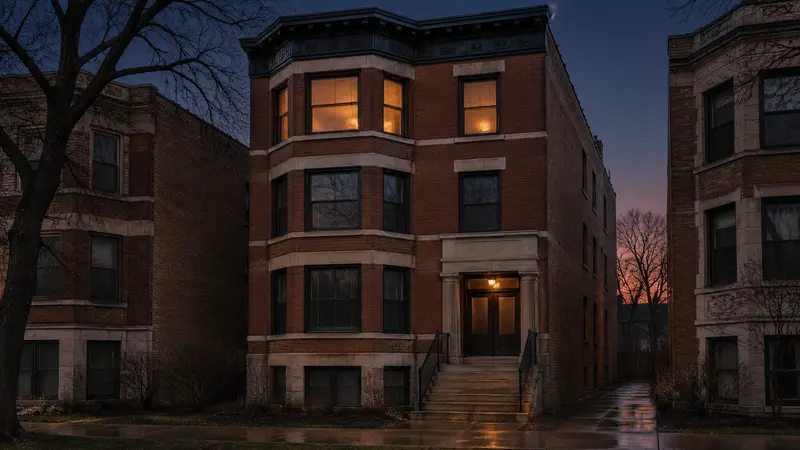
A three-flat is still a 1-4 unit residential loan and a class 2-11 building, but the third unit changes the code work, the buyer and the exits. The top floor needs two ways out, FHA buyers must pass a rent test, and a condo conversion starts with 180 days of tenant notice.
- Assessor class
- 2-11, assessed at 10% of market value
- Building code group
- R-5: One, two or three dwelling units, up to four stories above grade
- Single exit allowed
- First and second stories only; not permitted on the third story or higher
- Sprinklers in an R-5 building
- Not required
- FHA limit, 3-unit, Cook County
- $837,700
- FHA rent test on 3-4 units
- PITI may not exceed 100% of net self-sufficiency rental income
- BRRRR exit
- DSCR loan at 5.75%-10.5%, 30-year, up to 75% LTV cash-out in Chicago
Program terms as of November 26, 2026. Rates as of November 25, 2026.
On this page
- Is a three-flat still a residential loan and a class 2 building?
- Which building code group is a three-flat in?
- Why does the third floor need a second way out?
- How do three-flat buyers underwrite the price?
- Which community areas have the most three-flats?
- Should you sell the finished three-flat or refinance and hold?
- Can you sell the three units as condos instead?
- Which exit fits which situation?
- What should you send a lender on a three-flat?
A third floor looks like one more apartment on the same footprint. In practice it brings a second required exit from the top unit, a lender rent test on your likeliest buyer, and two exits for you that a house does not have: holding it as a rental or selling the floors one at a time.
The three-flat is a standard Chicago building. The Commission on Chicago Landmarks calls it a significant residential type in designating Lake View's Newport Avenue District, which is known for brick and stone-fronted examples. For the basics shared with two units, see the two-flat page; the full list is under building types we cover.
Is a three-flat still a residential loan and a class 2 building?
Yes on both counts. Three units sits inside the 1-4 unit residential category that flip lenders and FHA use, and the Assessor's class 2-11 covers apartment buildings of 2 to 6 units, assessed at 10% of market value. Program terms are unchanged: up to 90% of purchase price plus 100% of approved rehab, capped at 75% of supported ARV.
The lines to watch are above you. A fifth unit leaves the residential loan category, and a seventh leaves class 2. The City's Certificate of Occupancy trigger also sits one unit up: Construction or substantial alteration of 4 or more dwelling units.
Which building code group is a three-flat in?
Group R-5, the same group as a house or a two-flat. Chicago rewrote the model code's residential groups, and Section 14B-3-310 sets the limits of R-5: One, two or three dwelling units, up to four stories above grade. Group R-2, the apartment-house group, starts at more than three units.
Two consequences follow for a rehab budget:
- Sprinklers. Chicago's amendments to the residential sprinkler section list Group R-5 buildings as an exception: Not required.
- The fourth unit. Legalizing a garden unit makes four units and moves the building to R-2, a different review.
Existing buildings are reviewed under the Chicago Building Rehabilitation Code (Title 14R, mandatory since August 1, 2020), so required upgrades depend on scope. That call belongs to your architect.
Why does the third floor need a second way out?
Because the code stops allowing a single exit above the second story. Chicago's version of Table 1006.3.3(1) permits one exit for residential stories as follows: First and second stories only; not permitted on the third story or higher. In R-5 buildings the two exits also have to be remote from each other.
That is the job the rear stair and porch do. Every porch element must carry 100 pounds per square foot, so get a three-story porch inspected before closing; permit thresholds are under porch repair rules.
How do three-flat buyers underwrite the price?
They test the rent, even when they plan to live there. For an owner-occupant using FHA, HUD Handbook 4000.1 adds a rule that does not apply to two units, where PITI means principal, interest, taxes and insurance: PITI may not exceed 100% of net self-sufficiency rental income. The rent figure is the appraiser's market rent for all three units less the greater of the appraiser's vacancy and maintenance estimate or 25 percent. The FHA ceiling for a 3-unit in Cook County is $837,700.
So a three-flat priced above what its rents carry loses FHA buyers. Investors run a similar test through DSCR. The ARV still rests on comparable sales of three-unit buildings, as covered under ARV support. The comp packet with a rent schedule has a place for the rent schedule.
Which community areas have the most three-flats?
Areas on the West and Near Northwest Sides. Census data groups 3 and 4 unit structures together; the table sets that share next to class 2-11 sales.
| Community area | Units in 3-4 unit buildings | Class 2-11 median | Class 2-11 sales |
|---|---|---|---|
| Lower West Side | 33.6% | $510,000 | 157 |
| North Lawndale | 33.2% | $363,000 | 377 |
| West Town | 33.1% | $926,000 | 427 |
| Logan Square | 27.2% | $805,000 | 380 |
Source: Cook County Assessor's Office, Assessor - Parcel Sales (dataset wvhk-k5uv), 2024-05-01 to 2026-04-30; retrieved 2026-11-26. Source: Cook County Assessor's Office, Assessor - Parcel Universe (Current) (dataset pabr-t5kh); retrieved 2026-11-26. Source: U.S. Census Bureau, American Community Survey 2020-2024 5-Year Estimates, Detailed Tables (table-based summary file) (dataset ACSDT5Y2024), 2020-01-01 to 2024-12-31; retrieved 2026-11-26. Source: City of Chicago, Boundaries - Census Tracts - 2020 (dataset 7qjk-677h); retrieved 2026-11-26.
The North Lawndale data page adds permit and violation counts.
Should you sell the finished three-flat or refinance and hold?
Three rents make the hold worth pricing. The example runs one building through both exits: a sale, and a cash-out refinance into the program's BRRRR exit, a DSCR loan at 5.75%-10.5%, 30-year, up to 75% LTV cash-out in Chicago.
One finished three-flat, two exits: sell at $705,000 or refinance and hold
Same building, same rehab. Rents, value and rates are illustrative.
Exit A: sell the finished three-flat
| Line | Amount | How it is figured |
|---|---|---|
| Sale price | $705,000 | |
| Commission, seller transfer taxes, closing | -$43,023 | 5% commission plus $3,173 of transfer tax |
| Flip loan payoff | -$493,500 | 90% of price plus the rehab budget |
| Cash you had invested | $119,263 | down payment, closing, points, interest, carry, contingency |
| Profit before income tax | $49,215 | cash from the sale less cash invested |
| Cash from the sale closing | $168,478 |
Line items sum to the stated result. Checked in code at build.
Exit B: refinance into a DSCR loan
| Line | Amount | How it is figured |
|---|---|---|
| New loan | $528,750 | 75% of a $705,000 appraisal |
| Refinance closing costs | -$10,575 | 2% of the new loan |
| Flip loan payoff | -$493,500 | |
| Cash still in the building | $94,588 | |
| Equity after the refinance | $176,250 | |
| Cash back at the refinance | $24,675 |
Line items sum to the stated result. Checked in code at build.
Exit B: each month after the refinance
| Line | Amount | How it is figured |
|---|---|---|
| Rent, three units | $6,450 | $2,150 a unit |
| Principal and interest | -$3,697 | 7.5%, 30-year |
| Property taxes | -$900 | |
| Insurance | -$320 | |
| DSCR | 1.31 | rent divided by the payment with taxes and insurance |
| Monthly cash flow before repairs and vacancy | $1,533 |
Line items sum to the stated result. Checked in code at build.
Selling returns your $119,263 plus $49,215. Refinancing returns $24,675, leaves $94,588 in the building and keeps $176,250 of equity.
Assumptions
- Flip rate 10.5% and DSCR rate 7.5% sit inside the published ranges of 8.99%-13.5% and 5.75%-10.5%. Neither is an offer.
- The hold case ignores lease-up time, vacancy, repairs and management.
Neither exit is free of cash: the down payment, closing costs, interest and carry are yours until the sale or the refinance. Model your own rents in the flip versus BRRRR exit comparer. The strategy question is covered under flip or hold as a rental, and Jaken Finance Group has a Chicago BRRRR strategy guide and DSCR loans for Chicago rentals.
Can you sell the three units as condos instead?
Yes, by recording a condominium declaration, and the timeline depends on whether anyone lives there. State law, Section 30 of the Condominium Property Act, and Chicago's Section 13-72-060 both key the notice to people who are tenants on the day notice is given.
| Item | Figure | Source | Effective |
|---|---|---|---|
| Illinois condo conversion notice of intent | At least 30 days and no more than one year before recording the declaration | Illinois General Assembly | 2026 |
| Chicago condo conversion notice to tenants | 180 days before recording the declaration (210 days for tenants over 65, deaf, blind or unable to walk unassisted) | City of Chicago (American Legal Publishing) | 2012-07-30 |
| Chicago condo conversion relocation fee | $1,500 per qualified tenant, or one month's rent up to $2,500 where rent is higher | City of Chicago (American Legal Publishing) | 2012-07-30 |
Condo conversion notice rules
A vacant building has no tenants to notify. An occupied one adds about half a year before the first unit can close. Conversion also swaps one sale for three and creates an association. The condo flip page covers the disclosure side. Have a condominium attorney draft the declaration; this is general information, not legal advice.
Which exit fits which situation?
| Situation | Exit that usually fits | Why |
|---|---|---|
| Vacant at purchase, strong three-unit comps | Sell as a three-flat | One closing, FHA and investor buyers both in play |
| Rents cover the DSCR payment, thin sale margin | Refinance and hold | Keeps the equity, returns part of your cash |
| Vacant, condo comps far above three-flat comps | Condo conversion | Three sales, no tenant notice period to run |
| Tenants in place with leases | Sell or hold as is | Conversion notice and RLTO duties add months |
Lenders want the exit named up front; see sale versus refinance exits.
When a three-flat plan breaks
The plan breaks when it counts a unit or an exit that is not there: a "four-flat" whose garden unit is missing from the zoning certificate, or a third floor whose only rear stair is a porch nobody has inspected. It also breaks when the resale price needs rents the block does not pay.
Price on three legal units, budget the rear porch from an inspection, and check the price against market rent before you close. If the numbers only work as condos and the building is occupied, treat it as a hold.
What should you send a lender on a three-flat?
Send the address, the legal unit count, a rent schedule, three-unit comps and a line-item budget that shows the porch and each mechanical system separately. Say which exit you intend. The two-flat and three-flat financing guide from Jaken Finance Group covers loan structure for both building types.
Questions: Flipping a three-flat
Does a three-flat need a Certificate of Occupancy after a gut rehab?
Usually not. The City's trigger for a Certificate of Occupancy reads: Construction or substantial alteration of 4 or more dwelling units. A three-unit building rehabbed as three units falls below it. A change of occupancy does require one, and adding a legal fourth unit crosses the line. You can also request a certificate voluntarily before work starts. Confirm with your architect when the permit is filed.
Can I count a basement apartment as a fourth unit when I sell?
Only if it is a legal dwelling unit. The Certificate of Zoning Compliance you deliver at closing states the legal unit count, and a fourth unit also moves the building out of code Group R-5, which stops at three units. That brings Group R-2 rules for exits and fire protection into the permit review. Price the building on its certified units, and read the 4 versus 5 unit page before adding more.
Do three-flat appraisals use the income approach?
Sales come first. The program's ARV is supported by comparable sales; a third-party valuation may be required, which for this building means closed sales of similar three-unit buildings. Rent still reaches the price through your buyer's lender: FHA uses the appraiser's fair market rent for every unit and requires that PITI may not exceed 100% of net self-sufficiency rental income, and a DSCR lender sizes its loan to the rent. Put a rent schedule next to the sales in your comp packet.
What do I owe tenants if I convert an occupied three-flat to condos?
Notice, time and possibly money. Chicago requires notice 180 days before recording the declaration (210 days for tenants over 65, deaf, blind or unable to walk unassisted), and tenants may stay through that period on the same terms and hold a right of first refusal on their unit. A qualified tenant can also elect relocation assistance of $1,500 per qualified tenant, or one month's rent up to $2,500 where rent is higher. These duties attach to people who are tenants when notice is given, so confirm occupancy and lease dates before you buy.
How do I split utilities across three units?
Count what exists first: gas meters, electric meters and heating plants. A single boiler serving three floors leaves the owner paying heat at the ordinance minimum of 68 degrees F from 8:30 a.m. to 10:30 p.m. for the whole building, which lowers what an income-minded buyer will pay. Separating heat means three furnaces or boilers plus gas piping and flues, all permit work. Decide before the rough-in stage, because the choice drives the mechanical layout on every floor.
Local rates and rules cited on this page
| Item | Figure | Primary source | Effective |
|---|---|---|---|
| Cook County Class 2 residential assessment level | 10% of market value | How Residential Properties Are Valued (Cook County Assessor's Office) | 2026 |
| Certificate of Occupancy required | Construction or substantial alteration of 4 or more dwelling units | Certificates of Occupancy (City of Chicago Department of Buildings) | 2026 |
| Group R-5 occupancy under the Chicago Building Code | One, two or three dwelling units, up to four stories above grade | Municipal Code of Chicago 14B-3-310 Residential Group R (City of Chicago (American Legal Publishing)) | 2020-02-19 |
| Automatic sprinklers in Group R-5 buildings | Not required | Municipal Code of Chicago 14B-9-903 Automatic sprinkler systems (City of Chicago (American Legal Publishing)) | 2026 (code as in force, supplement S-75) |
| Chicago Building Rehabilitation Code | Title 14R, mandatory since August 1, 2020 | Chicago Construction Codes (City of Chicago Department of Buildings) | 2020-08-01 |
| Stories allowed a single exit, residential | First and second stories only; not permitted on the third story or higher | Municipal Code of Chicago 14B-10-1006 Number of exits and exit access doorways (City of Chicago (American Legal Publishing)) | 2026 (code as in force, supplement S-75) |
| Porch and deck live load | 100 pounds per square foot | Porch and Deck Safety (City of Chicago Department of Buildings) | 2026 |
| FHA self-sufficiency test, 3-4 unit properties | PITI may not exceed 100% of net self-sufficiency rental income | FHA Single Family Housing Policy Handbook 4000.1 (U.S. Department of Housing and Urban Development) | 2022-05-09 |
| FHA forward mortgage limit, Cook County, 3-unit, 2026 | $837,700 | FHA Mortgage Limits lookup (Cook County, IL, CY2026) (U.S. Department of Housing and Urban Development) | 2026-01-01 |
| Chicago condo conversion notice to tenants | 180 days before recording the declaration (210 days for tenants over 65, deaf, blind or unable to walk unassisted) | Municipal Code of Chicago 13-72-060 Notice to tenants of intent (City of Chicago (American Legal Publishing)) | 2012-07-30 |
| Chicago condo conversion relocation fee | $1,500 per qualified tenant, or one month's rent up to $2,500 where rent is higher | Municipal Code of Chicago 13-72-065 Tenant relocation assistance (City of Chicago (American Legal Publishing)) | 2012-07-30 |
| Minimum indoor temperature, daytime | 68 degrees F from 8:30 a.m. to 10:30 p.m. | Chicago Heat Ordinance (City of Chicago Department of Buildings) | 2026 |
| Chicago transfer tax, City portion (buyer) | $3.75 per $500 of price | Real Property Transfer Tax (7551) (City of Chicago Department of Finance) | 2008-04-01 |
| Chicago transfer tax, CTA portion (seller) | $1.50 per $500 of price | Real Property Transfer Tax (7551) (City of Chicago Department of Finance) | 2008-04-01 |
| Cook County real estate transfer tax | $0.25 per $500 of value | Transfer Fees (Cook County Clerk) | 1968-01-01 |
| Illinois state real estate transfer tax | $0.50 per $500 of value | 35 ILCS 200/31-10, Imposition of tax (Illinois General Assembly) | 2005-06-01 |
Rates as of November 25, 2026. Confirm with the agency before relying on any figure.
Sources
- Municipal Code of Chicago 14B-3-310 Residential Group R, City of Chicago, 2026.
- Municipal Code of Chicago 14B-10-1006 Number of exits and exit access doorways, City of Chicago, 2026.
- Municipal Code of Chicago 14B-9-903 Automatic sprinkler systems, City of Chicago, 2026.
- Municipal Code of Chicago 13-72-060 Notice to tenants of intent, City of Chicago, 2026.
- 765 ILCS 605/30 Conversion condominiums; notice; recording, Illinois General Assembly, 2026.
- FHA Single Family Housing Policy Handbook 4000.1, U.S. Department of Housing and Urban Development, 2022-05-09.
- Certificate of Occupancy, City of Chicago Department of Buildings, 2026.
- Newport Avenue District, Commission on Chicago Landmarks, 2005-02-09.