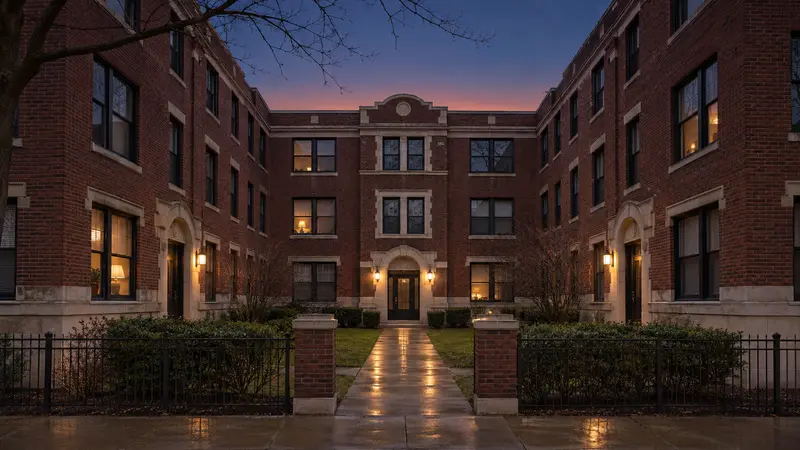
The Near West Side is a condo market with fast commercial-scale permitting, not a house-flipping market. Condominiums were 84.4% of its recorded sales, at a median $360,000. Only 99 two-to-six unit buildings sold. Permits issue in a median 28 days, but the $275,000 median permit cost is not a house rehab budget.
- Renovation permits, 24 months
- 609
- Median days to issue
- 28 (city: 56)
- Share of permits self-certified
- 68.1%
- Median reported permit cost
- $275,000 (city: $105,000)
- Condo sales and median
- 841 at $360,000
- Two-to-six unit sales and median
- 99 at $730,000
- Single-family sales and median
- 56 at $603,500
- Units in buildings of five or more
- 76%
Program terms as of November 26, 2026. Rates as of November 25, 2026.
On this page
- Why does the Near West Side issue permits in half the city's time?
- Why is the Near West Side's median permit cost more than double the city's?
- How few houses and flat buildings trade on the Near West Side?
- What does flip math look like when you use the Near West Side medians?
- What fills the violation list when half the citations are elevators?
- What kind of housing stands on the Near West Side?
- Which Near West Side project fits which plan?
- What do you do next with a Near West Side address?
609 renovation permits in 24 months, a median 28 days to issue, and a median declared cost of $275,000. Set beside 56 single-family sales and 99 flat-building sales, those Near West Side figures describe two different markets sharing one map.
The Near West Side is community area 28, running from Kinzie Street south to 16th Street and from the South Branch of the Chicago River west past Western Avenue. Most of the construction activity there is not the kind a flip loan funds. This page separates the two Near West Side markets.
Sources: City of Chicago Data Portal (Building Permits ydr8-5enu, Building Violations 22u3-xenr, 311 Service Requests v6vf-nfxy), 2024-11-01 to 2026-10-31; Cook County Assessor Parcel Sales (wvhk-k5uv), 2024-05-01 to 2026-04-30.
Why does the Near West Side issue permits in half the city's time?
Because 68.1% of its renovation permits were self-certified. Those 415 permits issued in a median 16 days, faster than the citywide self-certified median of 27. The Near West Side's 151 Standard Plan Review permits took 94 days, the same as the citywide median for that path.
| Review path | Permits | Median days | Middle half | Citywide median |
|---|---|---|---|---|
| Self Cert | 415 | 16 | 6 to 35 | 27 |
| Standard Plan Review | 151 | 94 | 53 to 157 | 94 |
| Direct Developer Services | 43 | 97 | 67 to 133 | 87.5 |
| All renovation/alteration permits | 609 | 28 | 9 to 82 | 56 |
Source: City of Chicago, Department of Buildings, Building Permits (dataset ydr8-5enu), 2024-11-01 to 2026-10-31; retrieved 2026-11-26.
The Department of Buildings opens Self-Certification to eligible residential, business, mercantile and assembly projects, with an architect or structural engineer taking responsibility for code compliance. A plain two-flat rehab on the Near West Side may or may not qualify, so plan on the Standard Plan Review figure until your architect says otherwise. Days are counted from application to issuance, and Express Permit Program work is excluded. The paths are compared under permit routes and timelines.
Why is the Near West Side's median permit cost more than double the city's?
The Renovation/Alteration permit type covers every kind of building, and the Near West Side has few small ones. 76% of its housing units are in buildings of five or more units, and 43 permits went through Developer Services, the route the City reserves for larger, complex projects. Office, retail and institutional alterations sit in the same count as kitchens and porches.
So the median is real, but it is not a house number. For a residential budget, build the scope trade by trade; the scope-level cost guide shows how, and the trade-by-trade budget builder does the arithmetic.
How few houses and flat buildings trade on the Near West Side?
Very few: 56 single-family and 99 two-to-six unit sales in 24 months, against 841 condominium sales.
| Property class | Sales | 25th pct. | Median | 75th pct. | Citywide median |
|---|---|---|---|---|---|
| Single-family (class 2-02 to 2-10, 2-34, 2-78) | 56 | $376,225 | $603,500 | $720,000 | $307,100 |
| Two to six units (class 2-11, 2-12) | 99 | $528,500 | $730,000 | $897,500 | $443,000 |
| Condominium (class 2-99) | 841 | $276,000 | $360,000 | $495,000 | $325,000 |
Source: Cook County Assessor's Office, Assessor - Parcel Sales (dataset wvhk-k5uv), 2024-05-01 to 2026-04-30; retrieved 2026-11-26. Source: Cook County Assessor's Office, Assessor - Parcel Universe (Current) (dataset pabr-t5kh); retrieved 2026-11-26.
These are Cook County Assessor recorded sales between 2024-05-01 and 2026-04-30, with non-market deed types and multi-parcel sales removed. Both small-building samples clear the 20-sale floor but are shallow enough that the quartiles move with a handful of trades. The Institute for Housing Studies counts 41.3% of Near West Side housing units as condominiums and reports that business buyers took 41.7% of the 48 two-to-four unit buildings sold in 2025. If your target is a unit, not a building, start with flipping a Chicago condo.
What does flip math look like when you use the Near West Side medians?
It loses $212,714. The example runs on two-to-six unit sales because, at 99, they are the deeper of the two small-building samples.
Near West Side medians at face value: $528,500 purchase, $275,000 rehab, $730,000 resale
This example is built to fail, and the failure is the point. It feeds the Near West Side's own medians into the same flip math used on the other neighborhood pages. Carry inputs are illustrative.
The flip with the Near West Side permit median as the rehab
| Line | Amount | How it is figured |
|---|---|---|
| Resale, median two-to-six unit sale | $730,000 | |
| Purchase and buy-side costs | -$536,664 | $528,500 25th percentile sale plus closing and transfer tax |
| Construction | -$302,500 | $275,000 plus 10% contingency |
| Financing | -$47,127 | 1.5 points, fees, and 10.2% interest for 7.93 months on $547,500 |
| Taxes, insurance, utilities | -$12,138 | |
| Selling costs | -$44,285 | |
| Down payment needed | $256,000 | the ARV cap leaves only $272,500 for the purchase after the $275,000 holdback |
| Result | -$212,714 |
Line items sum to the stated result. Checked in code at build.
Change one input: the rehab budget
| Line | Amount | How it is figured |
|---|---|---|
| Result with the Near West Side permit median | -$212,714 | rehab of $275,000 |
| Result with the citywide permit median | -$25,714 | rehab of $105,000 |
| Break-even purchase at the citywide rehab figure | $502,500 | against a 25th percentile of $528,500 |
Neither version works at the medians, which is the finding: the spread between quartile and median is $201,500, and costs eat all of it.
Assumptions
- Rate 10.2%, chosen inside the published 8.99%-13.5%; not a quote.
- Hold of 7.93 months: 7 for work and sale plus the area's 28-day median permit wait.
- Reported permit cost is what applicants declare for permitted work. On the Near West Side most of those permits are not small residential rehabs.
Two things break. First, a $275,000 rehab against a $730,000 resale pushes the loan into the ARV cap, and the rehab holdback uses up half the loan. JFG's draw process guide explains how a holdback is released. Second, even after swapping in the citywide permit median of $105,000, the Near West Side deal still returns -$25,714. This is median-to-median arithmetic, not a prediction about a specific building. It says the typical Near West Side flat building is not priced to leave a rehab-and-resell margin.
What fills the violation list when half the citations are elevators?
Inspection scheduling and mechanical items. The elevator bureau wrote 1,134 of the Near West Side's 2,328 violation line items, 48.7% of the total, and those belong to buildings with elevators, not to two-flats. With that bureau set aside, the list is led by notices to arrange a premises inspection, then refrigeration inspections, exterior walls, boiler licensing and interior walls.
| Most cited violation (elevator bureau excluded) | Citations, 24 months |
|---|---|
| Arrange Premise Inspection (CN190019) | 92 |
| Arrange For Inspection (RF301041) | 60 |
| Repair Exterior Wall (CN061014) | 45 |
| Owner Or Licensed Contractor (BR1001) | 33 |
| Repair Interior Walls/Ceiling (CN101015) | 32 |
| All violations, 530 addresses | 2,328 |
Source: City of Chicago, Department of Buildings, Building Violations (dataset 22u3-xenr), 2024-11-01 to 2026-10-31; retrieved 2026-11-26. Source: City of Chicago, Boundaries - Community Areas (dataset igwz-8jzy); retrieved 2026-11-26.
The 530 cited addresses are the better measure of how many Near West Side properties are involved. Most Near West Side records show as open in the portal regardless of age. Vacant-building complaints are low as well: 98 in 24 months, or 17.2 per square mile against 46.3 citywide.
What kind of housing stands on the Near West Side?
Newer and larger than in West Town or the Lower West Side. Only 20.5% of the Near West Side's 38,955 housing units were built before 1940, and 3.6% are detached houses.
| Housing stock | Near West Side |
|---|---|
| Housing units | 38,955 |
| Single-family detached share | 3.6% |
| Units in 2 to 4 unit buildings | 14% |
| Built before 1940 | 20.5% |
| Owner-occupied share of occupied units | 34.7% |
Source: U.S. Census Bureau, American Community Survey 2020-2024 5-Year Estimates, Detailed Tables (table-based summary file) (dataset ACSDT5Y2024), 2020-01-01 to 2024-12-31; retrieved 2026-11-26. Source: City of Chicago, Boundaries - Census Tracts - 2020 (dataset 7qjk-677h); retrieved 2026-11-26.
Those shares come from 2020-2024 American Community Survey tract estimates, 20 Near West Side tracts in all. The older small buildings that do exist can carry a survey rating: under the City's Demolition-Delay Ordinance, a demolition permit for a red- or orange-rated building is subject to a hold (Up to 90 days).
Which Near West Side project fits which plan?
| What you are looking at | What the data says | Plan to test |
|---|---|---|
| Condo unit | 841 sales, median $360,000 | Cosmetic unit flip; association rules control the schedule |
| Two-to-six unit building | 99 sales, median $730,000 | Rehab and hold, or buy far below $528,500 |
| Single-family house | 56 sales, median $603,500 | Flip only with comps on the same few blocks |
| Building of five or more units | Mostly outside the classes counted on this page | Commercial underwriting; see where five units changes lending |
Source: Cook County Assessor's Office, Assessor - Parcel Sales (dataset wvhk-k5uv), 2024-05-01 to 2026-04-30; retrieved 2026-11-26.
| Line | Stations inside the community area |
|---|---|
| Blue (Forest Park branch) | Clinton, UIC-Halsted, Racine, Illinois Medical District, Western |
| Green and Pink | Clinton, Morgan, Ashland |
| Green only | Damen |
| Pink only | Polk |
Station locations come from the City's CTA stop list tested against the community area boundary.
What fails on the Near West Side
Underwriting a two-flat here with the rule of thumb you use in a bungalow neighborhood fails twice: the resale comps are too few to support a firm ARV, and the purchase quartile sits too close to the median. A lender sizing to 75% of supported ARV will discount a value resting on two or three sales. The better route is a condo-unit flip with deep comps, or a different area: neighboring West Town to the north and Pilsen's Lower West Side to the south recorded 491 and 175 flat-building sales against 99 here.
What do you do next with a Near West Side address?
Decide which Near West Side market the building is in before you price it. Then write a line-item budget in the line-item scope and budget sheet instead of leaning on the area's permit median. JFG's Chicago fix and flip loan page lists what the lender needs to see on a Near West Side file. For contrast, see the Near North Side or the full list of neighborhood pages.
Questions: Near West Side flip data
How many L stations are on the Near West Side?
Ten station entries in the City's CTA stop list fall inside the Near West Side community area. On the Blue Line: Clinton, UIC-Halsted, Racine, Illinois Medical District and Western. On the shared Green and Pink line track: Clinton, Morgan and Ashland, plus Damen on the Green Line alone. Polk is Pink Line only. Near West Side lots close to those stations can qualify for the zoning code's transit parking reduction (Up to 100%).
Which wards cover the Near West Side?
Three wards hold about 94% of the Near West Side on the 2023 map. Measured from the City's ward boundary file, the 28th Ward covers about 38% of the land, the 27th about 37% and the 34th about 19%, with the 25th Ward holding roughly 3%. Check the ward by address before any zoning conversation.
Are there TIF districts on the Near West Side?
Ten districts in the City's TIF boundary file list the Near West Side community area. They include Central West and Midwest, both running to 2036, and Kinzie Industrial Conservation Area, Roosevelt/Racine, Western/Ogden and Canal/Congress, which run to 2034. A TIF does not alter permit review for a Near West Side rehab, but it is worth one lookup on the City map before closing.
Did Near West Side two-to-six unit prices move during the sale window?
The yearly groups are too small to say. The Assessor data shows a two-to-six unit median of $761,500 on 30 sales in 2024 and $599,900 on only 17 sales in early 2026. Under 20 sales is a thin sample, so one or two unusual Near West Side buildings can move that figure a long way.
Where is the Illinois Medical District?
The Illinois Medical District's office address is 2100 West Harrison Street, and a Blue Line station on the Forest Park branch carries its name. It sits in the western half of the Near West Side community area. Institutional and medical build-outs are a likely reason this area's renovation permits skew large, so do not read the $275,000 median as a residential figure.
Local rates and rules cited on this page
| Item | Figure | Primary source | Effective |
|---|---|---|---|
| Demolition-Delay hold | Up to 90 days | Demolition Delay (City of Chicago Department of Planning and Development) | 2003 |
| Parking reduction near CTA rail or listed bus corridors | Up to 100% | Chicago Zoning Ordinance 17-10-0100 General (Transit-Served Locations) (American Legal Publishing (Chicago Zoning Ordinance)) | 2026-09-29 |
| Chicago transfer tax, City portion (buyer) | $3.75 per $500 of price | Real Property Transfer Tax (7551) (City of Chicago Department of Finance) | 2008-04-01 |
| Chicago transfer tax, CTA portion (seller) | $1.50 per $500 of price | Real Property Transfer Tax (7551) (City of Chicago Department of Finance) | 2008-04-01 |
| Cook County real estate transfer tax | $0.25 per $500 of value | Transfer Fees (Cook County Clerk) | 1968-01-01 |
| Illinois state real estate transfer tax | $0.50 per $500 of value | 35 ILCS 200/31-10, Imposition of tax (Illinois General Assembly) | 2005-06-01 |
Rates as of November 25, 2026. Confirm with the agency before relying on any figure.
Sources
- Building Permits (dataset ydr8-5enu), City of Chicago Department of Buildings, 2026-11.
- Self-Certified Permit Application Program, City of Chicago Department of Buildings, 2026.
- Standard Plan Review Permit Program, City of Chicago Department of Buildings, 2026.
- Assessor - Parcel Sales (dataset wvhk-k5uv), Cook County Assessor's Office, 2026-11.
- Housing Market Indicators Data Portal: Near West Side, Institute for Housing Studies at DePaul University, 2025.
- CTA - List of 'L' Stops (dataset 8pix-ypme), City of Chicago / Chicago Transit Authority, 2025-11.
- Green Line route guide, Chicago Transit Authority, 2026.
- Building Violations (dataset 22u3-xenr), City of Chicago Department of Buildings, 2026-11.
- Illinois Medical District: About, Illinois Medical District Commission, 2026.
- Demolition Delay, City of Chicago Department of Planning and Development, 2003.