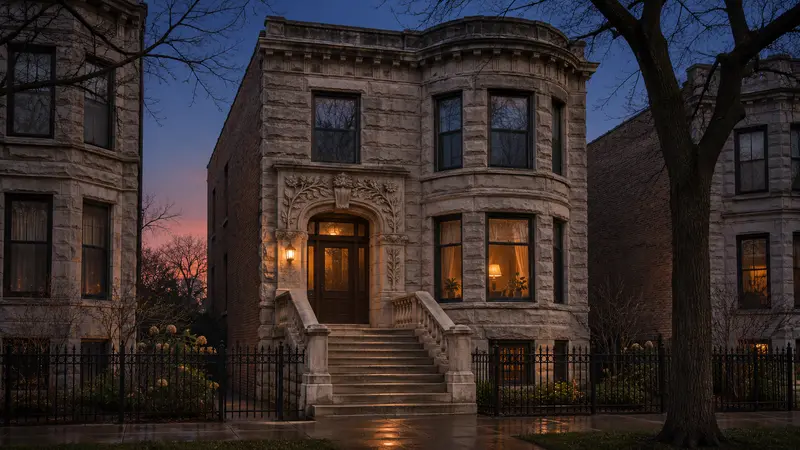
Two separate rules apply: landmark status puts every permit in front of Historic Preservation staff, and an orange or red survey rating puts a demolition permit on hold. The hold runs up to 90 days. On the example below, waiting it out costs $8,570 in interest and carry before any wrecking permit can issue.
- Landmark permit review covers
- All permits on designated or proposed landmarks and landmark districts
- Demolition-Delay hold
- Up to 90 days, extendable by agreement
- Buildings the hold covers
- Red- and orange-rated in the Chicago Historic Resources Survey
- Orange-rated stock
- About 9,600 properties
- Red-rated stock
- About 300 properties
- Commission workload
- More than 900 a year, most approved in one day
- Class L tax incentive
- Commercial, industrial and income-producing nonprofit landmarks only
Program terms as of November 26, 2026. Rates as of November 25, 2026.
On this page
- How do you check a property's landmark and survey status?
- What do the CHRS color codes mean?
- What work does the Commission review at permit?
- Which exterior items change your scope in a district?
- How does the Demolition-Delay hold work?
- What does the hold cost in carry?
- How do these rules change ARV and the loan?
- Does the Class L incentive help a residential flip?
- What should you do before you offer?
A Chicago flip meets preservation rules through two doors. One is designation: the building is a Chicago Landmark or sits inside a landmark district, so the Commission on Chicago Landmarks has a say in permits. The other is a color code from a 1995 survey, which controls nothing about your rehab but can freeze a wrecking permit for a season.
Both are free to check before you write an offer. This page is general education published by a lender, not legal advice; confirm a specific property with the Historic Preservation Division or a zoning attorney.
How do you check a property's landmark and survey status?
Search the address on the City's zoning and land use map, where the City marks the red and orange buildings covered by the hold. Then pull the record in the Chicago Historic Resources Survey database, the CHRS, which lists construction date, architect, style, landmark status and PIN.
Record three answers: designated landmark or not, inside a district or not, and the color. If the map and the database disagree, call the Historic Preservation Division. Add the result to the file you build from the City-records diligence checklist, next to open permits and violations.
What do the CHRS color codes mean?
The survey ranked pre-1940 buildings by significance, and only the top two colors carry a legal consequence. It identified 17,371 properties, built before 1940.
| Code | What the City says it means | Effect on a flip |
|---|---|---|
| Red | Potentially significant to the city, state or nation. About 300 properties. | Demolition permit held |
| Orange | Potentially significant to the surrounding community. About 9,600 properties. | Demolition permit held |
| Yellow | Relatively unaltered, part of a concentration of significant buildings | None from the rating |
| Yellow-green | Covered in artificial siding when surveyed | None from the rating |
| Green | Exterior slightly altered | None from the rating |
| Purple | Exterior extensively altered | None from the rating |
| Blue | Built after 1940; listed only when in a district or considered for designation | None from the rating |
The ratings date from field work that ended in 1995, so a color can describe a facade that has since changed.
What work does the Commission review at permit?
All of it, if the property is designated or proposed. The City says Historic Preservation staff review every permit application on landmarks and in districts to confirm the work will not harm significant features. There is no separate landmark permit; review rides along with the normal building permit path.
According to the Commission's owner guidance, the significant features in a district are typically the exterior elevations visible from the public right-of-way. That is why front windows draw more comment than an interior gut. Designation can also work for you: the guidance points to a historic preservation provision in the City's Rehabilitation Code that gives designated landmarks more flexibility in how the Building Code is applied, so ask your architect whether it eases an existing stair or opening. The same guidance reports the workload this way: More than 900 a year, most approved in one day. New infill construction, additions and demolitions that need City Council review go to the Commission at a public meeting, on its calendar and not yours.
Which exterior items change your scope in a district?
Windows, masonry and anything added where the street can see it. The Commission judges changes against criteria built on the U.S. Secretary of the Interior's Standards for Rehabilitation, plus its own published guidelines for alterations and new construction.
- Windows. Street-facing openings are the usual sticking point. The City's list of permit-exempt work says its exceptions may not apply to landmark property, so do not assume a like-for-like swap is exempt.
- Masonry. A greystone or face-brick front is a significant feature by definition. Price tuckpointing and brick replacement after staff comment, and read the porch and parapet rules for the permit side.
- Additions and dormers. Additions go to the Commission, and visibility from the street is the test. They also have to fit the zoning envelope for added space, which the Commission does not control.
Ask for a pre-permit review. The City encourages it and says it can speed the formal one.
How does the Demolition-Delay hold work?
The Demolition-Delay Ordinance, adopted in 2003, lets the City hold a demolition permit on a building rated red or orange. Length of the hold: Up to 90 days. The clock starts when the application reaches the Historic Preservation Division, not when you close and not when you first call. The City uses the time to explore preservation options, landmark designation included.
Two details matter to a budget. The hold can be extended by mutual agreement with the applicant. And the City posts its demolition delay hold lists by year back to 2003, so you can see what was held near you.
What does the hold cost in carry?
It costs interest on what you borrowed to buy, plus taxes, insurance and utilities, for every day the permit sits while nothing is built.
Gut it or wreck it: an orange-rated frame two-flat bought for $238,000
The gut-rehab permit is not subject to the hold. The wrecking permit is. Inputs are illustrative, not an offer.
Cost of sitting through the full hold
| Line | Amount | How it is figured |
|---|---|---|
| Interest on the acquisition advance | $6,159 | $214,200 x 11.5% / 360 = $68.43 a day x 90 days |
| Taxes, insurance and utilities | $2,411 | $815 a month = $26.79 a day x 90 days |
| Cost per day of hold | $95.22 | interest plus carry |
| Each 30-day extension you agree to | $2,857 | the hold can be lengthened by mutual agreement |
| Carry cost of a 90-day hold | $8,570 |
Line items sum to the stated result. Checked in code at build.
The gut-rehab path skips the $8,570 entirely, which is why the status check belongs before the offer, not after closing.
Assumptions
- The 11.5% interest rate is our illustrative pick from the published 8.99%-13.5% range. It is not a quote.
- Only the acquisition advance of $214,200 is outstanding during the hold; no rehab draws have funded.
- Monthly carry of $815 is a placeholder. Use your own tax bill, insurance quote and utility minimums.
Put your own loan balance and monthly bills into the cost-of-waiting calculator. If the hold would push you near maturity, read how running past your loan term is handled before you commit to the teardown path. Extension terms are underwritten file by file, ask your loan officer.
How do these rules change ARV and the loan?
They change which exit you can underwrite. A lender sizes a rehab loan at up to 90% of purchase price plus 100% of approved rehab, capped at 75% of supported ARV, and the ARV has to be supported by sales of comparable finished buildings. A teardown-and-rebuild value on an orange-rated lot is not a rehab comp, and a rooftop addition in a district is not approved until the Commission approves it.
So bring the status, the color and any staff correspondence with your scope of work. The way appraisers and lenders support value rewards scopes that are permittable as drawn. Leverage is not the same as no cash: closing costs, interest, overruns and work done ahead of draws are still yours. JFG lists its document and experience requirements and its Chicago hard money program separately.
Does the Class L incentive help a residential flip?
Almost never. The City describes Class L as 10% assessment level for 10 years, then 15% and 20% for landmark commercial, industrial and income-producing nonprofit buildings, tied to a rehab investment of at least half the building's value. A one-to-four unit residential flip is outside that scope. What does matter to your buyer is reassessment after permitted work.
When preservation rules break the deal
A deal priced as a teardown on an orange or red lot does not work on a rehab loan clock. The wrecking permit can wait out the full hold, the hold can end in a designation recommendation, and a flip loan with a rehab holdback is not a ground-up construction loan. The better route: reprice the offer as a rehab that keeps the structure, or make the offer contingent on a released demolition permit and let the seller carry the wait.
A district deal whose ARV depends on a visible third story has the same problem. Until staff approve the massing, underwrite the building as it stands.
What should you do before you offer?
- Search the address on the zoning map and write down district status and color.
- Open the CHRS record and save it to the deal file.
- If orange or red, decide now whether any version of your plan needs a wrecking permit.
- If designated, send the exterior scope to Historic Preservation staff and request a pre-permit review.
- Price the hold with your own balance and carry.
- Send status, scope and comps together when you ask for terms.
Run the same checks on any greystone rehab, where the facade is the asset. For the rest of the local rulebook, start at the Chicago rules hub.
Questions: Landmark districts and demolition delay
Does an orange rating stop me from gutting the interior?
No. The Demolition-Delay Ordinance holds demolition permits, and an orange or red rating by itself is a survey finding, not a landmark designation. Interior work, mechanical replacement and a normal gut rehab go through the Department of Buildings like any other job. The gray area is a scope that removes most of the structure. Have your architect describe it precisely and ask the Historic Preservation Division how the application will be classified before you close.
Is a building in a landmark district always orange or red?
No, and the reverse is not true either. The survey lists designated-district properties in every color, including post-1940 buildings coded blue. Designation comes from a City Council ordinance; the color comes from field work the City finished in 1995. A yellow or green building inside a district still gets Commission review on every permit. An orange building outside any district gets no design review at all, only the demolition hold. Check both layers separately on the zoning map.
Does landmark status raise my property taxes during the hold?
Not directly. The Commission's owner guidance says neither the Assessor's valuation nor the tax rate is affected directly by designation. What moves your bill after a flip is the permit work itself, because Cook County can reassess improvements off cycle. Budget carry taxes from the current bill, expect the buyer's attorney to raise any post-rehab increase through the proration credit, and confirm specifics with a property tax attorney.
Can the Commission change my zoning or let me build bigger?
It has no zoning power. The Commission says it has no jurisdiction over zoning, though it can recommend reduced setback depths where that keeps a district's character intact. So a rear addition or dormer in a district has to clear two independent tests: the bulk limits of the zoning district, and the Commission's criteria for work visible from the public way. Passing one does nothing for the other. Run the zoning math first because it is objective, then take the design to staff.
What happens if I replace windows without approval in a district?
You risk a stop work order and paying twice for the same openings. The City's list of permit-exempt work warns that its exceptions may not apply to proposed or designated landmarks and districts, so the usual in-kind window exemption is not a safe assumption. A stop work order carries its own penalty on top of the permit fee, and the replacement units are a sunk cost. Send staff the window schedule and get the answer in writing before ordering.
Local rates and rules cited on this page
| Item | Figure | Primary source | Effective |
|---|---|---|---|
| Properties identified in the Chicago Historic Resources Survey | 17,371 properties, built before 1940 | Chicago Historic Resources Survey (City of Chicago Department of Planning and Development) | 1995 |
| Red-rated properties in the Chicago Historic Resources Survey | About 300 properties | Chicago Historic Resources Survey (City of Chicago Department of Planning and Development) | 1995 |
| Orange-rated properties in the Chicago Historic Resources Survey | About 9,600 properties | Chicago Historic Resources Survey (City of Chicago Department of Planning and Development) | 1995 |
| Landmark permits reviewed by the Commission | More than 900 a year, most approved in one day | Chicago Landmarks: Owner Q and A (City of Chicago, Commission on Chicago Landmarks) | 2026 |
| Demolition-Delay hold | Up to 90 days | Demolition Delay (City of Chicago Department of Planning and Development) | 2003 |
| Class L property tax incentive | 10% assessment level for 10 years, then 15% and 20% | Class L Property Tax Incentive (City of Chicago Department of Planning and Development) | 2026 |
| Landmark permit review | All permits on designated or proposed landmarks and landmark districts | Historic Preservation Permit Review (City of Chicago Department of Planning and Development) | 2026 |
| Buildings covered by Demolition-Delay | Red- and orange-rated in the Chicago Historic Resources Survey | Demolition Delay (City of Chicago Department of Planning and Development) | 2003 |
Rates as of November 25, 2026. Confirm with the agency before relying on any figure.
Sources
- Demolition Delay, City of Chicago Department of Planning and Development, 2026.
- Landmark Permit Review, City of Chicago Department of Planning and Development, 2026.
- Chicago Historic Resources Survey, City of Chicago Department of Planning and Development, 1995 survey; page accessed 2026.
- Chicago Landmarks: Owner Q and A, City of Chicago, Commission on Chicago Landmarks, 2026.
- Class L Property Tax Incentive, City of Chicago Department of Planning and Development, 2026.
- Chicago Zoning and Land Use Map, City of Chicago, 2026.
- What Types of Work Do Not Require a Building Permit?, City of Chicago Department of Buildings, 2026.