Permitted rehab work can be reassessed in any year, not just Chicago's triennial year, so the tax bill your buyer inherits is not the one on the listing. At a 10% of market value assessment level, the 3.0300 equalizer and Chicago's 6.853152% rate, the example bill moves from $4,901 to $10,632 a year.
- Residential assessment level
- 10% of market value
- State equalizer, tax year 2025
- 3.0300
- Chicago composite rate, tax year 2025
- 6.853152%
- Next Chicago triennial reassessment
- Tax year 2027, on bills paid in 2028
- Off-cycle trigger
- Permit work can be reassessed in any year
- Owner's notice to the Assessor
- Prorated from occupancy permit date; notify assessor within 30 days
- Vacancy relief, 1-6 units
- Casualty only, up to 24 months
Program terms as of November 26, 2026. Rates as of November 25, 2026.
On this page
- How does Cook County turn a value into a bill?
- When does the Assessor reassess a Chicago property?
- How does permit work reach the Assessor's Office?
- Is the added value taxed for the whole year?
- Do you get tax relief while the building sits empty?
- Which exemptions fall off the bill at a sale?
- What does the before-and-after bill look like?
- Why do the buyer's escrow and the closing proration change?
- What should a flipper do with this before listing?
The tax line on a listing sheet describes the building you bought, not the one you are selling. A gutted and rebuilt house is worth more, the Cook County Assessor has a pipeline for finding that out, and the bill follows. For a flipper the higher bill mostly lands on someone else, but it shapes what that buyer can afford, what their attorney asks for at closing, and what you owe if the hold runs long.
Figures are tax year 2025 factors as published through November 25, 2026. Treat this as general education and confirm with a Cook County property tax attorney or CPA.
How does Cook County turn a value into a bill?
Four numbers multiplied together. The Assessor estimates market value; the rest is published arithmetic. Mixed-use buildings face a class question first; see storefronts with flats above.
| Step | Factor | Current figure | Set by |
|---|---|---|---|
| 1 | Assessment level for residential (Class 2) | 10% of market value | County ordinance |
| 2 | State equalizer | 3.0300 | Illinois Department of Revenue |
| 3 | Exemptions subtracted from EAV | $10,000 reduction in EAV for a homeowner | Assessor, on application |
| 4 | Chicago composite tax rate | 6.853152% | Cook County Clerk |
The Assessor's page on how residential property is valued states the level, the Department of Revenue published the 2025 multiplier, and the rate comes from the Clerk's annual report. The prior year's rate was 6.618606%, so the rate itself moves.
When does the Assessor reassess a Chicago property?
On a three-year cycle, plus whenever a permit gives it a reason. The Clerk's 2025 tax rate release lays out the triennial reassessment calendar.
| Tax year | Area reassessed | Bills payable |
|---|---|---|
| 2024 | City of Chicago | 2025 |
| 2025 | North and northwest suburbs | 2026 |
| 2026 | South and west suburbs | 2027 |
| 2027 | City of Chicago | 2028 |
The cycle is not a safe harbor. The Assessor's assessment calendar says properties outside the reassessment area are still revalued when there is a change from division work, permit applications or other special circumstances, and the owner then receives a reassessment notice. A 2026 gut in Chicago can be picked up before 2027.
How does permit work reach the Assessor's Office?
Through the permit itself and through two reporting duties in state law. The Assessor's Home Improvement Exemption page describes the mechanics in passing: when the office receives building permits, staff field-check the improvement.
The statutes add deadlines. Under 35 ILCS 200/9-160, the authority that issues building or occupancy permits must notify the chief county assessment officer by December 31 when a full or partial occupancy permit issues. Under 35 ILCS 200/9-180, the owner's side reads: Prorated from occupancy permit date; notify assessor within 30 days.
Not every job counts. Under 35 ILCS 200/10-20, maintenance and repairs to a residence do not raise its assessed valuation if they add no square footage, do not materially alter the structure and use materials worth no more than those replaced. An addition or a layout-changing gut falls outside that.
Improvements that were missed can be assessed later as omitted property, and a sale at a much higher price is its own signal. Permit timing is covered under DOB permit paths and timelines.
Is the added value taxed for the whole year?
No, it is prorated from the date the work is usable. Section 9-180 makes the January 1 owner liable for the increase on a proportionate basis, from the date the occupancy permit issued or the improvement was habitable and fit for use through December 31, computed on a 365-day year.
For a flip finished in September, roughly a third of that year's increase attaches to that tax year. Because Cook County bills a year behind, the partial-year amount shows up on a bill issued the following year, usually after you have sold.
Do you get tax relief while the building sits empty?
On a one- to six-unit residential property, no. The Assessor's vacancy policy limits residential relief this way: Casualty only, up to 24 months. A rehab is not a casualty. Land value is never adjusted for vacancy.
Asking anyway has a side effect. A vacancy-based assessment request is one of the facts that creates a legal presumption under Chicago's vacant building registration rules. Larger buildings are treated differently; see the questions below and four units versus five.
Which exemptions fall off the bill at a sale?
The seller's. Many distressed properties were owner-occupied, so the last bill carries a Homeowner Exemption, and sometimes senior exemptions, that an investor-owner does not get. Your carrying bill can therefore be higher than the seller's even before any reassessment.
The state transfer declaration asks for the homestead exemptions shown on the most recent bill, so the change of ownership is visible to the County from the day the deed records. Your owner-occupant buyer applies for their own exemption after closing.
What does the before-and-after bill look like?
At current factors a Chicago home with no exemptions pays about 2.08% of the Assessor's market value each year.
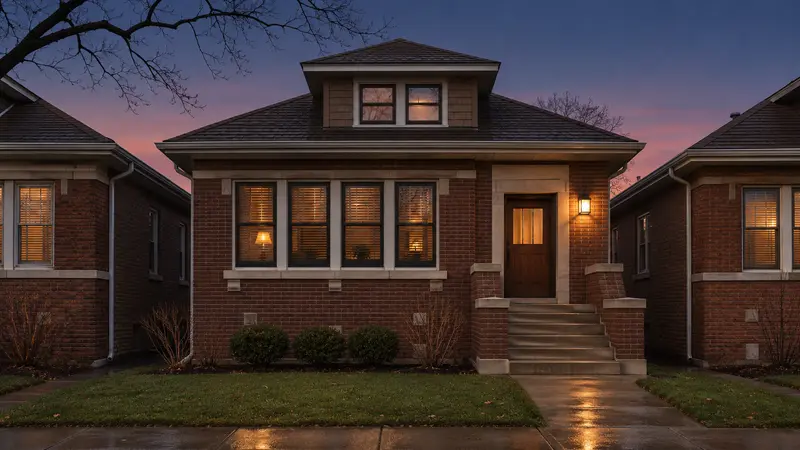
An Irving Park bungalow: taxed at $236,000 before, $512,000 after
Before is the Assessor's pre-rehab market value. After assumes the Assessor's new estimate lands at the resale price, which it may not. Values are illustrative.
The annual bill at each value, no exemptions
| Line | Amount | How it is figured |
|---|---|---|
| Bill at the pre-rehab value | $4,901 | $236,000 x 10% = $23,600 assessed; x 3.03 = $71,508 EAV; x 6.85% |
| Added by the rehab value | $5,731 | EAV rises to $155,136 |
| Effective rate on market value | 2.08% | before exemptions |
| Bill at the post-rehab value | $10,632 |
Line items sum to the stated result. Checked in code at build.
What an owner-occupant buyer would pay
| Line | Amount | How it is figured |
|---|---|---|
| Bill at the post-rehab value | $10,632 | |
| Homeowner Exemption | -$685 | $10,000 reduction in EAV, x 6.85% |
| Monthly escrow at the old bill | $408 | what the listing's tax line implies |
| Monthly escrow at the new bill | $829 | $420 a month more |
| Buyer's bill after the exemption | $9,946 |
Line items sum to the stated result. Checked in code at build.
A buyer who qualified on $408 a month of taxes is looking at $829 once the new value reaches a bill.
Assumptions
- Uses tax year 2025 factors (bills payable in 2026). The equalizer and composite rate are reset every year, and the rate varies by tax code within Chicago.
- The Assessor estimates value with a mass appraisal model. A sale price is evidence, not the assessment.
- No senior, freeze or other exemptions are modeled, and none are assumed for the investor-owner.
Try your own values in the post-rehab property tax estimator. During the hold, your carry is the old bill; see monthly carry during the hold.
Why do the buyer's escrow and the closing proration change?
Because both are built from the last bill, and the last bill is stale. A mortgage lender sizes the buyer's monthly escrow from the most recent taxes it can document. When the reassessed bill arrives, the escrow account is short and the payment is raised to catch up.
Tax proration has the same problem. Cook County taxes are paid a year in arrears: the Treasurer's property tax primer explains that the first installment is 55% of the prior year's total tax, with the balance on a second bill after rates are set. At closing the seller credits the buyer for taxes accrued but not yet billed, calculated as a percentage of the last full bill.
That percentage is a negotiated contract term, not a statute. After a visible rehab, expect the buyer's attorney to ask for a higher percentage or a written agreement to re-prorate when the actual bill issues. Transfer stamps at the same closing are covered in transfer taxes on both closings.
The assumption that fails
Marketing a finished flip with the old tax bill and hoping the buyer's lender does the same math.
Estimate the post-rehab bill yourself, disclose it as an estimate, and price with it. If you keep the building, the new bill is yours: run it through the flip versus BRRRR comparison before choosing the refinance exit.
What should a flipper do with this before listing?
- Pull the current assessed value and exemptions for the PIN from the Assessor's site before you buy.
- Estimate the bill at your expected resale value with current factors, and again with the homeowner exemption.
- Put the estimate in your listing packet.
- Tell your closing attorney early that the proration percentage will be negotiated, and decide your position on re-proration.
Record the PIN, current bill and exemptions on the due diligence checklist. For the full walkthrough of classes, exemptions and appeals, the JFG Cook County property tax guide goes deeper, and JFG's Chicago DSCR loans page covers the rental loan where the new bill becomes part of DSCR. The county-by-county picture is in city versus collar counties, and other local rules are at Chicago rules for flippers.
Questions: Reassessment after rehab
Will the Assessor set my flip's new value at the price I sell it for?
Not automatically. The Assessor's Office says it values homes with statistical models built on characteristics and recent neighborhood sales, then has analysts review the results. Your sale becomes one data point, and updated characteristics from the permit matter as much as the price. A recent closing statement is, however, listed by the Assessor as evidence an owner can submit in an overvaluation appeal, so a buyer who is assessed above the purchase price has a straightforward argument.
Am I required to tell the Assessor the rehab is finished?
State law says so. For the owner of improved property, 35 ILCS 200/9-180 reads: Prorated from occupancy permit date; notify assessor within 30 days. The clock runs from the occupancy permit or from completion, and the notice goes on the assessor's form, by certified mail with the legal description, requesting reassessment. Separately, the office that issues permits has its own duty to report occupancy permits by December 31. Ask your closing attorney how this is handled in practice on a rehab that needs no occupancy certificate.
Does the Home Improvement Exemption cover a flipper's rehab?
Do not underwrite to it. The Assessor describes the benefit as letting a homeowner add value without being taxed on it: Up to $75,000 of added value exempt for up to 4 years. There is no application; it is applied after the office field-checks the permit. Whether a given property receives it is the Assessor's call, and the page is written for homeowners, not investor entities. If your buyer is an owner-occupant, their attorney can ask the Assessor's Office whether it applies to the permitted work.
Can an LLC appeal the new assessment without a lawyer?
At the Assessor's level an owner can file during the township's open window, which is About 30 days after the reassessment notice. The Board of Review is stricter: Attorney required for LLCs and corporations, and complaints must arrive by the Township's official closing date. After a Board decision the next stop is the state Property Tax Appeal Board, with a filing window of 30 days after the Board of Review decision. A flipper who will sell before the next bill rarely appeals, but a BRRRR investor should calendar all three.
Is the rule different for a building with seven or more units?
Yes, in two ways. The Assessor's vacancy policy treats apartment buildings over six units as commercial for vacancy purposes and recognizes renovation-related vacancy there: Up to 24 months per event, when the whole building is uninhabitable and producing no income. And the classification changes, since Class 2 stops at six units. A gut rehab of a larger building is the one case where vacancy relief during construction is a realistic line to ask a property tax attorney about.
Local rates and rules cited on this page
| Item | Figure | Primary source | Effective |
|---|---|---|---|
| Cook County Class 2 residential assessment level | 10% of market value | How Residential Properties Are Valued (Cook County Assessor's Office) | 2026 |
| Cook County final equalization factor, tax year 2025 | 3.0300 | 2025 Cook County Final Multiplier Announced (Illinois Department of Revenue) | 2026-06-18 |
| Cook County Homeowner Exemption | $10,000 reduction in EAV | Homeowner Exemption (Cook County Assessor's Office) | 2017 |
| City of Chicago general composite tax rate, tax year 2025 | 6.853152% | 2025 Cook County Tax Rates Released (tax rate report) (Cook County Clerk) | 2025 |
| City of Chicago general composite tax rate, tax year 2024 | 6.618606% | 2025 Cook County Tax Rates Released (tax rate report) (Cook County Clerk) | 2026-09-23 |
| New or added improvements taxed pro rata from occupancy | Prorated from occupancy permit date; notify assessor within 30 days | 35 ILCS 200/9-180, Pro-rata valuations (Illinois General Assembly) | 2000-01-01 |
| Assessor vacancy relief for 1-6 unit residential | Casualty only, up to 24 months | Assessor's Vacancy Policy (Cook County Assessor's Office) | 2026 |
| First installment amount | 55% of the prior year's total tax | How the Illinois Property Tax System Works (October 2025 update) (Cook County Treasurer's Office) | 2025-10 |
| Building permits trigger off-cycle reassessment | Permit work can be reassessed in any year | Assessment & Appeal Calendar (Cook County Assessor's Office) | 2026 |
| Home Improvement Exemption | Up to $75,000 of added value exempt for up to 4 years | Home Improvement Exemption (Cook County Assessor's Office) | 2026 |
| Assessor appeal filing window | About 30 days after the reassessment notice | Residential Appeals (Cook County Assessor's Office) | 2026 |
| Board of Review: LLC and corporate owners need an attorney | Attorney required for LLCs and corporations | Board of Review Official Rules (last updated July 27, 2026) (Cook County Board of Review) | 2026-07-27 |
| Board of Review appeal deadline | Township's official closing date | Board of Review Official Rules (last updated July 27, 2026) (Cook County Board of Review) | 2026-07-27 |
| Appeal to the Property Tax Appeal Board | 30 days after the Board of Review decision | 35 ILCS 200/16-160, Property Tax Appeal Board; process (Illinois General Assembly) | 2026 |
| Renovation-related vacancy relief (commercial, incl. 7+ unit apartments) | Up to 24 months per event | Assessor's Vacancy Policy (Cook County Assessor's Office) | 2026 |
Rates as of November 25, 2026. Confirm with the agency before relying on any figure.
Sources
- Assessment and Appeal Calendar, Cook County Assessor's Office, 2026.
- How Residential Property Is Valued, Cook County Assessor's Office, 2026.
- Vacancy Policy, Cook County Assessor's Office, 2026.
- Home Improvement Exemption, Cook County Assessor's Office, 2026.
- Residential Appeals, Cook County Assessor's Office, 2026.
- 35 ILCS 200/9-160, Illinois General Assembly, P.A. 91-486, effective January 1, 2000.
- 35 ILCS 200/9-180, Illinois General Assembly, P.A. 91-486, effective January 1, 2000.
- 35 ILCS 200/10-20, Repairs and maintenance of residential property, Illinois General Assembly, P.A. 90-788, effective August 14, 1998.
- 2025 Cook County Tax Rates Released, Cook County Clerk, September 23, 2026.
- 2025 Cook County final multiplier, Illinois Department of Revenue, June 18, 2026.
- Property Tax Primer, Cook County Treasurer, October 2025.