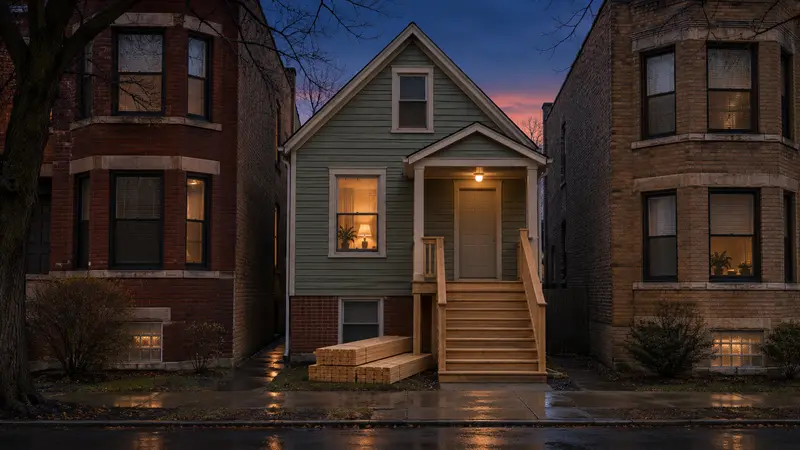
You pay the bid itself with your own certified funds: a flip loan closes in 7-10 business days, and the Sheriff's sale terms are 10% down at sale; balance within 24 hours. Financing enters later: on the rehab once the deed records, or on an ordinary purchase from the bank that took the property back.
- Sheriff's sale terms
- 10% down at sale; balance within 24 hours
- Judicial Sales Corporation terms
- Most sales 25% down; balance by 2 PM next business day
- Buyer's right to possession
- 30 days after order confirming sale
- Flip loan closing time
- 7-10 business days on complete files, counted after borrower conditions are met
- Loan on an auction buy after the deed
- underwritten file by file
Program terms as of November 26, 2026. Rates as of November 25, 2026.
On this page
- How does a Cook County judicial sale run from judgment to deed?
- What do the Sheriff and the private selling officer require on sale day?
- Why can't a flip loan pay for the bid?
- Where can lender money enter after the sale?
- What does the cash calendar look like on a real bid?
- How long does confirmation take, and can the judge say no?
- When do you get the keys, and what if someone lives there?
- Can the former owner still take the property back?
- What does a judicial deed do to title, taxes and water?
- What should you check before you register to bid?
- What is the next step if you still want to bid?
A judicial sale is the one way to buy Chicago real estate where the seller will not wait for your lender. The court's selling officer wants certified funds on a schedule measured in hours, hands you a certificate instead of a deed, and gives you no key. This lender-published page says plainly which parts a loan can fund.
It is general education on the Illinois Mortgage Foreclosure Law as of November 2026. Hire a foreclosure attorney before you register.
How does a Cook County judicial sale run from judgment to deed?
A Cook County foreclosure ends in a public auction ordered by a Chancery judge and run by a selling officer, either the Sheriff or a private firm the court appoints.
Four documents mark your progress. You get a receipt when you pay the deposit. Under section 15-1507 you get a certificate of sale once the bid is paid in full, and it states that it is subject to court confirmation. The judge then enters an order confirming the sale. Only after that does the officer sign a deed.
What do the Sheriff and the private selling officer require on sale day?
Both require certified funds, but the deposit differs and the notice of sale controls. The Sheriff's Office holds sales on weekdays at 1 p.m. at the Daley Center, and its payment terms are 10% down at sale; balance within 24 hours. The Judicial Sales Corporation states its usual terms this way: Most sales 25% down; balance by 2 PM next business day. Some of its sales carry a different deposit, and its rule on funds is: Certified check registered on the day of sale; no lines of credit or third-party checks. It also warns that failing to pay the balance may forfeit the deposit.
Why can't a flip loan pay for the bid?
A flip loan cannot fund the bid because the calendars do not meet. JFG publishes a closing time of 7-10 business days on complete files, counted after borrower conditions are met, and the balance is due the next business day. No appraisal or title commitment can exist for a building nobody may enter and whose deed is unsigned.
Regular bidders use their own liquidity, a partner, or a credit line; see paying cash or drawing a HELOC for the trade-offs. A proof of funds from a lender helps on negotiated purchases, and you can request one from JFG, but a selling officer will not take a letter in place of a cashier's check.
Where can lender money enter after the sale?
Lender money can enter at three points after the sale, and only one is a standard published product.
| Entry point | What exists then | Status with JFG |
|---|---|---|
| Sale day, deposit and balance | Receipt, then certificate of sale | Not financeable; certified funds only |
| After confirmation, at the deed | Confirmation order, no possession | Underwritten file by file |
| After the deed records and you have access | Recorded deed, a scope of work | Refinance or rehab-only loan: underwritten file by file, ask your loan officer |
| Buying later from the foreclosing lender | Contract, title commitment, inspection | Published: up to 90% of purchase price plus 100% of approved rehab, capped at 75% of supported ARV |
The last row is the quiet alternative: when no third party bids, the lender takes the property and later lists it, and that purchase closes like any other at 8.99%-13.5% and 1-3 points. JFG also publishes bridge financing in Chicago and a Chicago hard money program; whether either fits a recent auction buy is not published. A loan never removes the need for cash: closing costs, interest and work done ahead of draws stay with you.
What does the cash calendar look like on a real bid?
The cash calendar has two parts: the bid, paid on the sale's short payment terms, and the cost of waiting for a deed and possession.
A $164,000 winning bid on a vacant frame two-flat, keys about 85 days later
Inputs are illustrative, not an offer.
Certified funds due on the sale's payment terms
| Line | Amount | How it is figured |
|---|---|---|
| Deposit when bidding closes | $41,000 | 25% of $164,000 |
| Balance by 2 PM the next business day | $123,000 | bid less deposit |
| Cash paid for the bid | $164,000 |
Line items sum to the stated result. Checked in code at build.
Cash spent waiting for the deed and the keys
| Line | Amount | How it is figured |
|---|---|---|
| Vacant-building insurance | $680 | $240 a month, 85 days |
| Property taxes accruing | $1,162 | $410 a month, 85 days |
| Attorney, confirmation and deed | $1,500 | illustrative flat fee |
| Chicago transfer tax, buyer side | $1,230 | $3.75 per $500 of price |
| Deed recording | $107 | Cook County flat fee |
| Full Payment Certificate | $50 | City application fee |
| Cost of the wait | $4,729 |
Line items sum to the stated result. Checked in code at build.
At possession you have $168,729 of your own cash in a building you have not been inside.
Assumptions
- Confirmation 55 days after the sale is an assumption; possession follows on the statutory schedule: 30 days after order confirming sale.
- Back taxes, water debt and occupant costs are excluded and can exceed every line shown.
Compare that total with a negotiated purchase before you set a ceiling. The page on closing cash on a financed purchase shows the financed version, and the maximum offer tool backs a bid ceiling out of resale value.
How long does confirmation take, and can the judge say no?
Confirmation takes as long as the lender's attorney and the court calendar take. The lender's attorney, not the bidder, files the motion. Under section 15-1508 the judge must confirm unless a required notice was not given, the terms were unconscionable, the sale was fraudulent, or justice was otherwise not done. The Judicial Sales Corporation says approval can take weeks or months. After the order, section 15-1509 directs the officer to execute the deed on request, and the Sheriff's Office says the purchaser records it.
When do you get the keys, and what if someone lives there?
Your right to possession runs on the statutory schedule (30 days after order confirming sale), and only against people who were parties to the case. Under section 15-1701 an occupant who was never named needs a supplemental eviction petition, filed within 90 days after the confirmation order, with a hearing at least 21 days after service.
Tenants with a bona fide lease get more. Section 9-207.5 lets the purchaser end such a lease only at the end of its term, or on a month-to-month tenancy, with at least 90 days' written notice.
Can the former owner still take the property back?
Usually not by the time you bid, but check the dates in the judgment. The residential redemption period is set by statute: Later of 7 months after service or 3 months after judgment. A special right to redeem after confirmation arises when the foreclosing lender buys for less than the redemption amount, so it matters mainly when you later purchase from that lender.
What does a judicial deed do to title, taxes and water?
A judicial deed bars the claims of the parties to the foreclosure and nothing else. Section 15-1509 makes it an entire bar of claims of parties and of notified non-record claimants, and says the deed carries no covenant. A senior lien, a lienholder who was never joined, and unpaid property taxes sit outside that bar. The selling officer does not insure title.
Three Chicago items follow the building. A Full Payment Certificate is required on every transfer, taxable or exempt, under the City's certificate rules, so water debt is yours to clear. Open code cases stay with the property, which is why unresolved City code cases belong in bid math. And an empty building must be registered under the vacant building rules. See water certification and liens for the steps; no seller is there to pay.
What should you check before you register to bid?
Check the court file, the taxes, City records and the street, in that order, because the first two can end your interest for free.
- Pull the Chancery case from the notice of sale. Read the judgment for the redemption date and the named defendants.
- Order a tract search on the PIN, looking for senior liens and lienholders who were not joined.
- Look up delinquent and sold taxes with the Cook County Clerk and Treasurer.
- Run the address through the Department of Buildings records search.
- Drive by twice. Lights, cars and mail tell you whether keys come on the statutory date or after an eviction.
- Set the bid ceiling from resale value down, subtracting the cost of the wait, using the pre-bid diligence checklist.
When a judicial sale is the wrong way to buy
A judicial sale will not work if the bid would take most of your liquid cash. You would own an uninspected building with no money for the roof it turns out to need, and a rehab loan afterward is not assured. It also fails when the title search shows a senior lien.
The better route is a negotiated purchase with a title commitment and a loan in place. An estate purchase often carries a similar discount with fewer unknowns.
What is the next step if you still want to bid?
Pick a sale date three weeks out and run the six checks on two properties without bidding. If you plan to finance the rehab after the deed records, send the address, bid ceiling and budget to a loan officer before the sale. The other process guides cover what follows the deed, and the rules for deed stamps cover the transfer taxes.
Questions: Cook County judicial sale purchases
Can I assign my winning bid to my LLC before the deed issues?
Usually yes. The Illinois Mortgage Foreclosure Law says the certificate of sale is freely assignable by endorsement, so a bidder who registered personally can endorse it to an LLC and have the deed issued to the entity. Do it before the deed is drawn, since a second deed means new transfer declarations and another Full Payment Certificate. Have your attorney confirm the wording.
What if the court refuses to confirm the sale?
You get your money back, but not your time. The Sheriff's Office says a purchaser can obtain a court order to recover the purchase price, and The Judicial Sales Corporation says the bidder receives a full refund under the court's order. Nobody pays interest for the weeks your cash sat idle, and your insurance and legal costs stay with you.
Is there a seller disclosure report at a judicial sale?
No. The Illinois Residential Real Property Disclosure Act exempts court-ordered transfers and foreclosure sale deeds, and a lender reselling a property it took back is exempt too. You get no disclosure, no inspection contingency and no repair credit. A drive-by, City records and the court file are your whole inspection, so price the roof and sewer as unknowns.
Do I owe Chicago transfer tax on a sheriff's or judicial deed?
A third-party bidder generally does. The City's foreclosure exemption covers a deed to the lender, and City guidance says an investor buying at the sale is not covered. The buyer-side City portion is $3.75 per $500 of price. The state exemption likewise reaches only deeds to the mortgage holder. Ask your attorney how the deed will be stamped.
How soon after a judicial sale can I resell the finished house?
Once you hold a recorded deed, but watch two clocks. The foreclosure statute says your buyer is not a bona fide purchaser until the period for appealing the confirmation order has run, so title companies check that date. And FHA runs its own clock on a resale: Ineligible for FHA financing at 90 days or less. A full rehab usually outlasts both.
Local rates and rules cited on this page
| Item | Figure | Primary source | Effective |
|---|---|---|---|
| Cook County Sheriff sale payment terms | 10% down at sale; balance within 24 hours | Foreclosure Property Sale (FAQ) (Cook County Sheriff's Office) | 2026 |
| Judicial Sales Corporation payment terms | Most sales 25% down; balance by 2 PM next business day | FAQ - The Judicial Sales Corporation (The Judicial Sales Corporation) | 2026 |
| Judicial Sales Corporation bidder funds | Certified check registered on the day of sale; no lines of credit or third-party checks | FAQ (The Judicial Sales Corporation) | 2026 |
| Buyer's right to possession after sale | 30 days after order confirming sale | 735 ILCS 5/15-1701(d) - Right to Possession (Illinois General Assembly (ilga.gov)) | 2018-01-01 |
| Supplemental eviction petition against unnamed occupants | within 90 days after the confirmation order | 735 ILCS 5/15-1701, Right to possession (Illinois General Assembly) | 2018-01-01 |
| Hearing on a supplemental eviction petition | at least 21 days after service | 735 ILCS 5/15-1701, Right to possession (Illinois General Assembly) | 2018-01-01 |
| Notice to end a bona fide lease after a judicial sale | at least 90 days' written notice | 735 ILCS 5/9-207.5, Termination of bona fide leases in residential real estate in foreclosure (Illinois General Assembly) | 2013-11-19 |
| Residential foreclosure redemption period | Later of 7 months after service or 3 months after judgment | 735 ILCS 5/15-1603(b)(1) - Redemption (Illinois General Assembly (ilga.gov)) | 2025-08-15 |
| Chicago transfer tax, City portion (buyer) | $3.75 per $500 of price | Real Property Transfer Tax (7551) (City of Chicago Department of Finance) | 2008-04-01 |
| FHA anti-flipping: resale within 90 days | Ineligible for FHA financing at 90 days or less | 24 CFR 203.37a - Sale of property (eCFR / HUD) | 2006-06-07 |
| Cook County deed recording fee | $107 per deed | Recording Fees (Cook County Clerk) | 2024-04-01 |
| Chicago Full Payment Certificate fee | $50 | Full Payment Certificates (City of Chicago Department of Finance) | 2026 |
| Chicago transfer tax, CTA portion (seller) | $1.50 per $500 of price | Real Property Transfer Tax (7551) (City of Chicago Department of Finance) | 2008-04-01 |
| Cook County real estate transfer tax | $0.25 per $500 of value | Transfer Fees (Cook County Clerk) | 1968-01-01 |
| Illinois state real estate transfer tax | $0.50 per $500 of value | 35 ILCS 200/31-10, Imposition of tax (Illinois General Assembly) | 2005-06-01 |
Rates as of November 25, 2026. Confirm with the agency before relying on any figure.
Sources
- Foreclosure Property Sale, Cook County Sheriff's Office, 2026.
- Frequently Asked Questions, The Judicial Sales Corporation, 2026.
- 735 ILCS 5/15-1507, Judicial Sale, Illinois General Assembly, P.A. 103-930, eff. 2025-01-01.
- 735 ILCS 5/15-1508, Report of Sale and Confirmation of Sale, Illinois General Assembly, 2026.
- 735 ILCS 5/15-1509, Transfer of Title and Title Acquired, Illinois General Assembly, P.A. 86-974.
- 735 ILCS 5/15-1701, Right to Possession, Illinois General Assembly, 2018-01-01.
- 735 ILCS 5/9-207.5, Termination of bona fide leases in residential real estate in foreclosure, Illinois General Assembly, P.A. 98-514, eff. 2013-11-19.
- Full Payment Certificates, City of Chicago Department of Finance, 2026.