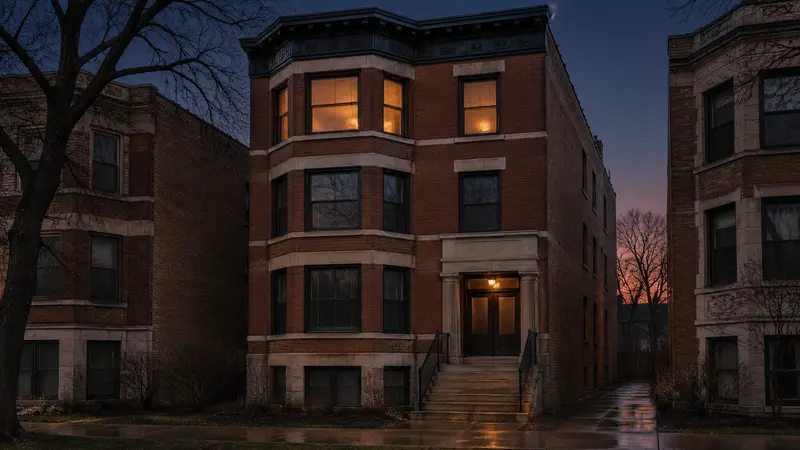
The day you close on an occupied Chicago building you are the landlord under the Residential Landlord and Tenant Ordinance, liable for every deposit the seller took. Ending a tenancy takes written notice of 30 days, 60 days or 120 days depending on tenure. Waiting out the longest notice costs a net $10,942 on the example loan.
- Notice, tenancy under 6 months
- 30 days
- Notice, 6 months to 3 years
- 60 days
- Notice, over 3 years
- 120 days
- Deposit letter from a new owner
- 14 days after the transfer
- Deposit violation damages
- Two times the deposit plus interest
- Illegal lockout fine
- $200 to $500 per day
- Foreclosure relocation assistance
- $10,600 per qualified tenant unit
Program terms as of November 26, 2026. Rates as of November 25, 2026.
On this page
- Does the ordinance cover an investor-owned flip?
- What do you inherit with the tenants on closing day?
- How much notice does each tenant get before a rehab?
- What does waiting for the notices cost?
- Does Chicago require a reason or relocation money to end a tenancy?
- What can you not do to empty a building?
- Can you pay a tenant to leave early?
- How does a flip lender look at an occupied building?
- What changes if the flip becomes a rental?
- What should you collect before going firm on an occupied building?
Many Chicago two- and three-flats are sold with people living in them. Buying one makes you a landlord before you are a rehabber, and the same ordinance governs you if the flip later becomes a rental.
This page is general education on the ordinance text and City guidance as published on November 25, 2026. Landlord-tenant mistakes carry statutory damages, so have a Chicago landlord-tenant attorney review notices before they go out.
Does the ordinance cover an investor-owned flip?
Yes. The City's RLTO page says the RLTO covers most rental units, with the main carve-out being Owner-occupied buildings with 6 units or fewer. An LLC that buys a tenant-occupied three-flat is not an owner-occupant, so the full ordinance applies from closing.
Even the exemption is partial. The exclusions section keeps two rules in force for every rented unit in an owner-occupied small building: the termination notice periods and the ban on lockouts.
What do you inherit with the tenants on closing day?
The leases, the deposits and the seller's compliance history. Under section 5-12-080, a successor landlord is liable to each tenant for the security deposit, statutory interest and prepaid rent paid to the prior owner.
The first deadline is short. A new owner must tell each tenant in writing that it now holds the deposit: 14 days after the transfer. Deposits must sit in a federally insured interest-bearing account in Illinois, separate from your own funds. Failing any of these deposit rules entitles the tenant to Two times the deposit plus interest.
How much notice does each tenant get before a rehab?
It depends on how long each has lived there. The 2020 Fair Notice Ordinance set three tiers for terminating a periodic tenancy, declining to renew a lease or raising rent, codified at section 5-12-130(j).
| Tenant has lived in the unit | Written notice before the termination date |
|---|---|
| Less than 6 months | 30 days |
| 6 months to 3 years | 60 days |
| More than 3 years | 120 days |
Notice runs to the stated termination date of the rental agreement, so a fixed-term lease with eight months left is not ended by a short letter. If the notice is missing or defective, the tenant's right to stay is Up to 60 days, or 120 days for tenancies over three years, and an eviction filed before that period ends can be defeated on that ground.
What does waiting for the notices cost?
Interest and carry for the longest clock, less whatever rent comes in. With mixed tenures, the building is not empty until the longest-tenured household's notice runs.
Three tenants, three notice clocks: a Humboldt Park three-flat bought for $372,000
One tenant moved in four months ago, one two years ago, one five years ago. The gut cannot start until all three units are empty. Rents, deposits and carry are illustrative inputs.
Net cost of waiting 120 days for the longest notice to run
| Line | Amount | How it is figured |
|---|---|---|
| Interest on the acquisition advance | $12,722 | $334,800 x 11.4% / 360 = $106.02 a day x 120 |
| Taxes, insurance, utilities | $5,839 | $1,480 a month = $48.66 a day x 120 |
| Rent collected during the notices | -$7,620 | 30 days at $1,150, 60 at $1,275, 120 at $980 a month |
| If bought at a foreclosure sale: relocation assistance | $31,800 | 3 x $10,600 per qualified tenant unit, unless new leases are agreed |
| Net cost of the wait | $10,942 |
Line items sum to the stated result. Checked in code at build.
Deposits you owe back, whether or not the seller handed them over
| Line | Amount | How it is figured |
|---|---|---|
| Unit 1 deposit | $1,150 | |
| Unit 2 deposit | $1,275 | |
| Unit 3 deposit | $900 | |
| Exposure if the deposit rules are broken | $6,650 | Two times the deposit plus interest |
| Deposit liability assumed at closing | $3,325 |
Line items sum to the stated result. Checked in code at build.
Rent covers part of the wait, which is why an occupied building can pencil. The number to watch is days: each extra day past the notice costs $154.68 with no rent against it.
Assumptions
- Rate of 11.4% is an input inside the published range of 8.99%-13.5%, not an offer. Interest runs on the acquisition advance; no rehab draws have funded.
- Assumes every tenant pays through move-out and leaves when the notice expires. Notices are assumed served correctly the week of closing. An eviction case adds time this table does not show.
Model your own dates in the calculator for a delayed start. A wait this long eats into a loan whose term is underwritten file by file, ask your loan officer; what happens at the other end is covered in running past maturity.
Does Chicago require a reason or relocation money to end a tenancy?
The notice subsection we read states periods, not reasons; it does not list required grounds for a non-renewal. Money is owed in one situation that flippers do meet: foreclosure.
Under the Keep Chicago Renting Ordinance, the new owner of a foreclosed rental building must either offer a qualified tenant a new lease negotiated in good faith or pay relocation assistance of $10,600 per qualified tenant unit. Tenants may reject the lease offer and still collect. Notice of the ownership change is due 21 days after becoming owner. State law adds a floor at 735 ILCS 5/9-207.5: a judicial sale purchaser needs 90 days of written notice to end a bona fide lease.
An occupied building bought at a judicial sale therefore carries costs an ordinary purchase does not; see judicial sale purchases.
The rules may also change. The City's status for a broader rewrite: Introduced June 29; pending City Council approval. The Department of Housing's Protecting Renters Ordinance page describes an annual registry of non-owner-occupied rental units with tiered fees.
What can you not do to empty a building?
Anything that pushes a tenant out without a court order. Section 5-12-160 makes it unlawful to oust or threaten to oust a tenant by changing or removing locks, removing doors or windows, cutting off electricity, gas, water or heat, removing appliances or the tenant's belongings, or making the unit uninhabitable.
That list reads like the first week of a demolition schedule. The fine is $200 to $500 per day, and the tenant can separately recover two months' rent or twice actual damages, whichever is greater. Occupied units must also be heated in season; see winter work.
Can you pay a tenant to leave early?
Nothing in the sections cited here bars a voluntary move-out agreement, often called cash for keys. The limits are the ones above: no pressure through utilities, locks or threats.
Have an attorney draft it, pay on move-out with keys returned, and settle the deposit in the same document. The example's per-day figure tells you what an early exit is worth.
How does a flip lender look at an occupied building?
As a schedule and collateral question. This site is published by a lender, and JFG's program is for non-owner-occupied investment property only; a building rented to tenants fits that, while one the borrower lives in does not.
Tenant status is underwriting detail. Expect to supply the rent roll, leases, deposit ledger and vacancy plan, with a draw schedule that reflects when units empty. Leverage of up to 90% of purchase price plus 100% of approved rehab, capped at 75% of supported ARV does not cover the wait: interest, carry and any move-out payments are your cash. JFG's two-flat and three-flat financing guide covers how these buildings are financed.
What changes if the flip becomes a rental?
You pick up the ongoing duties: the City's ordinance summary attached to every written lease and renewal, capped late fees, and the deposit rules above.
The financing changes too. A rental exit means a long-term loan sized on DSCR; compare the paths in flip versus BRRRR and sale versus refinance. JFG's RLTO compliance guide is the fuller landlord reference, and its Chicago DSCR loans page describes the rental loan.
The plan that fails
Closing on an occupied building with a rehab start date two weeks out. No notice tier is that short, and a long-term tenant is owed 120 days.
Either make vacancy at closing a contract condition the seller must meet lawfully, or buy it as an occupied building with the notice period and rent in the budget. Once the last tenant leaves, the vacant building registration clock starts.
What should you collect before going firm on an occupied building?
Six items, all from the seller, during attorney review.
- A certified rent roll with move-in dates, rent, deposit and prepaid rent for each unit.
- Every lease and renewal, to find fixed terms that outlast your schedule.
- Tenant estoppel letters confirming deposits and tenure.
- A closing credit for all deposits and accrued interest.
- Whether the property came through foreclosure, which brings relocation duties.
- Draft notices from your attorney, ready to serve the week you close.
Add them to the due diligence checklist. Suburban buildings follow other ordinances; see flipping in suburban Cook. Other city rules that move a budget are in the City ordinance guides.
Questions: RLTO if you hold or inherit tenants
Does a month-to-month tenant with no written lease get the same notice?
Yes. The City's Fair Notice guidance says the rules apply to all tenants, whether they have a written year-long lease or an informal month-to-month arrangement. What sets the notice period is how long the person has lived in the unit, not the paperwork. Get move-in dates from the seller in writing and check them with the tenants, because a tenant in place over three years is owed the longest notice even if the last written lease expired long ago.
What if the seller never turns over the security deposits?
You owe them anyway. The ordinance makes the successor landlord liable to each tenant for the deposit, statutory interest and prepaid rent paid to the prior owner. The seller stays jointly liable only until the funds are transferred and the tenant is notified. The practical fix is a closing credit for every deposit on the rent roll, plus an estoppel letter from each tenant confirming the amount.
Do I owe deposit interest on a tenant I only keep for a few months?
Possibly, because the clock is the deposit's age, not your ownership. Interest is owed on deposits and prepaid rent held more than six months, accruing from the start of the rental term, and a successor landlord takes on the statutory interest with the deposit. The 2026 rate is 0.01%, so the dollars are trivial. The deadlines are not: return of the deposit and interest is due 45 days after move-out, and the itemized damage statement 30 days after move-out.
A tenant I inherited has stopped paying. Does that shorten the timeline?
It changes the track, not necessarily the length. Nonpayment is handled with a written notice of 5 days, after which the landlord may terminate and file for eviction. But the ordinance gives the tenant a one-time right to cure by paying the rent owed plus the landlord's filing and service costs at any point before an eviction order is entered. Court time is outside your control, so do not schedule a gut around a quick eviction.
Does the same ordinance apply to a flip in suburban Cook County?
No, a different one does. The county has its own Residential Tenant Landlord Ordinance, in force since June 1, 2021, with its own rules such as a security deposit cap of 1.5 times monthly rent. Chicago's ordinance governs inside the city. For a suburban building, read the county ordinance and ask a local attorney which notice periods control before you serve anything.
Local rates and rules cited on this page
| Item | Figure | Primary source | Effective |
|---|---|---|---|
| RLTO exemption for small owner-occupied buildings | Owner-occupied buildings with 6 units or fewer | Residential Landlord and Tenant Ordinance (City of Chicago Department of Housing) | 2026 |
| Successor landlord security deposit notice | 14 days after the transfer | Municipal Code of Chicago 5-12-080 Security deposits (City of Chicago (American Legal Publishing)) | 2010-07-28 |
| Damages for a security deposit violation | Two times the deposit plus interest | Municipal Code of Chicago 5-12-080 Security deposits (City of Chicago (American Legal Publishing)) | 2010-07-28 |
| Notice to end tenancy or raise rent, tenancy under 6 months | 30 days | Municipal Code of Chicago 5-12-130 Landlord remedies (American Legal Publishing (Municipal Code of Chicago)) | 2020-07 |
| Notice to end tenancy or raise rent, 6 months to 3 years | 60 days | Know Your Rights: Fair Notice Ordinance (City of Chicago Department of Housing) | 2020-07 |
| Notice to end tenancy or raise rent, over 3 years | 120 days | Know Your Rights: Fair Notice Ordinance (City of Chicago Department of Housing) | 2020-07 |
| Tenant's right to stay after a defective notice | Up to 60 days, or 120 days for tenancies over three years | Municipal Code of Chicago 5-12-130 Landlord remedies (City of Chicago (American Legal Publishing)) | 2020-07-22 |
| Keep Chicago Renting relocation assistance | $10,600 per qualified tenant unit | Keep Chicago Renting (City of Chicago Department of Housing) | 2013-09-24 |
| Keep Chicago Renting notice to tenants | 21 days after becoming owner | Keep Chicago Renting (City of Chicago Department of Housing) | 2013-09-24 |
| Notice to end a bona fide lease after foreclosure | 90 days | 735 ILCS 5/9-207.5 (Illinois General Assembly) | 2013-11-19 |
| Protecting Renters Ordinance status | Introduced June 29; pending City Council approval | Protecting Renters Ordinance (City of Chicago Department of Housing) | 2026-11-25 |
| Fine for an illegal lockout | $200 to $500 per day | Municipal Code of Chicago 5-12-160 Prohibition on interruption of tenant occupancy by landlord (City of Chicago (American Legal Publishing)) | 1991-11-06 |
| RLTO security deposit interest rate, 2026 | 0.01% | Security Deposit Interest Rates (City of Chicago Department of Housing) | 2026-01-01 |
| Security deposit return deadline | 45 days after move-out | Security Deposit Interest Rates (City of Chicago Department of Housing) | 2026 |
| Itemized damage statement deadline | 30 days after move-out | Security Deposit Interest Rates (City of Chicago Department of Housing) | 2026 |
| Nonpayment notice period | 5 days | Municipal Code of Chicago 5-12-130 Landlord remedies (American Legal Publishing (Municipal Code of Chicago)) | 2020-07 |
| Cook County RTLO effective date | June 1, 2021 | Residential Tenant Landlord Ordinance (Cook County Government) | 2021-06-01 |
| Cook County RTLO security deposit cap | 1.5 times monthly rent | Residential Tenant Landlord Ordinance (Cook County Government) | 2021-06-01 |
Rates as of November 25, 2026. Confirm with the agency before relying on any figure.
Sources
- Residential Landlord and Tenant Ordinance, City of Chicago Department of Housing, 2026.
- Know Your Rights: Fair Notice Ordinance, City of Chicago Department of Housing, Ordinance approved July 2020.
- Municipal Code of Chicago 5-12-130, Landlord remedies, City of Chicago (American Legal Publishing), 2026.
- Municipal Code of Chicago 5-12-080, Security deposits, City of Chicago (American Legal Publishing), Amended July 28, 2010.
- Municipal Code of Chicago 5-12-160, Prohibition on interruption of tenant occupancy by landlord, City of Chicago (American Legal Publishing), Amended November 6, 1991.
- Municipal Code of Chicago 5-12-020, Exclusions, City of Chicago (American Legal Publishing), Amended July 22, 2020.
- Keep Chicago Renting, City of Chicago Department of Housing, 2026.
- 735 ILCS 5/9-207.5, Illinois General Assembly, P.A. 98-514, effective November 19, 2013.
- Protecting Renters Ordinance, City of Chicago Department of Housing, 2026.
- Security Deposit Interest Rates, City of Chicago Department of Housing, 2026.