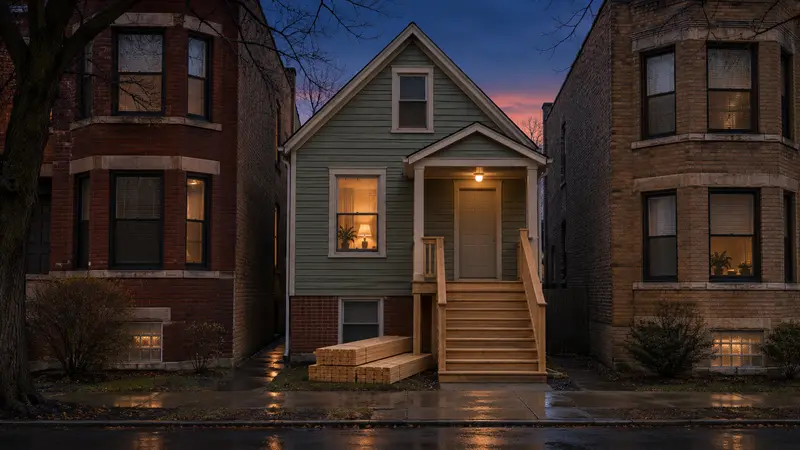
Rehab when renovated cottages nearby have sold high enough to carry the work; sell as a lot when the block's value is new construction and the frame is past saving. The example cottage nets $53,004 rehabbed over 7 months and $20,690 sold as is over 3. Demolition in the 606 and Pilsen districts carries a City surcharge.
- Built
- Mostly the 1870s to the 1910s
- Form
- One and a half stories, gable to the street, on a 25-foot lot
- Demolition surcharge, Pilsen and 606 districts
- $20,000 per unit and $60,000 per building
- Surcharge sunset
- December 31, 2029
- Demolition-Delay hold
- Up to 90 days on red- and orange-rated buildings
- New footing depth
- 42 inches below final grade
- Citywide demolition permits, 24 months
- 1,303
Program terms as of November 26, 2026. Rates as of November 25, 2026.
On this page
- What is a workers cottage, and why are so many frame?
- What have owners already changed, and what should you check?
- How often are cottages torn down, and for what?
- Why do new-construction comps distort a cottage's ARV?
- When does a lender see a rehab, and when a teardown?
- What does demolition trigger in Chicago?
- Which pays more on one cottage: the rehab or the lot sale?
- Can you add space instead of tearing down?
- How do you decide during attorney review?
- What do you send once you have picked an outcome?
A workers cottage is the one Chicago building type where a builder may want your property more than a homebuyer does. The house is small, the lot is standard, and on some blocks a new house on that lot sells for more than double the cottage. So the first question is which of two products you bought: a house to renovate, or a site.
Other building types, including the single-family gut rehab, are listed under Chicago property types.
What is a workers cottage, and why are so many frame?
It is a one-and-a-half-story house with its gable facing the street, narrow enough for a 25-foot lot, built mostly from the 1870s to the 1910s. The Chicago Workers Cottage Initiative's identification guide describes an entry set to one side, larger rooms down one wall and small bedrooms down the other.
The frame ones exist because of where the fire rules stopped. After the fires of 1871 and 1874 the city banned new wooden buildings inside its limits, and frame construction continued outside them in Lake, Jefferson and Lake View townships, which were annexed later. The City's description of the Old Town Triangle District records the same sequence.
What have owners already changed, and what should you check?
Assume the house has been altered more than once. The Initiative lists the usual changes: frame cottages jacked up to add a floor or basement beneath, attic and basement apartments with separate entrances, rear extensions, and original wood hidden under later siding. Each one is an inspection item:
- A raised house. Look at what it was set on, and at the sill where old frame meets newer foundation. New footings in Chicago go 42 inches below final grade.
- An extra unit. A basement or attic apartment counts only if the zoning certificate lists it; see title, water and zoning certificates.
- Covered siding. You cannot see the sheathing or the framing condition until the cladding comes off, so carry a real contingency.
Bring a structural engineer before the attorney review period ends.
How often are cottages torn down, and for what?
Often, in the right market. The Initiative's teardown analysis counted 420 demolition permits in Logan Square from 2006 through 2020, almost half of them workers cottages, and 205 in Avondale. Most replacements were single-family homes; about a quarter were three- or four-story condo buildings.
City permit data shows where that is still happening. The table counts wrecking and new-construction permits over 24 months beside single-family sale prices.
| Community area | Demolition permits | New construction permits | Single-family median | Top quarter starts at |
|---|---|---|---|---|
| Lake View | 107 | 171 | $1,700,000 | $2,175,000 |
| West Town | 97 | 173 | $1,225,000 | $1,561,138 |
| North Center | 95 | 137 | $1,565,000 | $1,950,000 |
| Logan Square | 53 | 107 | $1,050,000 | $1,381,000 |
| Humboldt Park | 23 | 101 | $320,000 | $465,000 |
Source: City of Chicago, Department of Buildings, Building Permits (dataset ydr8-5enu), 2024-11-01 to 2026-10-31; retrieved 2026-11-26. Source: Cook County Assessor's Office, Assessor - Parcel Sales (dataset wvhk-k5uv), 2024-05-01 to 2026-04-30; retrieved 2026-11-26. Source: Cook County Assessor's Office, Assessor - Parcel Universe (Current) (dataset pabr-t5kh); retrieved 2026-11-26.
High demolition counts beside high single-family prices mark where a builder will bid on your cottage. The Logan Square data page has the full breakdown.
Why do new-construction comps distort a cottage's ARV?
Because they are sales of a different product on the same lot. In the Initiative's Logan Square sample from 2017 to 2020, 16 cottages sold at a median of $375,500 before demolition, and the single-family homes built on the sampled lots sold at a median of $1,047,500. An area's single-family median blends both.
A renovated cottage is not worth the new-construction number. ARV is supported by comparable sales; a third-party valuation may be required, which here means closed sales of renovated cottages of similar size. Assemble them in the comp packet download; the method is under supporting an after-repair value.
When does a lender see a rehab, and when a teardown?
A lender sees a rehab when the existing structure stays and the budget ends in a house the comps support. The program here funds that: up to 90% of purchase price plus 100% of approved rehab, capped at 75% of supported ARV. Rehab draws are staged against a rehab holdback, with inspections.
It sees a teardown when the scope is demolition followed by a new building. That is ground-up construction, a different loan, and the figures on this site do not describe it. If the engineer says the frame cannot be saved, say so in the loan request instead of labeling new construction as renovation.
What does demolition trigger in Chicago?
Three checks, all by address.
- Surcharge. In the Pilsen and 606 districts the demolition surcharge is $20,000 per unit and $60,000 per building, scheduled to sunset December 31, 2029.
- What can replace it. In the 606 district the rule for a new detached house reads: Not allowed in RS3 where more than 50% of the block face is multi-unit (40% in RT3.5). Under the bulk and density standards, minimum lot areas are RS1 6,250; RS2 5,000; RS3 and RT3.5 2,500; RT4 to RM6.5 1,650 square feet, though a house may still be built on an existing lot of record.
- Demolition delay. A cottage rated red or orange in the historic survey can have its demolition permit held for up to 90 days. See landmark review and demolition delay.
Every one of these lowers what a builder pays you. This is general information; confirm a specific lot with a zoning attorney.
Which pays more on one cottage: the rehab or the lot sale?
The example prices both on the same purchase.
One $240,000 frame cottage, two outcomes
Outcome 1 rehabs the house. Outcome 2 resells it untouched to a builder. Prices, budget and hold lengths are illustrative.
Outcome 1: rehab and sell at $520,000
| Line | Amount | How it is figured |
|---|---|---|
| Sale price | $520,000 | |
| Commission, seller transfer taxes, closing | -$32,240 | |
| Loan payoff | -$351,000 | purchase advance plus $135,000 of draws |
| Cash you put in | -$83,756 | down payment, closing, points, 7 months of interest and carry, 12% contingency |
| Profit per month held | $7,572 | |
| Profit before income tax | $53,004 |
Line items sum to the stated result. Checked in code at build.
Outcome 2: sell as a lot at $300,000
| Line | Amount | How it is figured |
|---|---|---|
| Sale price | $300,000 | |
| Commission, seller transfer taxes, closing | -$20,250 | |
| Loan payoff | -$216,000 | purchase advance only |
| Cash you put in | -$43,060 | down payment, closing, points, 3 months of interest and carry |
| Profit per month held | $6,897 | |
| Profit before income tax | $20,690 |
Line items sum to the stated result. Checked in code at build.
The rehab earns $53,004 on $83,756 of cash; the lot sale earns $20,690 on $43,060 in under half the time.
Assumptions
- A 11.5% rate and 2 points are assumed for both outcomes; the published ranges are 8.99%-13.5% and 1-3 points.
- Outcome 2 assumes purchase financing with no rehab draw. Confirm with a loan officer that a resale without rehab fits the program before relying on it.
- You do not demolish in Outcome 2; the builder does.
The rehab loan covers 100% of the approved budget, yet the rehab still ties up more cash, because interest, carry and contingency run longer. Work backward from either resale price in the maximum offer calculator. For a quick resale to a builder, compare transactional funding and flip loans first.
Can you add space instead of tearing down?
Often. Floor area in RS3 is capped at 0.90 of lot area, so measure how much of that the cottage already uses. The rear setback is 30% of lot depth or 50 feet, whichever is less (28% for a detached house). A rear addition or dormer adds bedrooms without triggering any demolition rule; see zoning for dormers and additions and the dormer math on the bungalow page.
How do you decide during attorney review?
- Look up the zoning district, the 606 and Pilsen boundaries and the historic survey color.
- Pull closed sales of renovated cottages and, separately, of lots and teardowns nearby.
- Walk the house with a structural engineer and get the foundation and sill findings in writing.
- Price the rehab from a contractor's line-item bid with a contingency sized to the hidden framing.
- Ask one or two builders what they would pay for the property as it stands.
- Compare profit, cash and months for each outcome, then choose the loan request to match.
When neither outcome works
The deal fails when the purchase price already assumes a builder's lot value and you plan a rehab, or assumes a renovated resale that no cottage on the block has reached. It also fails when the lot sale depends on a demolition the surcharge, the 606 rule or a demolition hold makes slower or costlier than the builder will accept.
If the engineer's report is bad and the lot value is not there, cancel during attorney review. If the report is good and comps are thin, a lighter scope at a lower resale is safer than a full gut.
What do you send once you have picked an outcome?
For a rehab, send the engineer's letter, the line-item bid, the renovated-cottage comps and the zoning district. Jaken Finance Group publishes loan pages for Avondale and Pilsen, two areas where this page's teardown data and demolition rules apply. Leverage for first-time flippers is reviewed; maximum leverage is not assured.
Questions: Flipping a workers cottage
Is a brick workers cottage a different deal from a frame one?
The form is the same and the risk moves. The Chicago Workers Cottage Initiative notes that brick was required in much of the city while outlying and later-annexed areas allowed wood, so the two tend to sit in different neighborhoods. A brick cottage shifts the envelope budget to masonry and parapets. A frame one shifts it to sills, siding and what the cladding hides. Value each against sales of its own construction type.
Who pays the demolition surcharge if I sell the cottage to a builder?
Whoever applies for the demolition permit. Inside the Pilsen and 606 districts the City charges $20,000 per unit and $60,000 per building, and the applicant must send a Dwelling Unit Demolition Surcharge form to the Department of Housing before the permit issues. A builder buying your cottage will subtract that from the offer, so it lowers your lot price even though you never write the check.
Can a cottage lot be rebuilt as a two-flat?
Zoning sometimes favors it. In RS3 the lot area per unit can drop to 1,500 square feet per unit where most of the block face is already multi-unit or the lot is in the 606 district, which permits a two-unit building and nothing larger. That is new construction, outside the purchase-plus-rehab loan described on this site. Use it to price the lot to builders.
Does stripping old siding off a frame cottage trigger lead rules?
Yes, if painted surfaces are disturbed. The EPA renovation rule covers the following: Paid work disturbing paint in housing built before 1978. The exterior minor-repair exemption stops at 20 square feet or less, far less than a wall of clapboard. Exterior work also needs ground cover extending 10 feet beyond the work surface, which is awkward on a lot with narrow side yards. More detail is under lead paint rules for rehabs.
Do I owe the buyer a disclosure report on a gutted and rebuilt cottage?
Yes. Under the Illinois Residential Real Property Disclosure Act the rule on new and rehabbed homes is: Never-occupied new construction is exempt; rehabbed existing homes are not. A cottage taken to the studs is still an existing home, and the delivery deadline is unchanged: Before the contract is signed. Add the federal lead disclosure for pre-1978 housing, and have your attorney review your answers.
Local rates and rules cited on this page
| Item | Figure | Primary source | Effective |
|---|---|---|---|
| Footing depth for frost protection | 42 inches below final grade | Municipal Code of Chicago 14B-18-1809 Shallow foundations (American Legal Publishing (Municipal Code of Chicago)) | 2020-08-01 |
| Demolition surcharge, Pilsen and 606 areas | $20,000 per unit and $60,000 per building | Demolition Surcharge (City of Chicago Department of Housing) | 2024-09 |
| Demolition surcharge sunset | December 31, 2029 | Demolition Surcharge (City of Chicago Department of Housing) | 2024-09 |
| New detached houses in the 606 Predominance of the Block District | Not allowed in RS3 where more than 50% of the block face is multi-unit (40% in RT3.5) | Chicago Zoning Ordinance 17-7-0590 Predominance of the Block (606) District (American Legal Publishing (Chicago Zoning Ordinance)) | 2025-07-16 |
| Minimum lot area by district | RS1 6,250; RS2 5,000; RS3 and RT3.5 2,500; RT4 to RM6.5 1,650 square feet | Chicago Zoning Ordinance 17-2-0300 Bulk and density standards (American Legal Publishing (Chicago Zoning Ordinance)) | 2026-09-29 |
| RS3 maximum floor area ratio | 0.90 | Chicago Zoning Ordinance 17-2-0300 Bulk and density standards (American Legal Publishing (Chicago Zoning Ordinance)) | 2026-09-29 |
| Minimum rear setback, R districts | 30% of lot depth or 50 feet, whichever is less (28% for a detached house) | Chicago Zoning Ordinance 17-2-0300 Bulk and density standards (American Legal Publishing (Chicago Zoning Ordinance)) | 2025-09-25 |
| Demolition-Delay hold | Up to 90 days | Demolition Delay (City of Chicago Department of Planning and Development) | 2003 |
| RS3 two-flat lot area exception | 1,500 square feet per unit | Chicago Zoning Ordinance 17-2-0300 Bulk and density standards (American Legal Publishing (Chicago Zoning Ordinance)) | 2026-09-29 |
| EPA RRP rule coverage | Paid work disturbing paint in housing built before 1978 | Lead Renovation, Repair and Painting Program (U.S. Environmental Protection Agency) | 2026 |
| RRP minor repair exemption, exterior | 20 square feet or less | 40 CFR 745.83 - Definitions (eCFR / U.S. Environmental Protection Agency) | 2026 |
| RRP exterior ground containment | 10 feet beyond the work surface | 40 CFR 745.85 Work practice standards (eCFR / U.S. Environmental Protection Agency) | 2026 |
| New construction vs. rehab | Never-occupied new construction is exempt; rehabbed existing homes are not | 765 ILCS 77/15(9) - Seller exemptions (Illinois General Assembly (ilga.gov)) | 2022-05-13 |
| When the disclosure report is due | Before the contract is signed | 765 ILCS 77/20 - Disclosure report requirements (Illinois General Assembly (ilga.gov)) | 2022-05-13 |
| Chicago transfer tax, City portion (buyer) | $3.75 per $500 of price | Real Property Transfer Tax (7551) (City of Chicago Department of Finance) | 2008-04-01 |
| Chicago transfer tax, CTA portion (seller) | $1.50 per $500 of price | Real Property Transfer Tax (7551) (City of Chicago Department of Finance) | 2008-04-01 |
| Cook County real estate transfer tax | $0.25 per $500 of value | Transfer Fees (Cook County Clerk) | 1968-01-01 |
| Illinois state real estate transfer tax | $0.50 per $500 of value | 35 ILCS 200/31-10, Imposition of tax (Illinois General Assembly) | 2005-06-01 |
Rates as of November 25, 2026. Confirm with the agency before relying on any figure.
Sources
- What is a Workers Cottage?, Chicago Workers Cottage Initiative, 2026.
- A History of the Chicago Workers Cottage, Chicago Workers Cottage Initiative, 2026.
- Analyzing Teardowns of Workers Cottages, Chicago Workers Cottage Initiative, c. 2021.
- Old Town Triangle District, Commission on Chicago Landmarks, 1977-10-28.
- Demolition Surcharge, City of Chicago Department of Housing, 2024-09.
- Demolition Delay, City of Chicago Department of Planning and Development, 2003.
- Municipal Code of Chicago 17-2-0300 Bulk and density standards, City of Chicago, 2026.