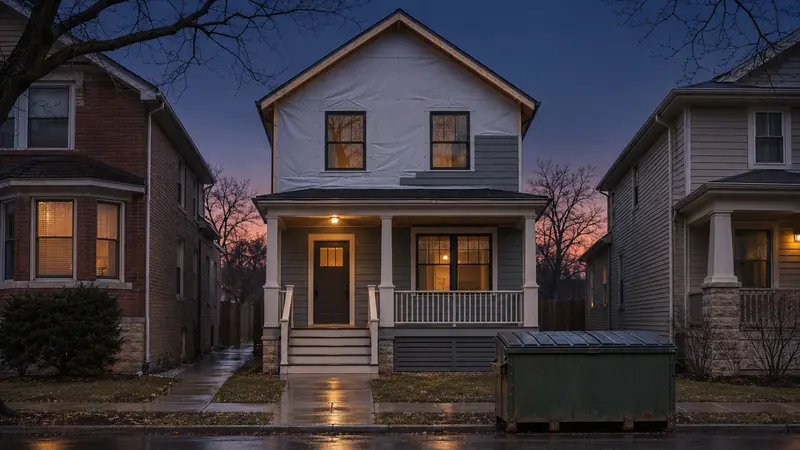
A gut is financed like any flip, but the holdback becomes most of the loan and the ARV cap usually sizes it. Leverage is up to 90% of purchase price plus 100% of approved rehab, capped at 75% of supported ARV. Standard Plan Review permits took a median 94 days citywide, and interest accrues through that wait.
- Leverage
- up to 90% of purchase price plus 100% of approved rehab, capped at 75% of supported ARV
- Permit path
- Standard Plan Review or Self-Certification, with drawings by an Illinois architect
- Standard Plan Review, median days to issue
- 94 citywide (5,535 renovation permits)
- Self-Certification, median days to issue
- 27 citywide
- Plan-based permit deposit
- $600 non-refundable
- Rehab draws
- staged against a rehab holdback, with inspections
- Example: holdback share of the loan
- 67.9%
Program terms as of November 26, 2026. Rates as of November 25, 2026.
On this page
- What makes a rehab a gut to the Department of Buildings?
- How long is the wait between closing and demolition?
- Why does the ARV cap bind when rehab is bigger than the price?
- The numbers on a rehab-heavy house
- How do draws change when the holdback is most of the loan?
- How much contingency belongs in a gut budget?
- What does a near-land as-is value do to your file?
- Which holding rules apply while the house is an empty shell?
- Where do single-family guts show up in Chicago?
- What should be in hand before you ask for gut terms?
A gut takes a house back to framing and masonry and rebuilds every system inside it. On the lending side that reverses the usual proportions: the purchase is the small number, the rehab holdback is the large one, and most of the loan reaches you only after work is inspected. The City adds stamped drawings and a plan-review wait before demolition.
This page covers the single-family version: one house on one lot, bought vacant, held as non-owner-occupied investment property. That occupancy is why FHA 203(k), which HUD limits to primary residences, is not on the table for a flip; the 203(k) and HomeStyle comparison covers the owner-occupant route. Lighter scopes are on the Chicago bungalow page and the frame cottage page; the property types hub lists the rest.
What makes a rehab a gut to the Department of Buildings?
A rehab becomes a gut for permit purposes once it changes structure, layout or building systems, because that work needs drawings. The City's no-permit allowance for replacing drywall or plaster with no systems work is short: Up to 1,000 square feet.
Drawings mean Standard Plan Review, which the Department of Buildings describes as the main process for applications that need architectural plans. An architect prepares the set, zoning approval comes first, and the application carries a $600 non-refundable deposit. The alternative is Self-Certification: the City's Self-Cert program page says a registered Illinois architect or structural engineer takes responsibility for code compliance, and permits typically issue within 10 business days after zoning approval.
Applications started on or after December 1, 2026 fall under the Phase 3 code update, which brings in the 2026 Energy Transformation Code. On licensing, the City's general contractor rule reads: Required for work done for pay, as an investment, or to sell or lease. The permit paths comparison covers each route. This is general education; confirm your scope with a licensed design professional.
How long is the wait between closing and demolition?
Plan on roughly three months for Standard Plan Review and about one for Self-Certification, based on what the City actually issued. The table uses renovation and alteration permits from the City's building permits dataset, counting days from application start to issue.
| Review path | Permits issued, 24 months | Median days | Middle half of permits |
|---|---|---|---|
| Standard Plan Review | 5,535 | 94 | 49 to 161 days |
| Self-Certification | 4,995 | 27 | 9 to 54 days |
Source: City of Chicago, Department of Buildings, Building Permits (dataset ydr8-5enu), 2024-11-01 to 2026-10-31; retrieved 2026-11-26.
These medians cover every renovation permit, from a porch rebuild to a full gut, so treat them as a floor for a whole-house set. Each day accrues interest on the money advanced at closing.
Why does the ARV cap bind when rehab is bigger than the price?
The ARV cap binds on a gut because the cost limit covers nearly the whole project while the cap covers only part of the finished value. The program lends up to 90% of purchase price plus 100% of approved rehab, capped at 75% of supported ARV. With a small purchase and a large budget, the cost side approaches total cost, while the cap stays at 75% of ARV.
Rehab dollars are funded first inside the loan, so a shortfall shows up as a smaller advance toward the purchase and a larger down payment. Financing 100% of rehab still takes cash: closing costs, interest, overruns and work done ahead of each draw are yours. The cost limit versus ARV cap page walks through the general rule.
The numbers on a rehab-heavy house
A $150,000 house that needs $265,000 of work
Every input is illustrative, not an offer. Rehab is 63.9% of project cost.
Cash at closing when comps support a $520,000 ARV
| Line | Amount | How it is figured |
|---|---|---|
| Cost limit | $400,000 | 90% of $150,000 plus 100% of $265,000 |
| ARV cap | $390,000 | 75% of $520,000; the lower limit, so it sets the loan |
| Down payment | $25,000 | $150,000 less the $125,000 advanced at closing |
| Origination, 2 points | $7,800 | on $390,000 |
| Chicago transfer tax, buyer portion | $1,125 | |
| Title, attorney, recording | $3,400 | |
| Cash at closing | $37,325 |
Line items sum to the stated result. Checked in code at build.
Same house if the valuation supports only $470,000
| Line | Amount | How it is figured |
|---|---|---|
| ARV cap | $352,500 | 75% of $470,000 |
| Down payment | $62,500 | advance at closing falls to $87,500 |
| Origination, 2 points | $7,050 | on $352,500 |
| Chicago transfer tax, buyer portion | $1,125 | |
| Title, attorney, recording | $3,400 | |
| Added cash versus the first table | $36,750 | |
| Cash at closing | $74,075 |
Line items sum to the stated result. Checked in code at build.
Cash during a 12-month hold, first scenario
| Line | Amount | How it is figured |
|---|---|---|
| Interest while the permit is in review | $3,437 | 3 months on the $125,000 advance |
| Interest during construction | $12,948 | 6 months, balance rising with each draw |
| Interest while listed and under contract | $10,725 | 3 months on $390,000 |
| Contingency held in cash | $39,750 | 15% of rehab |
| Cash during the hold | $66,860 |
Line items sum to the stated result. Checked in code at build.
A $520,000 to $470,000 change in supported ARV moves $36,750 from the lender's side of the closing statement to yours.
Assumptions
- The 11% rate and 2 points are inputs inside the published ranges of 8.99%-13.5% and 1-3 points, not a quote.
- Interest on the drawn balance is an assumption for illustration. Taxes, insurance, utilities and resale costs are left out.
How do draws change when the holdback is most of the loan?
Draws on a gut are larger and more front-loaded than on a cosmetic flip, and you finance each phase yourself until it is inspected. The published program term is that rehab draws are staged against a rehab holdback, with inspections. Draw fees are underwritten file by file, ask your loan officer.
Demolition, structural repair and rough-ins leave a house that looks worse than the day you bought it, so the first draw depends on a budget that breaks those phases into lines an inspector can verify. Build that budget in the budget template with scope lines before you apply, and read the draw and inspection sequence for timing. JFG publishes its own draw process guide.
How much contingency belongs in a gut budget?
There is no published contingency percentage, so set it from what the walls can hide. The example carries 15% of rehab as an input, not a standard. A gut exposes foundation, framing and buried plumbing that no walkthrough can price.
Contingency is cash. The loan funds the approved budget, and overruns are yours. The rehab cost by scope page separates cosmetic, moderate and gut budgets.
What does a near-land as-is value do to your file?
A house that needs everything is worth, as it stands, close to what a buyer would pay for the lot and shell, so nearly all the collateral value is still to be built and the weight falls on ARV. The published standard is that ARV is supported by comparable sales; a third-party valuation may be required.
On a gut, the comparable sales have to be fully renovated or new houses of similar size on similar blocks, not updated kitchens in original shells. Whether a low as-is value reduces the advance at closing is underwritten file by file, ask your loan officer. The page on how ARV is supported shows what a defensible comp set looks like.
Which holding rules apply while the house is an empty shell?
Three sets of rules follow a vacant, gutted house: vacant building registration, lead-safe work practices and reassessment.
- Vacancy. A vacant building must be registered (deadline: Within 30 days) and carry liability coverage of $300,000 per occurrence. The City's vacant buildings page adds a rule for stalled sites: Must register within 30 days after permitted work stops. Details are on the vacant registration page.
- Lead. EPA's RRP rule has a wide reach: Paid work disturbing paint in housing built before 1978.
- Property tax. The Cook County Assessor's assessment calendar notes that permit applications can trigger reassessment outside the regular cycle.
Where do single-family guts show up in Chicago?
Detached houses dominate only some community areas, and local prices decide whether a gut fits under the ARV cap.
| Community area | Detached houses, share of units | Median single-family sale | Standard Plan Review median |
|---|---|---|---|
| West Englewood | 53.2% | $137,000 | 103 days |
| Auburn Gresham | 43% | $174,000 | 84 days |
| Portage Park | 44.7% | $425,650 | 78 days |
Source: U.S. Census Bureau, American Community Survey 2020-2024 5-Year Estimates, Detailed Tables (table-based summary file) (dataset ACSDT5Y2024), 2020-01-01 to 2024-12-31; retrieved 2026-11-26. Source: Cook County Assessor's Office, Assessor - Parcel Sales (dataset wvhk-k5uv), 2024-05-01 to 2026-04-30; retrieved 2026-11-26. Source: City of Chicago, Department of Buildings, Building Permits (dataset ydr8-5enu), 2024-11-01 to 2026-10-31; retrieved 2026-11-26.
Where the median sale is low, as in West Englewood, a full gut budget can exceed what the finished house supports, and the cap rules the deal out.
When a gut will not finance this way
The structure fails when 75% of supported ARV is less than the rehab budget itself. On the example house that point is an ARV below $353,333: you would pay the whole purchase price plus the uncovered work in cash.
The better route is to change the deal: offer less, cut the scope to what the comps reward, or bring a partner. Gap or second-lien funding needs separate approval and first-lender consent.
What should be in hand before you ask for gut terms?
- Pull renovated or new single-family sales near the subject and note why each compares.
- Get a line-item budget from a licensed general contractor, split into phases you can draw against.
- Ask an architect which permit path the scope fits and when drawings can be filed.
- Run the price through the hold-adjusted offer calculator with the permit wait added to your hold.
- Send the package through JFG's Chicago fix and flip program page and ask which interest basis applies.
Questions: Single-family gut rehab
Can the rehab budget be larger than the whole loan?
Yes, and that is where a gut stops working without more cash. The loan is capped at 75% of supported ARV. If that cap is below your rehab budget, you pay the full purchase price plus the uncovered rehab in cash. On the example house that happens when supported ARV falls under $353,333. Gap or second-lien funding needs separate approval and first-lender consent, so the cleaner fixes are a lower price or a smaller scope.
Will an FHA buyer's lender question a resale at more than double my purchase price?
Only if you resell quickly. Under HUD's property flipping rule, a resale 91 to 180 days after the seller's acquisition needs a second appraisal when the price is 100% or more above what you paid. A full gut with a plan-review wait usually outlasts that window, after which the trigger no longer applies. Keep the permit, paid invoices and draw records anyway.
Does a gutted single-family house need a certificate of occupancy before I sell it?
Usually not. The Department of Buildings requires a Certificate of Occupancy for permitted work that builds or substantially alters four or more dwelling units, or that changes the occupancy. A one-unit house stays under that line. What your buyer's attorney will want instead is a permit with every inspection passed and closed. Confirm the requirement for your scope with your architect.
Should I self-certify or use Standard Plan Review for a gut?
Ask the architect first, because only a registered self-certification professional can use that path. City data favors it on time: self-certified renovation permits issued in a median 27 days against 94 for Standard Plan Review. The City's estimate assumes valid contractor licenses and no open violations or stop work orders, so clear inherited violations before you file.
Is interest charged on the holdback before I draw it?
That depends on the loan documents, and it matters on a gut because the holdback is most of the commitment. In the example, interest on the drawn balance totals $27,110 over 12 months, while interest on the full commitment from day one would be $42,900. Both are illustrations at an assumed rate. Ask which basis applies and get it in the term sheet.
Local rates and rules cited on this page
| Item | Figure | Primary source | Effective |
|---|---|---|---|
| No-permit limit for drywall or plaster replacement | Up to 1,000 square feet | What Types of Work Do Not Require a Building Permit? (Full List) (City of Chicago Department of Buildings) | 2026 |
| Plan-based permit application deposit | $600 non-refundable | Department of Buildings Changes for 2026 (City of Chicago Department of Buildings) | 2026-01-06 |
| Self-Certification typical issuance time | 10 business days after zoning approval | Self-Certified Permit Application Program (City of Chicago Department of Buildings) | 2026 |
| General contractor license trigger | Required for work done for pay, as an investment, or to sell or lease | General Contractor License (City of Chicago Department of Buildings) | 2026 |
| Vacant building registration deadline | Within 30 days | Requirements for Vacant Building Owners (Revised 1/2026) (City of Chicago Department of Buildings) | 2026-01 |
| Vacant building liability insurance, residential | $300,000 per occurrence | Requirements for Vacant Building Owners (Revised 1/2026) (City of Chicago Department of Buildings) | 2026-01 |
| Stalled construction sites | Must register within 30 days after permitted work stops | Vacant Buildings FAQ (City of Chicago Department of Buildings) | 2026 |
| EPA RRP rule coverage | Paid work disturbing paint in housing built before 1978 | Lead Renovation, Repair and Painting Program (U.S. Environmental Protection Agency) | 2026 |
| FHA anti-flipping: second-appraisal resale window | 91 to 180 days after the seller's acquisition | 24 CFR 203.37a - Sale of property (eCFR / HUD) | 2006-06-07 |
| Chicago transfer tax, City portion (buyer) | $3.75 per $500 of price | Real Property Transfer Tax (7551) (City of Chicago Department of Finance) | 2008-04-01 |
| Chicago transfer tax, CTA portion (seller) | $1.50 per $500 of price | Real Property Transfer Tax (7551) (City of Chicago Department of Finance) | 2008-04-01 |
| Cook County real estate transfer tax | $0.25 per $500 of value | Transfer Fees (Cook County Clerk) | 1968-01-01 |
| Illinois state real estate transfer tax | $0.50 per $500 of value | 35 ILCS 200/31-10, Imposition of tax (Illinois General Assembly) | 2005-06-01 |
Rates as of November 25, 2026. Confirm with the agency before relying on any figure.
Sources
- Standard Plan Review Permit Program, City of Chicago Department of Buildings, 2026.
- Self-Certified Permit Application Program, City of Chicago Department of Buildings, 2026.
- Implementation of Phase 3 Construction Codes Modernization Ordinance, City of Chicago Department of Buildings, 2026-10-06.
- Building Permits dataset, City of Chicago Department of Buildings, 2026-11-25.
- General Contractor License, City of Chicago Department of Buildings, 2026.
- Assessment Calendar and Deadlines, Cook County Assessor's Office, 2026.
- 24 CFR 203.37a, Sale of property, eCFR / HUD, 2006-06-07.
- 203(k) Program Comparison Fact Sheet, FHA Office of Single Family Housing, 2024-11-04.
- Vacant Buildings, City of Chicago Department of Buildings, 2026.