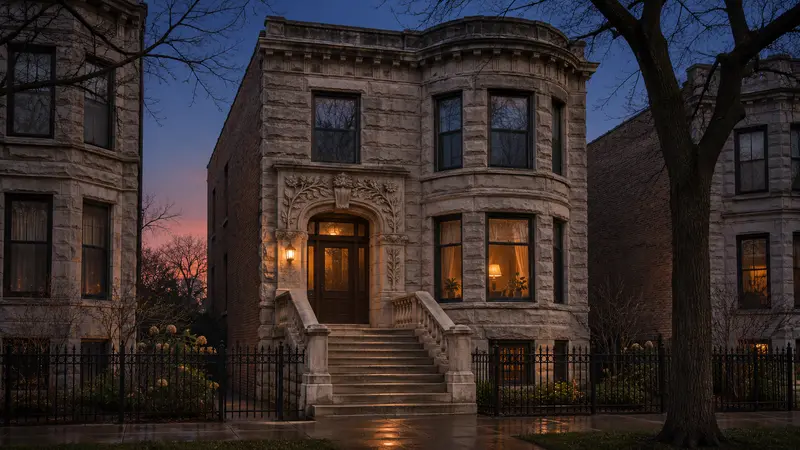
A greystone flips like a brick flat building with one extra trade and a longer clock: the Bedford limestone front needs a mason who works in soft mortar. In the example a $28,000 facade line and 2 extra months cut profit by $44,112. Check landmark status and the survey rating before you price demolition or new openings.
- What makes it a greystone
- Front facade of Bedford limestone on a masonry building
- Built
- 1890 to 1930
- Estimated number remaining
- 30,000, per the Historic Chicago Greystone Initiative (2009)
- Recommended repointing mortar
- Type O, no stronger
- Masonry replacement without a permit
- Up to 50 square feet, in-kind (brick or concrete masonry)
- Demolition-Delay hold
- Up to 90 days, for red- and orange-rated buildings
- Lead rules
- Paid work disturbing paint in housing built before 1978
Program terms as of November 26, 2026. Rates as of November 25, 2026.
On this page
- What is a greystone, structurally?
- Where are Chicago's greystones?
- What goes wrong with a limestone front?
- How should the facade be repointed and cleaned?
- Which facade and parapet work needs a permit?
- Is the greystone in a landmark district or rated in the survey?
- What do a masonry line and two extra months do to the margin?
- Does a limestone front raise the ARV?
- What does lead paint law require on a building this old?
- How do you assess the facade before closing?
- What should the loan request for a greystone include?
From the sidewalk a greystone looks like a stone building. It is not. The stone is a face on the street side, and the building behind it is ordinary Chicago masonry. That split is the whole flip: three walls you budget like any brick flat, and one that needs a different mason, a different mortar and more time.
Unit-count questions are the same as for any flat building; see flipping a two-flat and three-flat exits and egress. The full list is under Chicago property types.
What is a greystone, structurally?
A greystone is a masonry building whose front facade is Bedford limestone quarried in south-central Indiana. The Historic Chicago Greystone Initiative's design guidelines call it a style of construction, not an architectural style, popular between 1890 and 1930 and built at every scale from workers cottages to mansions on standard 25-by-125-foot lots. The 2009 guidelines estimate 30,000 remain.
For a budget, read that as two envelopes. The limestone front carries the carved detail and cornice. The side and rear walls, parapet and chimneys are brick and follow the usual tuckpointing and lintel logic.
Where are Chicago's greystones?
In a belt three to seven miles from the Loop. The Initiative's guidelines name Lake View, Lincoln Park, Logan Square, Humboldt Park, East and West Garfield Park, North Lawndale, Englewood, Washington Park, Kenwood, Hyde Park and Woodlawn among others, with concentrations along Logan, Douglas and Grand Boulevards and King Drive. The Chicago Architecture Center singles out the greystone two-flats of North Lawndale's K-Town.
The same building type sells into very different markets:
| Community area | Units built before 1940 | Units in 2-4 unit buildings | Class 2-11 median | Middle half of sales |
|---|---|---|---|---|
| North Lawndale | 53.8% | 61% | $363,000 | $202,000 to $470,000 |
| Humboldt Park | 62.3% | 56.8% | $400,000 | $276,150 to $535,000 |
| Logan Square | 58.3% | 43.8% | $805,000 | $600,000 to $1,050,000 |
| Lake View | 34.7% | 19.4% | $1,150,000 | $910,000 to $1,450,000 |
Source: Cook County Assessor's Office, Assessor - Parcel Sales (dataset wvhk-k5uv), 2024-05-01 to 2026-04-30; retrieved 2026-11-26. Source: Cook County Assessor's Office, Assessor - Parcel Universe (Current) (dataset pabr-t5kh); retrieved 2026-11-26. Source: U.S. Census Bureau, American Community Survey 2020-2024 5-Year Estimates, Detailed Tables (table-based summary file) (dataset ACSDT5Y2024), 2020-01-01 to 2024-12-31; retrieved 2026-11-26. Source: City of Chicago, Boundaries - Census Tracts - 2020 (dataset 7qjk-677h); retrieved 2026-11-26.
A mason prices the wall, not the neighborhood, so the same facade scope weighs far more on a lower resale. The North Lawndale data page shows the price band where that pressure is highest.
What goes wrong with a limestone front?
Water, almost always. The guidelines treat failed mortar joints, cracks and damaged stone as symptoms and list the causes behind them: a leaking roof, clogged gutters, freeze and thaw in wet walls, settling foundations, and earlier repairs made with the wrong materials. They also flag deteriorating cornices, pediments and chimneys as common.
The order of work follows: fix the roof, flashing and gutters first, or the new stone repair fails for the same reason the old one did.
How should the facade be repointed and cleaned?
Softly. The Greystone Initiative's guidance is to repoint only where joints have failed, with Type O mortar matched to the original in strength, color and profile, and never with a stronger mix, Portland cement or masonry cement. The National Park Service gives the reason in Preservation Brief 2: repointing mortar should be softer or more permeable than the masonry units and no harder than the historic mortar, so that stress and moisture leave through the joint instead of the stone.
Cleaning follows the same rule. Start with low-velocity water; use chemical cleaners only through qualified professionals; do not sandblast, grit blast or pressure wash. The guidelines also tell owners to require a mockup panel before the mason proceeds. Write that mockup into the bid request, and compare bids on mortar type and method in the side-by-side bid sheet, not on price alone.
Which facade and parapet work needs a permit?
Most of it. The Department of Buildings lists what can be done without a building permit, and for brick or concrete masonry the limit reads: Up to 50 square feet, in-kind. Larger repairs are permit work. The Express Permit masonry worktype covers in-kind parapet rebuilding with this limit: Unbraced height up to 5 feet, in kind. Lintels are handled the same way: Up to 6 feet (72 inches) long without stamped specifications. The thresholds and the plan-based path are laid out under masonry and parapet permits.
Is the greystone in a landmark district or rated in the survey?
Find out before you bid, because it changes who reviews the permit. In a City landmark district, such as the Logan Square Boulevards District designated in 2005, Historic Preservation staff review every permit application. The Commission's own count of that workload: More than 900 a year, most approved in one day.
Outside a district, the Chicago Historic Resources Survey still matters. Under the Demolition-Delay Ordinance, a demolition permit for a building rated red or orange can be held for up to 90 days. The orange tier alone: About 9,600 properties. The process is on the page about landmark district renovation rules.
What do a masonry line and two extra months do to the margin?
More than the bid amount suggests. The example takes one deal and runs it twice.
The same $310,000 two-flat, in brick and with a limestone front
The baseline is a brick two-flat. The greystone case adds a facade line and a longer schedule to the same deal. All inputs are illustrative.
What the limestone front adds to cost
| Line | Amount | How it is figured |
|---|---|---|
| Facade and parapet masonry line | $28,000 | illustrative allowance, not a quote |
| Contingency on that line | $2,800 | 10% |
| Points on the larger loan | $560 | loan grows from $419,000 to $447,000 |
| Added interest | $9,992 | 2 more months, larger balance, 11% |
| Added taxes, insurance and utilities | $2,760 | 2 months at $1,380 |
| Added cost | $44,112 |
Line items sum to the stated result. Checked in code at build.
Margin on a $640,000 resale
| Line | Amount | How it is figured |
|---|---|---|
| Profit, brick baseline | $84,174 | 7 months, $140,000 rehab |
| Facade line and longer schedule | -$44,112 | |
| Margin, brick baseline | 13.15% | |
| Margin, greystone | 6.26% | |
| Cash invested, greystone | $113,758 | against $97,646 for the baseline |
| Profit, greystone | $40,063 |
Line items sum to the stated result. Checked in code at build.
A $28,000 line costs $44,112 once contingency, points, interest and carry are counted. Bid the facade before closing, not after.
Assumptions
- Both cases are priced at 11% with 2 points, an illustrative pick from the published 8.99%-13.5% and 1-3 points.
- Both cases use the same resale price. A limestone front earns a premium only where closed sales show one.
The loan can carry the facade line, since leverage is up to 90% of purchase price plus 100% of approved rehab, capped at 75% of supported ARV, but the added interest, carry and contingency are cash. Extension terms are underwritten file by file, ask your loan officer, so do not plan on a cheap overrun; the options are described under flips that run long. Price your own slip in the schedule-slip cost tool.
Does a limestone front raise the ARV?
Only if closed sales say so. ARV is supported by comparable sales; a third-party valuation may be required, and greystones come in every size, so the comp set starts with unit count and living area and treats the facade as an adjustment. On a block of greystones the comps already include the stone. On a mixed block, do not add a premium the appraiser cannot find. The rules appraisers follow are under ARV comp selection.
What does lead paint law require on a building this old?
Certified, lead-safe work. Every greystone predates 1978, and the EPA's renovation rule covers the following: Paid work disturbing paint in housing built before 1978. The firm needs EPA certification. The civil penalty ceiling: Up to $49,772 per violation, per day. Disclosure duties at resale are on the page about lead paint rules for flippers.
How do you assess the facade before closing?
- Look up the address on the City zoning map for a landmark district or a Chicago Historic Resources Survey color, and pull the permit history from the Chicago Department of Buildings records.
- Photograph the cornice, parapet, bay and every open joint from the street and from the roof.
- Trace each damaged area to a water source: roof edge, gutter, flashing or grade.
- Walk the front with a mason who repoints in Type O mortar, and ask for a mockup allowance in the bid.
- Get a separate number for the brick side and rear walls and the chimneys.
- Add the facade duration to the schedule, then check it against the season.
When a greystone flip is the wrong deal
It is the wrong deal when the facade needs stone replacement and the neighborhood's resale band cannot absorb it, or when the plan depends on demolition or a new front on a building the City will review. A hard-mortar repair by a general tuckpointer is not a saving; it sets up the next failure and a buyer's inspection objection.
If the facade number does not fit, renegotiate the price with the mason's bid in hand, or choose a brick building on the next block.
What should the loan request for a greystone include?
Include the mason's facade bid as its own budget line, photos of the front and parapet, the landmark or survey status, and a schedule that shows the facade work by month. Jaken Finance Group funds hard money loans in Chicago on that kind of file, including Logan Square projects. First-time flippers are reviewed; maximum leverage is not assured.
Questions: Flipping a greystone
Can I paint or seal a limestone facade to freshen it up?
The preservation guidance says no. The Historic Chicago Greystone Initiative's design guidelines list painting, stucco and sealers among the things not to do to greystone masonry, along with covering it in synthetic stucco, siding or imitation stone. The same guidelines trace most stone damage to water in the wall. If the stone is heavily soiled, the starting point is low-velocity water, then professional chemical cleaning if needed.
Is every greystone a two-flat?
No. The Greystone Initiative describes a construction type, not a unit count: limestone-fronted workers cottages, two-flats, row houses and mansions all qualify. The Assessor's class follows the units, so a greystone with two to six apartments is class 2-11 and a single-family one carries a house class. Build your comp set on unit count and size first. The limestone is an adjustment, not the basis of value.
Does the Historic Chicago Greystone Initiative fund investor rehabs?
Its published materials describe help for owner-occupants. The Initiative was launched in September 2006 by Neighborhood Housing Services of Chicago with the City and other partners, growing out of NHS work in North Lawndale, and offers technical assistance and financing aimed at rehabbing an owner-occupied greystone. An investor's financing is a business-purpose loan: the program here is for non-owner-occupied investment property only. Its repair guidance is still worth handing to your mason.
Do brownstone and sandstone fronts follow the same repair rules?
Largely, yes. In 2008 the Greystone Initiative widened its scope to sandstone, redstone and brownstone-clad buildings from the same 1890 to 1930 period, noting that they share building characteristics and maintenance needs with limestone fronts and often sit on the same blocks. The cautions carry over: soft mortar, no abrasive cleaning, fix water entry first.
Can facade work on a greystone run through a Chicago winter?
Parts of it should not. The Greystone Initiative's guidelines say not to use any cleaning method involving water or liquid chemicals when temperatures are near or below freezing, so a fall closing can push the facade scope to spring. That is how a seven-month plan becomes nine. See winter work rules before you set the schedule.
Local rates and rules cited on this page
| Item | Figure | Primary source | Effective |
|---|---|---|---|
| Masonry replacement without a permit | Up to 50 square feet, in-kind | What Types of Work Do Not Require a Building Permit? (Full List) (City of Chicago Department of Buildings) | 2026 |
| Parapet rebuild on an Express masonry permit | Unbraced height up to 5 feet, in kind | Masonry Work: Express Permit terms and conditions (City of Chicago Department of Buildings) | 2023-11-06 |
| Lintel replacement on an Express masonry permit | Up to 6 feet (72 inches) long without stamped specifications | Masonry Work: Express Permit terms and conditions (City of Chicago Department of Buildings) | 2023-11-06 |
| Landmark permits reviewed by the Commission | More than 900 a year, most approved in one day | Chicago Landmarks: Owner Q and A (City of Chicago, Commission on Chicago Landmarks) | 2026 |
| Orange-rated properties in the Chicago Historic Resources Survey | About 9,600 properties | Chicago Historic Resources Survey (City of Chicago Department of Planning and Development) | 1995 |
| EPA RRP rule coverage | Paid work disturbing paint in housing built before 1978 | Lead Renovation, Repair and Painting Program (U.S. Environmental Protection Agency) | 2026 |
| TSCA civil penalty (RRP and lead disclosure violations) | Up to $49,772 per violation, per day | 40 CFR 19.4 - Statutory civil monetary penalties, as adjusted for inflation (eCFR / U.S. Environmental Protection Agency) | 2025-01-08 |
| Demolition-Delay hold | Up to 90 days | Demolition Delay (City of Chicago Department of Planning and Development) | 2003 |
| Chicago transfer tax, City portion (buyer) | $3.75 per $500 of price | Real Property Transfer Tax (7551) (City of Chicago Department of Finance) | 2008-04-01 |
| Chicago transfer tax, CTA portion (seller) | $1.50 per $500 of price | Real Property Transfer Tax (7551) (City of Chicago Department of Finance) | 2008-04-01 |
| Cook County real estate transfer tax | $0.25 per $500 of value | Transfer Fees (Cook County Clerk) | 1968-01-01 |
| Illinois state real estate transfer tax | $0.50 per $500 of value | 35 ILCS 200/31-10, Imposition of tax (Illinois General Assembly) | 2005-06-01 |
Rates as of November 25, 2026. Confirm with the agency before relying on any figure.
Sources
- Historic Chicago Greystone Initiative Design Guidelines, Historic Chicago Greystone Initiative / Neighborhood Housing Services of Chicago, hosted by Landmarks Illinois, 2009.
- Preservation Brief 2: Repointing Mortar Joints in Historic Masonry Buildings, National Park Service, Technical Preservation Services, current edition.
- Logan Square Boulevards District, Commission on Chicago Landmarks, 2005-11-01.
- Demolition Delay, City of Chicago Department of Planning and Development, 2003.
- When is a building permit not required?, City of Chicago Department of Buildings, 2026.
- Lead Renovation, Repair and Painting Program, U.S. Environmental Protection Agency, 2026.
- Two- and Three-flats, Chicago Architecture Center, 2026.