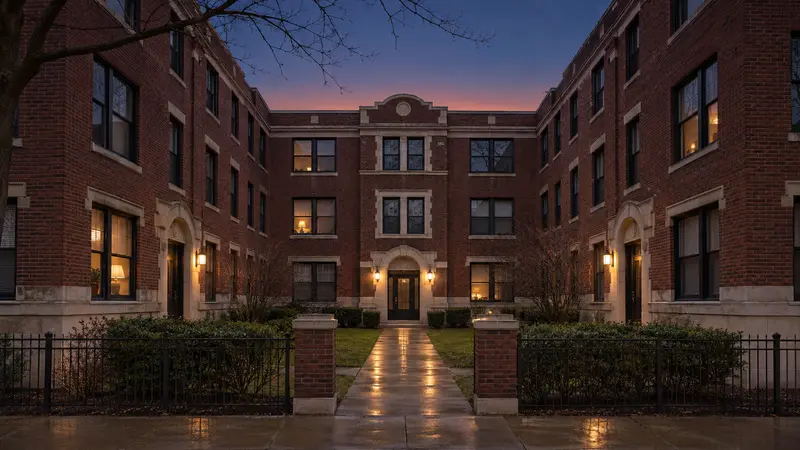
A condo flip is underwritten twice: the unit by your lender, and the building by your buyer's lender. Chicago condos sold at a median $325,000 across 20,676 recent sales. Assessments are carry you cannot pause, and the association must deliver its Section 22.1 package within 10 business days after a written request.
- Median Chicago condo sale
- $325,000 (middle half $210,000 to $539,925)
- Section 22.1 package
- 10 business days after a written request
- Package fee the seller can be charged
- $375, adjusted yearly for CPI, plus $100 for 72-hour rush service
- Owner petition on a special assessment
- Over 115% of prior-year assessments; 20% of votes; within 21 days
- Fannie Mae reserve test
- At least 10% of annual budgeted assessment income
- Vote to sell the whole building in Chicago
- 85% of unit owners
Program terms as of November 26, 2026. Rates as of November 25, 2026.
On this page
- What does the association decide that you cannot?
- What is in the Section 22.1 package, and how fast can you get it?
- How do assessments and a special assessment hit the carry?
- Why does your buyer's mortgage depend on the building?
- Do rental caps matter if you plan to sell?
- What do Chicago condos actually sell for?
- Could a bulk sale vote change your exit?
- How is a condo unit assessed and transferred?
- How will a flip lender look at a condo unit?
- What do you check before attorney review ends?
Inside the unit, a condo is the simplest rehab in Chicago: no roof, no masonry, no porch. Everything outside the drywall belongs to an association you do not control, and it shows up in your due diligence, your monthly carry and your buyer's loan approval.
Condos are also the city's deepest resale market by count: the Assessor's file shows 20,676 condo sales in 24 months, more than detached houses. The property types hub compares the other building types.
What does the association decide that you cannot?
The association decides the budget, the reserves, the rules for contractors and tenants, and whether a special assessment lands during your hold. You own one vote. Under the Illinois Condominium Property Act a board sends owners the proposed budget at least 25 days before adopting it, and Section 18 of the Act gives owners a petition right only when the increase is large: Over 115% of prior-year assessments; 20% of votes; within 21 days. Below that line a board can levy and you pay.
A unit priced under its comparable sales may be cheap because a roof or facade bill is about to be divided among the owners.
What is in the Section 22.1 package, and how fast can you get it?
The 22.1 package is the association's disclosure file for a resale, and the association must furnish it 10 business days after a written request. Section 22.1 lists what the seller obtains from the board and makes available to a buyer on demand:
- the declaration, bylaws and rules
- the unit's account, with unpaid assessments and liens
- capital expenditures anticipated in the current or next two fiscal years
- the reserve fund balance and any amount earmarked for a project
- the last fiscal year's financial statement
- pending suits or judgments involving the association
- the association's insurance coverage
The association may charge the seller $375, adjusted yearly for CPI, plus $100 for 72-hour rush service. You read this file as buyer during the attorney review period and order a fresh one as seller. A collection-policy item joins the list on January 1, 2027. This is general education; have your attorney read the documents.
How do assessments and a special assessment hit the carry?
Monthly assessments are a fixed carry line from closing to resale, and a special assessment is a lump that someone has to clear before the unit sells.
A $172,000 Edgewater one-bedroom with a special assessment in progress
Illustrative inputs, not an offer. The association's charges are kept on their own lines so you can see their weight.
Carry for 5 months
| Line | Amount | How it is figured |
|---|---|---|
| Loan interest | $8,435 | $192,800 x 10.5% / 12 x 5 |
| Monthly assessments | $2,190 | $438 a month |
| Special assessment balance | $5,400 | paid off so the buyer takes the unit clear |
| Property tax accrual | $1,425 | |
| Unit owner insurance | $240 | |
| Electric and gas | $475 | |
| Association share of carry | 41.8% | |
| Carry | $18,165 |
Line items sum to the stated result. Checked in code at build.
From resale price to profit
| Line | Amount | How it is figured |
|---|---|---|
| Resale price | $272,000 | |
| Purchase price | -$172,000 | |
| Renovation | -$38,000 | |
| Origination, 2 points | -$3,856 | |
| Purchase closing costs and buyer transfer tax | -$4,190 | |
| Carry | -$18,165 | |
| Brokerage | -$13,600 | 5% of price |
| Seller transfer taxes | -$1,224 | |
| Seller closing costs | -$2,400 | |
| Section 22.1 package fee | -$375 | statutory cap before CPI adjustment |
| Same deal with no association charges | $25,780 | |
| Profit before income tax | $18,190 |
Line items sum to the stated result. Checked in code at build.
The association takes 41.8% of carry here. Without its charges the same deal would clear $25,780.
Assumptions
- Rate of 10.5% and 2 points are inputs inside the published ranges of 8.99%-13.5% and 1-3 points.
- Loan sized at up to 90% of purchase price plus 100% of approved rehab, capped at 75% of supported ARV; the cost limit of $192,800 is below the ARV cap of $204,000. Whether a given condo building is eligible is underwritten file by file.
Run your own building in the analyzer with monthly carry lines, and see how carry grows with each month for how these lines scale with time.
Why does your buyer's mortgage depend on the building?
A conventional lender reviews the condo project as well as the borrower, so a building that fails review shrinks your buyer pool to cash and portfolio loans. Fannie Mae publishes the tests in its Selling Guide, under ineligible projects and the full review process:
| What the buyer's lender checks | Fannie Mae standard | Where you find the answer |
|---|---|---|
| Reserves in the budget | At least 10% of annual budgeted assessment income | Budget in the 22.1 package |
| Owners behind on assessments | No more than 15% of units 60 or more days past due | Ask the manager in writing |
| Commercial space in the building | No more than 35% of the project | Declaration and floor plans |
| Unfunded critical repairs | Ineligible at More than $10,000 per unit due within 12 months | Capital plan, board minutes |
| Litigation | Pending suits generally make a project ineligible, with minor exceptions | Item 6 of the 22.1 package |
A renovation fixes none of these. If the building fails one, your ARV has to come from sales to buyers who faced the same limit.
Do rental caps matter if you plan to sell?
Yes, because a rental cap removes investor buyers from your resale and your own fallback of holding the unit as a rental. State law does not set a cap. The declaration or rules do, and Section 18 makes those leasing provisions binding on tenants and requires an owner who leases to deliver the lease to the board: By the date of occupancy or 10 days after signing, whichever is first.
A building at its cap ends any plan to refinance into a DSCR loan. The sale versus refinance page and JFG's Chicago DSCR loan page cover the rental exit.
What do Chicago condos actually sell for?
Condo prices vary more by community area than any other property type. These are class 2-99 residential condominium sales from the Cook County Assessor's file.
| Area | Condo sales, 24 months | 25th percentile | Median | 75th percentile |
|---|---|---|---|---|
| Chicago | 20,676 | $210,000 | $325,000 | $539,925 |
| Near North Side | 3,748 | $232,500 | $345,000 | $580,000 |
| Lake View | 2,517 | $251,000 | $409,000 | $649,000 |
| Edgewater | 1,170 | $168,000 | $244,950 | $357,250 |
| South Shore | 253 | $64,000 | $102,700 | $141,000 |
Source: Cook County Assessor's Office, Assessor - Parcel Sales (dataset wvhk-k5uv), 2024-05-01 to 2026-04-30; retrieved 2026-11-26.
The Near North Side community area alone accounts for 18.1% of the city's condo sales, and 92.5% of its housing units sit in structures of five or more units. In the Edgewater area that share is 76.3% at a lower median price.
Could a bulk sale vote change your exit?
It could, in a building an investor wants to buy whole and return to rentals. Under Section 15 of the Act the owners can vote to sell the entire property: 75% of unit owners (buildings of 4 or more units). Chicago set a higher bar in 2019, and Municipal Code 13-72-085 requires 85% of unit owners unless the declaration demands more.
If a vote passes during your hold, you sell at the bulk price whether or not your renovation is finished. Confirm the current ordinance text with counsel. Small walk-up buildings are covered on the three-flat page and the two-flat page.
How is a condo unit assessed and transferred?
A residential condo is class 2-99, assessed at 10% of market value like a house. The Assessor values the whole building first and then applies each unit's percentage of ownership from the declaration, so a unit's assessed value follows the building's value and its ownership share.
Transfer taxes match any Chicago sale; see Chicago transfer taxes. The closing adds a paid assessment letter from the association, and the title and lien page covers the rest of the file.
How will a flip lender look at a condo unit?
A flip lender sizes the loan on the unit the same way as on a house, at up to 90% of purchase price plus 100% of approved rehab, capped at 75% of supported ARV, and then asks about the building. Condo eligibility by building size, owner-occupancy or litigation is underwritten file by file, ask your loan officer. Send the budget, reserve balance and master insurance certificate with the deal. JFG's Chicago investment property financing page lists its programs. Financing the full rehab still takes cash: closing costs, interest and every assessment are yours.
When a condo flip is the wrong deal
Walk away when the 22.1 package shows a special assessment larger than your projected profit, reserves near zero with facade or roof work ahead, or pending litigation. Your buyer's lender will find all three.
The better route is a unit in a building that passes the lender checks, or a small building you own outright, where the roof and the budget are your decisions.
What do you check before attorney review ends?
- Request the full Section 22.1 package the day the contract is signed.
- Ask the manager in writing for the delinquency count, rental cap status and pending special assessments.
- Read the rules on contractor hours, insurance and deposits, then get your contractor's acceptance.
- Add the building items to your building diligence checklist and price the assessments into your offer.
Questions: Condo unit flips
Who pays a special assessment that was adopted before I close on the purchase?
Whoever the contract says. Treat it as a negotiated term and settle it in attorney review. The Section 22.1 package shows the unit's account, anticipated capital expenditures and the reserve balance, which tells you whether another assessment is likely. Your own buyer will ask the same question, and the example assumes you pay the balance so the unit sells clear.
Can I buy a condo at a foreclosure sale without inheriting the old owner's unpaid assessments?
Not entirely. Under Section 9 of the Condominium Property Act, a third-party buyer at a judicial sale owes 6 months of unpaid common expenses that the prior owner left unpaid, counted back from the association's collection action, plus regular assessments from the month after the sale. Ask for the account ledger before you bid. The judicial sale page covers the rest of that process.
Do I need a Certificate of Zoning Compliance to sell a Chicago condo?
No. The City's certificate rule covers this: Residential property with 5 or fewer dwelling units. The Department of Planning and Development excludes condominiums and cooperatives. A Full Payment Certificate for water charges is still required on every transfer of real property, taxable or exempt, and the City's stated processing time is this: Up to 10 business days; in-person may finish same day. Build that turnaround into your contract dates.
Will the association let my contractor work in the building?
That is set by the declaration and rules, so read them before you price the job. Look for work-hour limits, elevator reservations, insurance certificates, damage deposits and board approval of plumbing or electrical changes. Section 22.1 also makes the seller state that prior alterations are believed to comply with the condominium instruments, which is your cue to ask what the last owner changed.
Does a small self-managed building make a condo flip harder?
It changes what can go wrong. A three- or six-unit association may have no manager, thin reserves and one owner behind on assessments, and a lender's project review asks about each. Fannie Mae's full review sets this limit: No more than 15% of units 60 or more days past due. A single delinquent owner in a six-unit building is already over it. Get the budget, reserve balance and delinquency count in writing.
Local rates and rules cited on this page
| Item | Figure | Primary source | Effective |
|---|---|---|---|
| Proposed condo budget delivered to owners before board adoption | at least 25 days | 765 ILCS 605/18 (Illinois General Assembly (ilga.gov)) | 2026 |
| Owner petition against a budget or special assessment | Over 115% of prior-year assessments; 20% of votes; within 21 days | 765 ILCS 605/18 (Illinois General Assembly (ilga.gov)) | 2026 |
| Condo resale disclosure (Section 22.1) response time | 10 business days after a written request | 765 ILCS 605/22.1 (Illinois General Assembly (ilga.gov)) | 2023-01-01 |
| Condo resale disclosure (Section 22.1) fee cap | $375, adjusted yearly for CPI, plus $100 for 72-hour rush service | 765 ILCS 605/22.1 (Illinois General Assembly (ilga.gov)) | 2023-01-01 |
| Fannie Mae condo full review: budgeted reserves | At least 10% of annual budgeted assessment income | Selling Guide, Full Review Process (Fannie Mae) | 2026-08-05 |
| Fannie Mae condo full review: delinquent assessments | No more than 15% of units 60 or more days past due | Selling Guide, Full Review Process (Fannie Mae) | 2026-08-05 |
| Fannie Mae condo projects: commercial space | No more than 35% of the project | Selling Guide B4-2.1-03, Ineligible Projects (Fannie Mae) | 2026-11-04 |
| Fannie Mae condo projects: unfunded repairs | More than $10,000 per unit due within 12 months | Selling Guide B4-2.1-03, Ineligible Projects (Fannie Mae) | 2026-11-04 |
| Delivering a unit lease to the condo board | By the date of occupancy or 10 days after signing, whichever is first | 765 ILCS 605/18 (Illinois General Assembly (ilga.gov)) | 2026 |
| Owner vote to sell a whole condo property, Illinois | 75% of unit owners (buildings of 4 or more units) | 765 ILCS 605/15 (Illinois General Assembly (ilga.gov)) | 2018-01-01 |
| Owner vote to sell a whole condo property, Chicago | 85% of unit owners | Municipal Code of Chicago 13-72-085, Sale of condominium property (City of Chicago (American Legal Publishing)) | 2019 |
| Cook County Class 2 residential assessment level | 10% of market value | How Residential Properties Are Valued (Cook County Assessor's Office) | 2026 |
| Prior assessments owed by a third-party foreclosure buyer of a condo | 6 months of unpaid common expenses | 765 ILCS 605/9 (Illinois General Assembly (ilga.gov)) | 2026 |
| Transfers that need a Certificate of Zoning Compliance | Residential property with 5 or fewer dwelling units | Certificate of Zoning Compliance (City of Chicago Department of Planning and Development) | 2026 |
| Full Payment Certificate processing time | Up to 10 business days; in-person may finish same day | Full Payment Certificates (City of Chicago Department of Finance) | 2026 |
| Chicago transfer tax, City portion (buyer) | $3.75 per $500 of price | Real Property Transfer Tax (7551) (City of Chicago Department of Finance) | 2008-04-01 |
| Chicago transfer tax, CTA portion (seller) | $1.50 per $500 of price | Real Property Transfer Tax (7551) (City of Chicago Department of Finance) | 2008-04-01 |
| Cook County real estate transfer tax | $0.25 per $500 of value | Transfer Fees (Cook County Clerk) | 1968-01-01 |
| Illinois state real estate transfer tax | $0.50 per $500 of value | 35 ILCS 200/31-10, Imposition of tax (Illinois General Assembly) | 2005-06-01 |
Rates as of November 25, 2026. Confirm with the agency before relying on any figure.
Sources
- 765 ILCS 605/22.1, resale disclosures, Illinois General Assembly, 2023-01-01.
- 765 ILCS 605/18, contents of bylaws, Illinois General Assembly, 2026.
- 765 ILCS 605/15, sale of property, Illinois General Assembly, 2018-01-01.
- 765 ILCS 605/9, common expenses and liens, Illinois General Assembly, 2026.
- Municipal Code of Chicago 13-72-085, Sale of condominium property, City of Chicago, 2019.
- Selling Guide B4-2.1-03, Ineligible Projects, Fannie Mae, 2026-11-04.
- Selling Guide, Full Review Process, Fannie Mae, 2026-08-05.
- Condominiums: how condos are valued, Cook County Assessor's Office, 2026.