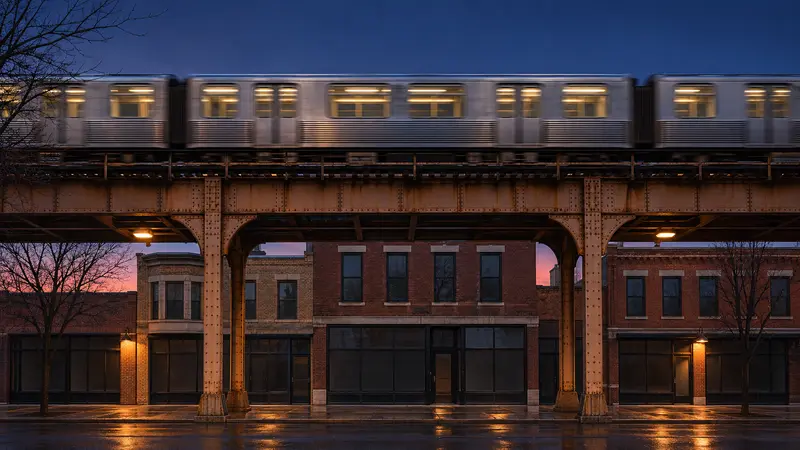
On the Lower West Side the permit calendar decides whether a Pilsen flip makes or loses money. Renovation permits took a median 82 days to issue, 26 more than citywide. A two-to-six unit building bought at $372,500 and resold at the $525,000 median returns $1,105 on the self-certified timeline and -$26,478 on a slow plan review.
- Median days to issue a renovation permit
- 82 (city: 56)
- Standard Plan Review, middle half
- 57 to 212 days
- Renovation permits, 24 months
- 161
- Median two-to-six unit sale
- $525,000 (175 sales)
- Single-family sales in the window
- 44, median $420,000
- Median reported permit cost
- $60,000
- Carry per month in the example
- $4,825
Program terms as of November 26, 2026. Rates as of November 25, 2026.
On this page
- How long does plan review run on a Pilsen rehab?
- What does each month of waiting cost a Lower West Side flip?
- What may you build on a Pilsen lot inside the Multi-Unit Preservation District?
- What do Pilsen flat buildings sell for?
- Which repairs do inspectors write up between 16th Street and the river?
- Can you add a unit on the Lower West Side instead of removing one?
- How old is the Lower West Side's housing?
- How do you shorten the permit wait on a Pilsen project?
- What is the next move on a Lower West Side deal?
Pilsen is the name most buyers use; the Lower West Side is what the City's data calls it. Community area 31 runs from 16th Street south to the Stevenson Expressway, with the South Branch of the Chicago River as its east and southeast edge and the rail corridor just past Western Avenue on the west.
Of the 20 community areas on this site, only two wait longer for a renovation permit. This page puts a dollar figure on that Pilsen wait.
Sources: City of Chicago Data Portal (Building Permits ydr8-5enu, Building Violations 22u3-xenr, 311 Service Requests v6vf-nfxy), 2024-11-01 to 2026-10-31; Cook County Assessor Parcel Sales (wvhk-k5uv), 2024-05-01 to 2026-04-30.
How long does plan review run on a Pilsen rehab?
A median 105 days under Standard Plan Review, and a quarter of those 109 Lower West Side permits took longer than 212 days. The citywide Standard Plan Review median is 94.
| Review path | Permits | Median days | Middle half | Citywide median |
|---|---|---|---|---|
| Standard Plan Review | 109 | 105 | 57 to 212 | 94 |
| Self Cert | 44 | 40.5 | 29 to 82 | 27 |
| Direct Developer Services | 8 | 166 | 56 to 335 | 87.5 |
| All renovation/alteration permits | 161 | 82 | 39 to 154 | 56 |
Source: City of Chicago, Department of Buildings, Building Permits (dataset ydr8-5enu), 2024-11-01 to 2026-10-31; retrieved 2026-11-26.
Only 44 Lower West Side permits were self-certified, at a median 40.5 days. Time is measured from application start to issuance, so it includes the days an applicant spends answering corrections. The count is the Renovation/Alteration permit type; Express Permit Program jobs such as in-kind porch or masonry repair are filed separately. A full contract-to-payoff sequence shows where a Lower West Side permit sits among the other steps.
What does each month of waiting cost a Lower West Side flip?
About $4,825 in this example, which makes the 82-day median wait worth $13,188. Flat buildings carry the example: the Lower West Side recorded 175 two-to-six unit sales against 44 houses.
One Pilsen deal, four permit calendars
Purchase at $372,500, the Lower West Side 25th percentile for two-to-six unit buildings; resale at the $525,000 median. Rate and carry inputs are illustrative.
Costs that ignore the calendar
| Line | Amount | How it is figured |
|---|---|---|
| Purchase | $372,500 | |
| Buy-side closing and City transfer tax | $6,594 | |
| Rehab plus 12% contingency | $67,200 | $60,000 is the Lower West Side median reported permit cost |
| Points and lender fees | $9,525 | 2 points on $393,750; the ARV cap sets the loan |
| Commission, seller transfer taxes, closing | $32,613 | |
| Fixed cost | $488,431 |
Line items sum to the stated result. Checked in code at build.
Costs that run every month
| Line | Amount | How it is figured |
|---|---|---|
| Interest | $32,095 | 11.2% on the full loan for 8.73 months |
| Taxes, insurance, utilities | $10,043 | |
| Share spent waiting for the permit | $13,188 | 82 days at $4,825 a month |
| Time cost at the median wait | $42,138 |
Line items sum to the stated result. Checked in code at build.
Result by permit wait
| Line | Amount | How it is figured |
|---|---|---|
| Self-Certification median, 40.5 days | $1,105 | |
| All Lower West Side permits, 82 days | -$5,570 | |
| Standard Plan Review median, 105 days | -$9,269 | |
| Standard Plan Review 75th percentile, 212 days | -$26,478 |
The same building swings $27,583 between the fastest and slowest of these four calendars.
Assumptions
- An 11.2% rate is used; the published range is 8.99%-13.5%.
- Each hold is 6 months of construction and sale plus the permit wait shown, converted at 30 days a month.
- The 25th percentile sale is a proxy for a discounted purchase, and permit-reported cost understates a full rehab.
At the overall median wait the deal returns -$5,570: a small loss. It turns positive only on the self-certified calendar and falls to -$26,478 if plan review runs to the 75th percentile. That is arithmetic on medians, not a forecast, but in Pilsen the review path is a line item. The monthly carry breakdown breaks the monthly figure down, and the cost-per-day delay tool prices your own loan per day. Interest-only payments, taxes and insurance all come from your cash while a Pilsen permit is in review.
What may you build on a Pilsen lot inside the Multi-Unit Preservation District?
Fewer small buildings than Pilsen's base zoning suggests. Municipal Code 17-7-0583 says a detached house or two-flat may be established in the district only where more than half the lots on that side of the block already hold houses or two-flats.
| Block face around the Pilsen lot | New house or two-flat as of right? | What that means for a rehab plan |
|---|---|---|
| More than 50% houses and two-flats | Yes | A deconversion or small replacement building is still a zoning question, not a barred one |
| 50% or fewer | No | Keep the three-flat or larger building at its unit count, or seek a zoning change |
| Vacant lots on the block | Counted either way, at the applicant's choice | Run the count both ways before you offer |
| Item | Figure | Source | Effective |
|---|---|---|---|
| Pilsen Multi-Unit Preservation District rule | Detached house or two-flat allowed only where more than 50% of the block face already holds one | City of Chicago (American Legal Publishing) | 2021-04-21 |
Source for the block-face threshold in the table above.
The district covers parcels zoned RT4 and RM4.5 through RM6.5. The City's 2021 announcement and the Code list its boundary street by street, starting at 16th Street and Newberry Avenue, following Cermak Road along the south and reaching the alley east of Western Avenue. Demolishing a residential building there also triggers the surcharge of $20,000 per unit and $60,000 per building, scheduled to sunset December 31, 2029.
What do Pilsen flat buildings sell for?
A median $525,000 across 175 two-to-six unit sales, with a wide middle half: $372,500 to $735,000.
| Property class | Sales | 25th pct. | Median | 75th pct. | Citywide median |
|---|---|---|---|---|---|
| Single-family (class 2-02 to 2-10, 2-34, 2-78) | 44 | $295,000 | $420,000 | $583,750 | $307,100 |
| Two to six units (class 2-11, 2-12) | 175 | $372,500 | $525,000 | $735,000 | $443,000 |
| Condominium (class 2-99) | 72 | $325,038 | $423,725 | $505,000 | $325,000 |
Source: Cook County Assessor's Office, Assessor - Parcel Sales (dataset wvhk-k5uv), 2024-05-01 to 2026-04-30; retrieved 2026-11-26. Source: Cook County Assessor's Office, Assessor - Parcel Universe (Current) (dataset pabr-t5kh); retrieved 2026-11-26.
The Assessor sale records behind these Lower West Side figures run 2024-05-01 to 2026-04-30 and leave out non-market deed types. The Institute for Housing Studies puts 61.2% of Lower West Side housing units in two-to-four unit buildings and reports business buyers on 31.3% of those sales in 2025. For the building type behind most Pilsen sales, see flipping a two-flat.
Which repairs do inspectors write up between 16th Street and the river?
On the Lower West Side, exterior walls and exterior stairs. "Repair exterior stair" was cited 55 times on the Lower West Side in 24 months, and it does not appear in the citywide top five. The conservation bureau wrote 968 of the area's 1,293 violation line items, spread over 300 addresses.
| Most cited violation (elevator bureau excluded) | Citations, 24 months |
|---|---|
| Arrange Premise Inspection (CN190019) | 106 |
| Repair Exterior Wall (CN061014) | 88 |
| Repair Exterior Stair (CN070014) | 55 |
| Plans & Permits Req - Contrctr (NC2011) | 32 |
| Maintain Window (CN104035) | 31 |
| All violations, 300 addresses | 1,293 |
Source: City of Chicago, Department of Buildings, Building Violations (dataset 22u3-xenr), 2024-11-01 to 2026-10-31; retrieved 2026-11-26. Source: City of Chicago, Boundaries - Community Areas (dataset igwz-8jzy); retrieved 2026-11-26.
Most Lower West Side records display as open, so read the inspection history. On a Pilsen two-flat, a rear stair or porch rebuild needs its own permit and can sit in plan review with the rest of the job.
Can you add a unit on the Lower West Side instead of removing one?
Often, yes. The City allows ADUs by right in multi-unit residential districts, which includes the RT4 and RM lots the Pilsen district covers. A conversion unit needs a principal building at least 20 years old, and no extra parking is required. RS-zoned lots are different: Section 17-7-0574 places much of the ground south of 16th Street and west of Canal Street in Zone 2, where a detached house must be owner-occupied and an administrative adjustment is required. The page on conversion unit rules covers pre-certification for a Pilsen conversion unit.
How old is the Lower West Side's housing?
58% of its 16,193 units date from before 1940, and 54.5% are in two-to-four unit buildings, according to 2020-2024 American Community Survey estimates summed from 11 tracts.
| Housing stock | Lower West Side |
|---|---|
| Housing units | 16,193 |
| Single-family detached share | 14% |
| Units in 2 to 4 unit buildings | 54.5% |
| Built before 1940 | 58% |
| Owner-occupied share of occupied units | 32% |
Source: U.S. Census Bureau, American Community Survey 2020-2024 5-Year Estimates, Detailed Tables (table-based summary file) (dataset ACSDT5Y2024), 2020-01-01 to 2024-12-31; retrieved 2026-11-26. Source: City of Chicago, Boundaries - Census Tracts - 2020 (dataset 7qjk-677h); retrieved 2026-11-26.
How do you shorten the permit wait on a Pilsen project?
- Before you offer, ask an architect registered for Self-Certification whether the scope qualifies. On the Lower West Side that answer is worth about two months.
- Clear the address. The City says a self-certified permit typically issues 10 business days after zoning approval, and only when there are no building violations or stop work orders on the property.
- Count the block face against the Multi-Unit Preservation District test so zoning review does not send the plans back.
- Split in-kind stair, porch and masonry repairs into Express Permit Program filings where the work qualifies.
- Put the permit wait into your schedule with the milestone schedule template and size your reserves to it.
The Pilsen plan that the calendar kills
A thin-margin flip that needs Standard Plan Review and assumes a six-month total hold does not work here. The Lower West Side's own permit record adds 105 days at the median and 212 at the slow end, and the example shows the result going from $1,105 to -$26,478 on timing alone. In Pilsen, buy with room for the long review or choose a scope that self-certifies.
What is the next move on a Lower West Side deal?
Price the Pilsen wait, then price the building. JFG's Pilsen lending page describes how the lender views the neighborhood, and its two-flat and three-flat financing guide covers the buildings that make up most Pilsen sales. Compare South Lawndale and the Near West Side across 16th Street, or return to the full community-area index.
Questions: Lower West Side (Pilsen) flip data
What extra review does a demolition in Pilsen trigger?
Two things beyond the wrecking permit. Inside the Multi-Unit Preservation District the Department of Housing must approve a Dwelling Unit Demolition Surcharge form, and the surcharge is $20,000 per unit and $60,000 per building. Separately, any Lower West Side building with a red or orange survey rating faces a Demolition-Delay hold (Up to 90 days). The area saw 17 wrecking permits in 24 months against 161 renovation permits.
Which Pink Line stations are on the Lower West Side?
Three: 18th, Damen and Western. All fall inside the Lower West Side community area when the City's CTA stop list is tested against the boundary file. Harrison Park, 18.58 acres at 1824 S. Wood Street, is next to the National Museum of Mexican Art at 1852 W. 19th Street. Lots near any of the three stations can qualify for the zoning code's transit parking reduction.
How thin is the single-family sample in Pilsen?
Thin enough to avoid as a pricing basis. The Lower West Side recorded 44 single-family sales in the 24-month window, and the yearly groups are smaller still: 9 sales in 2024 and 6 in early 2026. Any year with fewer than 20 sales is a thin sample. That is why this page runs its flip on the 175 two-to-six unit sales.
Which wards cover the Lower West Side?
Mostly one. On the ward map in force since 2023, the 25th Ward covers about 74% of the Lower West Side's land area and the 12th Ward about 21%, with small pieces in the 28th and 11th. The City's TIF file lists the Pilsen industrial district and Western/Ogden here, both expiring at the end of 2034.
Are Lower West Side vacant-building complaints rising?
The recent half of the window is busier. Of the 92 vacant or abandoned building complaints filed with 311 for the Lower West Side in 24 months, 59 came in the latest 12. The rate, 31.5 per square mile, is still under the citywide 46.3. A complaint is a report, not an inspection result.
Local rates and rules cited on this page
| Item | Figure | Primary source | Effective |
|---|---|---|---|
| Demolition surcharge, Pilsen and 606 areas | $20,000 per unit and $60,000 per building | Demolition Surcharge (City of Chicago Department of Housing) | 2024-09 |
| Demolition surcharge sunset | December 31, 2029 | Demolition Surcharge (City of Chicago Department of Housing) | 2024-09 |
| Minimum building age for a conversion unit | 20 years | ADU Requirements (City of Chicago Department of Housing) | 2025-09 |
| Self-Certification typical issuance time | 10 business days after zoning approval | Self-Certified Permit Application Program (City of Chicago Department of Buildings) | 2026 |
| Demolition-Delay hold | Up to 90 days | Demolition Delay (City of Chicago Department of Planning and Development) | 2003 |
| Chicago transfer tax, City portion (buyer) | $3.75 per $500 of price | Real Property Transfer Tax (7551) (City of Chicago Department of Finance) | 2008-04-01 |
| Chicago transfer tax, CTA portion (seller) | $1.50 per $500 of price | Real Property Transfer Tax (7551) (City of Chicago Department of Finance) | 2008-04-01 |
| Cook County real estate transfer tax | $0.25 per $500 of value | Transfer Fees (Cook County Clerk) | 1968-01-01 |
| Illinois state real estate transfer tax | $0.50 per $500 of value | 35 ILCS 200/31-10, Imposition of tax (Illinois General Assembly) | 2005-06-01 |
Rates as of November 25, 2026. Confirm with the agency before relying on any figure.
Sources
- Building Permits (dataset ydr8-5enu), City of Chicago Department of Buildings, 2026-11.
- Municipal Code of Chicago 17-7-0580, Multi-Unit Preservation District, City of Chicago, 2021-04-21.
- City Council Passes Anti-Deconversion Ordinances for Pilsen and the 606, City of Chicago Department of Housing, 2021-01-27.
- Demolition Surcharge, City of Chicago Department of Housing, 2024-09.
- Municipal Code of Chicago 17-7-0570, Additional Dwelling Unit-Allowed RS Areas, City of Chicago, 2026.
- Additional Dwelling Units: Eligibility, City of Chicago Department of Housing, 2025-09.
- Assessor - Parcel Sales (dataset wvhk-k5uv), Cook County Assessor's Office, 2026-11.
- Housing Market Indicators Data Portal: Lower West Side, Institute for Housing Studies at DePaul University, 2025.
- Harrison (Carter) Park, Chicago Park District, 2026.
- Pink Line route guide, Chicago Transit Authority, 2026.