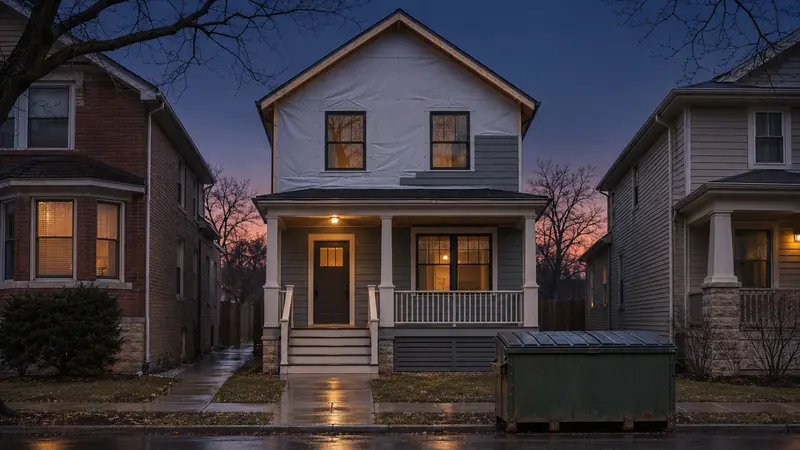
A first Chicago flip goes in this order: team, entity, proof of funds, deal criteria, City and county checks, loan submission, closing, permits, draws, listing. First-time flippers are reviewed; maximum leverage is not assured. Plan liquidity for cash to close, six months of reserves and the largest draw you will float.
- First-time flippers
- reviewed; maximum leverage is not assured
- Credit
- no minimum FICO on select programs; credit is reviewed, never waived
- Leverage
- up to 90% of purchase price plus 100% of approved rehab, capped at 75% of supported ARV
- Who may run the job
- A City-licensed general contractor
- Water certificate at purchase
- $50, Up to 10 business days; in-person may finish same day
- Zoning certificate at purchase
- $120, 5 business days for the initial decision
- Time to close
- 7-10 business days on complete files, counted after borrower conditions are met
Program terms as of November 26, 2026. Rates as of November 25, 2026.
On this page
- Who do you hire before you look at a house?
- Do you need an LLC before the first offer?
- What should your proof of funds and deal criteria say?
- Which Chicago checks come before the offer goes firm?
- How much cash does a first deal tie up?
- What goes in the loan submission?
- What happens between closing and the first draw?
- The whole sequence, in order
- When do you list, and what slows a first sale?
- Where do you start on Monday?
First flips in Chicago rarely fail on the kitchen. They fail on sequence: an offer written before anyone priced the roof, a contractor who turns out to be unlicensed in the city, a closing that waits on a certificate nobody ordered. This checklist puts the steps in the order that prevents those.
JFG, the lender that publishes this site, has a broader guide to starting flips in Chicago covering strategy and market choice. This page is narrower: the order, and the office behind each step.
Who do you hire before you look at a house?
Hire five people before the first showing, and verify each one in a public database.
| Role | What they do on a flip | How to verify |
|---|---|---|
| Real estate attorney | Contract review, title, closing | ARDC lawyer search |
| Agent | Purchase comps, resale pricing, listing | State license lookup |
| General contractor | Bids, permits, supervision | City licensed contractor list |
| Insurance agent | Builder's risk and liability | Ask for a quote on a vacant rehab |
| Lender | Terms, valuation, draws | Published program and a written term sheet |
The contractor line is the one first-timers skip. The City's general contractor rules require a license for permitted work done as an investment or for resale. A suburban contractor without a Chicago license cannot pull your permit.
Do you need an LLC before the first offer?
No, but decide before you sign, because the buyer named in the contract should match the borrower on the loan. Illinois charges $150 to file articles of organization and $75 for each annual report. A lender will ask for the articles, the operating agreement and a personal guarantee from the owners. Timing, vesting and what the title company needs are covered under closing in an LLC.
What should your proof of funds and deal criteria say?
Your proof of funds letter should match the offer you are making, and your criteria should rule most houses out. A letter states that financing is available for a stated price; listing agents read it next to your earnest money. How the letter works is explained under proof of funds, and you can ask JFG for one.
For a first deal, write the criteria down:
- One property type and two or three community areas you can drive to.
- Cosmetic to moderate scope: no additions, no added units, no structural masonry.
- A purchase price that leaves the liquidity shown in the example below.
- A maximum offer backed out of ARV, using the maximum offer calculator.
Which Chicago checks come before the offer goes firm?
Run six checks during attorney review, while you can still walk away. All of them use public records.
| Check | Office | What it tells you | Cost and timing |
|---|---|---|---|
| Permit and violation history | Department of Buildings records search | Open cases, past permits, unpermitted work | Free, same day |
| Tax status by PIN | Cook County Treasurer tax overview | Unpaid bills, whether taxes were sold, exemptions | Free, same day |
| Legal unit count | Planning and Development zoning certificate | Units the City recognizes | $120; 5 business days for the initial decision |
| Water account | Department of Finance Full Payment Certificate | Unpaid water and sewer charges | $50; Up to 10 business days; in-person may finish same day |
| Title | Your title company | Liens, judgments, easements | Ordered by your attorney |
| The building itself | Inspector and your contractor | Roof, sewer, structure, electrical service | Before review ends |
The seller normally orders the two certificates, but your closing waits on them, so ask on day one. What an open case means for price is covered under pricing an open violation, and the full list is in the complete pre-purchase checklist.
How much cash does a first deal tie up?
More than the down payment: cash to close, a reserve for the hold, and the work you pay for before each draw reimburses it.
Liquidity plan for a first deal: a $185,000 frame house with a $55,000 rehab
Inputs are illustrative, not an offer. The point is the total, not any single line.
Cash to close
| Line | Amount | How it is figured |
|---|---|---|
| Down payment | $18,500 | $185,000 less the $166,500 purchase advance |
| Points | $4,430 | 2 points on a $221,500 loan |
| Title, attorney and lender fees | $5,200 | illustrative |
| Chicago transfer tax, buyer side | $1,388 | $3.75 per $500 of price |
| Builder's risk premium | $2,400 | illustrative |
| LLC articles of organization | $150 | Illinois Secretary of State |
| Cash to close | $32,068 |
Line items sum to the stated result. Checked in code at build.
Reserves for 6 months
| Line | Amount | How it is figured |
|---|---|---|
| Interest | $12,736 | $221,500 at 11.5%, full commitment |
| Rehab contingency | $5,500 | 10% of $55,000 |
| Taxes, utilities and upkeep | $3,900 | $650 a month |
| Reserves | $22,136 |
Line items sum to the stated result. Checked in code at build.
Liquidity to have before the first offer
| Line | Amount | How it is figured |
|---|---|---|
| Cash to close | $32,068 | |
| Reserves | $22,136 | |
| Largest phase floated until its draw funds | $20,000 | demolition and rough framing, paid before inspection |
| Total liquidity | $74,204 |
Line items sum to the stated result. Checked in code at build.
A loan of $221,500 on a $185,000 house still asks for $74,204 of accessible cash. If your account holds only the down payment, the deal is too big for a first flip.
Assumptions
- Rate of 11.5% and 2 points are inputs inside the published ranges of 8.99%-13.5% and 1-3 points, not a quote. A first-time borrower may be offered less leverage than shown.
- The draw float comes back when the draw funds; the reserves may not.
Line-by-line detail on the first table is under what you wire at closing. JFG's fix and flip calculator is a quick cross-check on the loan size.
What goes in the loan submission?
A complete submission is the contract, a line-item scope of work with a contractor's bid, comparable sales supporting the resale price, entity documents and proof of liquidity. JFG reviews credit as well: no minimum FICO on select programs; credit is reviewed, never waived. Value is supported by comparable sales; a third-party valuation may be required. Use the submission checklist so nothing arrives piecemeal, because the published closing time of 7-10 business days on complete files, counted after borrower conditions are met starts when the file is whole. Borrower standards are summarized on the requirements page, and the first-timer questions under first-time flipper funding.
What happens between closing and the first draw?
Three things, in the same week: the permit application, the insurance and utility transfers, and demolition you pay for yourself.
Permits set the schedule. Repair-level work may fit the Express Permit Program. Work needing drawings carries a plan deposit of $600 non-refundable, and starting without a permit risks a stop-work penalty of 200% of the regular permit fee. Choose the path with your architect before closing; the options are compared under Chicago permit options compared.
Draws reimburse finished work. JFG's are staged against a rehab holdback, with inspections, so the first phase comes out of your pocket. Collect a lien waiver with every payment. The request cycle is laid out under draw requests, step by step.
The whole sequence, in order
- Verify and hire the attorney, agent, licensed general contractor and insurance agent.
- Talk to the lender; get the document list and a proof of funds letter.
- Decide on the entity and form it.
- Write deal criteria and a liquidity limit.
- Offer, then run the six checks during attorney review.
- Get a written bid on a line-item scope.
- Submit the complete loan file and order title.
- Bind insurance, confirm the City certificates, close.
- File the permit, register the building if it is vacant, start demolition.
- Request each draw as the phase finishes, with waivers.
- Pass final inspections, photograph, list.
- Order the payoff letter when a buyer's closing date is set.
When do you list, and what slows a first sale?
List when the permit is closed out and the house is photo-ready, not when the painters are still inside. Two things slow first sales. One is a permit left open: a buyer's attorney will find it in the same City search you ran. The other is a price set from the budget instead of from closed sales.
When to pass on the first deal
This checklist will not rescue a first deal that is too large or too complicated. A gut rehab, an added unit, a building with an open court case or a purchase that takes every dollar you have are the wrong first project, and a lender reviewing a first-time borrower may decline or cut leverage on exactly those files.
The better route is a smaller, cosmetic-to-moderate house in an area you know, with liquidity to spare. Finish one, then scale the scope.
Where do you start on Monday?
Fill in the liquidity plan with your own numbers and count the cash you can reach in 48 hours. Then make three calls: an attorney, a licensed general contractor, and a loan officer. When all three have seen your criteria, start looking at houses. The rest of the process guides take each later step in detail.
Questions: First Chicago flip checklist
Can I act as my own general contractor on a first flip?
Not on an investment property in Chicago. The City requires a general contractor license for permitted work done as an investment or with intent to sell, and the owner exception covers a primary residence only, one property a year. The smallest license, Class E, runs $300 per year; projects up to $500,000, but it carries insurance and application requirements. For a first deal, hire a licensed general contractor who pulls the permits and supervises the trades.
Will a first-time flipper get the full published leverage?
Not necessarily. JFG's published position on first-time flippers is: reviewed; maximum leverage is not assured. The program ceiling is up to 90% of purchase price plus 100% of approved rehab, capped at 75% of supported ARV, and a lender can size below it when the borrower has no completed projects. Build your budget on a larger down payment than the maximum implies, then treat any better offer as extra reserve. Leverage never removes the cash needed for closing costs, interest and work done ahead of draws.
What insurance has to be bound before closing?
The lender will want hazard coverage that fits a building under renovation, usually a builder's risk or vacant-dwelling policy, with the lender named as mortgagee. Liability matters too: if the house sits empty long enough to require Chicago vacant building registration, the City's minimum for a residential building is $300,000 per occurrence. Call an agent who writes investor policies the week you go under contract.
When does the vacant building registration apply to a rehab?
When the building meets the City's vacancy definition and stays that way. The City's owner requirements sheet sets three terms. Deadline: Within 30 days. Fee: $30 to $100 at initial registration. Term: 6 months, renewed until the building is sold or reoccupied. Many first flips are empty from closing day, so put registration on the closing-week list.
Does an old house change the checklist?
Yes, in one specific way. Paid renovation work that disturbs paint in housing built before 1978 falls under the EPA's Renovation, Repair and Painting rule, so the firm doing the work must be certified and a certified renovator must be assigned. If the house was built before 1978, ask each bidder for its EPA firm certificate along with the City license and the insurance certificate.
Local rates and rules cited on this page
| Item | Figure | Primary source | Effective |
|---|---|---|---|
| Illinois LLC Articles of Organization fee | $150 | 805 ILCS 180/50-10(b)(1) - Fees (Illinois General Assembly (ilga.gov)) | 2022-01-01 |
| Illinois LLC annual report fee | $75 | 805 ILCS 180/50-10(b)(11) - Fees (Illinois General Assembly (ilga.gov)) | 2022-01-01 |
| Certificate of Zoning Compliance fee | $120 | Certificate of Zoning Compliance (City of Chicago Department of Planning and Development) | 2021-01-11 |
| Certificate of Zoning Compliance decision time | 5 business days for the initial decision | Certificate of Zoning Compliance (City of Chicago Department of Planning and Development) | 2026 |
| Chicago Full Payment Certificate fee | $50 | Full Payment Certificates (City of Chicago Department of Finance) | 2026 |
| Full Payment Certificate processing time | Up to 10 business days; in-person may finish same day | Full Payment Certificates (City of Chicago Department of Finance) | 2026 |
| Plan-based permit application deposit | $600 non-refundable | Department of Buildings Changes for 2026 (City of Chicago Department of Buildings) | 2026-01-06 |
| Stop work order penalty for unpermitted work (code) | 200% of the regular permit fee | Municipal Code of Chicago 14A-12-1204.4 Stop work order (American Legal Publishing (Municipal Code of Chicago)) | 2022-12-14 |
| Chicago transfer tax, City portion (buyer) | $3.75 per $500 of price | Real Property Transfer Tax (7551) (City of Chicago Department of Finance) | 2008-04-01 |
| General contractor license, Class E | $300 per year; projects up to $500,000 | General Contractor License (City of Chicago Department of Buildings) | 2026-01-01 |
| Vacant building liability insurance, residential | $300,000 per occurrence | Requirements for Vacant Building Owners (Revised 1/2026) (City of Chicago Department of Buildings) | 2026-01 |
| Vacant building registration deadline | Within 30 days | Requirements for Vacant Building Owners (Revised 1/2026) (City of Chicago Department of Buildings) | 2026-01 |
| Vacant building registration fee | $30 to $100 at initial registration | Requirements for Vacant Building Owners (Revised 1/2026) (City of Chicago Department of Buildings) | 2026-01 |
| Vacant building registration term | 6 months | Requirements for Vacant Building Owners (Revised 1/2026) (City of Chicago Department of Buildings) | 2026-01 |
| Chicago transfer tax, CTA portion (seller) | $1.50 per $500 of price | Real Property Transfer Tax (7551) (City of Chicago Department of Finance) | 2008-04-01 |
| Cook County real estate transfer tax | $0.25 per $500 of value | Transfer Fees (Cook County Clerk) | 1968-01-01 |
| Illinois state real estate transfer tax | $0.50 per $500 of value | 35 ILCS 200/31-10, Imposition of tax (Illinois General Assembly) | 2005-06-01 |
Rates as of November 25, 2026. Confirm with the agency before relying on any figure.
Sources
- General Contractor License, City of Chicago Department of Buildings, 2026.
- Licensed Contractors lookup, City of Chicago, 2026.
- Lawyer Search, Attorney Registration and Disciplinary Commission of the Supreme Court of Illinois, 2026.
- License Lookup, Illinois Department of Financial and Professional Regulation, 2026.
- Building Permit and Inspection Records, City of Chicago Department of Buildings, 2026.
- Your Property Tax Overview, Cook County Treasurer, 2026.
- Full Payment Certificates, City of Chicago Department of Finance, 2026.
- Certificate of Zoning Compliance, City of Chicago Department of Planning and Development, 2026.