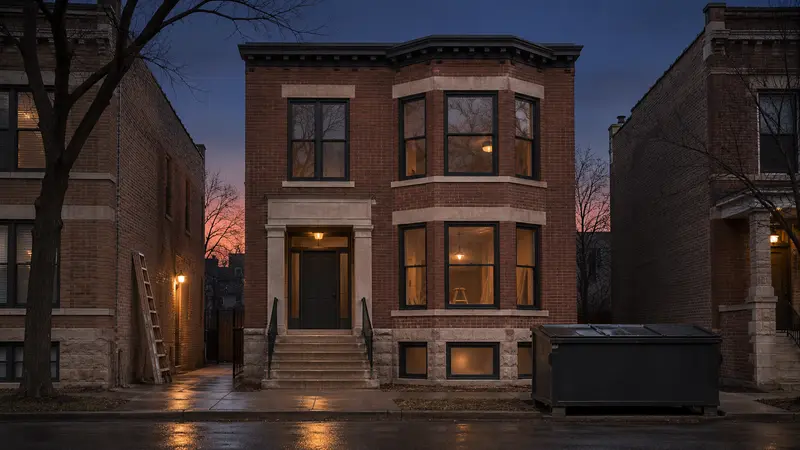
Chicago now allows additional dwelling units by right in multi-unit residential districts, and on single-family RS lots only inside designated areas. A building with one to four legal units can add one conversion unit and one coach house. In the example below a basement unit must add $145,806 of resale value to break even.
- Citywide expansion
- Approved by City Council September 2025
- RS lots
- Only inside an ADU-Allowed RS Area
- Conversion units
- 33% of existing legal units; 1 unit for buildings with 1-4 units
- Building age for a conversion unit
- 20 years
- Coach houses
- One per property
- Affordability trigger
- 50% of new ADUs when adding 2 or more, for 30 years
- Parking
- No additional parking required
- Short-term rental
- Not permitted
Program terms as of November 26, 2026. Rates as of November 25, 2026.
On this page
- Where can an investor add an ADU today?
- Coach house or conversion unit: which fits a flip?
- How many units can one building add?
- When do the affordability rules apply?
- Can an LLC that does not live there qualify in RS areas?
- What is the approval sequence?
- What does a basement unit cost against the value it adds?
- Does an ADU raise ARV or the size of a flip loan?
- What should you check this week?
Chicago banned new backyard houses and basement flats in 1957, then spent five years testing their return in pilot zones. In September 2025 the City Council widened the program to most of the city. For an investor that turns a basement or a garage site into a possible extra rent roll line, with conditions.
The City's code splits an ADU into two kinds. A conversion unit is inside the existing building, in a basement or attic. A coach house is a detached structure on the same lot. The rules differ for each, and so does the cost. This is general education from a lender; confirm a specific address with the Department of Housing and your architect.
Where can an investor add an ADU today?
In any multi-unit residential district, and in certain business and commercial districts, by right. The Department of Housing's ADU ordinance page describes the history: five pilot areas from 2020, then the 2025 expansion.
Single-family districts are the exception. The eligibility rules limit RS1, RS2 and RS3 lots as follows: Only inside an ADU-Allowed RS Area. The City's eligibility map answers the question by address. This page does not state an effective date for the expansion because we could not verify one.
Coach house or conversion unit: which fits a flip?
A conversion unit, in most cases, because it uses a structure you are already renovating.
| Conversion unit | Coach house | |
|---|---|---|
| Where | Inside the principal building | Detached, same lot |
| How many | 33% of existing legal units; 1 unit for buildings with 1-4 units | One per property |
| Building age test | 20 years | None, but the principal building must exist first |
| Added parking | No additional parking required | No additional parking required |
| Short-term rental | Not permitted | Not permitted if built after 2021 |
| Labor condition | None listed | Contractors in registered apprenticeship programs |
The apprenticeship condition is the one investors miss. The requirements page says a coach house builder must obligate the general contractor and all subcontractors to U.S. Department of Labor Registered Apprenticeship Programs. This page leaves out coach house size limits, which we could not verify.
How many units can one building add?
The zoning text allows conversion units at a 33% density bonus on buildings at least 20 years old. Under section 17-2-0303-C a fraction of one half or more rounds up, and a single-unit building may add one.
| Existing legal units | Conversion units | Coach house |
|---|---|---|
| 1 to 4 | 1 | 1 |
| 5 to 7 | 2 | 1 |
| 8 to 10 | 3 | 1 |
| 11 to 13 | 4 | 1 |
"Legal units" means the count on the zoning certificate, not the number of doorbells. The underlying district math is covered under zoning for added units.
When do the affordability rules apply?
Only when you add two or more ADUs to one property. The affordability page sets the requirement at 50% of new ADUs when adding 2 or more, for 30 years. The owner chooses which units are restricted, registers each one and records a covenant with the Cook County Clerk.
For a two-flat or three-flat rehab adding a single garden unit, the requirement does not come up. It matters on a six-flat adding two basement units, or on any lot adding a conversion unit and a coach house together. The recorded covenant also follows the property to your buyer for its full term, so disclose it early.
Can an LLC that does not live there qualify in RS areas?
Often not, for a detached house. Where an ADU-Allowed RS Area carries an owner-occupancy requirement and the principal building is a detached house, the owner must live there to be pre-certified, with photo ID and a second proof of residency. A flip loan is for non-owner-occupied property, so the two cannot be combined on that lot.
RS areas can also carry annual block caps: RS1: 1; RS2: 2; RS3: 3 pre-certifications per block per year. And some require an administrative adjustment first, at $500. In multi-unit districts none of these three conditions is listed.
What is the approval sequence?
- Run the address through the eligibility map and note any RS-area conditions.
- Confirm the legal unit count and the age of the principal building.
- Apply to the Department of Housing for pre-certification. The rule is: Required from the Department of Housing before permitting.
- Obtain an administrative adjustment if the area requires one.
- File for the building permit. Pre-certification does not approve the project; the Department of Buildings does.
- Build, pass inspections, then register any affordable unit and record its covenant.
A conversion unit is new dwelling space, so expect a plan-based permit; see permit paths and timelines.
What does a basement unit cost against the value it adds?
Add the build cost, soft costs, contingency and the extra months of interest and carry, then gross the total up for the cost of selling.
Adding a basement conversion unit to a two-flat already under rehab
Construction, soft cost and value inputs are illustrative. Replace them with bids and comps for your building.
What the basement unit adds to the project
| Line | Amount | How it is figured |
|---|---|---|
| Conversion unit construction | $96,000 | illustrative bid: excavation or slab work, egress, kitchen, bath, separate utilities |
| Architect, permit and pre-certification soft costs | $11,000 | illustrative |
| Contingency | $12,840 | 12% of $107,000 |
| Interest for 3 added months | $12,219 | $465,500 x 10.5% / 12 x 3 |
| Taxes, insurance, utilities for 3 added months | $3,540 | $1,180 a month |
| Break-even added resale value | $145,806 | added cost / (1 - 7% cost of sale) |
| Each further month of delay | $5,253 | interest plus carry |
| Added cost of the unit | $135,599 |
Line items sum to the stated result. Checked in code at build.
If three-unit comps do not support at least $145,806 over the two-flat value, the unit loses money on a sale and belongs only in a hold plan.
Assumptions
- Interest is figured at 10.5%, a number chosen from within the published 8.99%-13.5% band for illustration only.
- The base loan of $465,500 is sized at up to 90% of purchase price plus 100% of approved rehab, capped at 75% of supported ARV on the two-flat plan. The unit's cost is shown as cash here; whether it can be added to the financed budget is decided file by file.
- Cost of sale of 7% stands in for commission, transfer taxes and closing costs.
- One added unit does not trigger the affordability requirement.
Build the value side from sold three-unit buildings, not from rent estimates, and organize them in the ARV comp packet.
Does an ADU raise ARV or the size of a flip loan?
It raises ARV only when buyers of comparable finished buildings have paid for the extra legal unit, and it raises the loan only if the lender accepts that value. Whether projected ADU value counts is underwritten file by file. Expect questions about pre-certification status, permit status and whether the comps are true three-unit sales. The general method is described under how ARV gets supported.
The stronger case is usually a hold. Rent from a legal third unit improves DSCR on a refinance, which is the logic of BRRRR. Compare the two exits with the flip versus BRRRR exit comparer, and read selling versus refinancing out before committing. JFG covers the refinance side in its Chicago BRRRR strategy guide and its Chicago DSCR loan program. Remember that the conversion unit and a post-2021 coach house cannot be rented short term, so underwrite ordinary leases under the tenant ordinance for held buildings.
When an ADU is the wrong add
An ADU does not work as a rescue for a thin flip. It adds months before the permit, cash the base loan was not sized for, and a value assumption that depends on three-unit comps that may not exist on your block. It also cannot be done by an absentee LLC on a detached house in an RS area with an owner-occupancy rule. The better route is to finish and sell the building at its legal count, or to plan the unit from day one as part of a flip or BRRRR decision with the hold numbers in front of you.
What should you check this week?
Run the address on the eligibility map, pull the zoning certificate, and ask an architect for a one-page feasibility note on ceiling height and exits before you spend on drawings. Then price the unit with the break-even method above. The rest of the City rules that shape a rehab are on the Chicago rules hub.
Questions: ADU ordinance for investors
Is my property in an area that allows ADUs?
Check the City's ADU eligibility map by address. Multi-unit residential districts and certain business and commercial districts allow ADUs by right since the Council's 2025 expansion. Lots zoned RS1, RS2 or RS3 qualify only inside an ADU-Allowed RS Area, which the Council creates by ordinance and can condition with block caps, owner occupancy or an administrative adjustment. The map shows which conditions attach to a specific address, so run it before you price the unit.
Does an existing coach house need pre-certification?
Not always. The City says that when a coach house already exists and is considered legally established, repairing, remodeling or adding to it may not need ADU pre-certification. The burden is showing legal status, which starts with the unit count on the zoning certificate and the permit history. A coach house that was built or converted without permits is a new ADU for these purposes and goes through the full sequence, including the building-age and eligibility tests.
Can I build the coach house with my usual crew?
Only if they meet the labor condition. To build a coach house you must commit your general contractor and every subcontractor to participate in Registered Apprenticeship Programs approved by the U.S. Department of Labor. That requirement is specific to coach houses; the City does not list it for conversion units. Confirm your contractor's status before you bid the job, since replacing a contractor mid-approval means delay you pay interest on.
What rent can I charge for an affordable ADU?
Affordable ADUs must be rented to tenants at or below 60 percent of Area Median Income, and the City publishes the income limits and maximum monthly rents each year. The City's requirement covers 50% of new ADUs when adding 2 or more, for 30 years, and the restriction is recorded as a covenant against the property, with an annual compliance affidavit and a registration fee of $500 per affordable ADU. It applies only when you add two or more ADUs, so a typical two-flat adding a single basement unit is outside it.
Does a new ADU change the building's tax or loan class?
It can change the loan side. Adding a unit to a four-unit building makes five, and lenders commonly treat one-to-four unit and five-plus unit buildings as different products, so ask before you design it. On the tax side, Cook County can reassess permitted improvements in any year, so a unit added under permit may raise the assessment. Neither point is a reason to avoid the unit, but both belong in the hold-period numbers.
Local rates and rules cited on this page
| Item | Figure | Primary source | Effective |
|---|---|---|---|
| ADUs in single-family (RS) districts | Only inside an ADU-Allowed RS Area | ADU Eligibility (City of Chicago Department of Housing) | 2025-09 |
| Conversion units allowed | 33% of existing legal units; 1 unit for buildings with 1-4 units | ADU Requirements (City of Chicago Department of Housing) | 2025-09 |
| Coach houses allowed | One per property | ADU Requirements (City of Chicago Department of Housing) | 2025-09 |
| Minimum building age for a conversion unit | 20 years | ADU Requirements (City of Chicago Department of Housing) | 2025-09 |
| ADU parking requirement | No additional parking required | ADU Requirements (City of Chicago Department of Housing) | 2025-09 |
| ADU affordability requirement | 50% of new ADUs when adding 2 or more, for 30 years | ADU Affordability (City of Chicago Department of Housing) | 2025-09 |
| Annual ADU block caps in RS areas | RS1: 1; RS2: 2; RS3: 3 pre-certifications per block per year | ADU Requirements (City of Chicago Department of Housing) | 2025-09 |
| Administrative adjustment fee | $500 | Administrative Adjustments (City of Chicago Department of Planning and Development) | 2026 |
| ADU pre-certification | Required from the Department of Housing before permitting | Additional Dwelling Units (ADU) Program - Home (City of Chicago Department of Housing) | 2025-09 |
| ADU ordinance expansion | Approved by City Council September 2025 | Additional Dwelling Units (ADU) Program - Home (City of Chicago Department of Housing) | 2025-09 |
| ADU short-term rentals | Not permitted | ADU Requirements (City of Chicago Department of Housing) | 2025-09 |
| Affordable ADU registration fee | $500 per affordable ADU | ADU Affordability (City of Chicago Department of Housing) | 2025-09 |
Rates as of November 25, 2026. Confirm with the agency before relying on any figure.
Sources
- Additional Dwelling Units (ADU) Ordinance, City of Chicago Department of Housing, 2025-09 expansion; page accessed 2026.
- ADU Requirements, City of Chicago Department of Housing, 2026.
- ADU Eligibility, City of Chicago Department of Housing, 2026.
- ADU Affordability, City of Chicago Department of Housing, 2026.
- Chicago Zoning Ordinance 17-2-0303-C Conversion Unit, American Legal Publishing (Chicago Zoning Ordinance), amended through 2025-09-25.
- Administrative Adjustments, City of Chicago Department of Planning and Development, 2026.
- Registered Apprenticeship, U.S. Department of Labor, 2026.