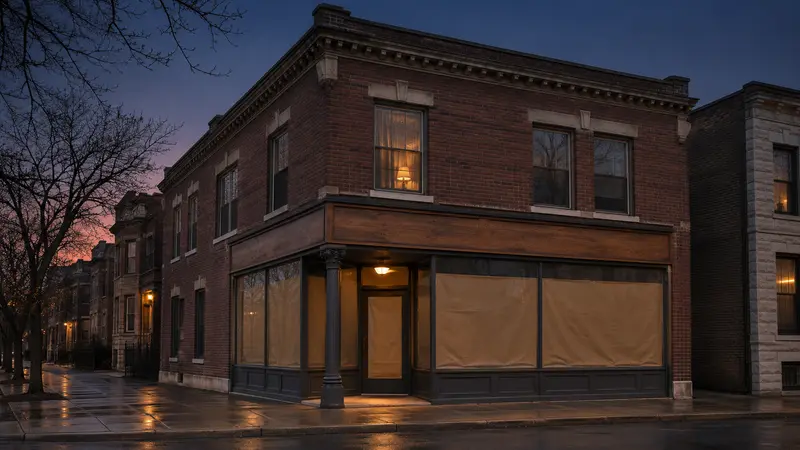
To the Cook County Assessor, a storefront with apartments stays residential only while it is small. The class 2-12 test: Apartments and commercial area totaling 6 units or fewer, under 20,000 square feet. Pass it and the level is 10% of market value instead of the commercial 25% of market value. Zoning and lenders test it separately.
- Class 2-12 test
- Apartments and commercial area totaling 6 units or fewer, under 20,000 square feet
- Class 2 assessment level
- 10% of market value
- Class 5 commercial level
- 25% of market value
- Apartments above the ground floor
- Permitted by right in B1, B2, B3, C1 and C2; not allowed in C3
- Apartment in the storefront space
- By right in B2; special use approval in B1, B3, C1 and C2; not allowed in C3
- Class 2-12 sales citywide, 24 months
- 542 against 8,701 for class 2-11
- Vacant mixed-use liability insurance
- $1,000,000 per occurrence
Program terms as of November 26, 2026. Rates as of November 25, 2026.
On this page
- How does the Cook County Assessor classify a storefront with flats?
- What does the class line cost in property tax?
- What does zoning allow above and behind the storefront?
- Can you turn the storefront into an apartment?
- Which loan fits: a flip loan or a bridge loan?
- Who buys the finished building, and with what money?
- How thin are the comps?
- What does an empty storefront cost while you hold?
- What should you verify before you offer?
The corner building with a shop at the sidewalk and two or three flats above it sits on a line. Call it residential and it is taxed like a three-flat. Call it commercial and the tax bill, the loan product and the buyer pool all change. The Assessor, the Zoning Ordinance and each lender make that call separately, on different facts.
This page takes the three tests in turn. For all-residential buildings, start at the building-type index or the two-flat rehab page.
How does the Cook County Assessor classify a storefront with flats?
The Assessor classifies by unit count, building area and commercial share, and a small mixed-use building lands in class 2. The office's class code definitions, revised December 16, 2024, set the lines:
| Building | Class | Assessment level |
|---|---|---|
| Apartments plus commercial area totaling 6 units or fewer, under 20,000 square feet | 2-12 | 10% |
| Mixed-use under 20,000 square feet with 7 or more units | 3-18 | 10% |
| Mixed-use of 20,000 to 99,999 square feet, no more than 60% commercial | 3-18 | 10% |
| Mixed-use that fits neither test | Split | Residential part at 10%, commercial part at 25% |
| Two- or three-story building with part or all retail or commercial space | 5-92 | 25% |
The assessment level is the share of market value that becomes assessed value, so the commercial level produces two and a half times the taxable base on the same value. Check the class on the property's PIN record before you trust a listing's tax figure, and take any mismatch to a property tax attorney.
What does the class line cost in property tax?
On the same value, the commercial level multiplies the bill by 2.5. The example applies the tax year 2025 equalizer from the Illinois Department of Revenue and the Chicago composite rate from the Cook County Clerk's rate report.
One $640,000 building, three ways the Assessor could treat it
Illustrative value, not an appraisal. Rates are tax year 2025: the Chicago composite rate and the Cook County equalizer.
Whole building at the commercial level versus class 2-12
| Line | Amount | How it is figured |
|---|---|---|
| Tax with the whole value at the class 5 level | $33,224 | $640,000 x 25% = $160,000 assessed; x 3.03 = $484,800 EAV; x 6.85% |
| Less tax as class 2-12 | -$13,290 | $640,000 x 10% = $64,000 assessed; x 3.03 = $193,920 EAV; x 6.85% |
| Per month | $1,661 | |
| Added tax per year | $19,934 |
Line items sum to the stated result. Checked in code at build.
Split treatment: 35% of value assessed as commercial
| Line | Amount | How it is figured |
|---|---|---|
| Residential portion at the class 2 level | $8,638 | on $41,600 assessed |
| Commercial portion at the class 5 level | $11,628 | on $56,000 assessed |
| Above the class 2-12 bill | $6,977 | |
| Tax per year, split | $20,267 |
Line items sum to the stated result. Checked in code at build.
The same $640,000 building carries $13,290 a year as class 2-12 and $33,224 if all of it is assessed as commercial.
Assumptions
- Uses 3.0300 as the equalizer and 6.853152% as the composite rate; your tax code's rate will differ.
- The Assessor's market value is not your purchase price or your ARV, and the 35% split is an input for illustration.
- No exemptions or incentive classes are applied.
That gap comes out of the income a buyer capitalizes, so it moves your resale price as well as your carry. Test your own figures in the property tax estimator for finished value, and read reassessment after rehab for when a permit resets the value. JFG's Cook County property tax guide goes deeper on appeals.
What does zoning allow above and behind the storefront?
Zoning answers a different question: which uses are legal on which floor. Where the lot is in a B (business) or C (commercial) district, the use table in section 17-3-0207 of the Chicago Zoning Ordinance treats the floors differently:
- Upper floors. Dwelling units above the ground floor: Permitted by right in B1, B2, B3, C1 and C2; not allowed in C3.
- Ground floor. Dwelling units below the second floor: By right in B2; special use approval in B1, B3, C1 and C2; not allowed in C3.
Can you turn the storefront into an apartment?
Only in some districts without a hearing, as the ground-floor rule above shows. Where special use approval applies, it comes from the Zoning Board of Appeals. The use table also lists a conversion unit category tied to the City's additional dwelling unit rules; the ADU conversion unit guide covers that path.
A conversion is a change of occupancy, and the City requires a Certificate of Occupancy for any change of occupancy. It can also change the Assessor's class. Get a zoning attorney's read before you count the extra rent. This is general education, not legal advice.
Which loan fits: a flip loan or a bridge loan?
It depends on how much of the building is commercial and what you plan to do with it. JFG's published flip program is a fix and flip loan on non-owner-occupied property, sized at up to 90% of purchase price plus 100% of approved rehab, capped at 75% of supported ARV. Whether a given storefront-and-flats building is written under that program or as a bridge loan is underwritten file by file, ask your loan officer.
Make the file easy to place: state the unit count, the commercial square footage, any lease, and whether the storefront stays commercial. JFG's Chicago bridge loans and Chicago hard money lending pages describe the alternatives, and this site's comparison of flip, bridge and hard money loans explains the differences. Whatever the product, rehab financing leaves closing costs, interest and overruns to you in cash.
Who buys the finished building, and with what money?
Mostly investors and owner-operators using commercial or portfolio debt, because the standard owner-occupant mortgage rarely fits. Fannie Mae's mixed-use eligibility rule is narrow: One-unit principal residence where the borrower owns and operates the business. A shop with three flats above fails the one-unit test before anything else is reviewed. An SBA loan for a shop owner rarely fits either: 13 CFR 120.131 requires the borrower's business to occupy at least 51 percent of an existing building's rentable space, and one storefront under three flats is the smaller part.
A two-flat does not have that problem, because conforming loans cover one- to four-unit residential property. Price your exit for a buyer who underwrites income: rents in place, a leased or leasable storefront and the tax class. Where the unit count nears the residential lending limit, the four versus five units page explains what changes.
How thin are the comps?
Thin enough that ARV support takes more work than on a two-flat. Class 2-12 sales are the difference between the Assessor's two- to six-unit group and its class 2-11 count.
| Area | Class 2-12 sales, 24 months | Class 2-11 sales | Housing units built before 1940 |
|---|---|---|---|
| Chicago | 542 | 8,701 | n/a |
| West Town | 64 | 427 | 40.9% |
| Logan Square | 24 | 380 | 58.3% |
| Austin | 19 | 502 | 49.5% |
| Lower West Side | 18 | 157 | 58% |
Source: Cook County Assessor's Office, Assessor - Parcel Sales (dataset wvhk-k5uv), 2024-05-01 to 2026-04-30; retrieved 2026-11-26. Source: U.S. Census Bureau, American Community Survey 2020-2024 5-Year Estimates, Detailed Tables (table-based summary file) (dataset ACSDT5Y2024), 2020-01-01 to 2024-12-31; retrieved 2026-11-26.
West Town has the most class 2-12 sales of any community area; the Lower West Side recorded 18 in two years. With so few sales, bring rent comparables with your sales, organized in the packet for sales and rent comps.
What does an empty storefront cost while you hold?
An empty storefront costs you insurance, registration and tax relief you might have expected. Vacant mixed-use buildings need higher liability limits under the City's vacant building rules, and the vacant registration page lists the deadlines.
On taxes, the Assessor's vacancy policy treats the two groups differently. For residential property, which it defines to include two- to six-unit buildings, relief is limited: Casualty only, up to 24 months. Commercial property can also claim market-related vacancy when an occupant-ready space has been marketed in good faith without a lease. Ask how the policy applies to a class 2-12 parcel before you assume a reduction for a dark storefront.
When a storefront building does not fit a flip loan
It does not fit when the commercial space dominates the building, when the plan depends on a zoning approval you do not have, or when the only ARV support is a rent you hope to get. A flip loan is sized to resale value from comparable sales, the weakest part of this file.
The better route is a bridge or commercial loan sized to the building as it is, a signed storefront lease before you list, and a longer hold in your budget. If the zoning change is the whole business plan, get the approval first.
What should you verify before you offer?
- Pull the PIN record and write down the class, the unit count and the building square footage.
- Look up the zoning district and compare the legal unit count with what is occupied.
- Recompute the tax bill at the class you expect after rehab, not the seller's.
- Collect leases for every unit and the storefront, or a broker's written rent opinion.
- Send unit count, commercial square footage and exit plan with your loan request.
Questions: Storefront with apartments
Does the storefront count as a unit toward the six-unit limit for class 2-12?
Yes. The Assessor's definition counts apartments and commercial area together, so a building with five apartments and two shops totals seven and falls outside class 2-12 even though it has fewer than six dwellings. At seven or more units under 20,000 square feet it moves to class 3-18, which the Assessor also lists at a 10% level. Pull the property's current class from its PIN page before you underwrite the tax bill.
Will my appraiser use sales or rent to value a mixed-use building?
Expect both, and expect thin sales evidence. The Assessor's file shows 542 class 2-12 sales in Chicago over 24 months against 8,701 for plain two- to six-unit buildings, so comparable sales are scarce on any one corridor. The Cook County Assessor says it reassesses most commercial property with the income approach. Ask your lender which approach its valuation will weight, and treat signed leases and a documented storefront rent as part of your ARV support.
Does the RLTO apply to the apartments over a store?
It applies to the dwelling units the same way it would in any investor-owned building; the ground-floor commercial lease is outside it. The ordinance's small-building exemption reads: Owner-occupied buildings with 6 units or fewer. A non-owner-occupied flip or rental does not qualify. See RLTO rules for holders and confirm your facts with a landlord-tenant attorney.
Can I keep the storefront empty and sell to a buyer who wants to live upstairs?
You can sell it that way, but the buyer's financing narrows. Fannie Mae limits mixed-use eligibility to this: One-unit principal residence where the borrower owns and operates the business. A building with a shop and two or three apartments does not fit, so an owner-occupant buyer has to look beyond a conforming loan, for example to a bank portfolio or commercial loan. An empty storefront also gives the buyer's appraiser no rent to work with.
Is a vacant mixed-use building insured differently while I hold it?
Yes. Chicago's vacant building rules set the minimum liability coverage for a vacant nonresidential or mixed-use structure at $1,000,000 per occurrence, compared with $300,000 per occurrence for a primarily residential one. The duty to register starts 30 days after vacancy or 30 days after taking ownership, whichever is later, and a site where permitted work has stopped must register too. Get that limit quoted before closing, because the premium belongs in your carry budget.
Local rates and rules cited on this page
| Item | Figure | Primary source | Effective |
|---|---|---|---|
| Dwelling units above the ground floor in B and C districts | Permitted by right in B1, B2, B3, C1 and C2; not allowed in C3 | Chicago Zoning Ordinance 17-3-0207, Use Table and Standards (City of Chicago (American Legal Publishing)) | 2026 |
| Dwelling units below the second floor in B and C districts | By right in B2; special use approval in B1, B3, C1 and C2; not allowed in C3 | Chicago Zoning Ordinance 17-3-0207, Use Table and Standards (City of Chicago (American Legal Publishing)) | 2026 |
| Fannie Mae mixed-use property eligibility | One-unit principal residence where the borrower owns and operates the business | Selling Guide B2-3-04, Special Property Eligibility Considerations (Fannie Mae) | 2026-11-04 |
| SBA owner-occupancy minimum, existing building | 51 percent | 13 CFR 120.131 - Leasing part of new construction or existing building to another business (eCFR / U.S. Small Business Administration) | 2003-08-28 |
| Assessor vacancy relief for 1-6 unit residential | Casualty only, up to 24 months | Assessor's Vacancy Policy (Cook County Assessor's Office) | 2026 |
| Cook County class 2-12 mixed-use definition | Apartments and commercial area totaling 6 units or fewer, under 20,000 square feet | Definitions for the Classifications of Real Property (revised 12/16/24) (Cook County Assessor's Office) | 2024-12-16 |
| Cook County Class 2 residential assessment level | 10% of market value | How Residential Properties Are Valued (Cook County Assessor's Office) | 2026 |
| Cook County Class 5 commercial/industrial assessment level | 25% of market value | Definitions for the Classifications of Real Property (revised 12/16/24) (Cook County Assessor's Office) | 2024-12-16 |
| Vacant building liability insurance, mixed-use or nonresidential | $1,000,000 per occurrence | Requirements for Vacant Building Owners (Revised 1/2026) (City of Chicago Department of Buildings) | 2026-01 |
| Cook County final equalization factor, tax year 2025 | 3.0300 | 2025 Cook County Final Multiplier Announced (Illinois Department of Revenue) | 2026-06-18 |
| City of Chicago general composite tax rate, tax year 2025 | 6.853152% | 2025 Cook County Tax Rates Released (tax rate report) (Cook County Clerk) | 2025 |
| RLTO exemption for small owner-occupied buildings | Owner-occupied buildings with 6 units or fewer | Residential Landlord and Tenant Ordinance (City of Chicago Department of Housing) | 2026 |
| Vacant building liability insurance, residential | $300,000 per occurrence | Requirements for Vacant Building Owners (Revised 1/2026) (City of Chicago Department of Buildings) | 2026-01 |
| When a buyer's vacant building registration duty starts | 30 days after vacancy or 30 days after taking ownership, whichever is later | Municipal Code of Chicago 14X-12-1204.2 Time for compliance (City of Chicago (American Legal Publishing)) | 2024-06-12 |
Rates as of November 25, 2026. Confirm with the agency before relying on any figure.
Sources
- Definitions for the Classifications of Real Property (revised 12/16/24), Cook County Assessor's Office, 2024-12-16.
- Chicago Zoning Ordinance 17-3-0207, Use Table and Standards, City of Chicago, 2026.
- Selling Guide B2-3-04, Special Property Eligibility Considerations, Fannie Mae, 2026-11-04.
- 13 CFR 120.131, Leasing part of new construction or existing building to another business, eCFR / U.S. Small Business Administration, 2003-08-28.
- Vacancy Policy, Cook County Assessor's Office, 2026.
- How Commercial Properties Are Valued, Cook County Assessor's Office, 2026.
- 2025 Cook County final multiplier, Illinois Department of Revenue, 2026-06-18.
- 2025 Tax Rate Report, Cook County Clerk, 2025.
- Vacant building owner information, City of Chicago Department of Buildings, 2026-01.