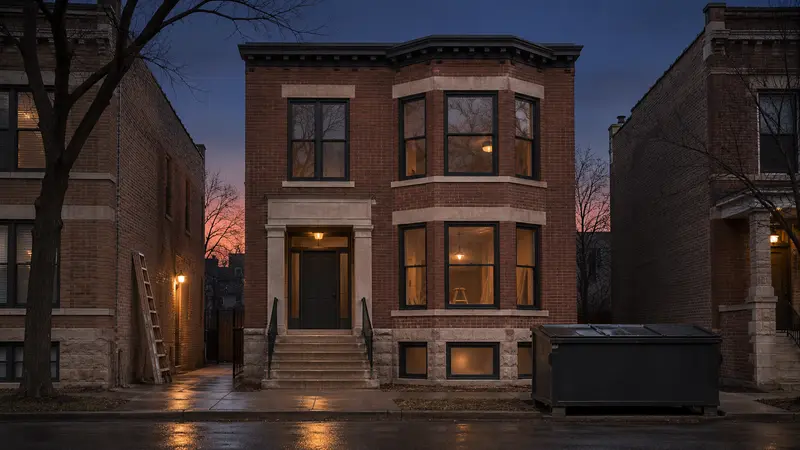
Occupancy decides it: FHA 203(k) is for a primary residence, HomeStyle Renovation allows investors on one-unit properties only, and a fix and flip loan is for non-owner-occupied investment property only. A flipper of a Chicago two-flat is left with the flip loan. An owner-occupant buying the same building should price the renovation mortgages first.
- FHA 203(k)
- One- to four-unit primary residence; Limited version caps rehab at $75,000
- HomeStyle Renovation, investors
- Allowed for one-unit investment properties
- HomeStyle renovation cap
- 75% of as-completed value (purchase: 75% of the lesser of price plus renovation costs or as-completed value)
- FHA limit, Cook County two-unit, 2026
- $693,050
- FHA resale rule
- Ineligible for FHA financing at 90 days or less
Program terms as of November 26, 2026. Rates as of November 25, 2026.
On this page
- Who is each of the three loans built for?
- Why can't a flipper close with a 203(k)?
- Can an investor use HomeStyle on a Chicago two-flat?
- How do timelines, contractors and consultants differ?
- What does one two-flat look like for an investor and an owner-occupant?
- How does FHA's 90-day rule change your resale calendar?
- Why does your end buyer's loan matter to your exit?
- Should a house-hacker use a flip loan on a two-flat?
- What should you check before you write the offer?
Search for rehab financing and the same three products come back together, as if a borrower could pick freely among them. In practice two questions sort them before price ever comes up: will you live in the building, and how many units does it have.
A lender that makes investor loans, not FHA or Fannie Mae mortgages, publishes this page. If you will live in the property, one of the other two usually fits you better.
Who is each of the three loans built for?
Each program names its borrower in its eligibility rules.
| Fix and flip loan (JFG) | FHA 203(k) | Fannie Mae HomeStyle Renovation | |
|---|---|---|---|
| Occupancy | Non-owner-occupied only | Primary residence | Primary residence, second home or investment |
| Units | Investment residential | 1 to 4 | 1 to 4 if you live there; 1 if you do not |
| Rehab limit | 100% of approved budget, loan capped at 75% of ARV | Limited: $75,000; Standard: no stated maximum | 75% of as-completed value (purchase: 75% of the lesser of price plus renovation costs or as-completed value) |
| Loan life | Short-term, interest-only | Long-term mortgage | Long-term mortgage |
| Work deadline | Set in the loan documents | 12 months Standard, 9 months Limited | 15 months from closing |
The 203(k) and HomeStyle columns come from HUD's program comparison fact sheet (revised November 4, 2024) and Fannie Mae's Selling Guide. How the three investor labels differ from each other is a separate question, answered in bridge and hard money terms.
Why can't a flipper close with a 203(k)?
Because the 203(k) insures a home the borrower will live in. HUD's fact sheet lists the eligible property as a one- to four-unit primary residence, and its FAQ says investor purchases of HUD-owned homes are not eligible for 203(k) financing. HUD's program page describes the audience as homebuyers and homeowners.
A flipper holds the building as inventory and never moves in, so the plan cannot fit the program.
Can an investor use HomeStyle on a Chicago two-flat?
Not as a pure investment. Fannie Mae's eligibility rules for HomeStyle allow a one- to four-unit principal residence, a one-unit second home and a one-unit investment property. A two-flat you will not occupy is not on that list.
A one-unit rental is. For that, the Eligibility Matrix dated August 5, 2026 shows a maximum 85% loan-to-value on a purchase, and renovation costs are capped: 75% of as-completed value (purchase: 75% of the lesser of price plus renovation costs or as-completed value). For a buy-and-hold single-family it deserves a quote alongside the route in flipping versus BRRRR.
How do timelines, contractors and consultants differ?
The renovation mortgages add program oversight that a flip loan handles through its own draw process.
- 203(k). The Standard version requires an FHA-approved consultant, who per HUD prepares the work write-up, inspects for draws and confirms permits before work starts. Work must finish within 12 months (Standard) or 9 months (Limited), with a contingency reserve of up to 20%.
- HomeStyle. Fannie Mae requires the work to be completed on its deadline, 15 months from closing, and HUD's sheet lists a contingency of up to 15%.
- Flip loan. Rehab funds are staged against a rehab holdback, with inspections, against the budget you submitted. Closing is 7-10 business days on complete files, counted after borrower conditions are met.
Chicago's review tracks are in permit paths and timing, and the investor sequence runs in the offer-to-payoff timeline.
What does one two-flat look like for an investor and an owner-occupant?
The investor brings more cash for a few months. The owner-occupant brings less and takes on a long-term mortgage and a residency commitment.
One Brighton Park two-flat, two kinds of buyer
Price $330,000, rehab $90,000, finished value $560,000. An investor flips it with a flip loan. An owner-occupant who will live in one unit prices a renovation mortgage. The second table checks eligibility and minimum cash only; it is not a loan quote.
Investor with a flip loan of $387,000: cash in
| Line | Amount | How it is figured |
|---|---|---|
| Down payment | $33,000 | price less the $297,000 advance |
| Closing costs and buyer transfer tax | $5,775 | |
| Points and lender fees | $7,700 | 1.5 points plus $1,895 |
| Contingency and 7 months of carry | $16,420 | |
| Interest | $23,139 | $387,000 x 10.25% / 12 x 7 |
| Projected profit at resale | $52,946 | |
| Investor cash invested | $86,034 |
Line items sum to the stated result. Checked in code at build.
Owner-occupant: what a renovation mortgage is sized on
| Line | Amount | How it is figured |
|---|---|---|
| Purchase price | $330,000 | |
| Renovation budget | $90,000 | above the $75,000 Limited 203(k) cap, so Standard 203(k) |
| 203(k) minimum investment | $14,700 | 3.5% of cost, from HUD's 96.5% maximum LTV |
| 203(k) base loan | $405,300 | under the $693,050 Cook County two-unit limit |
| HomeStyle minimum down payment | $21,000 | 5%, from Fannie Mae's 95% matrix maximum for 2-4 unit residences |
| Cost basis | $420,000 |
Line items sum to the stated result. Checked in code at build.
Assumptions
- Flip loan rate of 10.25% and 1.5 points are inputs inside the published ranges of 8.99%-13.5% and 1-3 points, not an offer.
- Owner-occupant figures apply published maximums to purchase plus renovation cost. Actual 203(k) and HomeStyle sizing also depends on appraisals, credit, income, mortgage insurance, reserves and closing costs.
The investor fronts $86,034 and projects $52,946 at resale. Funding the whole rehab budget still leaves the down payment, closing costs, interest, contingency and work done ahead of each draw to cover in cash. The owner-occupant's minimum investment starts near $14,700 with a 203(k) or $21,000 with HomeStyle, before closing costs and reserves. Because the $90,000 budget exceeds the Limited 203(k) cap, the FHA route means the Standard program and its consultant.
These are different transactions, not competing quotes.
| Item | Figure | Source | Effective |
|---|---|---|---|
| FHA forward mortgage limit, Cook County, 1-unit, 2026 | $541,287 | U.S. Department of Housing and Urban Development | 2026-01-01 |
| FHA forward mortgage limit, Cook County, 2-unit, 2026 | $693,050 | U.S. Department of Housing and Urban Development | 2026-01-01 |
| FHA forward mortgage limit, Cook County, 3-unit, 2026 | $837,700 | U.S. Department of Housing and Urban Development | 2026-01-01 |
| FHA forward mortgage limit, Cook County, 4-unit, 2026 | $1,041,125 | U.S. Department of Housing and Urban Development | 2026-01-01 |
2026 FHA limits in Cook County by unit count
Limits are from HUD's mortgage limits lookup for 2026.
How does FHA's 90-day rule change your resale calendar?
It sets the earliest date an FHA buyer can sign your contract. Under 24 CFR 203.37a, the clock runs from the settlement date of your purchase to the date the buyer executes the sales contract.
- Day 90 or earlier: Ineligible for FHA financing at 90 days or less.
- Days 91 to 180: Second appraisal if resale price is 100% or more over acquisition price.
- Exemptions cover sellers such as HUD, banks, the GSEs and heirs, not an investor reselling a rehab.
A fast cosmetic flip can be listed before day 91. Price the wait into your carry, or accept that early buyers exclude FHA borrowers.
Why does your end buyer's loan matter to your exit?
Your buyer's financing determines who can bid and when. A renovated two-flat is a natural purchase for an owner-occupant using FHA, and in 2026 the Cook County two-unit FHA limit is $693,050. A price that needs a larger loan narrows the FHA pool to buyers with bigger down payments. Comps, not loan limits, set your value; see how lenders test ARV.
Renovation mortgages also create a second exit. An owner-occupant approved for a 203(k) or HomeStyle loan can buy a building as-is and finance the work, so a project you would prefer not to finish may still sell, though slower than to cash. The trade-offs are in selling versus refinancing.
Should a house-hacker use a flip loan on a two-flat?
No. If you will live in one unit, this lender's program is closed to you: it is for non-owner-occupied investment property only. Under the Regulation Z commentary, credit to buy a rental property the owner will occupy is business-purpose only when the building has more than two units (12 CFR 1026.3), so an owner-occupied two-flat purchase is consumer credit.
Get a 203(k) quote from an FHA-approved lender and a HomeStyle quote from a Fannie Mae seller, and compare down payment, mortgage insurance and rate. The building issues are the same as an investor's; see what to check on a two-flat and Jaken Finance Group's two-flat and three-flat financing guide.
When a flip loan is the wrong answer here
A flip loan does not work if you plan to occupy any unit, and it is a poor choice for a long hold on a one-unit rental. In both cases price the renovation mortgages first.
The reverse failure: an investor who waits on a renovation mortgage to compete for a distressed two-flat against buyers who can close in days. For investment property, start with the lender's Chicago investment property financing overview.
What should you check before you write the offer?
- Decide occupancy first. Living there points to 203(k) or HomeStyle; not living there points to investor financing.
- Count legal units. HomeStyle for investors stops at one.
- Build the budget with the budget builder for flat buildings and the scope of work template. Every one of these loans is sized from it.
- If you are flipping, mark day 91 and day 181 after your closing on the calendar and plan your listing date around them.
- If you are wholesaling, remember FHA buyers cannot take an assigned contract; see funding a double close.
Other funding comparisons, including cash, partners and gap loans, are collected on the comparison hub.
Questions: Flip loan vs 203(k) and HomeStyle
What is the difference between a Standard and a Limited 203(k)?
Scope and oversight. HUD describes the Limited 203(k) as financing up to $75,000 of non-structural repairs, with a consultant optional. The Standard 203(k) is for major rehabilitation, needs at least $5,000 of work, permits structural changes and uses a HUD-approved consultant to write up the work and inspect for draws. Standard work must finish in 12 months, Limited in 9 months.
Can I buy with a 203(k), finish the work and then sell at a profit?
A 203(k) is an FHA-insured mortgage on a home you are buying as your primary residence, so applying for one when your plan is to renovate and resell misstates your occupancy to a federally insured lender. If your plans change after you have lived there, ask your FHA lender and an attorney what your loan documents require. For a project you intend to resell, use investor financing.
Can HomeStyle fund a single-family rental I plan to keep?
It can be considered. Fannie Mae's Selling Guide lists a one-unit investment property as eligible, and the August 2026 Eligibility Matrix shows a maximum of 85% loan-to-value for that purchase. It is a fully underwritten long-term mortgage with the renovation finished within 15 months. The alternative on this site is a flip loan followed by a refinance: DSCR loan at 5.75%-10.5%, 30-year, up to 75% LTV cash-out in Chicago.
Does the 90-day rule apply when my buyer has a conventional loan?
The rule on this page is an FHA regulation, 24 CFR 203.37a, and it governs eligibility for FHA mortgage insurance. Other loan programs set their own requirements for recently acquired properties, so a non-FHA buyer's lender may or may not ask about your purchase date and price. Have your attorney ask the buyer's lender early.
Can a wholesaler assign a contract to a buyer using FHA financing?
No. The same regulation requires an FHA-financed purchase to be from the owner of record and bars any sale or assignment of the sales contract: Seller must be owner of record; no contract assignment. A wholesaler who wants an FHA or 203(k) end buyer has to take title first, and then the resale clock starts from that settlement date.
Local rates and rules cited on this page
| Item | Figure | Primary source | Effective |
|---|---|---|---|
| FHA Limited 203(k) maximum rehab financing | $75,000 | 203(k) Rehabilitation Mortgage Insurance Program Types (U.S. Department of Housing and Urban Development) | 2026 |
| Fannie Mae HomeStyle Renovation cost cap | 75% of as-completed value (purchase: 75% of the lesser of price plus renovation costs or as-completed value) | Selling Guide B5-3.2-02, HomeStyle Renovation Mortgages: Loan and Borrower Eligibility (Fannie Mae) | 2026-11-04 |
| FHA Standard 203(k) work completion deadline | 12 months | 203(k) Rehabilitation Mortgage Insurance Program Comparison Fact Sheet (FHA Office of Single Family Housing) | 2024-11-04 |
| FHA Limited 203(k) work completion deadline | 9 months | 203(k) Rehabilitation Mortgage Insurance Program Comparison Fact Sheet (FHA Office of Single Family Housing) | 2024-11-04 |
| Fannie Mae HomeStyle Renovation work completion deadline | 15 months | Selling Guide B5-3.2-01, HomeStyle Renovation Mortgages (Fannie Mae) | 2025-12-10 |
| FHA anti-flipping: resale within 90 days | Ineligible for FHA financing at 90 days or less | 24 CFR 203.37a - Sale of property (eCFR / HUD) | 2006-06-07 |
| FHA anti-flipping: resale in days 91-180 | Second appraisal if resale price is 100% or more over acquisition price | 24 CFR 203.37a - Sale of property (eCFR / HUD) | 2006-06-07 |
| FHA forward mortgage limit, Cook County, 2-unit, 2026 | $693,050 | FHA Mortgage Limits lookup (Cook County, IL, CY2026) (U.S. Department of Housing and Urban Development) | 2026-01-01 |
| HomeStyle Renovation on investment property | Allowed for one-unit investment properties | Selling Guide B5-3.2-02, HomeStyle Renovation Mortgages: Loan and Borrower Eligibility (Fannie Mae) | 2026-11-04 |
| FHA Standard 203(k) minimum rehab cost | $5,000 | 203(k) Rehabilitation Mortgage Insurance Program Types (U.S. Department of Housing and Urban Development) | 2026 |
| FHA owner-of-record requirement | Seller must be owner of record; no contract assignment | 24 CFR 203.37a - Sale of property (eCFR / HUD) | 2006-06-07 |
| Chicago transfer tax, City portion (buyer) | $3.75 per $500 of price | Real Property Transfer Tax (7551) (City of Chicago Department of Finance) | 2008-04-01 |
| Chicago transfer tax, CTA portion (seller) | $1.50 per $500 of price | Real Property Transfer Tax (7551) (City of Chicago Department of Finance) | 2008-04-01 |
| Cook County real estate transfer tax | $0.25 per $500 of value | Transfer Fees (Cook County Clerk) | 1968-01-01 |
| Illinois state real estate transfer tax | $0.50 per $500 of value | 35 ILCS 200/31-10, Imposition of tax (Illinois General Assembly) | 2005-06-01 |
Rates as of November 25, 2026. Confirm with the agency before relying on any figure.
Sources
- 203(k) Rehabilitation Mortgage Insurance Program, U.S. Department of Housing and Urban Development, 2026.
- 203(k) Program Comparison Fact Sheet (FHA 203(k), HomeStyle, CHOICERenovation), FHA Office of Single Family Housing, 2024-11-04.
- 24 CFR 203.37a Sale of property, Electronic Code of Federal Regulations, 2006-06-07.
- Selling Guide B5-3.2-02, HomeStyle Renovation Mortgages: Loan and Borrower Eligibility, Fannie Mae, 2025-12-10.
- Selling Guide B5-3.2-01, HomeStyle Renovation Mortgages, Fannie Mae, 2025-12-10.
- Eligibility Matrix, Fannie Mae, 2026-08-05.
- FHA Mortgage Limits lookup, U.S. Department of Housing and Urban Development, 2026-01-01.
- 12 CFR 1026.3 Exempt transactions and official commentary, Consumer Financial Protection Bureau, 2026.